On September 5, HyperCore manual lending officially launched on the mainnet.
At first glance, this is just a new page for Hyperliquid that adds a "Deposit, Borrow, Earn Interest" function. But when placed within the ecosystem of spot trading, perpetual contracts, HIP-3, and combined margin products, it becomes clear that this upgrade is far more significant than just adding a DeFi feature.
Hyperliquid is integrating trade execution, collateral, financing, and risk management into the same underlying engine. What it's truly approaching is not another Aave, but rather an on-chain prime broker.
0xMaxs summarized this update into three changes: borrowing methods have shifted from automatic triggering to active management, HyperEVM applications can now embed lending capabilities, and the combination of HyperCore with HyperEVM further enhances ecological capital efficiency.
These three points speak to the direction, but there are also two questions that need clarification: Will native lending "kill" the lending protocols on HyperEVM? Can HYPE's valuation logic directly apply that of Aave and Morpho?
The answers are not that simple.
From Auto-borrowing to Manual-borrowing, the Difference is More Than Just an Extra Button
Previously, borrowing on HyperCore primarily functioned around Portfolio Margin. Users would use qualified assets like HYPE or BTC as collateral, with the system automatically borrowing the necessary funds when trading balances were insufficient; financing was an ancillary result of trading actions.
After manual lending was launched, users can actively arrange borrowing and lending without waiting for trading triggers. On August 26, this function was initially introduced in the testnet; on September 5, Hyperliquid announced its deployment on the mainnet.
This distinction is crucial.
When borrowing can only be triggered automatically by trading, it is merely a part of the margin system; when both users and smart contracts can actively call on lending, HyperCore begins to possess a composable "balance sheet."
The Just-Opened Fund Pool is No Longer Just a Proof of Concept
According to the snapshot shared by users of the HyperCore lending page, the total supply of USDC, USDH, and USDT stablecoins amounts to $591.29 million, with a total borrowing of $286.40 million, resulting in an overall utilization rate of 48.44%.
The same page also displays a supply balance of 1,816.329411 BTC and 9,575,728.353066 HYPE. Based on the reference prices of $79,937 and $88.22, the nominal value of these two asset classes totals $989.96 million. This figure is calculated as the point-in-time balance multiplied by the point-in-time price, not equal to the stablecoin liquidity that can be borrowed immediately.
These figures at least illustrate that by the time manual lending went live, it was already connected to a real combined margin fund pool, rather than waiting for liquidity to accumulate from zero.
Why are the Borrowing Rates for Three Types of Stablecoins All 5%, Yet the Deposit Yields are Different?
The stablecoin borrowing rate formula provided in Hyperliquid's official documentation is:
Borrowing APY = 5% + 4.75 × max(0, Utilization Rate - 80%)
When the utilization rate is below 80%, the borrowing rate remains at a base level of 5%; above 80%, the rate begins to rise, using higher costs to suppress new borrowings and attract capital supply.
The utilization rates for USDC, USDH, and USDT shown in the screenshot are 63.79%, 11.03%, and 37.87%, all below 80%, therefore the borrowing APY for all three is 5%.
The differences in deposit APY arise from the utilization rates. Official documentation indicates that the protocol retains 10% of the borrowing interest as a future liquidation buffer, with the remainder of the interest attributed to supplier yields based on shares.
Thus, the numbers on the page can be verified by the following relationship:
Deposit APY ≈ Borrowing APY × Utilization Rate × 90%
The value of this data lies not in "how high the rates are," but in its demonstration of a capital market driven by real supply and demand: the more borrowing, the higher the utilization rate, and thus the increased supplier yield; when the utilization rate gets overheated, borrowing costs will automatically rise.
Of course, the page APY is just a point-in-time value, not a fixed income or capital protection promise.
Why is it More Like an On-Chain Prime Broker?
In traditional financial markets, a prime broker does not merely help clients place orders. It also provides financing, securities lending, collateral management, position netting, and risk control to professional traders.
Hyperliquid already possesses spot, perpetual, HIP-3 markets, and combined margin. With the launch of manual lending, financing is also integrated into the same HyperCore state and risk engine:
The current LTV for HYPE is 65%, while for BTC it is 50%. This means that when calculating borrowing capacity, the system counts 65% and 50% of the collateral value, respectively, rather than treating the asset's market value as 100% of the borrowing limit.
However, the LTV is merely the maximum borrowing parameter allowed by the system and does not represent a safe borrowing ratio. Collateral declines, accumulated borrowing interest, or perpetual position losses can all worsen account health. The official FAQ explicitly states that when the Portfolio Margin Ratio reaches or exceeds 95%, the account may enter into liquidation processes, and the order of liquidation between spot collateral and perpetual positions is not guaranteed.
Therefore, manual lending indeed allows HYPE and BTC holders to gain stablecoin purchasing power without directly selling their assets, but the cost of this efficiency is the incorporation of price risk, interest costs, and trading positions into the same risk table.
HyperCore Handles "Money," HyperEVM Handles "Products"
The truly imaginative aspect of this upgrade is that HyperEVM smart contracts can now access HyperCore lending.
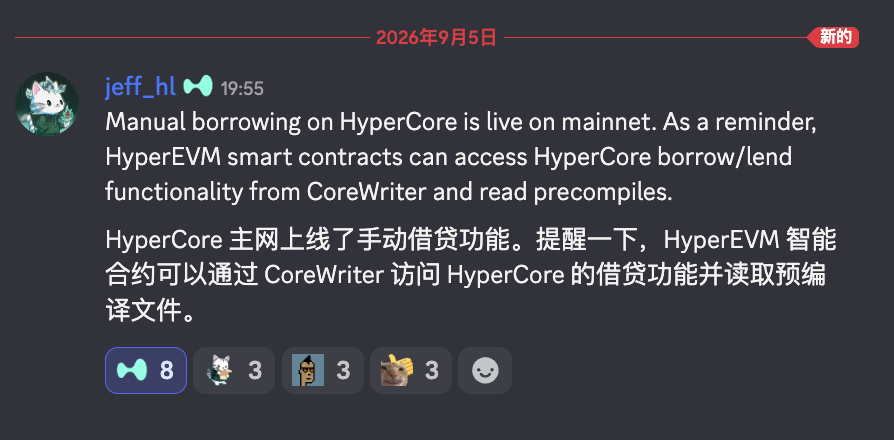
Jeff Yan's announcement pointed out that HyperEVM contracts can call on HyperCore's borrowing and lending functions through CoreWriter and reading-type precompiled contracts. The Hyperliquid official development documentation also shows that CoreWriter is responsible for sending operations from HyperEVM to HyperCore, while reading-type precompiled contracts allow contracts to query HyperCore's balance, position, oracle price, and other statuses.
This means that developers do not need to copy a whole new set of transaction and capital infrastructures, but can build upper-layer products around the native liquidity.
Hyperliquid's official documentation specifically states that HyperCore lending does not tokenize ERC-20; EVM protocols can package native yields into on-chain yield-bearing tokens or other products through CoreWriter and the precompiled contracts.
Therefore, a more accurate analogy is:
HyperCore provides balance sheets and settlement engines, while HyperEVM is responsible for packaging those balance sheets into user-accessible products.
This is the biggest difference between manual lending and ordinary "exchange wealth management." It not only serves end-users but can also become an underlying funding module for other applications.
Will HyperLend be "Fatally Struck"? Not Necessarily
dongdongRobin noted that the stablecoin borrowing APY on the HyperCore page is 5%, while the borrowing APY on HyperLend in its screenshot is 7.6%, leading to the judgment that borrowing demand may shift towards the native pool.
This pressure is real: both are borrowing stablecoins, but HyperCore eliminates the need for cross-protocol movement and directly connects with the trading and margin systems. If third-party protocols can only offer the same assets and funding uses but incur higher frictions and nominal costs, then their market space will naturally be compressed.
However, the idea that "all HyperEVM lending protocols will die" is still too simplistic. HyperLend founder Nessus pointed out in a tweet response that by using kHYPE or wstHYPE as collateral, and then factoring in Stake & Save, the net borrowing cost could be less than 5%, and the EVM side may also achieve higher collateral efficiency.
Native lending is more likely to eliminate "undifferentiated copies" rather than all HyperEVM protocols. Third-party teams need to pivot towards LST collateral, more assets, isolated risks, institutional services, compliant products, or automated strategies to find clearer product-market fit than merely relying on a capital pool.
Can HYPE's Valuation be Directly Added to Aave or Morpho's?
The launch of lending indeed increases the utility of HYPE.
Holders can use HYPE as collateral with a 65% LTV; the borrowed stablecoins may then enter the spot, perpetual, and HIP-3 markets, enhancing the turnover and stickiness of capital within the ecosystem.
0xMaxs further suggested that more borrowing funds may expand trading principal, increase fees, and attract stablecoin accumulation, creating a larger basis for AQAv2 returns.
This logic is reasonable, but one cannot directly translate it into guaranteed income, nor simply apply Aave or Morpho's valuations to HYPE.
Firstly, whether the borrowing eventually enters trading depends on user behavior; secondly, whether the stablecoin balance can net grow still depends on inflows and outflows of funds; more importantly, the official documentation shows that the 10% borrowing interest retained by the protocol serves as a liquidation buffer and is not explicitly allocated as cash flow distribution to HYPE holders.
Therefore, manual lending adds collateral utility, capital stickiness, and infrastructure optionality to HYPE, rather than providing a segment of revenue that can be priced based on earnings multiples.
Lending Enhances Capital Efficiency while Spreading Risk from One Position Across the Entire Account
For traders, the 5% borrowing cost is just the most visible piece of data.
The real management challenge lies in simultaneously handling three groups of constantly changing variables:
Risk Variables Possible Changes Impact on the Account
Borrowing Rate Rising after the utilization exceeds 80% Increased holding costs
Collateral Price Rapid decline in HYPE or BTC Decreased borrowing capacity and account health
Trading Position Perpetual losses or worsening funding rates Heightened overall account liquidation risk along with borrowing
Additionally, when the capital pool is fully borrowed or reaches borrowing limits, new positions can only rely on users to supplement settlement assets; suppliers may also find it challenging to withdraw all funds immediately during times of liquidity crunch.
This is also why Hyperliquid users in a lending era should not focus solely on a single APY figure. Financing, collateral, and trading have merged, and risk observation must elevate from individual position consideration to a holistic asset perspective.
The value of AiCoin is not to teach you to fill up on borrowing but to help you keep an eye on three variable dynamics.
After the launch of manual lending, a new linkage may emerge in the market: HYPE or BTC are collateralized, stablecoin borrowing enters trades, open interest increases, funding rate fluctuates, ultimately affecting collateral prices and account health.
Through the AiCoin mobile app, you can track to see if large holders of HYPE and BTC leverage or expand positions after collateralization, and then correlate prices, trading volumes, open interests, and funding rates to determine if new borrowing has turned into real trading demand or formed crowded positions.
When collateral assets fluctuate rapidly, mobile price alerts and anomalies can help users promptly reassess risks, rather than only opening accounts when borrowing interest changes. After confirming the market structure, users can quickly execute through AiCoin linked to Hyperliquid and uniformly review different positions within total asset management.
AiCoin will not eliminate borrowing and liquidation risks for users, but it can reduce the information blind spots of "only looking at borrowing costs and not considering collateral and positions."
Entering Hyperliquid through the exclusive AiCoin entry and using the invite code AICOIN88 allows you to earn 4% fee rebate according to the event rules:
Exclusive Link: https://app.hyperliquid.xyz/join/AICOIN88
Final Judgment
The launch of HyperCore manual lending signifies that the truly important aspect is not the emergence of another 5% borrowing APY, nor that HYPE can immediately apply Aave or Morpho's valuation multiples.
It marks again the expansion of Hyperliquid's product boundaries: moving from providing trading to also offering the collateral, financing, and unified risk control needed for trading; HyperEVM can continue to build yield tokens, vaults, market-making, and institutional financing products around these native capabilities.
If HyperCore previously addressed "where to trade," manual lending now begins to solve "with whose money to trade, where to place the collateral, and which system computes the risk."
This is precisely the core issue of a prime broker.
Hyperliquid has yet to fully replicate all the capabilities of Wall Street prime brokers, and native lending lacks verification over long-term bad debts, extreme market conditions, and interest rate cycles. But a new product main line has already formed:
HyperCore serves as the capital and risk foundation, while HyperEVM handles the strategy and product layer; the frontend and builders are responsible for distributing services to different users.
What truly needs to be tracked next is not the news of "lending functionality going live," but whether the stablecoin supply and borrowing can sustainably grow, whether utilization rates can remain healthy, whether lending capital translates into trading, and whether HyperEVM can create new products built on the native capital pool.
Exclusive Benefits for AiCoin Users
👉 Enter invite code AICOIN88 when binding your Hyperliquid account for a 4% fee rebate.
🔗 Exclusive registration link:
https://app.hyperliquid.xyz/join/AICOIN88
📖 Beginner Tutorials:
- "AiCoin PC Hyperliquid Authorization Trading Tutorial":
https://www.aicoin.com/zh-Hans/article/514197
- "AiCoin Mobile Hyperliquid Authorization Trading Tutorial":
https://www.aicoin.com/zh-Hans/article/541383
- "Zero-Basis Entry! Hyperliquid First Trade Ultra-Detailed Graphic Tutorial":
https://www.aicoin.com/zh-Hans/article/510225
📖 Community Communication:
- Telegram:
https://t.me/AiCoinWhaleData
- Discord:
https://discord.gg/D7UjAcFrah
- AiCoin Group Chat:
https://www.aicoin.com/link/chat?cid=N6OVMor5g
The content herein only reflects the author's personal views and does not represent the platform's stance. The opinions, conclusions, and suggestions in the text are for reference purposes only and do not constitute any investment advice related to the platform. Investing in US stocks carries market risk, regulatory risk, and compliance risk with local laws and regulations (especially regarding foreign exchange controls, overseas investment declarations, etc.).
免责声明:本文章仅代表作者个人观点,不代表本平台的立场和观点。本文章仅供信息分享,不构成对任何人的任何投资建议。用户与作者之间的任何争议,与本平台无关。如网页中刊载的文章或图片涉及侵权,请提供相关的权利证明和身份证明发送邮件到[email protected],本平台相关工作人员将会进行核查。