Original Author: Zhao Ying
Original Source: Wall Street Insight
Michael Hartnett, Chief Investment Strategist at Bank of America Securities, warned that the surge in global bond yields to a two-decade high is posing the biggest threat to the AI capital expenditure boom, and the upcoming U.S. midterm elections may serve as a catalyst for market turmoil.
In the latest edition of the "Flow Show" weekly report, Hartnett pointed out that if the Democratic Party sweeps both chambers in the midterm elections, U.S. stocks could face a drop of over 10%, the dollar would weaken, bond yields would decline, while the AI bubble would face the risk of bursting. He classified the "Democratic sweep" as one of the largest tail risks in the current market, yet investors have priced in almost none of it.
According to Polymarket data, the probability of the Democratic Party sweeping both chambers has risen to 50%, far higher than the 10% for the Republican sweep. President Trump's approval rating is currently hovering between 35% and 40%, significantly below the historical average of 53% two months before midterm elections, reinforcing Hartnett's warning logic.
Bond Market Sounds the Alarm First
Hartnett believes that the most noteworthy event in the market last week was not the better-than-expected employment data, but rather the comprehensive failure of the global bond market.
The 10-year U.S. Treasury yield rose to 4.81%, approaching levels seen during the 2008 financial crisis; the 30-year U.S. Treasury yield reached 5.31%, the highest since 2007. Meanwhile, Japan's 10-year government bond yield broke through 3.0%, the first time since 1996; the 30-year Japanese bond yield reached 4.2%, about four times the Bank of Japan's policy rate. In Europe, the 10-year German government bond yield rose to 3.38%, reaching a new high since 2011; the spread between French and German yields expanded to 88 basis points, while that between Italian and German yields reached 84 basis points, both touching levels seen during the 2012 Eurozone debt crisis. The Bloomberg Global Bond Yield Index has surged to the highest level since 2007, just 1 percentage point away from this century's peak.
Hartnett distilled this phenomenon into a key judgment: "Bonds Lead the Bubble." He believes that long-end yields—rather than the stock narrative—are the true anchor of current AI trading, and pointed out that until global 30-year yields drop below 5%, the builders and investors in AI infrastructure will continue to underperform those applying AI technology.
Midterm Elections: An Underestimated Market Variable
Hartnett candidly stated that the midterm elections are not like the "regime-change" elections of 1980 with Thatcher/Reagan or 2016 with Brexit/Trump, which fundamentally alter the upward trajectory of U.S. government spending. However, he emphasized that the structural differences in the election results could significantly impact asset prices.
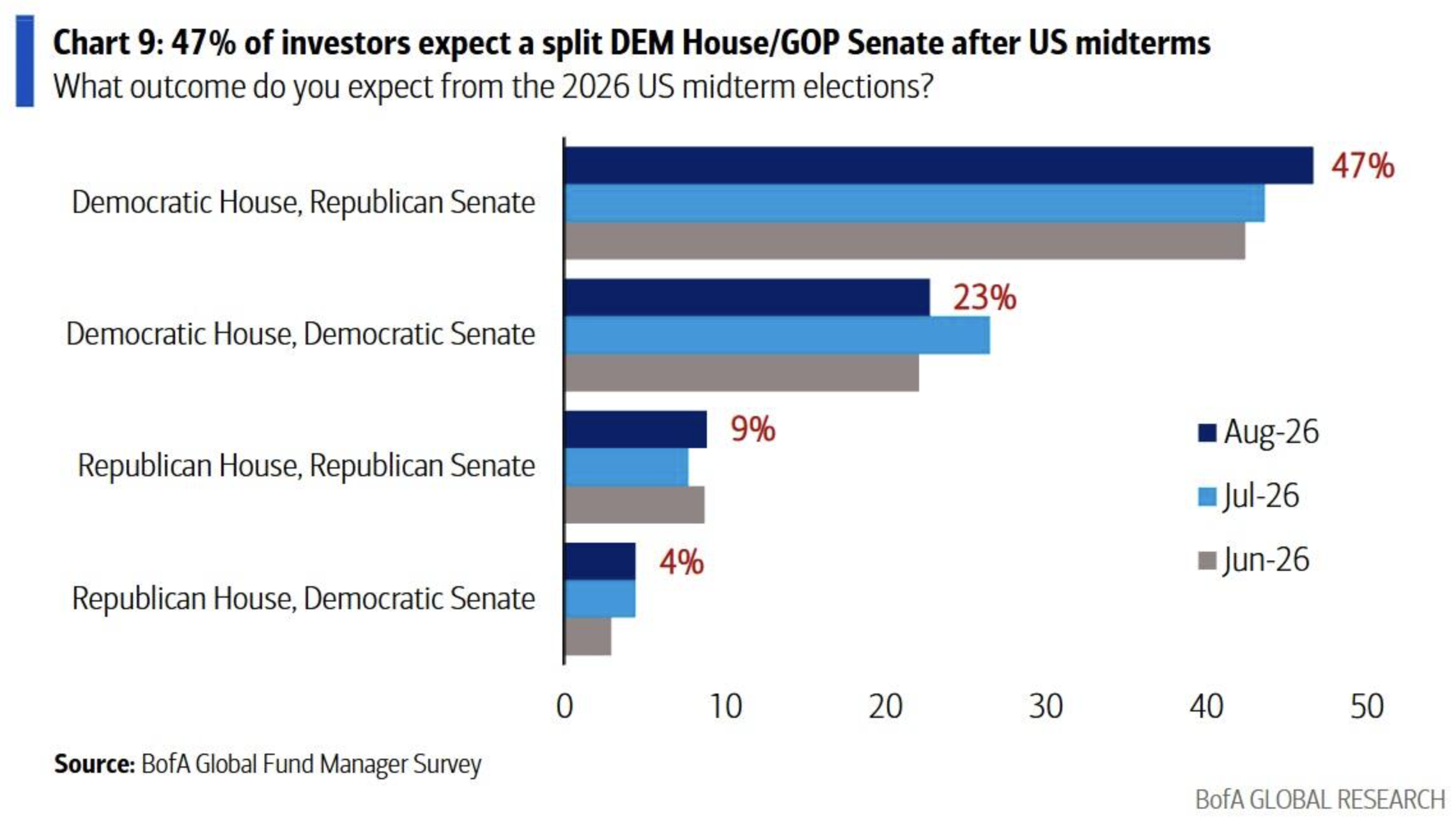
Bank of America's August fund manager survey revealed that 47% of respondents expect the result to be "Republicans control the Senate, Democrats control the House," 23% expect a Democratic sweep, and only 9% expect Republicans to maintain control of both chambers. Currently, Republicans lead in the Senate with 53 to 47 and in the House with 218 to 212.
In the Senate race, for the Democrats to achieve a sweep, they need to win at least four of six vulnerable Republican seats in North Carolina (92% flip probability), Maine (69%), Alaska (64%), Ohio (55%), Texas (51%), and Iowa (37%), while defending their own vulnerable seats in Georgia (94%), New Hampshire (84%), and Michigan (65%). Hartnett specifically identified Ohio, Texas, Iowa, and Michigan as key battleground states for investors to track closely.
Notably, Wall Street has turned its attention to the Texas gubernatorial election—where the incumbent Republican Governor Abbott (with a 49% polling approval rating) faces Democrat challenger Hinojosa (45%)—which is seen as an important barometer for the direction of AI data center expansion policies. Abbott was recently forced to announce a halt to data center construction in an attempt to stem his declining poll numbers.
Market Impact Pathways of a Democratic Sweep
Hartnett provided a clear transmission logic for the market impact under a Democratic sweep scenario.
He believes that if the electoral landscape shifts from "populist capitalism" to "populist socialism," it would mean a shift in tax and regulatory direction from reduction to increase, negatively impacting corporate profits, while accompanying policies aimed at lowering inflation, improving healthcare accessibility, and alleviating K-shaped wealth divergence will directly impact the AI capital expenditure boom and the "too big to fail" Wall Street ecosystem. Moreover, the erosion of Trump's political capital will weaken his ability to execute on priority issues such as AI, resource monopolies, and foreign pressure.
Based on the above assessments, Hartnett provided asset allocation recommendations for a scenario of a Democratic sweep: short financial stocks and the dollar as the optimal hedging tools; stock markets would drop by more than 10%, the dollar would weaken, and bond yields would decline; international stock markets would outperform, with Europe outperforming Asia.
Conversely, if Republicans unexpectedly maintain control of both chambers, it would indicate a rebound in overall risk appetite, a green light for the AI bubble, and a rekindling of the dollar's "exceptionalism" narrative. The most likely scenario of "Republicans controlling the Senate, Democrats controlling the House" corresponds to a moderate risk preference—"gridlock is the golden girl."
Strategic Allocation: Long Commodities and Gold, Beware of Crowded AI Trades
Within the aforementioned macro framework, Hartnett maintains his cross-cycle core allocation strategy: long commodities and gold, as hedges against inflation and geopolitical risks. He pointed out that governments' "whatever it takes" fiscal interventions are suppressing long-end yields and sustaining nominal GDP growth; in this context, the strategic logic that "any asset is better than bonds" remains valid.
In terms of AI trading, Hartnett's warnings are even more direct. He pointed out that the free cash flow of major cloud computing companies has turned negative under pressure from capital expenditure commitments, and the AI bubble "could burst at any time." He proposed a post-bubble operating framework of "long humiliation, short arrogance," recommending a shift towards long-dated bonds and defensive sectors, including consumer staples, mining/materials, and healthcare, to avoid crowded AI infrastructure construction-related assets.
From a long-cycle perspective, Hartnett also noticed a contrarian signal: the rolling return of U.S. stocks over the past 10 years has been 15%, commodities 11%, while U.S. Treasuries at -2%, marking the worst record in nearly a century. Historical data shows that a long-term negative return in bonds is often a good buying opportunity for stocks (1939, 1974, 2009) and commodities (1933, 2018), providing historical support for a bullish tactical outlook on Q4 bonds.
免责声明:本文章仅代表作者个人观点,不代表本平台的立场和观点。本文章仅供信息分享,不构成对任何人的任何投资建议。用户与作者之间的任何争议,与本平台无关。如网页中刊载的文章或图片涉及侵权,请提供相关的权利证明和身份证明发送邮件到[email protected],本平台相关工作人员将会进行核查。