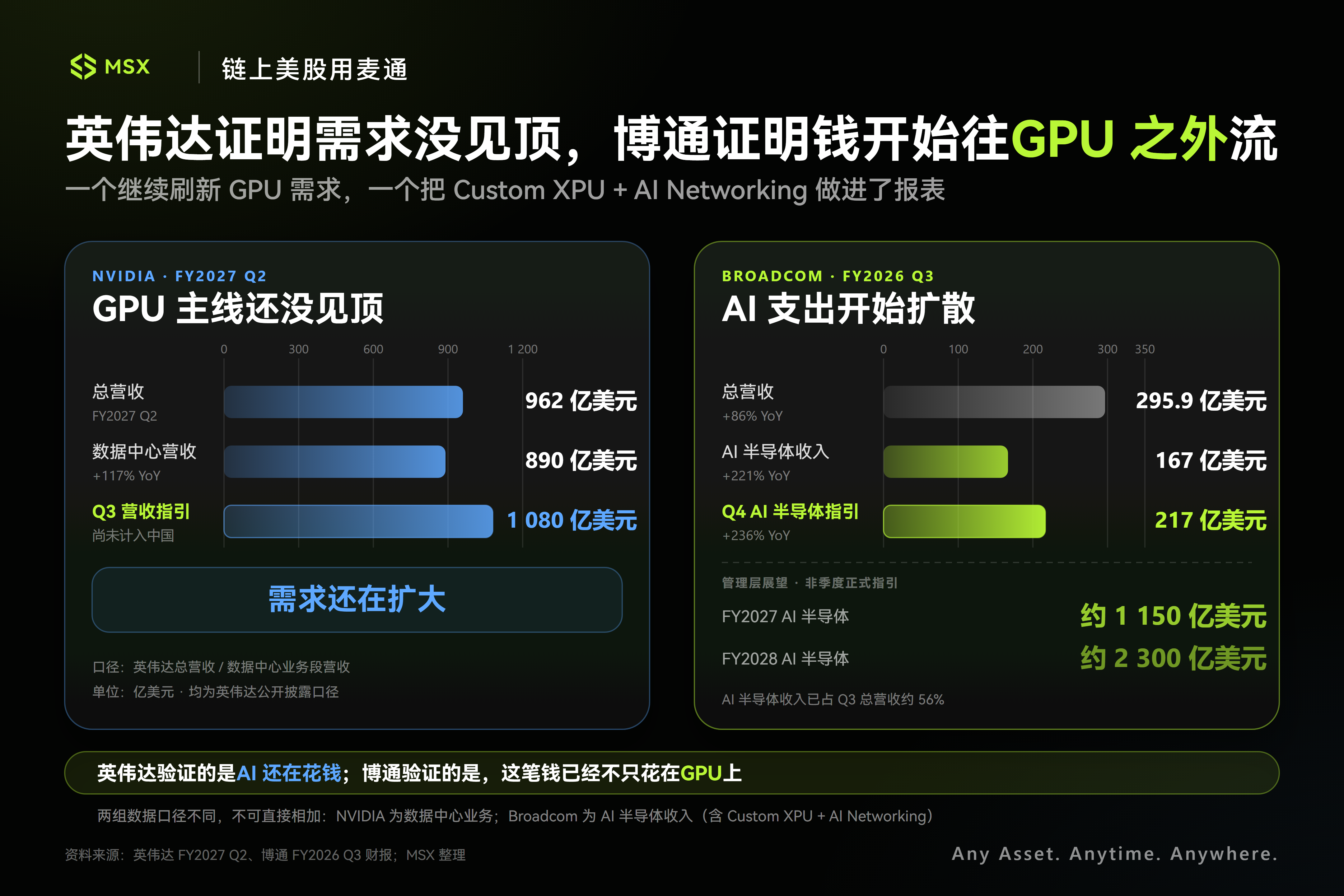
Last week's Nvidia earnings report proved that the demand for AI computing power has not peaked yet.
And last night, Broadcom's earnings report came out, which clarified another line.
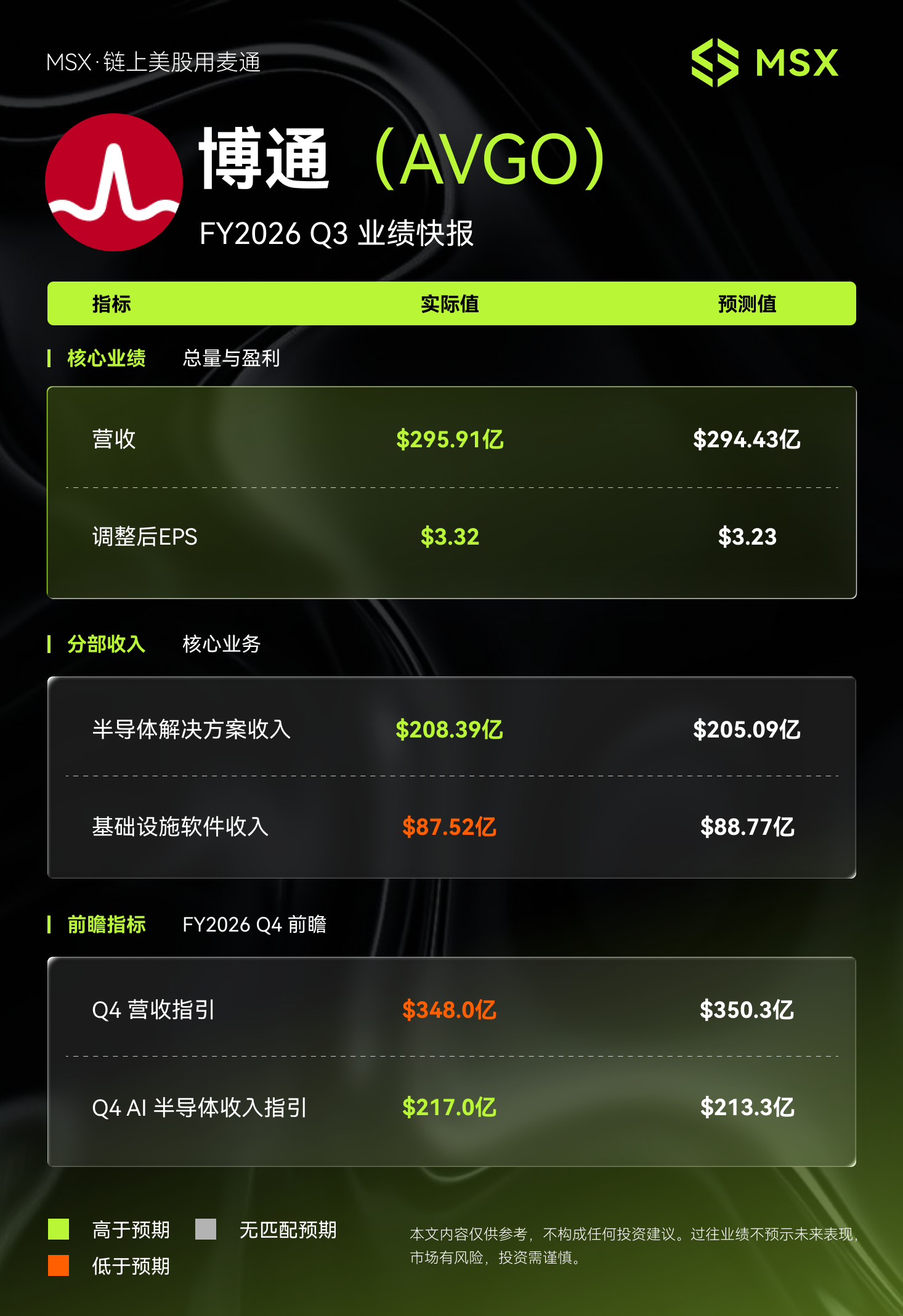
Q3 AI semiconductor revenue was $16.7 billion, higher than the previous guidance of $16 billion, with next quarter directly going to $21.7 billion. More importantly, FY2027 AI chip revenue is expected to be around $115 billion, and for FY2028, it is even projected to reach $230 billion.
So now, it's a bit late to debate whether ASIC counts as AI's second growth curve—money in AI has already been spent beyond just GPUs.
At least for Broadcom, this line has already begun to show up in the financial statements, and the volume ahead is larger than previously thought. The real focus going forward is whether major projects like Google, OpenAI, and Anthropic can be delivered on time and how much of it Broadcom can capture.
If all goes well, then let the music play on and continue the dance.
1. GPUs continue to surge, but major companies are also starting new layouts
The most informative part of Nvidia's earnings report is actually that despite such a high baseline, cloud providers, AI companies, and model laboratories have not stopped increasing computing power.
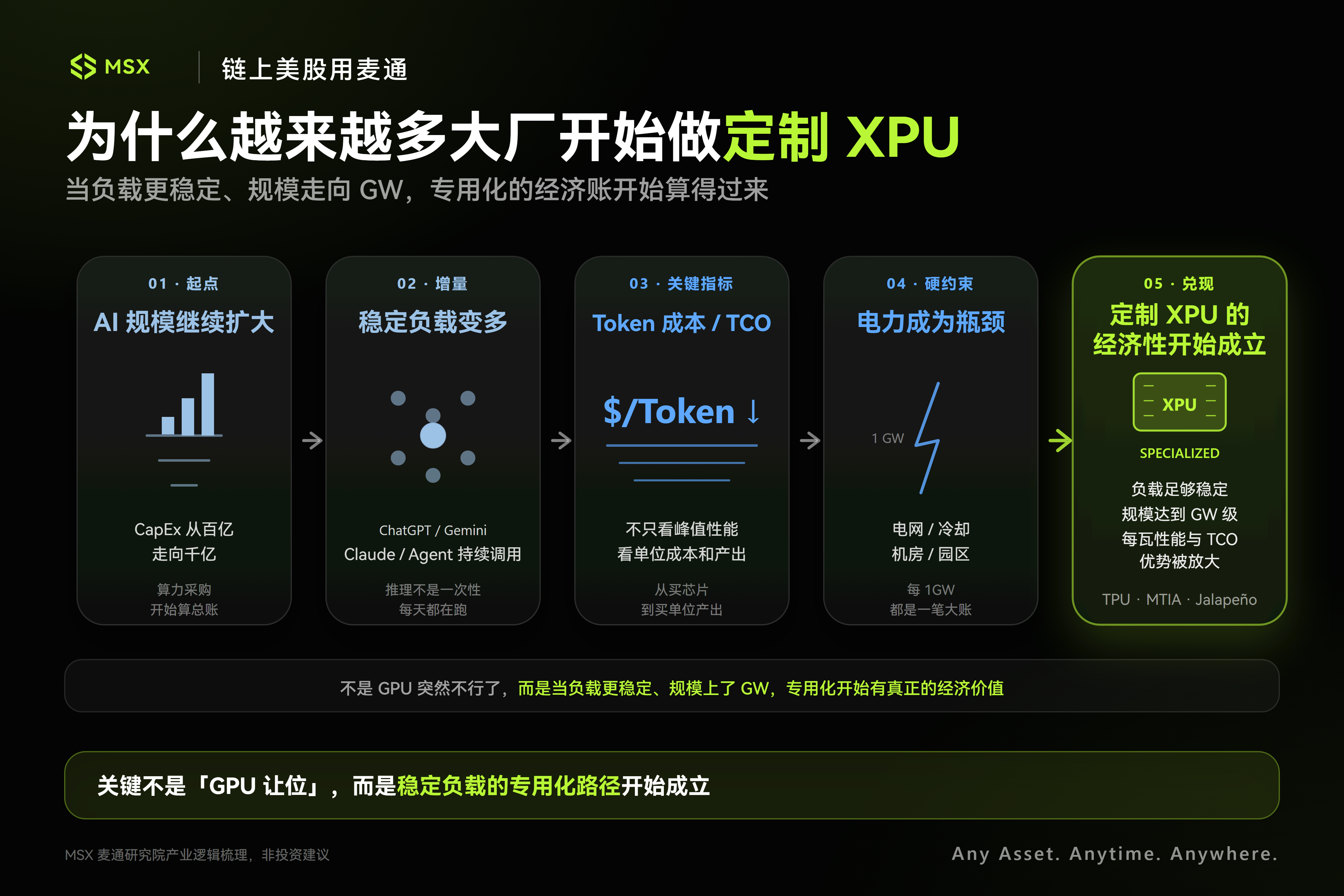
However, as AI CapEx moves from tens of billions to hundreds of billions and eventually enters the scale of over a hundred billion dollars annually, the procurement logic will certainly change.
For example, large firms are beginning to ask more: how much does it cost to accomplish a certain AI workload? With the same 1GW of electricity, how much effective computing power can be produced? If certain workloads are already highly stable, is it still necessary to use the most expensive products entirely?
This is precisely the background against which ASIC is becoming increasingly important.
Of course, simply understanding ASIC as "cheaper GPUs" is not accurate; its true advantage comes from specialization.
Customizing a chip is not cheap; the initial R&D investment is huge, the development cycle is long, and there is a whole set of adaptation issues to handle, including software, advanced packaging, networking, systems, and supply chains.
But conversely, once a certain workload is stable enough, deployment scales up from dozens of MW to hundreds of MW and ultimately to GW, improvements in unit cost, performance/power consumption ratio, and overall system TCO could be rapidly magnified.
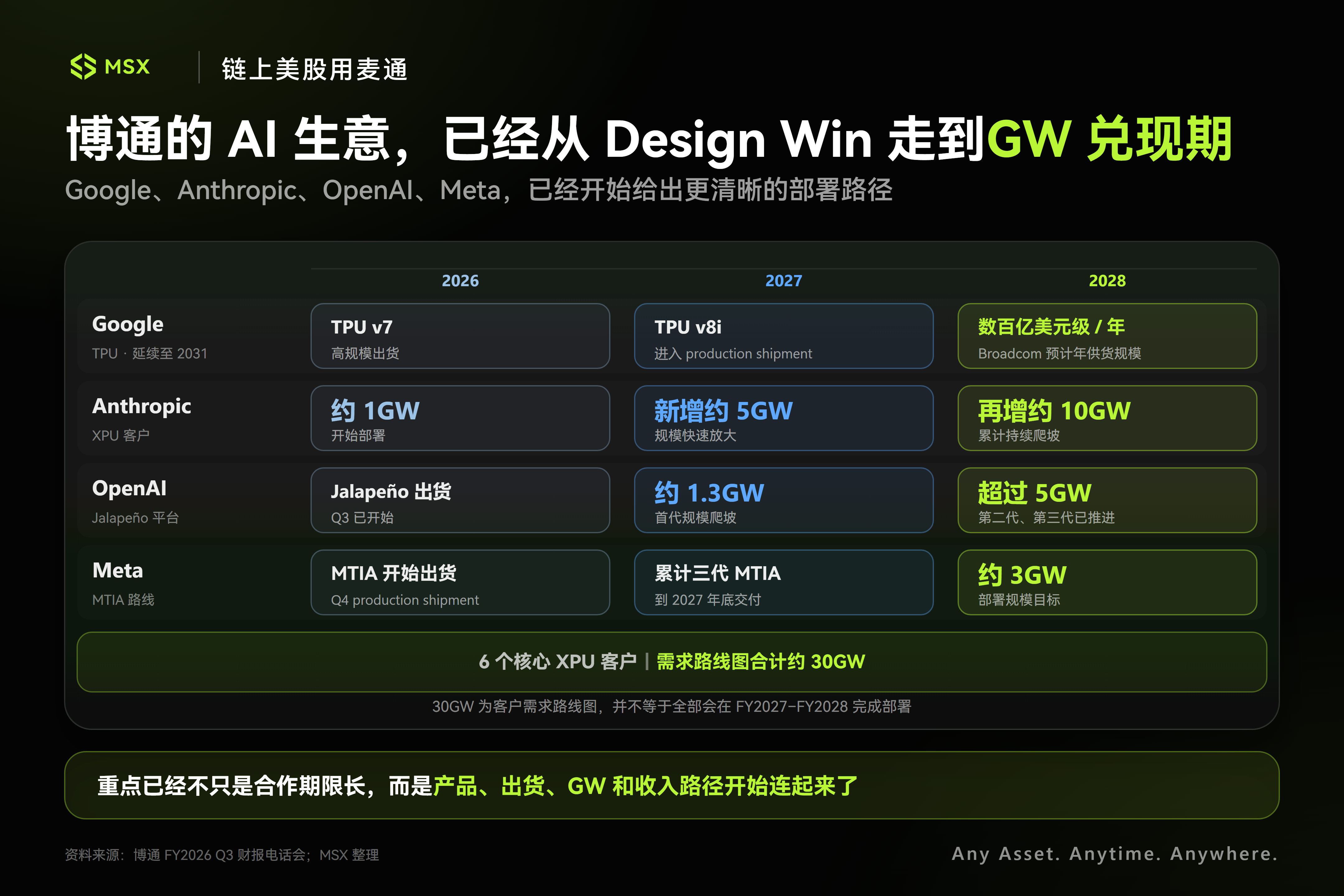
This is why Google insists on TPU for the long term, Meta continually expands MTIA, and OpenAI has begun to jointly develop its processors with Broadcom, all realizing that even migrating just a portion of the most stable and largest workloads from general-purpose chips to customized chips could bring enormous economic value.
A simple analysis shows that this is also aided by several conditions maturing simultaneously, with the most critical variable being that inference is becoming an increasingly important incremental workload.
As is well known, model training is often phase-based, but once ChatGPT, Gemini, Claude, and more Agents truly enter production environments, inference becomes a task that occurs every day.
Especially as the invocation volume increases and the model structure and service modes gradually stabilize, it becomes naturally more suitable for hardware optimization tailored to specific workloads. OpenAI officially released its first Intelligence Processor, Jalapeño, co-developed with Broadcom in June this year, aimed at LLM inference.
Notably, this is not an isolated chip; OpenAI and Broadcom have clearly defined it as the first generation product of a multi-generational computing platform, planned for deployment starting at the end of 2026 and to expand in scale to GW levels in the future.
Meta's path is also very similar, advancing four generations of MTIA within two years, focusing on recommendation, ranking, and generative AI, with several products explicitly adopting inference-first design concepts. In April of this year, they further expanded cooperation with Broadcom, with the first phase deployment exceeding 1GW, and future plans extend to several GW; cooperation on multi-generational products will continue until 2029.
This indicates that today's large AI clients are transitioning from a pure pursuit of peak performance to gradually entering another game rule: can tokens be produced more cheaply?
Once AI truly begins to commercialize, the cost of one million tokens, how much effective computing power can be generated per watt of electricity, and the TCO of an entire data center will become increasingly important.
The essence of ASIC is, in fact, that large AI companies are beginning to try to take back control over this portion of cost.
2. Broadcom's true bet is not just on ASIC, but on the entire AI cluster continuing to grow
Understanding this makes it much easier to view Broadcom's earnings report.
Last quarter, Broadcom's total revenue reached $22.187 billion, a 48% year-on-year increase; among it, AI semiconductor revenue reached $10.8 billion, a year-on-year increase of 143%.
The company provided a more aggressive guidance for the next quarter, forecasting a total revenue of about $29.4 billion, with AI semiconductor revenue expected to reach $16 billion, a year-on-year increase of over 200%.
What does $16 billion mean? It accounts for about 54% of Broadcom's projected total revenue for the quarter.
In other words, if the guidance is met, this single AI semiconductor business could contribute more than half of Broadcom's revenue—this even includes infrastructure software businesses like VMware in the calculations.
In other words, AI is directly altering this company's revenue structure.
However, there is a common misunderstanding here; $16 billion cannot be directly equated to "ASIC revenue," it also includes AI networking products like Ethernet switch chips, SerDes, PCIe, and optical interconnects.
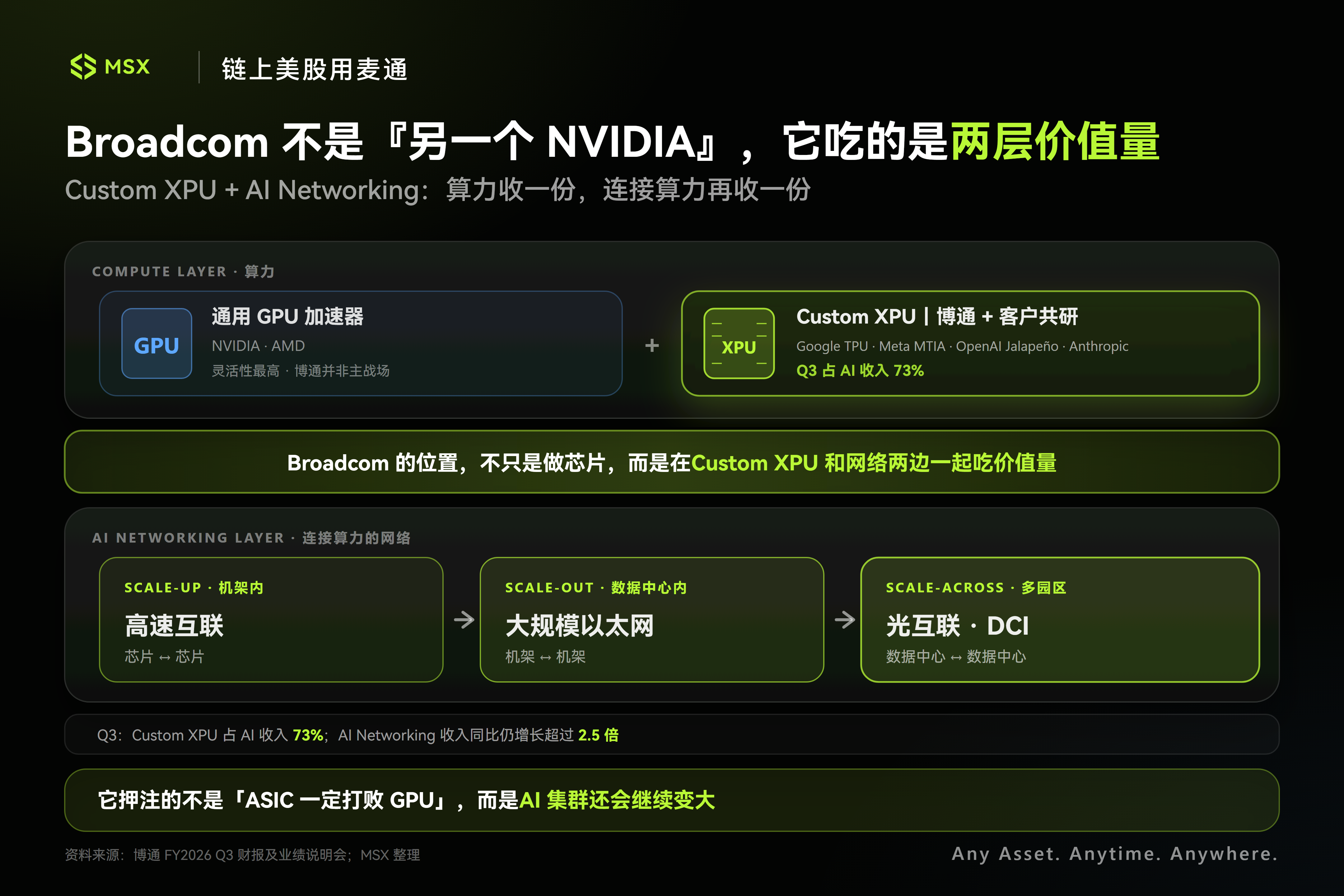
Last quarter, networking business accounted for nearly 40% of AI semiconductor revenue. Hock Tan pointed out that this percentage may have already approached a temporary peak but is more likely to return to about 30% in the long run.
So Broadcom is actually expanding two business lines simultaneously: Custom XPU and AI Networking, which is also the biggest difference from many pure chip companies.
As AI clusters grow from thousands of chips to tens of thousands, hundreds of thousands, or even larger scales, the connections between computing power become increasingly important.
Broadcom is further breaking down AI networking into scale-up, scale-out, and scale-across: from high-speed interconnection within racks to large-scale networks inside data centers, and then to connections between multiple data centers.
As long as AI clusters continue to grow, if large cloud providers increase self-developed ASICs, Broadcom can participate in Custom XPU; if GPU clusters expand, the open Ethernet networking market may continue to grow as well.
This puts Broadcom in an interesting position, as it is effectively betting on the increasing complexity of the entire AI infrastructure.
Of course, this does not mean that this business has no competition.
Although Google has signed a long-term agreement with Broadcom to jointly develop future generations of TPU and next-generation AI rack-related components, with the agreement covering as far as 2031; Google has also recently expanded its custom chip collaboration with Marvell.
This at least indicates that major clients are not likely to easily entrust their entire future architecture to a single supplier.
3. What happens after $100 billion?
The market has long known that Broadcom's AI would be strong.
So this earnings report was not about whether $16 billion could be achieved; fortunately, the answer is already out.
At least from now on, Broadcom's line is no longer a question of "whether there is a second growth curve," but rather how long this curve can ultimately be, but this also means that the market will become increasingly picky.
Previously, $100 billion was itself a surprise; now that $115 billion and $230 billion are presented, what we'll be looking at next is how these numbers can be realized.
Whether Google, Meta, OpenAI, and Anthropic’s projects can advance towards GW levels according to plan, whether the first-generation chips can be mass-produced, and whether the second and third generations can continue to be secured, will the networking business grow alongside cluster scale.
These will be more important than selling a few billion dollars more in any given quarter.
Another issue that cannot be overlooked is that major clients will not only support one supplier.
Google has begun to expand cooperation with other suppliers, and it’s likely that Meta and OpenAI will also maintain a multi-supplier system. So Broadcom's current advantage is real, but it has not reached the point of "locking in the customers."
From this perspective, the key challenge for Broadcom will be to prove whether it can remain in these clients' core supply chains in the long term.
In any case, this earnings report serves as a reminder that customized chips, networking, and interconnectivity, which previously seemed more like "supporting" segments, are gradually becoming the main line.
It also reminds the market that the current wave of infrastructure investment in AI may not be nearing the end of only having stock competition.
As long as major firms continue to build larger clusters, buy more electricity, and generate more tokens, new bottlenecks will continue to emerge, and new pools of profit will follow.
The AI business is evolving from a single chip to a complete set of infrastructure, which is also where the greater imaginative space lies.
免责声明:本文章仅代表作者个人观点,不代表本平台的立场和观点。本文章仅供信息分享,不构成对任何人的任何投资建议。用户与作者之间的任何争议,与本平台无关。如网页中刊载的文章或图片涉及侵权,请提供相关的权利证明和身份证明发送邮件到[email protected],本平台相关工作人员将会进行核查。