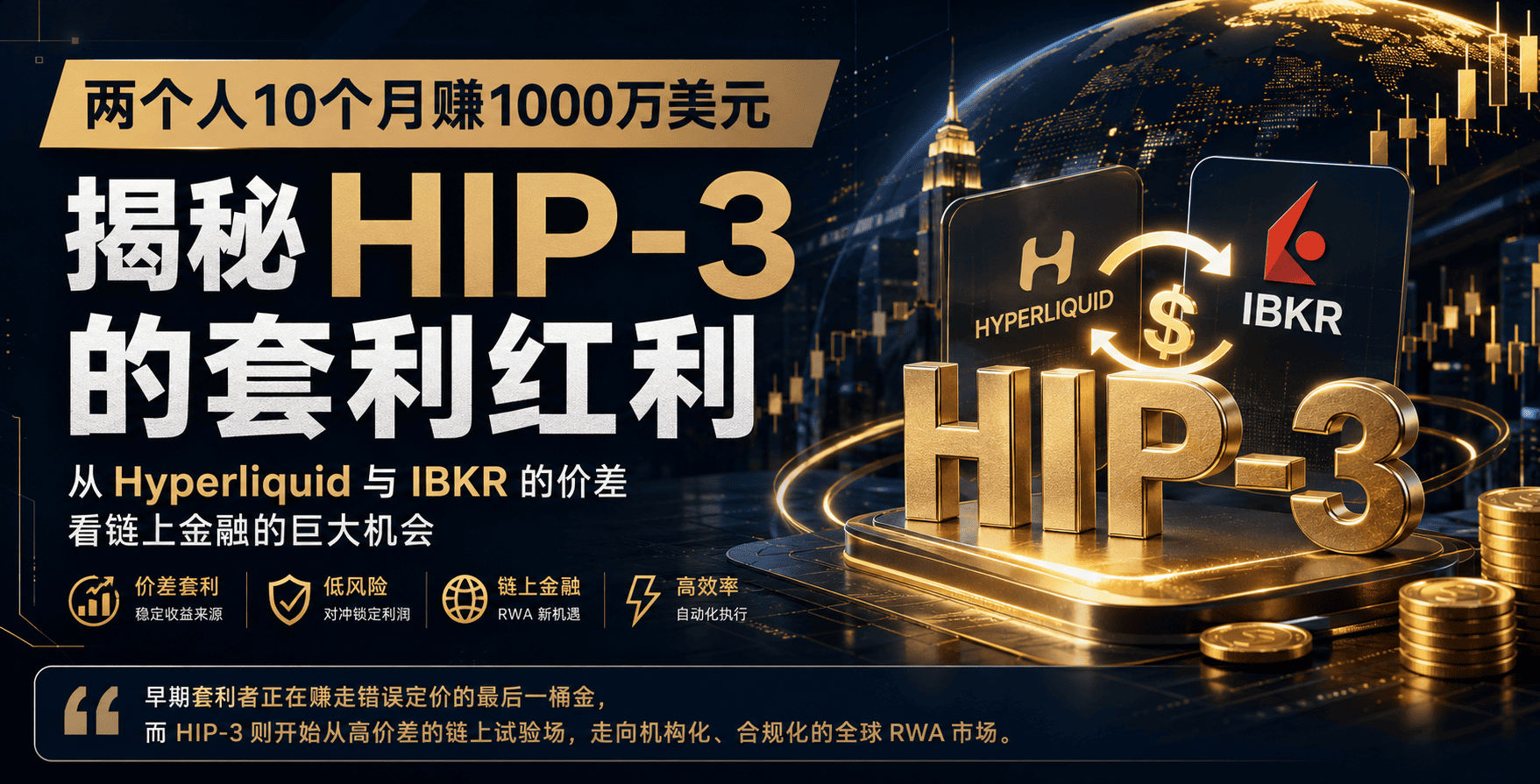
Two people, one robot, ten months, 32 billion dollars in transactions, over 10 million dollars in profit.
This is an experience recently shared by Hyperliquid trader CBB. Starting from October 2025, he, along with his brother, operated an arbitrage robot for perpetual contracts on stocks and commodities between Hyperliquid HIP-3 and Interactive Brokers (IBKR), and then expanded their trading scope to gold, silver, crude oil, and semiconductor stocks.
At first glance, this looks like a story of "ordinary people making a comeback through on-chain arbitrage."
However, CBB's conclusion is quite the opposite: with professional institutions like Wintermute entering the market, the price differences have noticeably narrowed, and this round of bonuses may be coming to an end.
At the same time, the Hyperliquid test network introduced HIP-3*. This allows newly established venues to choose a mechanism of limited operations that includes whitelisting, order cancellation, position reduction, and account migration capabilities, providing tools closer to brokerage for licensed operators to access the on-chain market.
Putting these two pieces of news together reveals a trend more important than "earning 10 million dollars":
Early arbitrageurs are capturing the last bucket of gold from mispricing, while HIP-3 is moving towards an institutionalized and compliant global RWA market from a high spread experimental ground.
This 10 million dollars was not earned by betting on one market movement
CBB's strategy is not mysterious.
The team uses IBKR's quotes as a reference price from TradFi, continually comparing the prices of the same underlying on HIP-3. When the on-chain price is lower than IBKR, the robot first buys on Hyperliquid and then establishes a corresponding short position on IBKR after confirming the trade; when the on-chain price is higher than IBKR, it first shorts on Hyperliquid and then buys on IBKR to hedge.
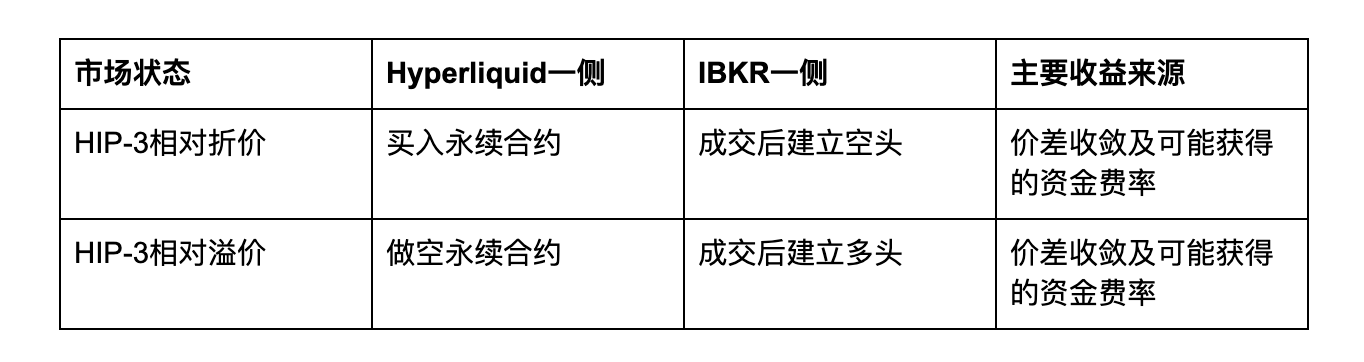
This is not a risk-free arbitrage in the traditional sense, where profits are locked in instantly and fully synchronized. The trades on both sides have an order of execution; after the on-chain transaction, the IBKR hedge leg only activates afterward. As long as the market changes quickly between the two trades, or if there is any issue with the broker API, bank transfer, market depth, or margin, the strategy will expose directional risk.
CBB disclosed that the total trading volume on both sides reached 32 billion dollars over ten months, with a profit of 10 million dollars, representing an annualized return on actual capital of 35%-45%. These figures are all self-reported by CBB and have not been audited or independently verified.
Dividing 10 million dollars by the 32 billion dollars in bilateral nominal transaction volume gives an average profit margin of only 3.13 basis points, calculated as:
10 million dollars ÷ 32 billion dollars × 10,000 = 3.125 basis points
In other words, this 10 million dollars did not come from a legendary heavy bet but rather from executing a very thin spread countless times.
The real advantage lies not in "getting the direction right," but in discovering price deviations, executing trades early, quickly hedging, and avoiding fatal mistakes amidst billions of dollars in turnover.
A 1.1 million dollar loss reveals the truth about "risk-free arbitrage"
In CBB's experience, the most worthwhile aspect for traders to repeatedly examine is not the 10 million dollar profit but the 1.1 million dollar loss.
On January 27, 2026, the IBKR API did not refresh normally. The robot mistakenly assumed that the delta between Hyperliquid and IBKR was continuously imbalanced, resulting in repeated increases of gold shorts on IBKR and ultimately accumulating a net short position of 120 million dollars. At that time, gold prices were rising rapidly, and the account soon received a margin call warning.
CBB had no choice but to shut down the robot and manually close the 120 million dollar gold short position within 15-30 minutes, resulting in a final loss of 1.1 million dollars.
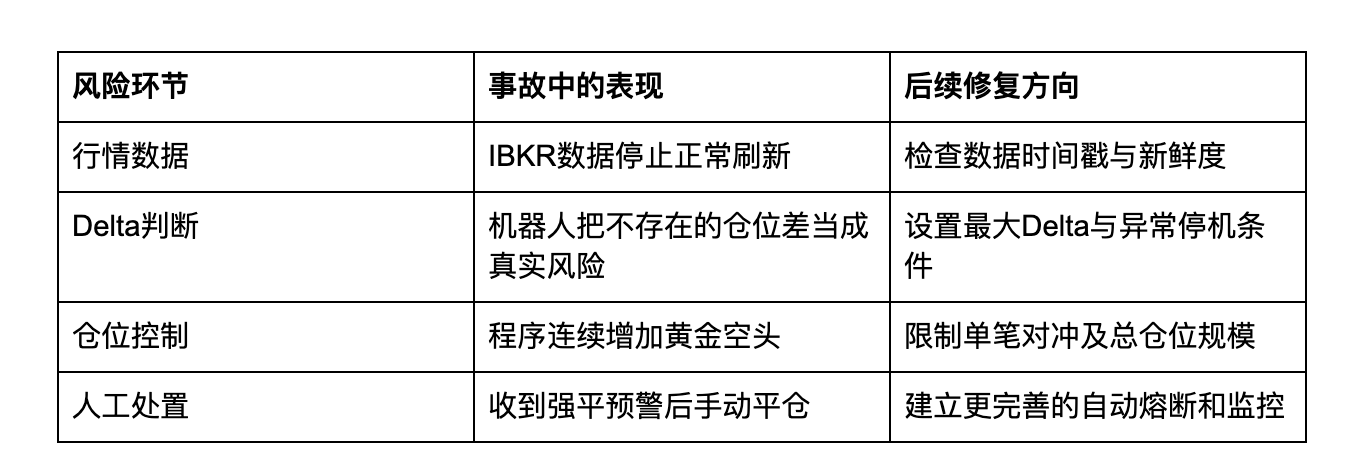
The loss from this incident was equivalent to 11% of its final disclosed cumulative profit. However, due to the absence of complete account equity and daily profit data, this ratio cannot be considered as the maximum drawdown of the strategy.
After the incident, the team increased the freshness verification for market data, set single hedge limits, maximum delta, maximum positions, and automatic shutdown mechanisms; simultaneously upgraded to faster market data sources authorized by Databento and Nasdaq, and dynamically adjusted opening price spreads based on available funds from IBKR.
This is the core of CBB's story: The greatest moat for an arbitrage robot is not the formula, but data quality, capital scheduling, and risk control engineering.
Why the more people discover this business, the fewer can continue to make big money?
Arbitrage has a near-cruel rule: it will destroy its own profit source.
In the initial stages of CBB's robot, the HIP-3 RWA market was still in its early phase. The trading time, participant structure, funding rates, and liquidity on-chain differed from those in TradFi, leading to relatively obvious price deviations.
In November 2025, the team completed 850 million dollars in transactions on HIP-3, earning over 500 thousand dollars in profit. In January 2026, as gold and silver prices heated up, they executed 1.7 billion dollars on Hyperliquid, generating over 600 thousand dollars just from funding fees. During a sharp decline in silver prices, there was once about a 3% price difference between Hyperliquid and IBKR, and the team earned approximately 600 thousand dollars from that movement. 2
But high profits attract more capital. CBB noted that as institutions like Wintermute joined in, competition evolved into a speed game; Ethena also plans to participate in stock basis trading. More robots targeting the same price spread would buy cheaper markets and sell pricier markets faster until prices converge.
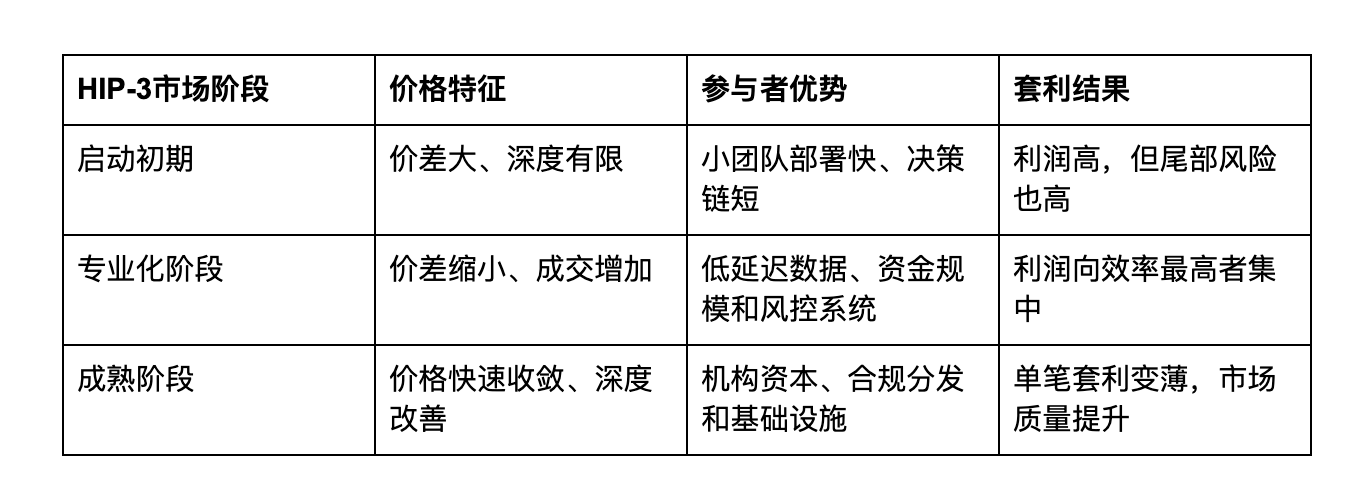
Therefore, when CBB says "the opportunity may be ending," it is not necessarily bad news for HIP-3.
From the perspective of an individual arbitrageur, the disappearance of price spreads means reduced profits; from the market perspective, it means tighter connections between on-chain quotes and traditional markets, more effective price discovery, and more reliable liquidity.
The less arbitrageurs earn, it may actually indicate that HIP-3 is maturing as a trading market.
HIP-3* emerges: Hyperliquid begins reserving space for "on-chain brokers"
As CBB's bonuses are squeezed by professional institutions, Hyperliquid also introduced HIP-3* in the test net.
Yaugourt summarized it as "adding broker permissions for deployers." But the "permissions" must be explained completely: HIP-3* does not hand over all users' assets to deployers, nor does it secretly modify existing market rules, but rather aims to provide a selectable model with selected permissions that limit the scope of the Venue at the time of creation and have the capability to write permissions into the protocol.
According to Hyperliquid's official documentation, a Venue can only be designated as HIP-3* at the time of creation, and existing markets cannot be switched afterward. Deployers can perform five types of agency operations for users of that Venue: 4
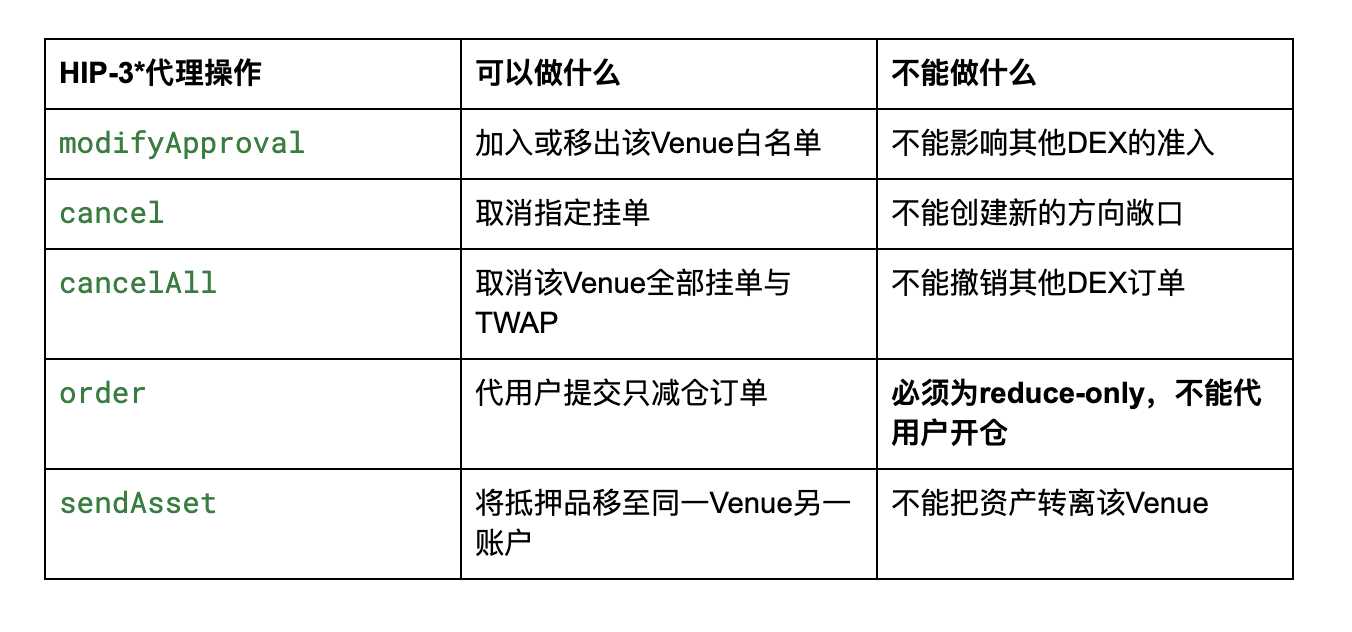
Additionally, the five types of operations can be authorized to different sub-deployers. This means compliance teams can manage whitelists, risk teams can handle order cancellations and position reductions, while any single role does not need to master all permissions.
Why do regulated operators need these capabilities?
If a client faces sanctions, a court mandates account freezes, or risk systems must force a reduction in positions, operators cannot just be a "web portal that cannot intervene in anything." Traditional brokerages and futures exchanges have processes for account access, order cancellations, position closures, and asset migrations; HIP-3* is attempting to embed similar functionalities into independent on-chain venues, while using protocols to limit power boundaries.
As of now, HIP-3* is still only a preliminary specification of the test net, has not formally launched on the main net, nor has it been proven that any specific brokerage or exchange has adopted it.
But the direction is clear: Hyperliquid not only wants to serve completely permissionless crypto-native trading, but is also exploring how to enable licensed institutions to establish on-chain markets that meet their requirements.
CBB and HIP-3*: actually two halves of the same story
CBB represents the first half of HIP-3: RWA has just been brought on-chain, with significant friction present among markets, and a two-person team that understands how to deploy quickly can capture mispricing earlier than institutions.
HIP-3* represents the second half: the protocol is starting to prepare accounts and risk tools for compliant operators, potentially allowing more brokerages, market makers, and institutional funds to enter.
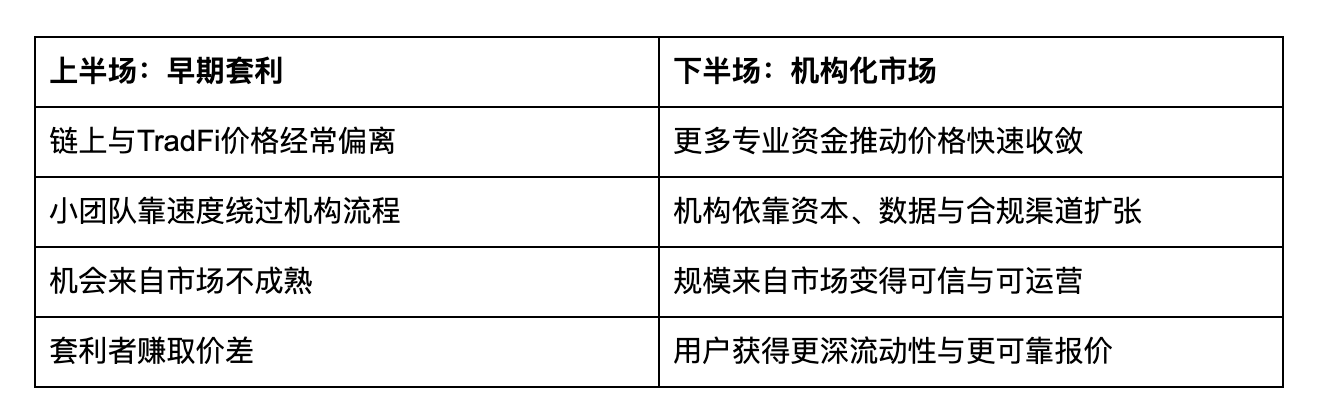
This is also why the narrowing of arbitrage windows and the long-term growth of HIP-3 are not contradictory.
Institutions entering the market will take profits from CBB, but they may also bring greater trading volumes, deeper order books, and more RWA assets; HIP-3* is trying to address the most pressing access and risk control issues for regulated operators.
As Hyperliquid evolves from "allowing any builder to open markets" to "allowing operators with different regulatory requirements to establish independent venues," its positioning is also shifting from an on-chain exchange to a trading and risk infrastructure that different front ends, brokerages, and market operators can call upon.
What can ordinary traders replicate from CBB?
What should not be replicated is the impulse to immediately build bilateral arbitrage robots after seeing "35%-45% APY."
CBB's strategy relies on IBKR trading permissions, Databento and Nasdaq market data authorizations, API development, bank capital scheduling, large capital, and round-the-clock risk monitoring. Any missing piece could turn seemingly neutral spread trading into a naked position trade. 2
What ordinary traders should truly learn is their decision-making sequence: first establish a reference price, then observe the on-chain deviations; first confirm the trade, then manage the risk; when abnormalities occur, first shut down and not continue betting that the system will recover automatically.
This is also where AiCoin's mobile platform can play a role.
During rapid fluctuations in HIP-3 assets like stocks, gold, crude oil, and semiconductors, one can first use AiCoin's professional candlestick, trading volume, open interest, and funding rates to assess whether the market is genuinely supported by real capital, then track and observe whether CBB-like addresses, market makers, and large players are building positions or beginning to withdraw.
Once the price structure and on-chain funding validate each other, the AiCoin can connect to Hyperliquid for rapid execution and uniformly manage positions across different assets on the mobile platform. AiCoin will not turn ordinary users into institutional arbitrage teams with two sets of trading systems, but it can help traders reduce the most common delays in information and execution gaps.
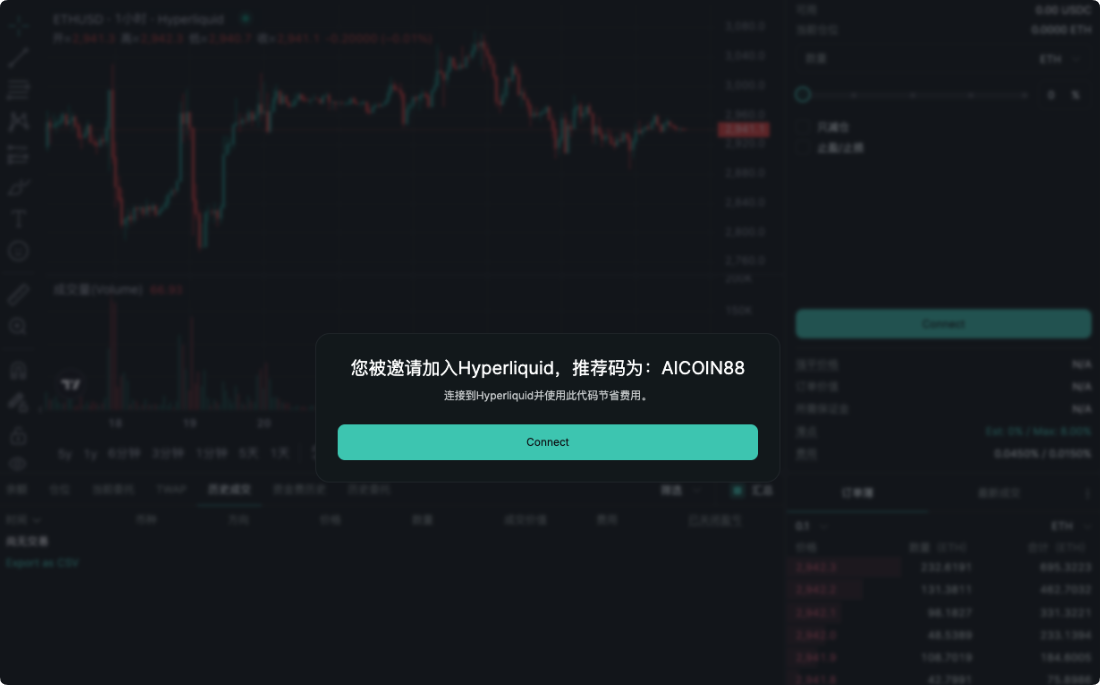
Access Hyperliquid through the exclusive AiCoin portal and use invite code AICOIN88 to receive 4% fee rebate according to activity rules:
Exclusive link:
https://app.hyperliquid.xyz/join/AICOIN88
Final Judgment
The 10 million dollars earned by CBB is not a profit statement that everyone can replicate, but rather the tuition paid for mispricing in the early HIP-3 market.
They established systems at speeds faster than institutional processes with just two people; they also proved with a 1.1 million dollar loss that arbitrage has never been risk-free. Now, professional funds such as Wintermute are compressing price spreads, while HIP-3* begins to provide brokerage capabilities for regulated venues.
It may seem like one era is ending, but it could very well be the beginning of another.
As the easy-to-catch price spreads gradually disappear, what remains is a deeper, more accurate, and more institutionally participatory on-chain RWA market.
Early bonuses belong to the ones who first discover the wrong prices; the advantages of the next stage will belong to those who can read on-chain funds, understand the rules of different venues, and prioritize risk management over profits.
AiCoin user exclusive benefits
👉 Enter invite code AICOIN88 when binding your Hyperliquid account to enjoy a 4% fee rebate.
🔗 Exclusive registration link:
https://app.hyperliquid.xyz/join/AICOIN88
📖 New user tutorial:
"AiCoin PC version Hyperliquid authorized trading tutorial":
https://www.aicoin.com/zh-Hans/article/514197
"AiCoin mobile version Hyperliquid authorized trading tutorial":
https://www.aicoin.com/zh-Hans/article/541383
"Beginner's Guide! Hyperliquid First Trade Super Detailed Tutorial":
https://www.aicoin.com/zh-Hans/article/510225
📖 Community Discussion:
Telegram:
https://t.me/AiCoinWhaleData
Discord:
AiCoin-Group Chat:
https://www.aicoin.com/link/chat?cid=N6OVMor5g
The content of this article solely represents the author's personal views and does not reflect the stance of this platform. The opinions, conclusions, and suggestions in the text are for investors' reference only, and do not constitute any investment advice related to this platform. Investors in US stocks should still bear market risks, regulatory risks, and compliance risks related to local laws and regulations (especially foreign exchange controls, overseas investment declarations, etc.)
免责声明:本文章仅代表作者个人观点,不代表本平台的立场和观点。本文章仅供信息分享,不构成对任何人的任何投资建议。用户与作者之间的任何争议,与本平台无关。如网页中刊载的文章或图片涉及侵权,请提供相关的权利证明和身份证明发送邮件到[email protected],本平台相关工作人员将会进行核查。