[MSX Institute · US Stock RWA Daily Observation] is a flagship daily report produced by leading RWA trading platform MSX. Relying on strong macro research capabilities, we capture the core pulse of the global traditional US stock market, liquidity changes, and the RWA tokenization market, assisting you in strategically positioning quality assets.
Today's Observation
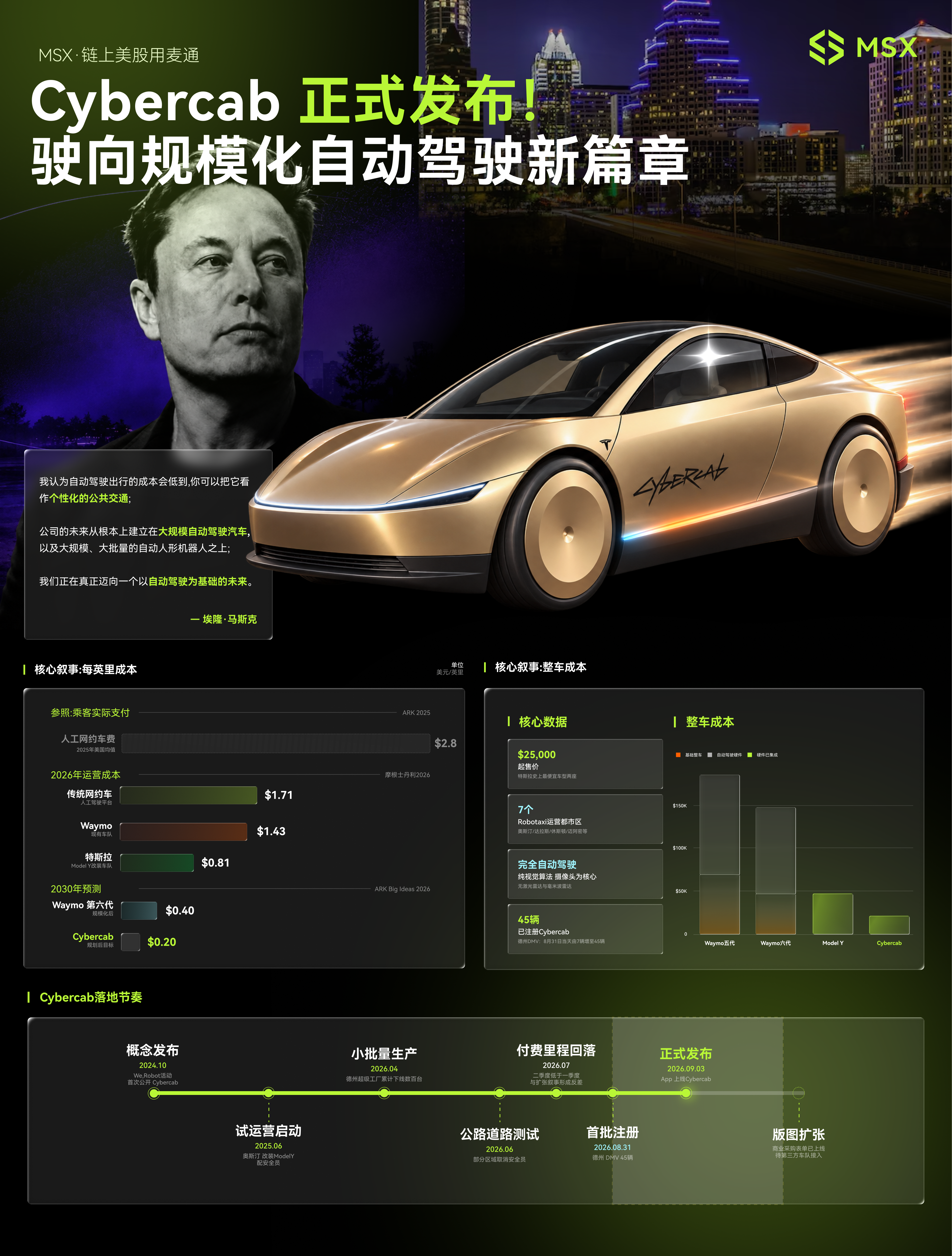
Tesla's Cybercab officially opened to the public in Austin on September 3, allowing attendees of the launch event to hail a ride that day. This vehicle has no steering wheel, no pedals, and seats only two people, with a starting price of $25,000. The real watershed is not the vehicle itself, but the two sets of costs: Morgan Stanley estimates the operational cost per mile for Tesla at $0.81, Waymo at $1.43, and traditional ride-hailing services at $1.71; on a per-vehicle cost basis, Waymo's sixth generation is approximately $125,000, the fifth generation around $200,000, while Cybercab is $25,000. On the same day, Tesla also launched a commercial procurement intent form, aiming to have third parties purchase and operate the vehicles.
Data Minute
The Cybercab was officially launched in Austin on September 3, 2026, with the first batch of public passengers completing ride-hailing that day, and allowing point-to-point pick-up and drop-off within a geographic fence.
Starting price of $25,000, two-seat layout, no steering wheel, no pedals, making it Tesla's cheapest model ever.
The Texas Gigafactory transitioned to mass production on April 21, 2026, after previously being in trial production; by July, several hundred units were visible near the factory.
Texas DMV registration data showed that on August 31, the number of Cybercab registrations increased from 7 to 45.
Operational costs per mile, Morgan Stanley estimates Tesla at $0.81, Waymo at $1.43, and traditional ride-hailing platforms at $1.71.
On a per-vehicle cost basis, Morgan Stanley estimates Waymo's fifth generation Jaguar I-PACE at around $200,000, and the sixth generation Ojai at about $125,000, with the base vehicle purchased from Zeekr at about $38,000, and the sixth-generation autonomous driving hardware costing less than $20,000, decreasing by over 50% from the previous generation.
Robotaxi currently covers 7 metropolitan areas: Austin, Dallas, Houston, Miami, Tampa, Orlando, and the San Francisco Bay Area, with Miami, Houston, and Dallas having eliminated in-car safety drivers.
In the second quarter, paid mileage was about 700,000 miles, compared to about 1.1 million miles in the first quarter, a decrease of 36%, with Musk explaining that it needs to first accumulate vehicle-specific mileage using the Cybercab equipped with a steering wheel and pedals; on the same day, Tesla launched the commercial procurement intent form, starting to gather interest from third-party fleets for purchasing and operating.
MSX View
The launch of Cybercab in Austin signifies that Tesla's autonomous driving story is transitioning from the "technology narrative" to the "commercialization realization" stage. The per-vehicle cost of $25,000 combined with an operational cost of about $0.81/mile gives Tesla the opportunity to simultaneously establish advantages on both vehicle costs and operational costs, and allows Robotaxi to truly possess the economic foundation for scalable expansion.
The introduction of the third-party commercial procurement intent form further expands the imagination of this narrative: Tesla does not necessarily need to buy all vehicles or bear all fleet assets but can gradually transform Robotaxi from a capital-intensive business model into a replicable platform model by providing Cybercab, autonomous driving software, and operational networks to third parties.
Starting from one city to ten cities, and then to more operators joining, Cybercab is turning the scalability of autonomous driving from concept into a roadmap. On the day of its release, the stock price rose about 6% intra-day, and the market may be re-evaluating this new growth curve from "vehicle manufacturing" to "autonomous driving platform."
About MSX
MSX is a leading RWA trading platform, committed to providing secure, efficient, and transparent access to global financial markets. As one of the earliest on-chain US stock trading platforms, MSX has always been at the forefront of the industry, leading market transformation through continuous innovation.
The platform deeply integrates blockchain technology with compliance frameworks, offering nearly 400 types of tokenized stocks and Pre-IPO assets for spot and derivatives trading, perfectly bridging the gap between traditional finance and the digital asset industry.
Centered around the core mission of "enabling the free flow of quality assets," MSX has now established a diversified digital financial service system covering US stock spot and perpetual contracts, crypto-to-crypto trading, Pre-IPO, and MSX Institute, aiming to provide global investors with all-time, high-performance access to quality asset participation.
Official website: https://msx.com/
Mandarin TG:https://t.me/MSXOfficial
Global TG:https://t.me/MSXGlobal
Global App Store / Google Play is now synchronized and available.
Risk Warning: The macro economy and US stock market are highly volatile; the content of this article is for academic and research observation reference from the MSX Institute and does not constitute any investment advice.
免责声明:本文章仅代表作者个人观点,不代表本平台的立场和观点。本文章仅供信息分享,不构成对任何人的任何投资建议。用户与作者之间的任何争议,与本平台无关。如网页中刊载的文章或图片涉及侵权,请提供相关的权利证明和身份证明发送邮件到support@aicoin.com,本平台相关工作人员将会进行核查。


