The CLARITY Act Enters a Critical Countdown: Senate Vote on September 15, Will 60 Votes Become a Watershed for Crypto Regulation?
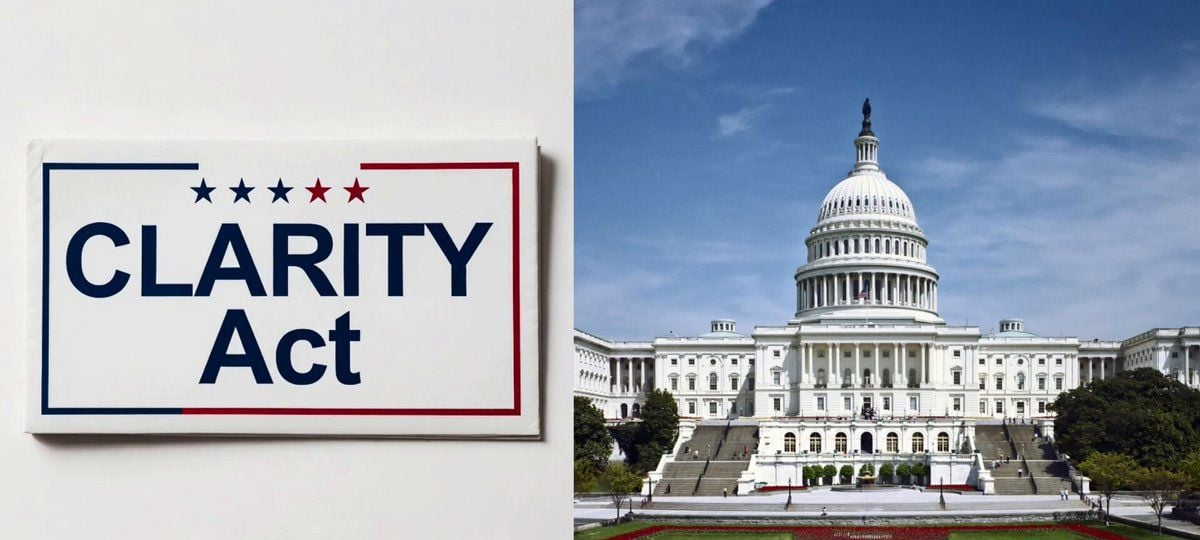
The long-awaited "Digital Asset Market Transparency Act" (CLARITY Act) is entering a truly critical stage in the U.S. cryptocurrency market.
House Majority Whip Tom Emmer has recently pressured the Senate again, pointing out that the Senate has become the main obstacle to advancing a federal digital asset regulatory framework. The House passed the bill as early as July 2025 with 294 votes in favor and 134 votes against, and the Senate Banking Committee also advanced a related version with a 15-9 result this May.
However, as of now, the CLARITY Act has yet to pass a full Senate vote.
The real key date has been locked in at September 15.
September 15: Must Secure 60 Votes to Move Forward
Senate Majority Leader John Thune has submitted a motion to vote on terminating the debate on advancing the CLARITY Act on September 15.
This is not a final vote to pass the bill, but its importance is not lower.
This is because terminating debate requires support from at least 60 votes. If this threshold cannot be met, the challenges for the bill to progress will significantly increase, possibly directly affecting its chances of being legislated by 2026. The Senate has limited time available to handle major legislation between its return from recess and the October election recess.
In other words, September 15 is effectively a vote on "whether to continue the discussion."
It is not simply a vote on "supporting or opposing cryptocurrency."
What Exactly Does the CLARITY Act Aim to Address?
The core task of the CLARITY Act is to redefine the regulatory boundaries of the U.S. digital asset market.
For a long time, the U.S. crypto industry has faced issues with overlapping regulatory jurisdictions between the SEC and the CFTC.
Which digital assets qualify as securities?
Which qualify as commodities?
Which trading platforms should be regulated by the SEC?
Which market activities should fall under the CFTC's responsibility?
These questions lack clearly defined legal boundaries, leading to a major source of regulatory uncertainty faced by U.S. crypto firms for a long time.
The CLARITY Act seeks to establish a more clearly defined digital asset market structure, determining regulatory jurisdictions for different types of assets and market participants while also incorporating requirements for disclosures, consumer protections, and market conduct.
Therefore, if the bill is ultimately enacted, its significance may far exceed any single token or trading platform.
It is, in fact, attempting to redefine the rules of the game for the U.S. digital asset market in the coming years.
Daily sharing real-time trading strategies, providing free position diagnostics, strategies for recovery, and market practical insights, scan to follow our official account"Bitcoin Radar",join the community for strategies!

But Now the Biggest Trouble is Not Just the Simple Opposition of Republicans Against Democrats
The real sticking points for the CLARITY Act are several specific policy issues.
The market is currently focused on at least issues including stablecoin yields, the scope of DeFi regulation, and conflicts of interest between government officials and crypto assets.
Among these, the issue of stablecoin yields is particularly sensitive.
The banking industry is concerned that if stablecoins can provide users with similar yield incentives through partner institutions or other means, it could further siphon off traditional bank deposits.
Meanwhile, the crypto industry argues that excessive restrictions on rewards related to stablecoins will weaken the competitiveness of the U.S. digital asset market.
This debate has actually been ongoing for months and is one of the main differences that has repeatedly surfaced in the advancement of the CLARITY Act.
Another major controversy involves DeFi.
The question regulators need to address is: to what extent should decentralized protocols bear compliance responsibilities?
If the rules are too strict, it may stifle U.S. DeFi innovation; if the rules are too lenient, it may leave room for market manipulation, illegal financial activities, and consumer protection risks.
"Ethical Provisions" Are Becoming Another Focus
In addition to stablecoins and DeFi, there is a more politicized issue—conflicts of interest for government officials participating in the crypto industry.
Some Democratic senators have previously made it clear that supporting the CLARITY Act does not mean unconditional support for the final version; they want to impose stricter conflict of interest limitations. There are still obvious divisions within the Senate regarding the relationship between government officials, especially senior officials, and digital assets.
This means that the CLARITY Act is now facing not only technical regulatory issues but also involves power plays on the American political level.
This is also why a bill that has already received significant support in the House and passed through Senate committee review still faces numerous difficulties at the full Senate stage.
Time Is Becoming the CLARITY Act's Biggest Enemy
Moreover, it is worth noting that the time window is rapidly shrinking.
The Senate has a crucial procedural node on September 15, but the House has recently reduced its voting schedule for September, with some meetings originally planned for late September being canceled.
This raises a very realistic question:
Even if the Senate can successfully secure 60 votes on September 15, there will be numerous text amendments, a full vote, and coordination work between the two chambers remaining.
Additionally, the U.S. Congress is facing time pressures brought on by the midterm elections this year.
Therefore, there is still a long way to go between "achieving procedural votes" and "ultimately becoming law."
Market Expectations Have Clearly Tempered
The CLARITY Act was previously viewed by the market as a significant breakthrough in U.S. crypto regulatory policy, but as the Senate continues to delay its vote, the market's expectations for its finalization in 2026 have noticeably declined.
At the beginning of August, Polymarket data showed that the probability of the bill being signed into law in 2026 had dropped to around 13%, and then it fluctuated as the procedural vote on September 15 was determined. Recent data points at different times still indicate that the market has not formed a consensus that it "will definitely pass."
This actually reflects a core issue:
The market is not betting on "whether the U.S. supports cryptocurrency" but rather whether the U.S. Congress can resolve specific policy differences within a limited timeframe.
The SEC's Attitude Is Also Worth Noting
Meanwhile, the attitude at the regulatory level is changing.
Latest news shows that SEC Chair Paul Atkins expects the CLARITY Act to advance in September, indicating that the regulatory agency does have some policy momentum to establish a more clearly defined digital asset market structure.
The SEC and CFTC have also been strengthening coordination in recent years, while U.S. regulatory agencies are gradually exploring how to extend traditional financial regulatory frameworks to tokenized assets, on-chain finance, and the digital asset derivatives market.
From this perspective, the significance of the CLARITY Act is no longer just "a crypto bill."
It may become an important foundation for the next stage of the U.S. digital financial regulatory system.
What Should the Market Really Focus On After September 15?
For the crypto market, what deserves the most attention is not simply the phrase "bill passed," but rather three signals.
First, whether 60 votes can be secured on September 15 will determine if the CLARITY Act has enough political space to continue advancing.
Second, whether compromises can be reached on stablecoin yields, DeFi, and ethical provisions will decide whether the final version will undergo significant changes.
Third, even if the Senate passes it, text coordination between the House and Senate may still produce new variables.
Therefore, it is still overly optimistic to say "the CLARITY Act is about to pass."
However, it cannot be ignored that U.S. digital asset regulation is entering an increasingly clear policy window.
If the CLARITY Act is ultimately enacted, the United States may for the first time have a systematic federal framework covering the digital asset market structure, regulatory authority, and industry participation rules.
On the other hand, if the 60 vote threshold on September 15 cannot be surpassed, the market may have to reassess the likelihood of this bill being legislated by 2026.
For BTC, ETH, and the entire U.S. crypto industry, September 15 may be the regulatory milestone truly worth keeping an eye on.
Daily sharing real-time trading strategies, providing free position diagnostics, strategies for recovery, and market practical insights, scan to follow our official account"Bitcoin Radar",join the community for strategies!

免责声明:本文章仅代表作者个人观点,不代表本平台的立场和观点。本文章仅供信息分享,不构成对任何人的任何投资建议。用户与作者之间的任何争议,与本平台无关。如网页中刊载的文章或图片涉及侵权,请提供相关的权利证明和身份证明发送邮件到support@aicoin.com,本平台相关工作人员将会进行核查。


