Why is an Internet brokerage starting to move towards crypto, banking, RWA, and blockchain infrastructure?
Author: AiPlot Research Institute
Focus: Fintech / RWA / Digital Asset Market Research
When mentioning Robinhood, many people's first impression is still "the stock trading app for young Americans." While this label is not incorrect, it is no longer sufficient to explain today's Robinhood.
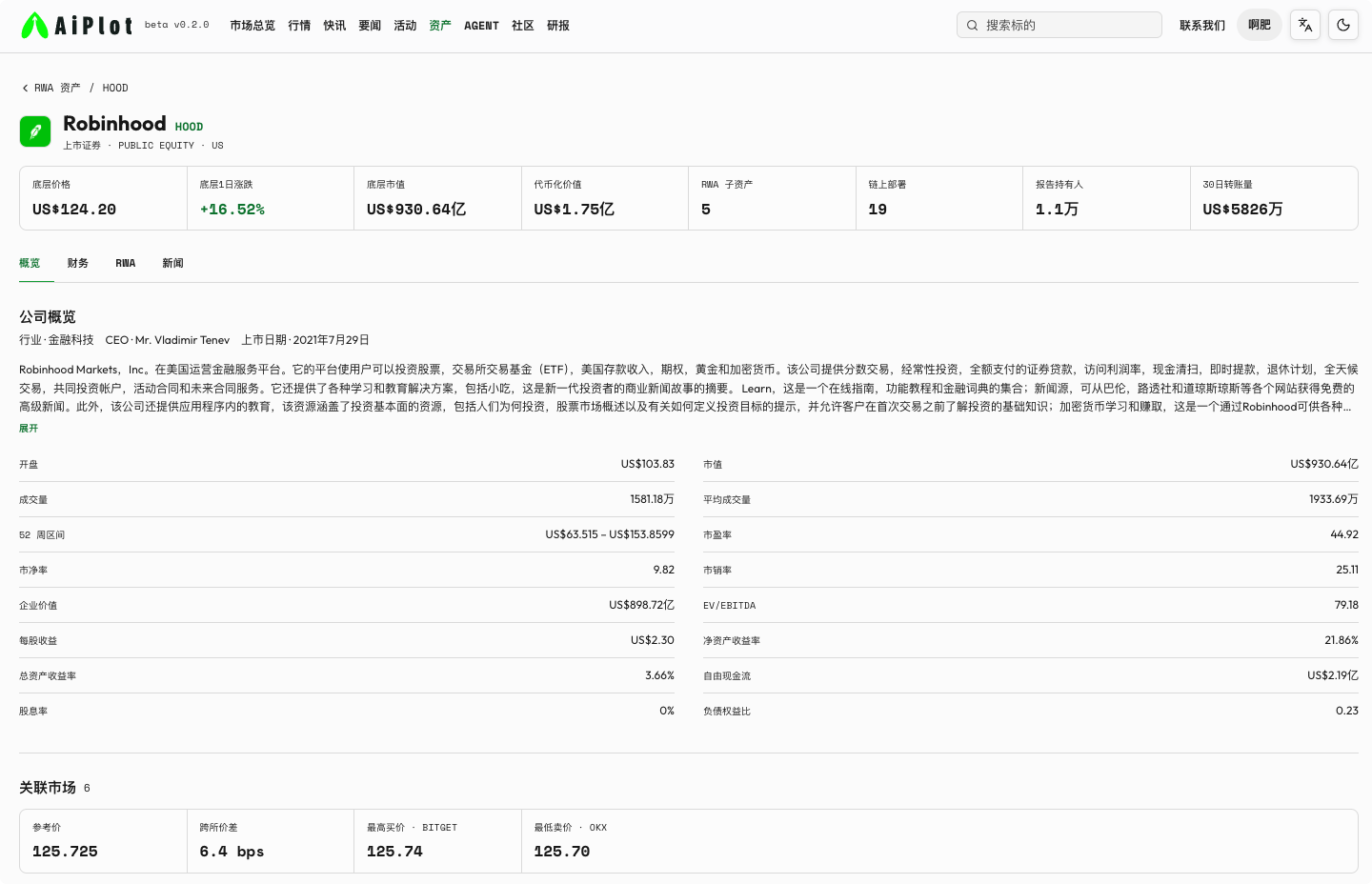
Robinhood initially gained market traction through its mobile experience and zero-commission stock trading, primarily serving small investors and young users who were often overlooked by traditional brokerages. However, after years of expansion, the products it offers now cover a variety of areas including stocks, ETFs, options, futures, cryptocurrencies, retirement accounts, portfolio management, cash management, membership services, prediction markets, and credit cards.
More importantly, Robinhood is building its own blockchain and launching stock tokens and on-chain financial products. At this point, it is no longer just a front-end application that helps users buy and sell financial products; rather, it is attempting to become a comprehensive gateway that connects users, financial assets, and underlying financial infrastructure.
To understand Robinhood, one must not only look at what products it sells but also consider which layer of the financial system it is trying to control.
1. How is Robinhood changing retail investment in the United States?
Before Robinhood, the stock trading market in the United States was largely dominated by traditional brokerages. The account opening process was complex, account thresholds were high, and trading interfaces were often more suited for professional investors. For younger individuals with smaller capital who are just starting to invest, there were significant friction costs to entering the market.
Robinhood's core breakthrough lies in transforming stock trading into a mobile Internet product. Users can open accounts, view market data, purchase fractional shares, and interact with stocks and ETFs via a relatively simple interface through their phones. The zero-commission strategy further reinforced this low-threshold experience, turning "investing" from a relatively specialized financial activity into a consumer-grade application that ordinary users can try at any time.
The significance is not merely reducing commissions to zero, but reshaping the relationship between users and the financial market: traditional brokerages emphasize accounts, orders, and trading rules, while Robinhood emphasizes product experience, instant feedback, and mobile usage scenarios.
Thus, Robinhood's early positioning can be summarized as: the front-end of the financial market for a new generation of retail investors.
This front-end access later became Robinhood's most significant strategic asset. Once users establish accounts, deposit funds, and develop investment habits on the platform, there is an opportunity for the platform to further provide more products, enhancing users' asset scale and usage frequency within the same financial ecosystem.
2. Zero commission does not equal no revenue: Robinhood's business model
Many people have a question when they first come across Robinhood: If stock trading does not charge traditional commissions, how does the company make money?
The answer is that Robinhood's revenue comes from multiple business lines rather than a single trading commission. According to Robinhood's full year 2025 financial report, the company's net revenue for the year reached $4.5 billion, a year-on-year increase of 52%; annual net deposits reached $68 billion, and Robinhood Gold subscribers reached 4.2 million.
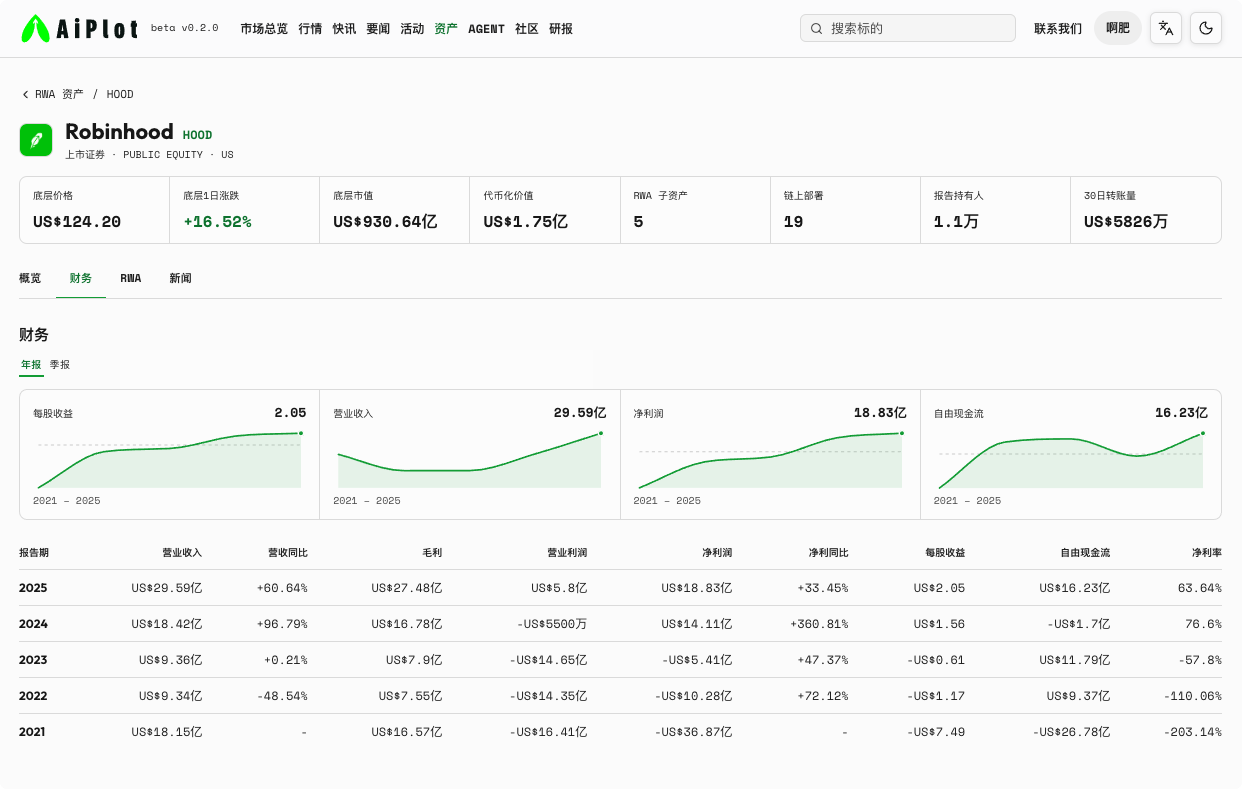
In the fourth quarter of 2025, Robinhood's net revenue was $1.28 billion, of which trading revenue was $776 million, net interest income was $411 million, and other revenue was $96 million. Among the other revenue, Robinhood Gold subscription income was $50 million, an increase of 56% year-on-year.
This set of data shows that Robinhood's business model has clearly exceeded the simple framework of "making money from stock trading."
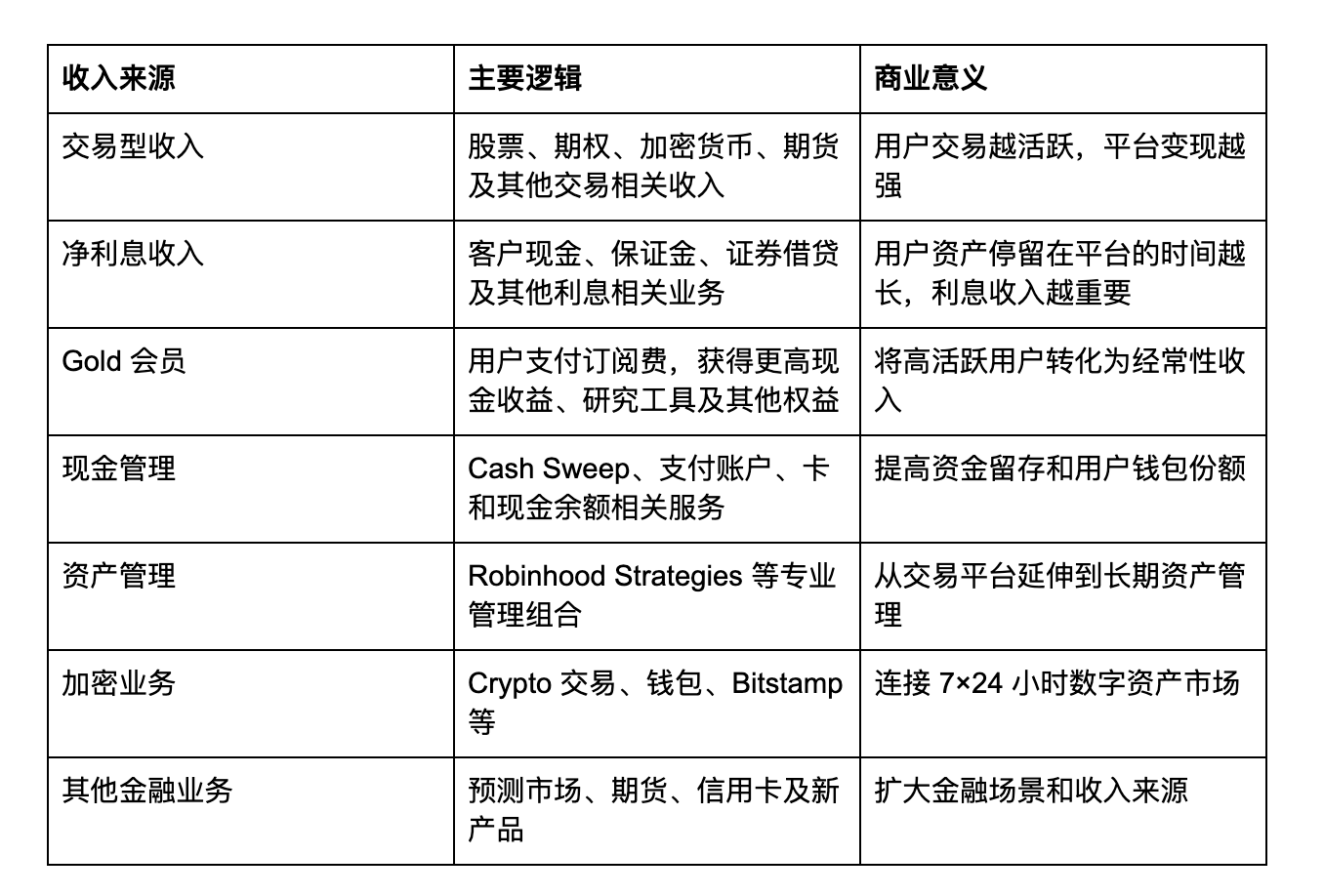
The so-called "zero commission" more accurately refers to replacing explicit trading fees with a more complex structure of financial service revenues. Users may not directly pay commissions for stock trading, but Robinhood can monetize its business through order flow, interest spreads, interest, membership fees, and other services.
This is a common logic among Internet financial platforms: first, reduce the threshold for single use, then establish revenue through user scale, funds retention, and cross-selling of multiple products.
3. Why has interest income become an important business for Robinhood?
Robinhood is not a bank, but it has a large amount of user cash, securities assets, and margin requirements, and these funds on its balance sheet can generate significant interest-related income.
A simple example is when users keep cash in their accounts, Robinhood can manage cash and arrange for interest with partner financial institutions; when users borrow funds on margin, the platform may earn income from financing interest; securities lending, cash sweeps, and other financial arrangements also affect net interest income.
This means that Robinhood's value comes not only from "how much users trade" but also from "how much funds users keep on the platform."
In the fourth quarter of 2025, Robinhood's net interest income reached $411 million, a year-on-year increase of 39%; during the same period, Cash Sweep reached $32.8 billion, and Margin Book reached $16.8 billion.
These two businesses reflect a key shift: Robinhood is transforming from a trading entry to a platform for fund retention and use. Users no longer just enter the platform to complete a trade and then leave; increasingly, more funds will stay on the platform and operate continuously in the form of cash, margin, portfolios, or other financial products.
From the perspective of platform economics, fund retention is often more important than single transactions. Trading revenues exhibit cyclicality, while cash, margin, and membership businesses can generate more stable, continuous asset operating income.
4. Robinhood Gold: From free tool to financial membership system
Robinhood Gold is a significant product that upgrades user relationships from "free trading" to "paid financial services."
The logic of the membership system is not complex: the platform offers users higher cash yields, research tools, margin conditions, credit card benefits, and other value-added services, and users form a continuous payment relationship through monthly or annual fees. For Robinhood, the value of membership business lies not only in subscription revenue but also in enhancing user retention and the platform's asset scale.
As of the fourth quarter of 2025, Robinhood Gold subscribers reached 4.2 million, a year-on-year increase of 58%.3 This indicates that Robinhood already has a group of users willing to pay for more comprehensive financial services, rather than relying solely on free trading to attract traffic.
This step is crucial. Free trading platforms often fall into intense price competition because competitors can replicate low fees. However, once a membership system is established, the competitive focus shifts to overall user experience, product depth, fund yield, credit services, research capabilities, and asset management.
In other words, Robinhood is transitioning from being "a cheap trading tool" to being "a financial account that users are willing to use long-term."
5. Cryptocurrency: Why isn't Robinhood satisfied with being just a brokerage?
Cryptocurrency business is one of the most important directions in Robinhood's business expansion.
From the user's perspective, stocks and cryptocurrencies have a natural complementary relationship. Stock investors want access to more asset classes; crypto users want to trade, hold, and transfer more assets within the same account. If Robinhood only offers stocks, it risks ceding users' cryptocurrency needs to Coinbase, Kraken, or other trading platforms.
Therefore, Robinhood's crypto strategy is not simply to add a few coins, but to incorporate the crypto market into its integrated financial account. The official homepage currently emphasizes Crypto 24/7 trading, covering digital assets such as BTC, ETH, XRP, SOL, DOGE, and SHIB.
At the same time, Robinhood is expanding its global crypto business through the acquisition of Bitstamp and the development of wallets. According to the company's 2025 financial report, Bitstamp's institutional trading volume continued to grow after the acquisition, and Robinhood's Stock Tokens product in Europe is also continuously expanding.
The significance of the crypto business for Robinhood has three layers.
First, it provides a 24/7 trading market, which can increase user usage frequency. Second, it allows Robinhood to acquire capabilities in wallet management, on-chain transfers, and digital asset custody. Third, it provides a natural user base and technical entry for subsequent products such as tokenized stocks, stablecoins, and RWA.
From this perspective, Robinhood's entry into the crypto market is not a deviation from its original business but rather a way to enhance the digital asset capabilities of the next generation of financial accounts.
6. RWA: A key step for Robinhood from financial front-end to underlying extension
One of the most noteworthy strategic changes for Robinhood is its initiation of the Robinhood Chain and the launch of stock tokens.
In 2025, Robinhood announced that it would offer over 200 U.S. stocks and ETF tokens to eligible European customers and stated that it would support tokenization of real assets, 24/7 trading, asset bridging, and self-custody through its own Layer 2 in the future.
In 2026, Robinhood announced the launch of the public mainnet of Robinhood Chain, positioning it as a Layer 2 for financial services and tokenization of real assets. The official statement indicated that the chain is based on the Arbitrum technology framework and integrates infrastructures such as Uniswap, Alchemy, BitGo, and Chainlink; eligible Stock Tokens can participate in on-chain trading, lending, and trading collateral.
This means that Robinhood's role may extend from "front-end financial products" to "the environment for running financial assets."
In the past, when users bought stocks, Robinhood primarily provided the interface, account, and trading services; the underlying market was jointly facilitated by exchanges, clearing houses, custodians, and brokerage systems. When users bought cryptocurrencies, Robinhood connected with exchanges, custodians, and public blockchain networks.
However, after establishing the Robinhood Chain, Robinhood begins to control more underlying aspects: on-chain circulation, trading, lending, liquidity, and application ecology post-asset issuance can all take place within a network designed around financial assets.
This is the strategic value of RWA to Robinhood. It is not merely adding a new product label, but rather allowing Robinhood the opportunity to place traditional assets into a new financial operating system.
7. What exactly are stock tokens? They cannot simply be equated with real stocks
To understand Robinhood's RWA products, it is essential to distinguish between "economic exposure to stocks" and "legal ownership of stocks."
Robinhood's official Stock Tokens page indicates that the related products are issued by Robinhood Assets (Jersey) Limited and are classified as tokenized debt securities, providing economic exposure to underlying securities but not granting investors direct legal or beneficial rights to those underlying securities. The official note also states that the Stock Tokens are supported 1:1 by underlying stocks and are held by licensed custodians.
Additionally, the Classic Stock Tokens from Robinhood Europe are blockchain derivative contracts that track the prices of publicly traded stocks and ETFs; the purchased items are not actual stocks and currently cannot be transferred to other wallets or platforms.
Therefore, what is referred to as "stock tokens" in the market may at least include different types of products:
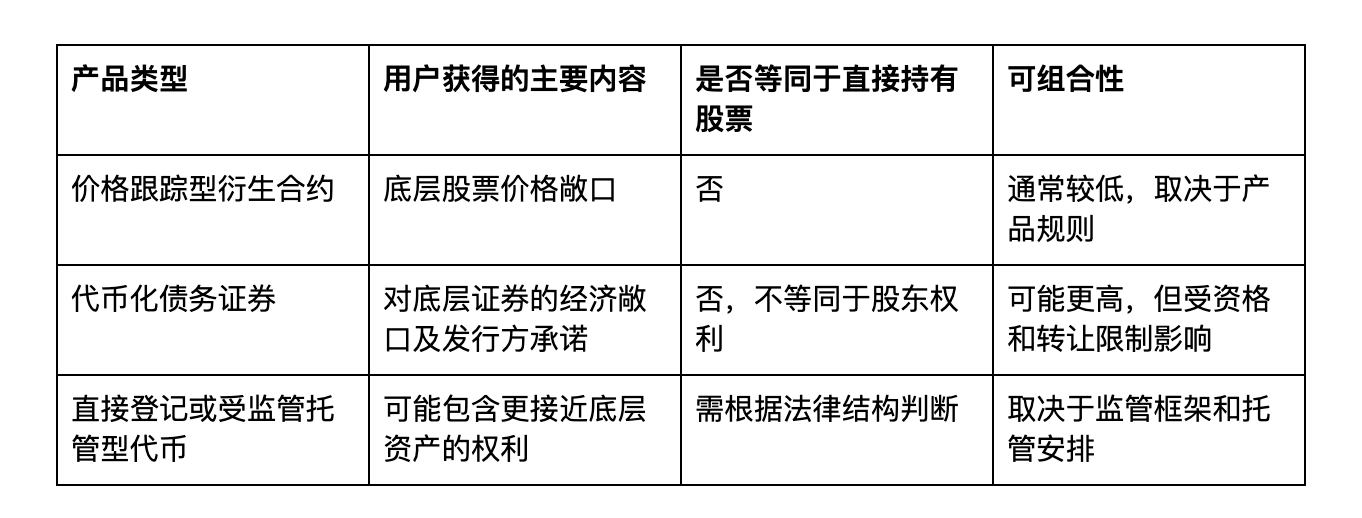
This distinction does not weaken the value of RWA; rather, it indicates that the innovation focus of RWA is not simply to replicate the stock registration system but to integrate the asset's price performance, yield distribution, collateral value, and trading capabilities into the on-chain financial environment.
For users, when researching RWA products, it's essential to focus on the issuer, legal structure, underlying support, investor qualifications, redemption rules, transferable scope, dividend handling, and custody arrangements, rather than solely looking at the product name.
8. Robinhood's long-term goal: From "one account buying many things" to "one system running many assets"
There is a very valuable judgment in the referenced content: Robinhood was originally more like a front-end gateway for financial products, helping users connect different underlying markets and infrastructures; with the emergence of Robinhood Chain, it suggests that it may aim to further become the infrastructure for the operation of financial assets.
This is a larger strategic imagination.
In the first stage, Robinhood enabled users to buy stocks within a single app. In the second stage, it integrated stocks, options, cryptocurrencies, futures, pensions, cash management, and prediction markets into one comprehensive financial account. In the third stage, it hopes to allow these assets to operate within a broader application through blockchain wallets, smart contracts, DEXs, lending protocols, and agents.
If this strategy holds, Robinhood's competitors are no longer limited to just another brokerage but include exchanges, crypto trading platforms, wallets, banks, payment platforms, asset management companies, and blockchain infrastructure providers.
Robinhood's goal can be summarized as: to become a unified entry point for users to access different assets, manage funds, and use financial services.
The value of RWA lies in extending this gateway from digitally native assets to the largest asset classes in the real world.
9. Why does AiPlot need to continuously observe Robinhood?
The expansion of Robinhood also indicates that future RWA research cannot focus solely on the price or market value of a specific token.
A truly research-worthy asset requires observation from multiple levels: what underlying assets it corresponds to, who issues it, what legal structure it adopts, on which blockchains it is deployed, how many holders exist, whether on-chain transfers are active, whether multiple trading markets exist, whether it has entered lending, market-making, or derivatives agreements, and what kind of liquidity relationships it forms with other on-chain assets.
For a comprehensive platform like Robinhood, it is also essential to further examine the relationship between the platform layer and the asset layer: which assets are issued directly by Robinhood, which assets are issued by third parties, which applications genuinely use tokenized stocks, which merely leverage RWA narratives for traffic, and which assets maintain ongoing trading and capital efficiency on-chain.
This is precisely where AiPlot's value lies as a data and intelligence platform for the RWA market. AiPlot can assist users starting from a company or asset code to further observe its tokenized versions, issuing parties, on-chain deployments, holders, transfer volumes, trading markets, DeFi usage, and related events.
In the case of Robinhood, AiPlot's focus should not simply be "how many types of stock tokens does Robinhood have," but rather: are these stock tokens genuinely held and traded by users? Have they entered lending and collateral scenarios? Are they forming liquidity across multiple networks? Are they becoming basic assets for other on-chain applications?
These data will ultimately determine whether Robinhood's RWA strategy is merely a marketing concept or if it is forming a new network of financial assets.
10. Conclusion: Robinhood may be an early example of the next generation of comprehensive financial platforms
Robinhood's development path is highly representative.
Starting from zero-commission stock trading, it first addressed the issue of ordinary users entering the capital market; subsequently, through options, cryptocurrencies, futures, pensions, asset management, cash management, memberships, and prediction markets, it gradually expanded users' wallet shares; now, it is again attempting to bring real assets into the on-chain financial system through stock tokens and Robinhood Chain.
Therefore, Robinhood can no longer be understood merely as "a young people's stock trading app." It is transforming from an Internet brokerage to a comprehensive financial platform and further exploring becoming the infrastructure for the on-chain operation of financial assets.
The core of this process is not merely an increase in product quantity but a deepening of the platform's control layers: from interface to account, from account to funds, from funds to assets, from assets to trading and application infrastructure.
If traditional brokerages' advantage lies in connecting users with capital markets, then Robinhood is attempting to expand that connection to the crypto market, on-chain protocols, and the real asset network. It may not smoothly achieve all its goals, as regulatory, product structure, custody, liquidity, and security issues will require long-term resolution; however, the questions it raises are already significant:
Will future financial platforms no longer just enable users to buy assets, but allow users to access, manage, combine, and use almost all types of assets within the same digital account?
Robinhood is answering this question with its product roadmap. For the RWA market, its true significance may not lie in how many stock tokens it has issued, but in how it may bring real assets into a distribution network with tens of millions of users, mature financial products, and on-chain infrastructures.
For more data and analysis, please follow Aiplot:
https://aiplot.com/
📖 Community Communication:
Telegram:
https://t.me/+IIYMcJigBAo4Mjg1
免责声明:本文章仅代表作者个人观点,不代表本平台的立场和观点。本文章仅供信息分享,不构成对任何人的任何投资建议。用户与作者之间的任何争议,与本平台无关。如网页中刊载的文章或图片涉及侵权,请提供相关的权利证明和身份证明发送邮件到support@aicoin.com,本平台相关工作人员将会进行核查。