Original author: Zhao Ying
Original source: Wall Street Watch
The United States is mobilizing capital on an unprecedented scale, deeply binding the AI race with dollar hegemony. The logic of this gamble is clear and radical: use the comprehensive opening of capital markets to fund AI infrastructure, reshape the global accessibility of dollar assets with blockchain technology, and then use AI leadership to reinforce the position of the dollar. However, the inherent fragility of this model is equally evident—the dollar is becoming more like a high-risk stock, rather than a safe-haven anchor in the traditional sense.
According to the Wind Trading Desk, Deutsche Bank released a foreign exchange special report on September 3, predicting that U.S. companies are expected to invest about $800 billion in AI capital expenditures this year, while AI venture capital has raised over $400 billion, with just the two largest AI laboratories collectively nearing $217 billion in financing, both valued close to $1 trillion. Meanwhile, mega-scale tech companies such as Google, Meta, Amazon, and Oracle have raised about ten times the annual average from 2020 to 2024 through the investment-grade credit market this year.
The effects of this capital mobilization have directly transmitted to the structural risks of the dollar. As the sources of U.S. financing switch from official long-term capital to private short-term tech capital, the correlation between the dollar and the stock market is rising, weakening its traditional risk-hedging properties. If the AI business model is found to be flawed or the U.S. falls behind in the AI race, the dollar will face severe downward pressure.
Capital Influx: Three Financing Channels Open Simultaneously
The United States is simultaneously financing on a large scale through private equity, public debt, and the stock market.
In the private market, AI venture capital has raised over $400 billion this year, with over 90% of the largest transactions concentrated in the U.S., and an annual growth rate three times that of last year. In the debt market, mega-scale tech firms have been forced to turn to bond financing on a large scale for the first time—Google, Meta, Oracle, and Amazon's financing through the investment-grade credit market this year is about ten times the annual average from 2020 to 2024. In the public stock market, Google completed its first stock issuance since its IPO in 2004, raising $85 billion; SpaceX completed the largest new stock listing in history with a market value close to $2 trillion.
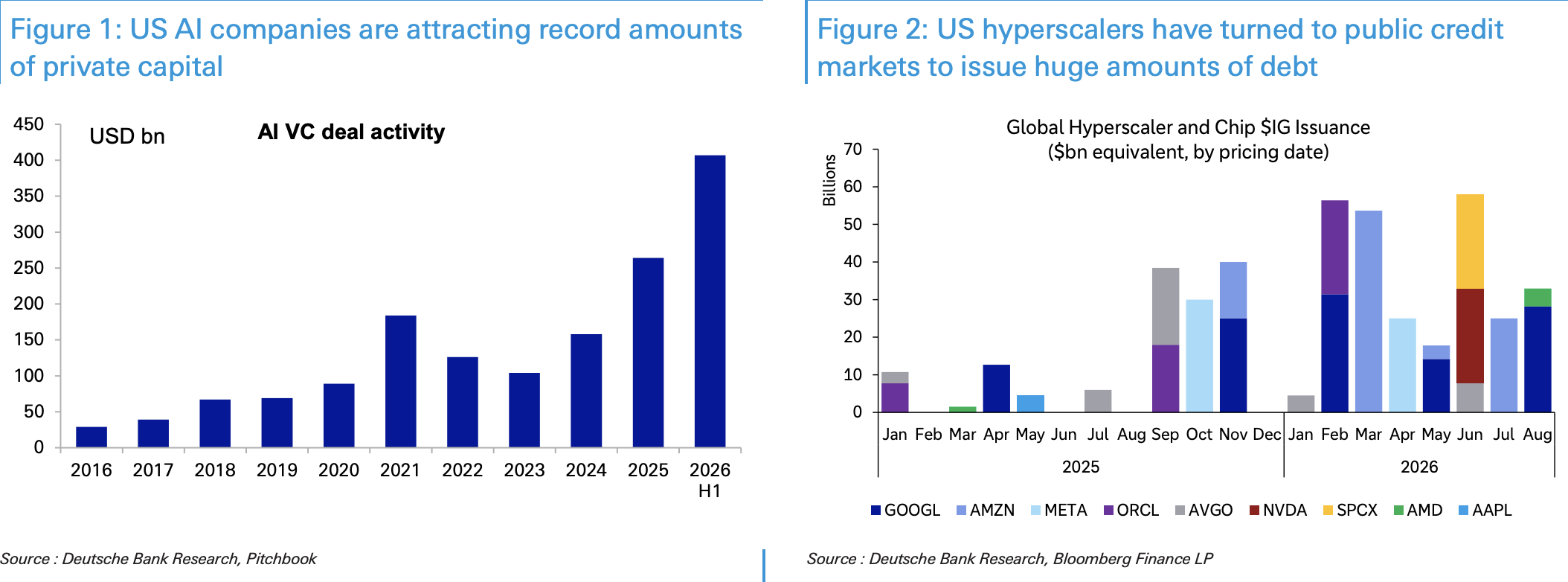
The backdrop of this financing wave is the increasingly expanding dual deficits in the U.S.—a fiscal deficit exceeding 6% of GDP and a current account deficit close to 4% of GDP. In the absence of domestic fiscal savings, the incremental demand for AI capital expenditures must rely on foreign funds. Deutsche Bank data shows that in the second quarter of 2026, the U.S. attracted over $400 billion in foreign equity capital in a single quarter, far surpassing any historical single-quarter level, and it has significantly exceeded debt capital inflows— which have long been the main source of financing for the U.S. capital account.
It is noteworthy that the willingness of foreign official entities to hold U.S. Treasury securities in the long term is declining due to geopolitical rifts, while the attractiveness of tech assets is compensating for this gap from private channels such as retail investors. SpaceX reportedly reserved about 30% of its IPO for retail investors, which is more than three times that of traditional IPOs, reflecting a clear awareness among U.S. companies of the shift in their financing structure.
Asset Tokenization: The Next Technical Pivot of Dollar Hegemony
At the same time as large-scale financing, the U.S. is deploying blockchain technology as infrastructure to attract global capital, pushing asset tokenization from concept to reality.
Asset tokenization refers to converting the ownership of financial assets like stocks, bonds, and real estate into digital tokens recorded on the blockchain. The Depository Trust & Clearing Corporation (DTCC) currently holds about $115 trillion in U.S. assets and has completed the tokenization of the first batch of assets for real transactions as of July 2026, with 40 financial institutions participating, including tests for tokenizing the S&P 500 ETF (SPY) and Morgan Stanley meeting the margin requirements for tokenized assets at the Chicago Mercantile Exchange. DTCC plans to officially launch tokenization services in October 2026.
On the regulatory front, the U.S. Securities and Exchange Commission (SEC) issued a "no-action" letter to DTCC in December 2025, confirming that the same securities could be traded on both traditional and on-chain tracks, enjoying the same investor protections and ownership rights. A subsequent ruling in January 2026 further clarified that the format of the securities or manner of holding them does not affect the applicability of federal securities law. This provides ample regulatory backing for tokenization.
On the exchange level, the New York Stock Exchange is collaborating with Securitize to develop a new digital platform aimed at achieving 24/7 trading, instant settlement, fragmented stock trading, and stablecoin settlement; NASDAQ announced the launch of "equity token design," intending to achieve full tokenization capabilities by 2027, and has announced that it will launch 23/5 trading by the end of 2025.
Deutsche Bank believes that the strategic significance of tokenization for the dollar lies in: on one hand, the collateral liquidity of tokenized assets is higher, which can enhance capital efficiency and increase the attractiveness of U.S. assets for global investors; on the other hand, if U.S. stocks and bonds can achieve 24/7 instant settlement, it will significantly lower the entry barrier for global retail investors, further expanding the demand base for dollar assets. The case of South Korea provides a reference—South Korea accounts for only 2% of global nominal GDP but contributed about 10% of the $740 billion foreign capital that flowed into the U.S. stock market last year, partly because South Korea opened up fragmented trading of foreign stocks relatively early.
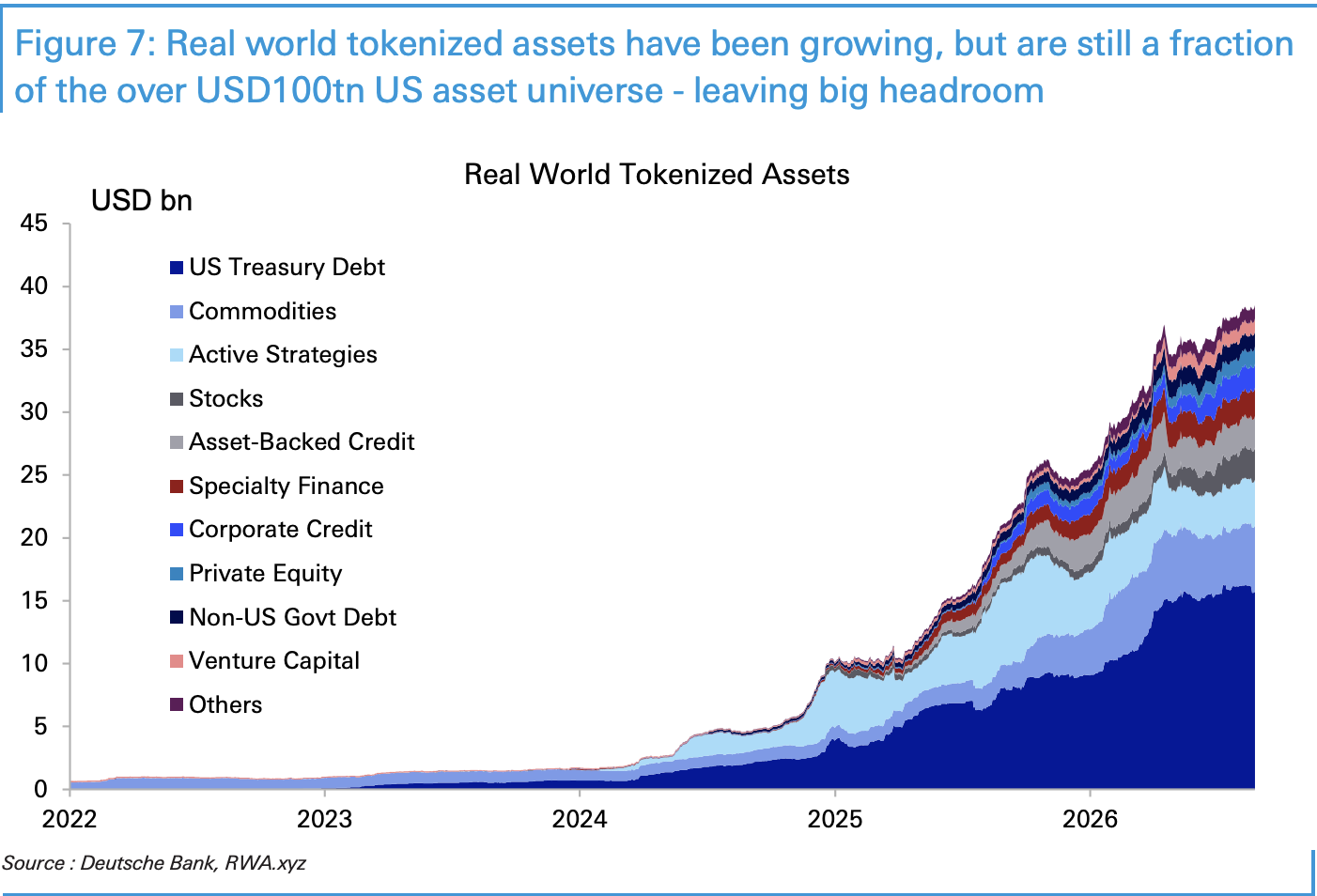
Currently, the global scale of real-world assets that have been tokenized is about $40 billion, compared to over $100 trillion of assets in the U.S., indicating tremendous growth potential. Market predictions suggest that by the 2030s, the scale of tokenized assets could reach between $2 trillion to $30 trillion.
The New Risk Map of the Dollar: From Safe-Haven Asset to AI Bet
This dual gamble of capital and technology is reshaping the risk attributes of the dollar.
Deutsche Bank points out that the U.S. is undergoing a fundamental change in its financing structure: from long-term, geopolitically driven capital inflows dominated by official sectors to short-term, tech return-driven capital inflows dominated by the private sector. This shift has significantly increased the correlation between the dollar and the stock market, weakening its historical role as a hedge against stock risks.
This logic implies that the fate of the dollar is deeply tied to the outcomes of the AI race. If AI capital expenditures ultimately prove to lack economic benefits, or if the U.S. loses its competitive edge in technology, the massive withdrawal of private capital will constitute a direct impact on the dollar.
Meanwhile, while tokenization lowers the barriers for capital inflows, it also equally reduces the friction for capital outflows. The enhancement of capital liquidity is a double-edged sword—it can accelerate capital inflows during favorable conditions, but it can also speed up capital escape during unfavorable conditions.
From a more macro perspective, Deutsche Bank believes that the U.S. is participating in the AI race with a model of "open market + closed technology": attracting global funds through the comprehensive opening of capital markets while maintaining the proprietary nature of AI model weights to safeguard corporate pricing power and shareholder returns. The core premise of this model is that U.S. AI companies can continuously maintain technical leadership and translate it into sustainable profitability.
The Capitalist Model Itself Undergoing Stress Testing
Deutsche Bank raises a deeper proposition in the report: the AI race is not only a technological contest but also a contest of economic models, and the U.S. shareholder capitalism model itself is undergoing stress testing.
The inherent logic of the U.S. model is: opening capital markets to attract global funds → large-scale capital investments driving technological innovation → technological leadership supporting corporate pricing power → high profit returns attracting more capital inflow. The establishment of this positive cycle relies on AI companies' ability to charge high subscription fees from global users and monetize the intellectual property of international markets.
However, this cycle has evident fragility. If AI business models cannot generate sufficient economic returns, or if U.S. enterprises' pricing power is eroded, corporate profits will come under pressure, thereby shaking the core logic for attracting foreign capital and exacerbating already high fiscal deficit pressures.
Deutsche Bank also pointed out that AI revenue streams are expected to improve the U.S. current account by about 1 percentage point through enhanced service exports over the next decade, but this prospect heavily depends on whether U.S. AI enterprises can maintain pricing power and successfully monetize their international user base.
The report ultimately characterizes this race as the ultimate test of the American core belief that "open capital markets always foster the best innovation." The outcome of the AI race will to a considerable extent determine whether this belief still holds, and whether the dollar's status as a global capital hub can be sustained.
免责声明:本文章仅代表作者个人观点,不代表本平台的立场和观点。本文章仅供信息分享,不构成对任何人的任何投资建议。用户与作者之间的任何争议,与本平台无关。如网页中刊载的文章或图片涉及侵权,请提供相关的权利证明和身份证明发送邮件到support@aicoin.com,本平台相关工作人员将会进行核查。


