
Locking on to an internet transformation in the manufacturing industry.
Text丨Li Geng
On August 4, 2026, PCB (Printed Circuit Board) manufacturer Jialichuang rang the bell on the Shenzhen Stock Exchange. After its issuance, the stock price soared at one point. Although the stock price fluctuated afterwards, its market value has initially maintained at nearly 100 billion RMB, roughly aligning with the overall valuation level of the domestic PCB industry.
The initial stagnation followed by a rise post-IPO is not surprising; what is remarkable is the business model that supports this venture and the level this business has reached.
In 2025, Jialichuang's top five customers contributed only 1.16% of the revenue. The total annual revenue of 10.23 billion RMB came from 1.3 million paying users with 21.08 million orders, with average spending per paying user and average order at only 7,870 RMB and 485 RMB, respectively. In comparison, other PCB manufacturing companies listed on the A-share market of equal size and above have their top five customers accounting for at least 20%, with the highest over 60%.
More importantly, the distinct user structure has not affected Jialichuang’s ability to convert profits. In 2025, Jialichuang's net profit margin was 12.4%; in the first half of 2026, Jialichuang's net profit margin further increased to 14.4%. In both periods, only three companies in the A-share market had a net profit margin higher than its own: Huadian Co., Shenzhen South Circuit Co., and Shenghong Technology. The latter three have all entered the core core camp of high-end AI supply chains related to NVIDIA (NVIDIA)’s AI servers, high-speed switches, or OAM (accelerator modules).
No major clients, yet achieving a business worth billions; a large user base and a greater number of orders, with profits competing with the most technologically advanced NVIDIA suppliers in the industry. This begs the question: what kind of business is Jialichuang, after all?
A billion-dollar business without major clients
The story of Jialichuang begins with a counterintuitive fact: the revenue in the billions is pieced together from extremely fragmented orders.
Generally speaking, the route to hardware is fixed: first, use computer software to design circuits; this step is called design; then, print a small sample board for verification, which is prototyping; only then is it possible to proceed to small batch trial production, and finally run it on the production line for mass production. What Jialichuang earns is precisely this most fragmented and least noticed segment at the front end of this chain.
In 2025, the revenue contribution from Jialichuang's top five customers was only 1.16%, with the largest single customer, Magic Power (a company that makes power electronic components), contributing only 0.28%. You can see names like Haier (white goods) and Weisheng (electric meters) on the client list, but none can sway its performance. In contrast, the vast majority of manufacturing companies are struggling to bind one or two major clients, while Jialichuang’s lifeline is scattered among 1.3 million paying users and 21 million orders.
Where do these orders come from? The answer is the "fragmentation" of hardware research and development, which means that demands like samples, prototyping, and small batches are naturally scattered, high-frequency, and frequently revised.
Twenty years ago, hardware engineers in Shenzhen who wanted to create a sample had to rely on connections to find board factories, with costs upwards of five to six thousand RMB, and had to wait half a month to a month. Even when they paid, the board factories might not want to take such small orders. High costs, unstable delivery times, inconsistent quality, and single service were the unavoidable problems for R&D prototyping at that time.
At that time, Jialichuang, which only rented a counter in Huaqiangbei, began using a manual paneling method to concentrate several customers’ small orders on one large board for production, significantly compressing startup costs and proposing a groundbreaking price of "dual-sided board samples as low as one RMB per piece, getting 10 samples for 100 RMB."
In 2012, the "Lichuang Mall (now renamed Lichuang Electronics)" was launched, allowing for one-stop procurement of electronic components. Engineers could buy all the components needed for a board online (this list is called BOM), and it also launched SMT placement services (soldering components onto boards) and custom laser steel mesh; from 2016 onward, it established four modern production bases in Guangdong, Jiangxi, and Jiangsu, greatly expanding PCB production capacity.
In 2017, it acquired the online design software EasyEDA, which after iteration became Lichuang EDA (EDA is the software for engineers to design circuit boards), free for all engineers to use, resolving the risk of small and medium solution providers unable to afford legitimate use and having to resort to pirated versions. Thus, it completed the integration of the industrial chain of "design software + component procurement + board production + placement": engineers no longer needed to find design software vendors, board factories, component distributors, and placement factories separately; they could complete the entire process of "one concept in, one product out" at Jialichuang through one portal.
In recent years, Jialichuang has further extended into the mechanical industry, gradually expanding into 3D printing, CNC manufacturing (numerical control processing), and FA mechanical parts e-commerce, extending service boundaries from the electronic industry chain to the mechanical industry chain, building comprehensive service capabilities that cover electronics, machinery, and industrial software. By the end of 2025, this system served over 180 countries and regions, with overseas revenue accounting for over 20%.
Dislocated competition with traditional large manufacturers
Catching scattered demands is just a strategy; the question is how to use the manufacturing body to digest the fragmented orders that manufacturing is least good at?
Jialichuang’s answer is deep operational transformation. Customers place orders independently on the official website, the system automatically reviews orders, and intelligent algorithms "stitch" the scattered pieces from different customers onto one large board for concentrated production.
The most intuitive value of this model is that prices and thresholds have been lowered. The price for PCB prototyping has been compressed to tens of RMB, with delivery in as fast as 12 hours. Capabilities that were once only affordable by large enterprises for rapid prototyping and full-link trial production can now be accessed at low costs by startup teams, research labs, and independent engineers.
Jialichuang calls this logic “manufacturing equality,” meaning that affordable and user-friendly R&D trial capabilities no longer belong only to large enterprises. It provides engineers with two free PCB samples each month, totaling over ten million in cumulative samples; it actively controls the price adjustment range when raw material prices rise, continuously benefiting the R&D community, all as actions based on this statement.
There are no salespeople making individual deals, no middlemen inflating prices; the entire chain is lightweight and requires fewer people. To realize this model, Jialichuang self-develops intelligent paneling algorithms, order coordination scheduling systems, and standardized process infrastructure, aggregating a large number of varied fragmented orders and synchronizing them into the production line. From ordering to delivery, sales, warehousing, logistics, and procurement are all operated on self-developed systems.
Jialichuang also explicitly states in its prospectus: the fact that its model may be imitated is a risk item, but the cost of imitation is a real investment of funds, time, and data accumulation, which cannot be achieved merely by opening an "online quotation page."
Of course, this matter cannot just be asserted by Jialichuang; the key is the gap with competitors.
First, closer competitors following fragmented routes like Huachiu and Jiepei have similar models, but in terms of self-built production capacity scale, EDA user count, and inventory SKU density (the number of in-stock products that can be shipped immediately after ordering), they are still not on the same level; traditional small-batch listed companies such as Xingsen and Jinbaize still rely on offline large clients, with almost no industrial internet ecosystem, and their revenue from small-batch samples is still behind Jialichuang.
Next are traditional PCB giants like Shenzhen South Circuit, Huadian Co., and Jingwang Electronics. They understand Jialichuang’s model but cannot replicate it or rationally choose not to learn from it.
The combined share of sample and small-batch production accounts for only about 15% to 20% of the entire PCB market, with limited share. Large PCB manufacturers bind themselves to major clients in brands, automotive, telecommunications, etc., profiting from scale and utilization rate (the operating rate of equipment, that is, whether the production line is busy). They won’t change their production lines or cultivate algorithms for these limited and fragmented demands. For large-scale board leaders like Shenzhen South Circuit and Huadian Co., their production lines are designed for large orders from thousands, whereby they earn profits without having to change lines; pursuing a small order starting at a hundred pieces is like using a heavy truck for city delivery.
Let alone the internet-based engineer outreach (community, content, SEO, extreme conversion) and flexible manufacturing systems required behind the massive small orders, which are new capabilities that traditional large manufacturers need to explore and accumulate from scratch.
Currently, Jialichuang has already formed a huge ecosystem: a large pool of EDA users in the millions paired with its supported packaging library, nearly a million available SKU, and a warehouse processing dozens of thousands of SKUs daily, along with converted placement and mechanical business. It has an absolute scale advantage in its niche market. Even if large enterprises want to join the battlefield, the funding demands and subsequent competitive intensity will increase further, leading to a drop in ROE.
Why does the market give it a “hundred billion” valuation?
Compared with the high net profit margins of Huadian Co., Shenzhen South Circuit, and Shenghong, which come from product premiums for high-layer, high-speed, and HDI boards, Jialichuang’s similar net profit margins come from a completely different structural profit formula.
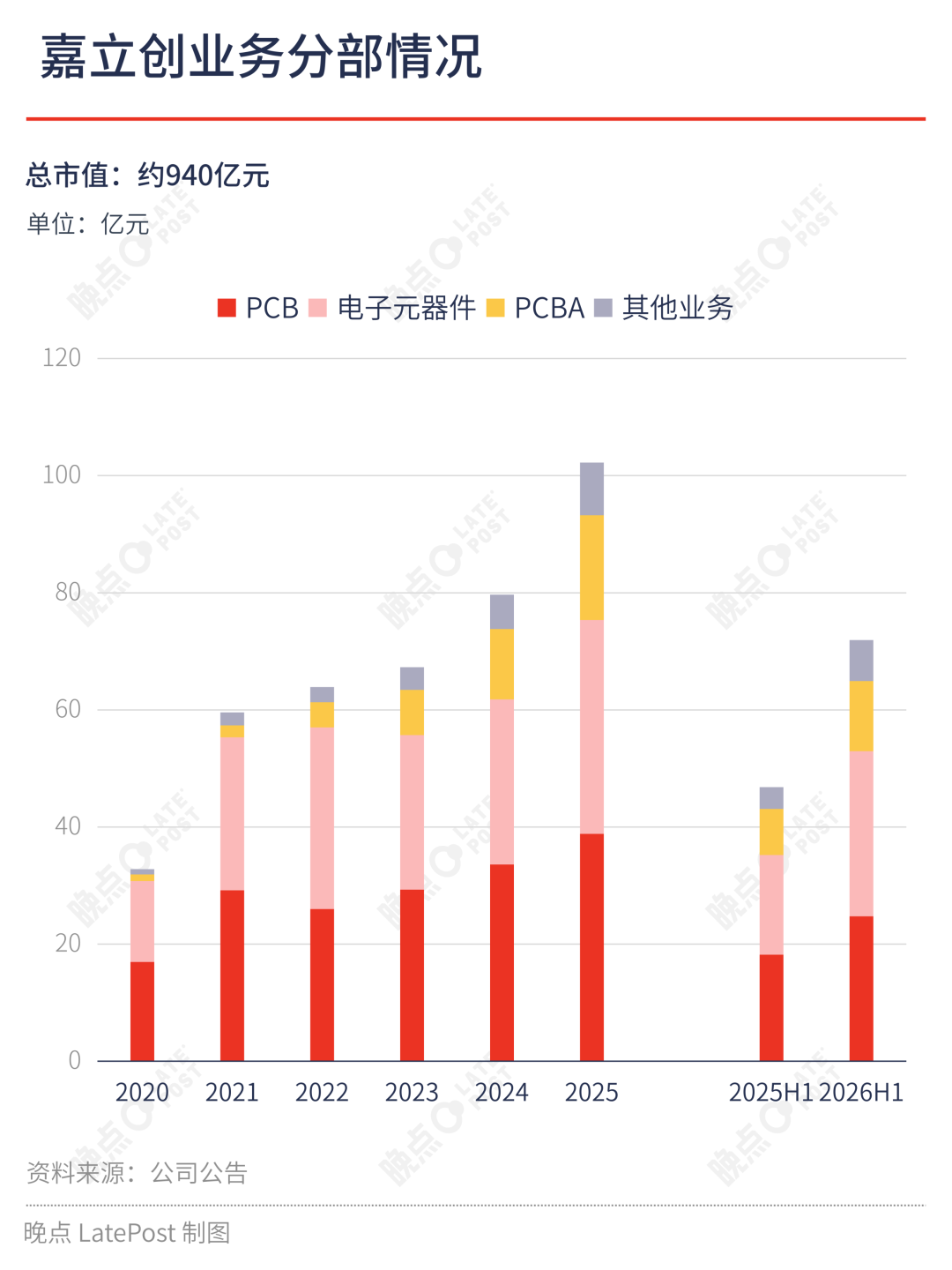
The approximate revenue structure of Jialichuang is:
In 2025 and the first half of 2026, the company’s PCB business revenues were 3.88 billion RMB and 2.47 billion RMB respectively, with a gross margin of about 28%;
During the same period, the company’s electronic component business revenues were 2.65 billion RMB and 2.82 billion RMB respectively, with a gross margin between 20% and 21%, and this business has become the company’s largest revenue segment;
At the same time, the company’s PCBA (one-stop delivery service) business revenues were 1.79 billion RMB and 1.20 billion RMB respectively, with a gross margin of about 38% to 39%, and in 2025, this business drove 470 million RMB of PCB revenue in reverse.
Data shows that pure PCB business is no longer the company's most important growth engine; one-stop solutions and a basket of component procurement have become the company's primary sources of revenue, and the two together can achieve over 60% growth, significantly higher than the PCB growth rate of 36%.
Therefore, the market gives Jialichuang a “hundred billion” market value, which is roughly based on three things beyond its profit depth and dislocated competition features.
First, there is the long-tail model itself. High order density, large user base, and high repurchase rate, growth does not rely on a single major client, inherently anti-fluctuation. It is also unlikely to be affected by the new cycle of the PCB industry driven by the AI wave. In the first quarter of 2026, Jialichuang's revenue was 3.029 billion RMB, a year-on-year growth of 45.29%; net profit attributable to shareholders was 376 million RMB, a year-on-year growth of 51.71%; in the second quarter, revenue was 4.144 billion RMB, a year-on-year growth of 61.3%; net profit attributable to shareholders was 654 million RMB, a year-on-year growth of 89.22%. The operational atmosphere is still trending upwards.
Secondly, there is the value of "entry" into the hardware innovation ecosystem. The rise of emerging companies like DJI, Yushu, and Zhiyuan Robotics comes with a low-threshold hardware prototyping ecosystem. Jialichuang's free EDA resolves the cost issue of legitimate licenses that can run into hundreds of thousands of RMB for engineers; one-stop prototyping compresses the threshold of "from idea to physical product" to an extremely low level. Jialichuang is one of the foundations of this innovation machine.
Finally, there is the industrial cycle. Prismark predicts that by 2026, the global PCB market scale will reach 95.8 billion USD, with a year-on-year growth of 12.5%; the high demand for advanced multilayer boards driven by AI servers, data centers, and high-speed communications is becoming the main engine for industry growth. As a rare "industrial internet + flexible intelligent manufacturing" entity in the A-share market, it is viewed by the market as a rare "physical AI infrastructure" target in this round of AI computing cycles.
Of course, expectations aside, doubts have always existed. Jialichuang's self-developed EDA excels at closing the loop of "from design to production" and offers practical ease of use, meeting the daily needs of the vast majority of engineers; however, in high-end modeling and simulation, signal integrity analysis and other deep waters, there are still gaps with international giants. Especially in high-end fields such as high-speed communication boards, Cadence, Siemens (Mentor), etc. still hold the dominant status. It allows engineers to afford it, but high-end modeling and simulation are still not deeply utilized.
As the scale crosses 10 billion, growth ceilings begin to manifest. To move from "R&D sampling" to "high-end mass production," core supply chain certification systems of leading technology and cloud manufacturers (such as NVIDIA, Alibaba) need to be broken through. These certifications test stable yields and long-term trust, and traversing this validation process often takes quarters; it cannot simply be achieved through free software and inexpensive boards. Once the growth rate of long-tail demand slows down, merely relying on manufacturing equality may not support the growth imagination corresponding to a hundred billion market value.
The only path ahead for Jialichuang is self-upgrading.
First, increase investment in processes and capacity, continually investing in high-layer boards, HDI, and advanced processes, and even if it cannot compete directly with traditional major manufacturers, it can enhance its product performance and service range. Jialichuang’s IPO fundraising is focused on high-layer PCB and PCBA intelligent production lines, and it has already completed mass production of 64-layer ultra-high-layer PCBs and HDI blind buried hole processes, aligning with this path.
Second, after upgrading technology and capacity, further shift to high-end EDA and software ecosystems through collaborations with higher-end clients and core chip ecosystems while maintaining the positioning of "the earliest and longest-standing partner of global hardware developers."
Image source: Visual China
免责声明:本文章仅代表作者个人观点,不代表本平台的立场和观点。本文章仅供信息分享,不构成对任何人的任何投资建议。用户与作者之间的任何争议,与本平台无关。如网页中刊载的文章或图片涉及侵权,请提供相关的权利证明和身份证明发送邮件到support@aicoin.com,本平台相关工作人员将会进行核查。


