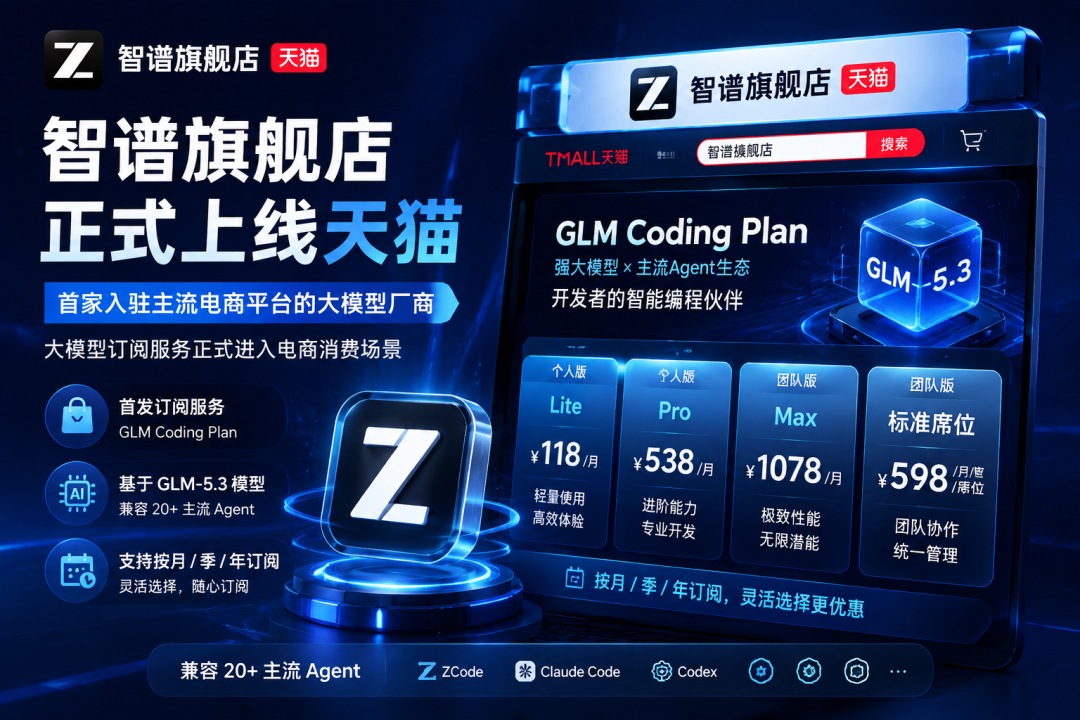
In the future, when you open Taobao and search for "Zhipu Flagship Store," what you can buy will no longer be just clothes and digital products—but the calling quota of large models.
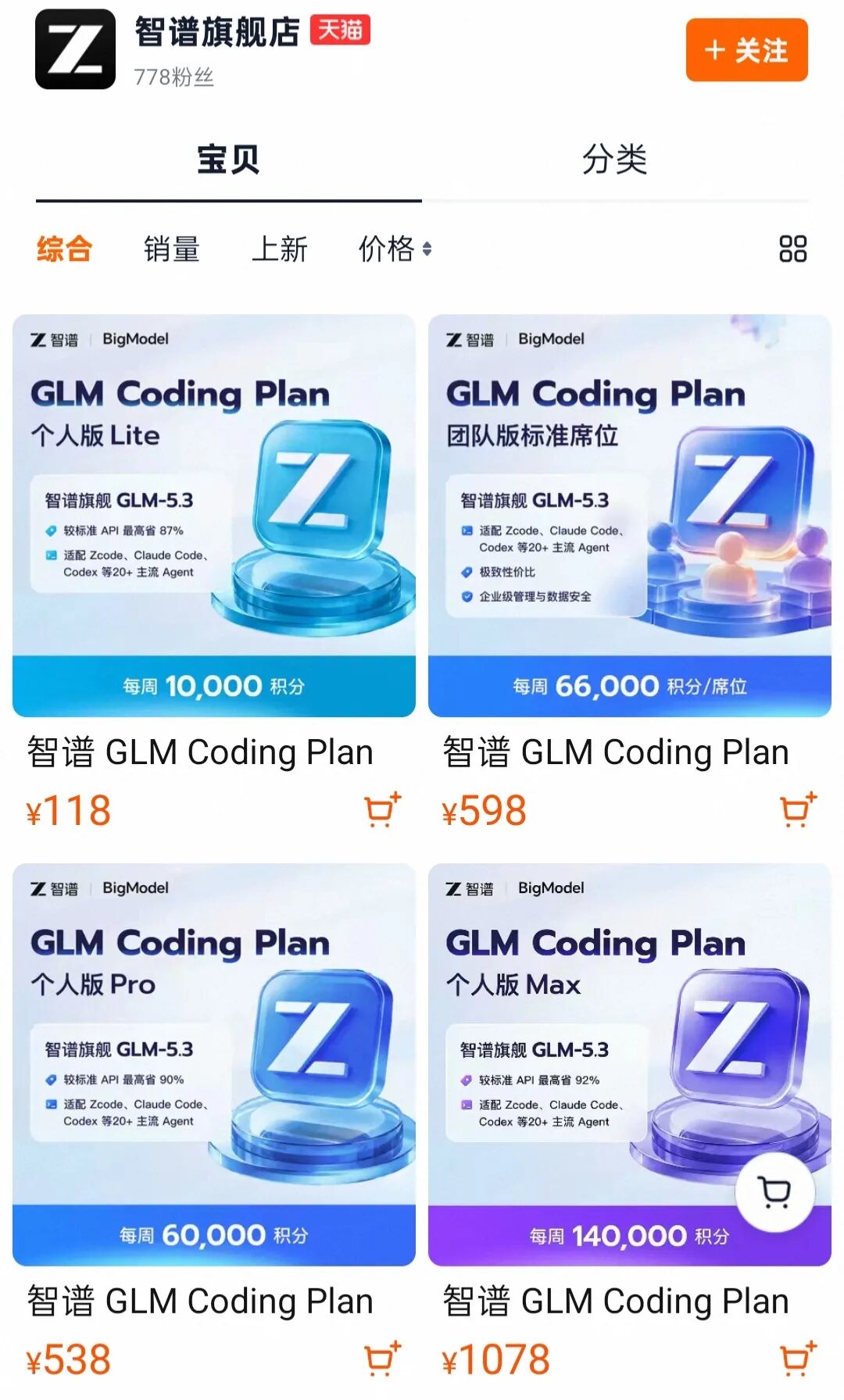
On September 2, Zhipu officially entered Tmall and opened an official flagship store, becoming the first large model manufacturer to appear on mainstream e-commerce platforms. What is listed in the store are not models, not API documentation, but four clearly priced subscription packages called "GLM Coding Plan": Personal version Lite at 118 yuan per month, Pro at 538 yuan per month, Max at 1078 yuan per month, and Team version standard seat at 598 yuan/month, supporting monthly, quarterly, and annual subscriptions, supporting Alipay, and issuing invoices.
An evaluation from a corporate engineer is quite to the point: "In the future, buying Tokens can be as smooth as recharging your mobile phone, and there might even be discounts during promotional events."
What is sold on the shelf
The packages are based on the GLM-5.3 model that was just released in August—this is Zhipu's latest flagship, scoring 60 points on the Artificial Analysis intelligence index, entering the global frontier model range, alongside Claude Fable 5 and GPT-5.6 Sol, and tied with Kimi K3 as the leading open-source model. It is compatible with more than 20 mainstream Agent tools such as ZCode, Claude Code, and Codex. After purchasing, you will receive a quota that can be casually used for code generation, debugging, and refactoring; any excess will be billed according to the standard API rate.
The model is indeed exactly like a mobile phone bill package: fixed monthly fee, bundled quota, and extra charges if exceeded. For high-frequency developers, locking in a monthly fee is cheaper than pay-per-use— the product page clearly states "saves up to 87% to 90% compared to standard API prices."
However, it is noteworthy that the pricing on Tmall has been significantly raised compared to the version at the beginning of the year: the monthly fees for Lite, Pro, and Max packages have increased from 49 yuan, 149 yuan, and 469 yuan to 118 yuan, 538 yuan, and 1078 yuan, respectively, with the most popular Pro tier becoming 3.6 times the original price. Zhipu explains this by saying that the new package has changed to a points system based on Token consumption, making the quota more transparent and predictable, with a 50% points discount during off-peak hours, and the model has been upgraded from GLM-5 to GLM-5.3.
Zhipu is not the only one raising prices. In the first half of this year, the Coding Plan market had just completed a price war, with Tencent, MiniMax, and Kimi successively taking down their monthly packages, and Alibaba shutting down entry-level positions, as the entire industry shifted from "low-price competition" to "streamlining and raising prices." Zhipu chose this timing to put the new package after the price increase on Tmall, supported by both model capabilities and survival pressure.
Why now
A glance at the financial report explains it all.
On the night of August 31, Zhipu released the mid-year report for 2026: the revenue for the first half of the year was 9.54 billion yuan, a year-on-year increase of 399.7%, exceeding the total revenue for last year; however, it suffered a net loss of 2.07 billion yuan. As the "world's first large model stock" that landed on the Hong Kong Stock Exchange in January this year, its stock price once surged from an issue price of 116.2 Hong Kong dollars to 2980 Hong Kong dollars, with a market value exceeding 1 trillion, before undergoing a significant adjustment, and the market value evaporating by over 500 billion Hong Kong dollars.
The growth engine has shifted gears: the revenue from the open platform and API in the first half of the year was 8.25 billion yuan, a year-on-year surge of 2735.7%, with its proportion of total revenue soaring from 15.2% in the same period last year to 86.5%. In other words, Zhipu has transformed from a traditional software company selling projects and customizations into a Token retailer selling usage volume. Chairman Liu Debing defined the key term for the first half of the year as "ability realization"—for the first time, the model was proven capable of independently completing tasks, leading to a shift in the revenue structure.
The backdrop is the explosion of the entire Token economy: the daily consumption of Tokens in China has already surpassed 140 trillion, increasing over 1000 times from 100 billion at the beginning of 2024. In May of this year, the three major operators collectively launched Token packages, Alibaba established the AlibabaTokenHub business group, and Tencent Cloud upgraded the comprehensive TokenHub—“selling Tokens” has become the busiest business in the AI industry chain. Zhipu entering Tmall is essentially about occupying the cash register closest to ordinary users in this retail war.
Concerns and solutions of subscription packages
However, the historical lessons left by mobile phone plans remain: there can be many tiers, but don't rely on guessing for the bill.
Some observers have already pointed out: the "10,000 points" number on the product page is very eye-catching, but what ordinary users really want to know is—are these points enough for me to write how much code, or run how many tasks? The usage of large models is much harder to perceive than mobile data; some people use it daily for work and feel it is worth it, while others only realize they are still subscribed when they open the bill the next month. The biggest enemy of the subscription system has never been price; it is silent renewals.
Fortunately, e-commerce shelves themselves are the best forcing mechanism. When Tokens transition from professional concepts in developer documentation to Taobao products, they must accept the rules of the retail world: a seven-day no-reason return policy, discount wars during Double 11, open evaluations and reviews in the buyer's showcase. Whichever package explanation reads like a script, or has inflated quotas will be corrected by the comment section; as competition moves further into retail, billing transparency and user experience will be harder to gloss over—this is a good thing for consumers.
Conclusion: Tokens are becoming like utilities
From self-service purchases on the official website, to operator packages, and now to Tmall flagship stores, the sales path of Tokens is replicating the popularization route of all digital products. The symbolic significance of Zhipu's step is far greater than the sales figures on opening day—as of the time of publication, the four products have not yet shown any sales.
But the direction is already clear: the capabilities of large models are changing from "technical products" to "daily consumables." Just as no one cares about which power plant generates the electricity, but rather how much the electricity costs per kilowatt and how convenient it is to recharge; in the future, most people will not care which model is behind it, only how much the monthly AI subscription fee is and whether it is worth it.
Next up, we can look forward to the Token discounts during Double 11.
免责声明:本文章仅代表作者个人观点,不代表本平台的立场和观点。本文章仅供信息分享,不构成对任何人的任何投资建议。用户与作者之间的任何争议,与本平台无关。如网页中刊载的文章或图片涉及侵权,请提供相关的权利证明和身份证明发送邮件到support@aicoin.com,本平台相关工作人员将会进行核查。


