Executive Summary
Dell Technologies Inc. (DELL) latest financial report makes it nearly impossible to find anything to criticize. The second quarter of fiscal year 2027 was, objectively speaking, an outstanding quarter.
In my previous article, I took a more conservative stance. At that time, the stock price had already risen significantly, and most importantly, I was still asking myself one question: Is Dell now just very good at selling a large number of AI servers, or is it itself also becoming a better company? These are not the same thing. If a large increase in sales revenue ultimately only flows to costly components that Dell cannot control, then this revenue growth itself will not create much value.
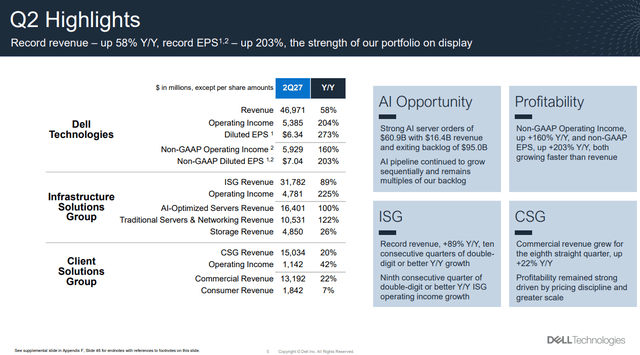
The second quarter of fiscal year 2027 essentially provided me with all the answers I needed. Dell announced record revenue, reaching $47 billion, a 58% year-over-year increase; non-GAAP diluted EPS also hit a record of $7.04, a 203% year-over-year increase. Dell also announced that AI server orders in this quarter reached $60.9 billion, with a backlog of AI server orders totaling $95 billion. However, the most important number for me is actually the ISG operating margin, which reached 15%, an increase of approximately 6.2 percentage points from a year ago's 8.8% operating margin. This means the company is not just selling more products, but it is genuinely making more money from those products.
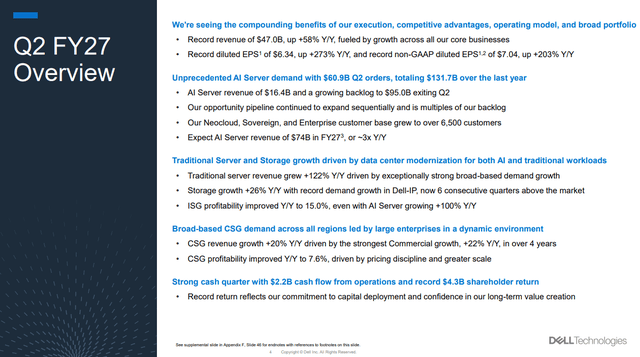
[Original image location: Dell Fiscal Year 2027 Second Quarter Earnings Summary (Company Presentation)]
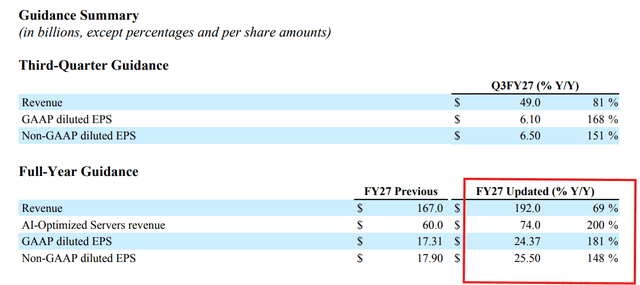
Dell has also raised its revenue forecast for fiscal year 2027 from $167 billion to $192 billion, while significantly increasing the non-GAAP EPS guidance from $17.90 to $25.50.
[Original image location: Dell Fiscal Year 2027 Revenue and EPS Guidance Increase (Company Presentation)]
The stock price reacted positively, closing around $425 during regular trading hours and rising about 8% in after-hours trading to around $459.
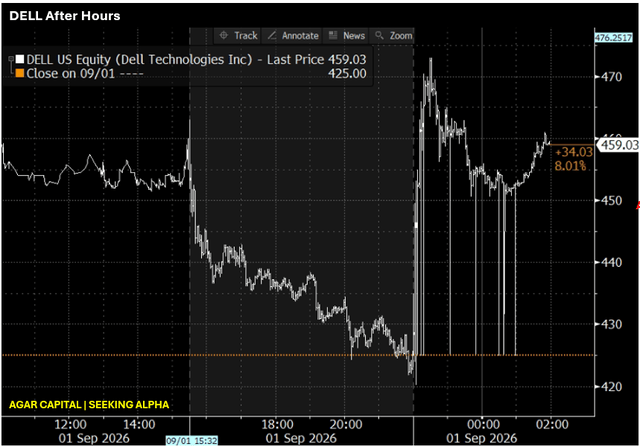
[Original image location: Dell Stock Performance After Earnings Report (Agar Capital, Bloomberg Terminal)]
For these reasons and other factors that will be discussed later, I am upgrading Dell's rating from "Hold" to "Buy." I did not upgrade it directly to "Strong Buy," as I do not want to chase high prices at the current level, especially since the company still faces issues with valuation, cash conversion, and supply chain, which prevent me from completely disregarding risks. However, even so, it is difficult to justify maintaining a "Hold" rating today.
Previous Analysis: Waiting Is Reasonable
I first analyzed Dell in November 2025. At that time, Dell's stock price was about $139 per share, and I gave it a "Strong Buy" rating, with a long-term price target of $180. According to my research, the core reason for giving a "Strong Buy" back then was that the market had not fully reflected the massive potential boost that AI server sales growth could bring to Dell's revenue and future earnings. After I gave the "Strong Buy" rating, Dell's stock price ultimately increased threefold.
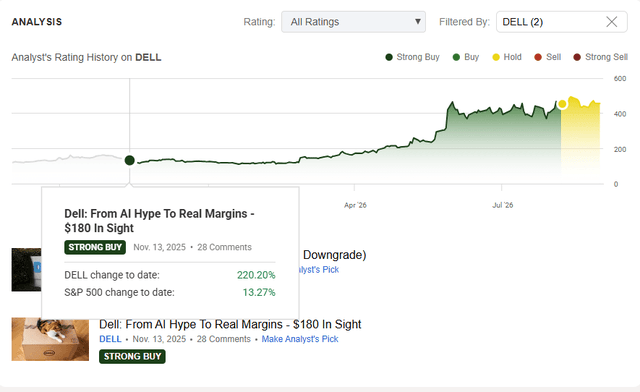
[Original image location: Dell Author Historical Ratings (Seeking Alpha)]
By August of this year, Dell's stock price had reached $453.77, and that was when I adjusted my rating on Dell to "Hold." I remained very optimistic about Dell's business model, but I no longer believed that at the time's valuation, the stock still had enough upside to support continuing to build a bullish position. Since I downgraded Dell to "Hold," although the stock price briefly exceeded the price at which I downgraded the rating, it ultimately fell back to $425 before the release of this quarterly earnings report. I think this is very important because it allowed me to patiently wait for the previously missing evidence without having to chase market narratives.
A Quarterly Financial Report That is Almost Flawless
Let's take a more detailed look at the financial data from the latest quarterly report. As I mentioned earlier, the company's revenue grew 58% year-over-year to $47 billion. The ISG, which is the infrastructure business, saw revenue grow 89% year-over-year to $31.8 billion.
[Original image location: Dell Fiscal Year 2027 Second Quarter Revenue Growth (Company Presentation)]
AI server revenue grew 100% year-over-year to $16.4 billion. Traditional servers and networking business revenue grew 122% to $10.5 billion. Storage business revenue grew 26% to $4.9 billion, and I believe the storage business is especially important because it helps enhance the economic quality of the overall revenue structure. CSG, which consists mainly of PC client solutions, also grew revenue by 20%. In short, there is not just one growth engine running; almost the entire product portfolio is accelerating.
[Original image location: Dell Revenue Growth by Business (Agar Capital, Bloomberg Terminal)]
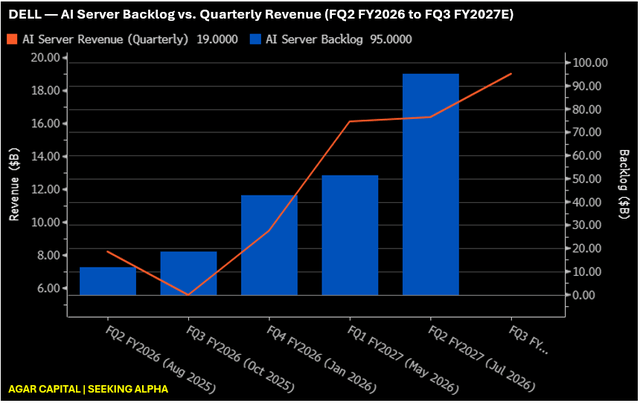
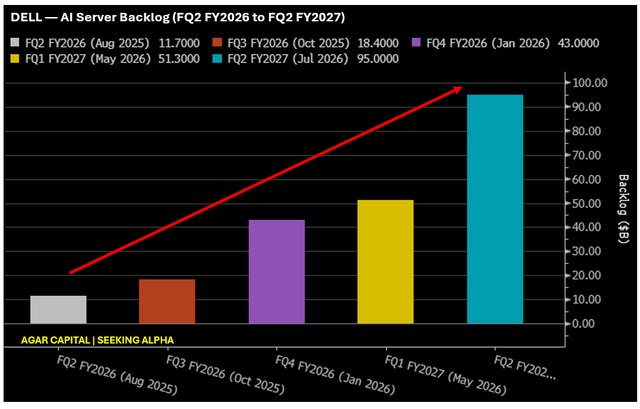
Another extremely important piece of data that Dell disclosed is the orders. In a single quarter, Dell added AI orders totaling $60.9 billion, while the accumulated AI orders over the past 12 months have exceeded $130 billion. This increased the company's backlog from $51.3 billion in the previous quarter to $95 billion. Dell expects third-quarter AI server revenue of about $19 billion. If we do a very rough calculation, the current backlog of $95 billion roughly corresponds to a revenue run rate of about five quarters. Of course, we cannot simply interpret the backlog as completely guaranteed revenue over the next five quarters, but having such a large order reserve clearly provides greater revenue visibility than in the past year.
Dell's guidance also significantly alleviated market concerns about whether this is merely a one-quarter anomaly. Specifically, the company expects third-quarter revenue to reach $49 billion, with adjusted EPS of $6.50. Additionally, for the entire fiscal year ending January 29, 2027, the company expects total revenue to reach $192 billion, AI server revenue to reach $74 billion, and adjusted EPS to reach $25.50.
Three Factors That Changed My Perspective
The first factor that truly changed my view of DELL is its backlog. DELL currently has a backlog of $95 billion. Once the backlog reaches this scale, the debate over "Is AI demand really real?" can basically come to an end.
[Original image location: Dell AI Server Backlog (Agar Capital, Bloomberg Terminal)]
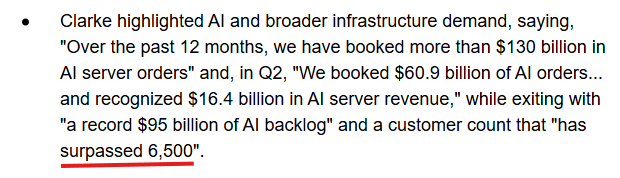
The next question became: How quickly can Dell actually deliver these devices that have already been sold through its Dell AI Factory? Notably, the current backlog is even smaller than the company's potential sales pipeline, which continues to grow. The number of customers using Dell AI Factory solutions has now exceeded 6,500, which is an extremely large number.
[Original image location: Number of Dell AI Factory Customers (Seeking Alpha)]
Therefore, this story is no longer limited to the three giant cloud service providers: Microsoft, Google, and Amazon. Dell's customers also include NeoCloud, government entities, and a large number of enterprise clients. Thus, the company's customer base is becoming more diversified, which is a positive change, because the more customers the company serves, the lower the concentration risk usually is.
However, the most important factor that made me view this stock in a completely different way is the profit margins. A few months ago, my question was: Is Dell merely very good at selling AI servers, or can it maintain high profit margins on those servers? This question has now been answered. The non-GAAP operating margin rose from 7.7% to 12.6%, while the ISG operating margin improved from 8.8% to 15%, with ISG operating income growing 225% year-over-year. The key point here is that Dell's profit growth rate far exceeds its revenue growth rate, which is exactly what I have been hoping to see.
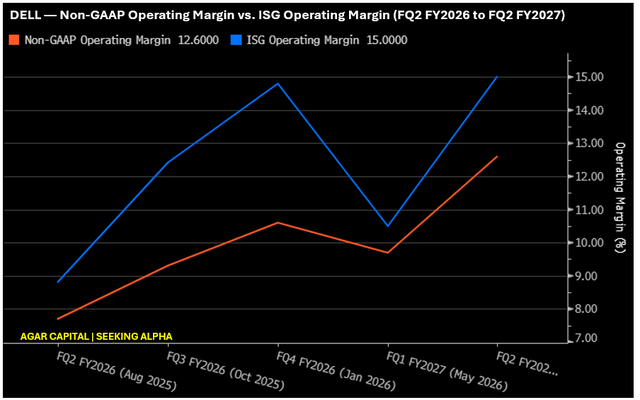
[Original image location: Dell Operating Margins and ISG Profit Growth (Agar Capital, Bloomberg Terminal)]
In my view, another very important piece of data is that Dell is gaining market share in the traditional server market. Over the past two quarters, the company's market share in traditional server business has cumulatively increased by over 10 percentage points.
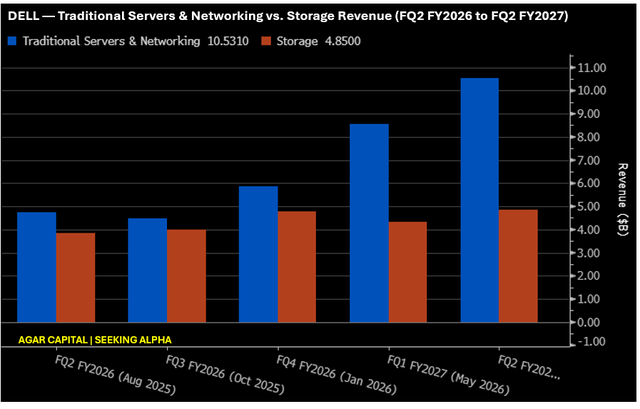
[Original image location: Dell Traditional Server Market Share Changes (Agar Capital, Bloomberg Terminal)]
What Still Has Not Fully Convicted Me?
The overall performance is almost perfect, but there are still some issues that prevent me from feeling confident enough to directly upgrade the rating from "Hold" to "Strong Buy."
Cash Flow
Operating cash flow in the second quarter decreased to $2.2 billion. Free cash flow dropped to $986 million, compared to $1.87 billion for the second quarter of fiscal year 2026. In addition, the company disclosed that the adjusted free cash flow (AFCF) for this quarter reached $8.15 billion. While AFCF can indeed explain some of the differences in the free cash flow metric, the gap between these two metrics is so large that it still makes me wish to continue tracking both in the future.
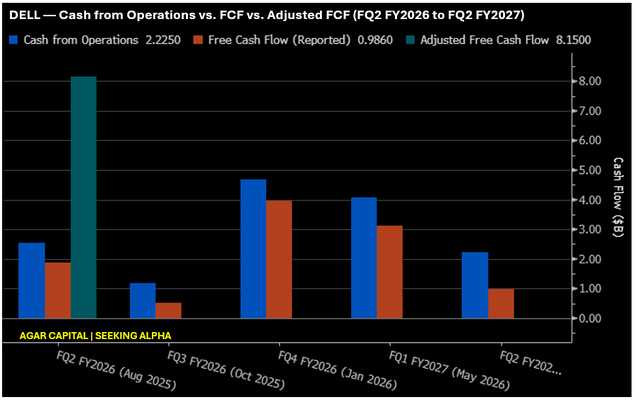
[Original image location: Dell Operating Cash Flow and Free Cash Flow (Agar Capital, Bloomberg Terminal)]
Working Capital
As mentioned earlier, to support this growth rate, Dell needs to invest a significant amount of capital. Since the beginning of this fiscal year, the company’s inventory levels have more than doubled, and accounts receivable have increased by about 30%. Given that Dell has experienced such rapid growth during this period, the increase in working capital makes sense, but it also means that a considerable portion of the revenue growth has not yet truly converted into cash.
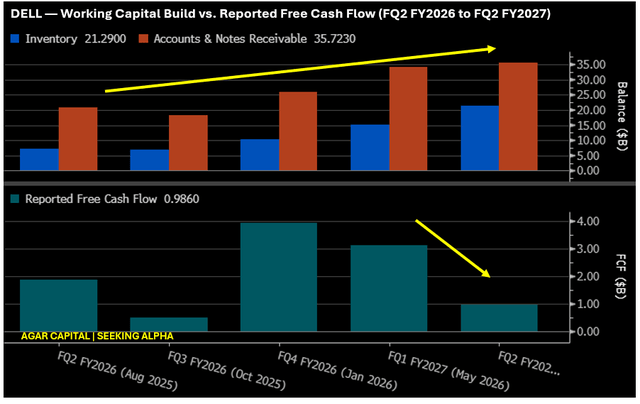
[Original image location: Dell Working Capital Changes (Agar Capital, Bloomberg Terminal)]
Supply Chain
Management has indicated to investors that the company is currently facing some supply chain constraints regarding memory, CPUs, hard drives, and various other components. On the surface, high demand and tight supply may sound like a "happy problem," but ultimately, it remains a logistics and execution issue. A backlog of $95 billion is certainly impressive, but the ultimate value hinges on the company’s ability to convert those orders into actual delivered products, and further into revenue and cash.
Valuation
In my previous article, I used an adjusted EPS forecast of about $22.20 for FY28, applying an 18 times earnings multiple. Based on those numbers, I believe Dell's fair value is around $400. Even back then, I thought an 18 times multiple was already a relatively generous valuation for Dell. However, after this quarterly performance and the subsequent raised FY27 guidance, this earnings forecast now seems clearly overly conservative. Dell currently expects FY27 adjusted EPS to reach $25.50, which is even higher than my previous forecast of $22.20 for FY28.
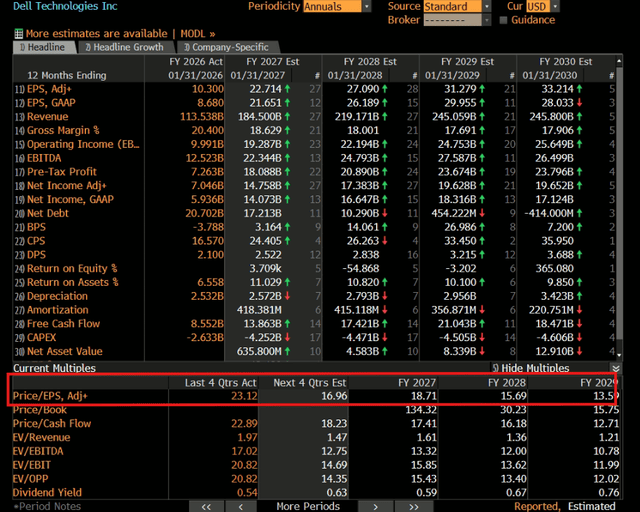
[Original image location: Dell EPS Expectations Changes (Agar Capital, Bloomberg Terminal)]
At an after-hours price of about $459, Dell's current valuation corresponds to approximately 18 times the latest FY27 EPS guidance of $25.50. This is not cheap for a hardware company. However, the reasons I am willing to pay an 18 times valuation today differ entirely from a few months ago: the company is achieving extremely high revenue growth, has a backlog of $95 billion in AI server orders, profit margins are increasing, and earnings growth rates have surpassed revenue growth rates.
Therefore, I believe it is reasonable to revise the target valuation multiple upward. My latest target price is $550, which corresponds to about 21.6 times FY27 EPS of $25.50. Compared to the after-hours stock price of about $459, this indicates about 20% upside potential.
This is indeed a significant revaluation compared to the 18 times multiple I was previously using, so I do not believe $550 is a conservative target. Dell still needs to prove that it can truly convert the backlog into revenue, maintain operational leverage, and continue to achieve earnings growth, rather than just experiencing a one-time performance surge. However, since the backlog has significantly enhanced future revenue visibility, I believe this higher valuation multiple is more easily supported today than in the past.
Core Conclusion
As I mentioned earlier, my previous article rated Dell as "Hold," which fundamentally relied on a very simple question: Can Dell truly convert the potential profitability opportunities brought by AI into actual profits? At least so far, the answer given by the company's latest quarterly earnings report is very clear: yes.
Moreover, Dell's AI backlog has reached $95 billion, with new orders in a single quarter totaling $60.9 billion, the ISG operating margin has improved to 15%, and storage and traditional server businesses continue to show strong growth, while FY27 EPS expectations have risen from $17.90 to $25.50. Increasing evidence suggests that Dell may be proving that AI can have a truly positive economic impact across its entire product portfolio, and not just generate additional revenue.
That said, Dell still faces several significant risks, including cash conversion and working capital issues, supply chain disruptions, and a valuation level that leaves little room for execution missteps. This is also why I did not assign a "Strong Buy" rating again. However, there has been enough significant change in the data, so I am upgrading Dell's rating from "Hold" to "Buy."
免责声明:本文章仅代表作者个人观点,不代表本平台的立场和观点。本文章仅供信息分享,不构成对任何人的任何投资建议。用户与作者之间的任何争议,与本平台无关。如网页中刊载的文章或图片涉及侵权,请提供相关的权利证明和身份证明发送邮件到support@aicoin.com,本平台相关工作人员将会进行核查。


