“Crypto-stock pairing” is just the beginning.
We might be standing on the eve of a grand bull market.
If the bull market really comes, one of the clearest main lines is likely to be:
Moving as many real-world assets onto the blockchain as possible, and then creating previously unimaginable new ways to play on top of those assets.
1/ The old question: Why buy stocks on the blockchain?
Traditional stocks trade just fine on NASDAQ, with regulation, liquidity, and dividends.
Why would users want to rush to the blockchain to buy?
In the past, tokenized stocks on the blockchain often had neither real ownership nor good liquidity, resembling a “shrunken version,” making no one willing to touch them.
Until two completely different routes emerged.
Route one: CEX products driven by demand
Represented by @MEXC, CEX follows a “demand-driven” approach.
What users want, it breaks down their needs and creates corresponding products.
▌RealStocks
For those who want company ownership and dividends, they can directly buy and hold real shares of over 7,000 global stocks and ETFs starting from just 5 USDT.
The underlying assets are custodied by licensed brokers partnered with MEXC.
▌Stock Futures
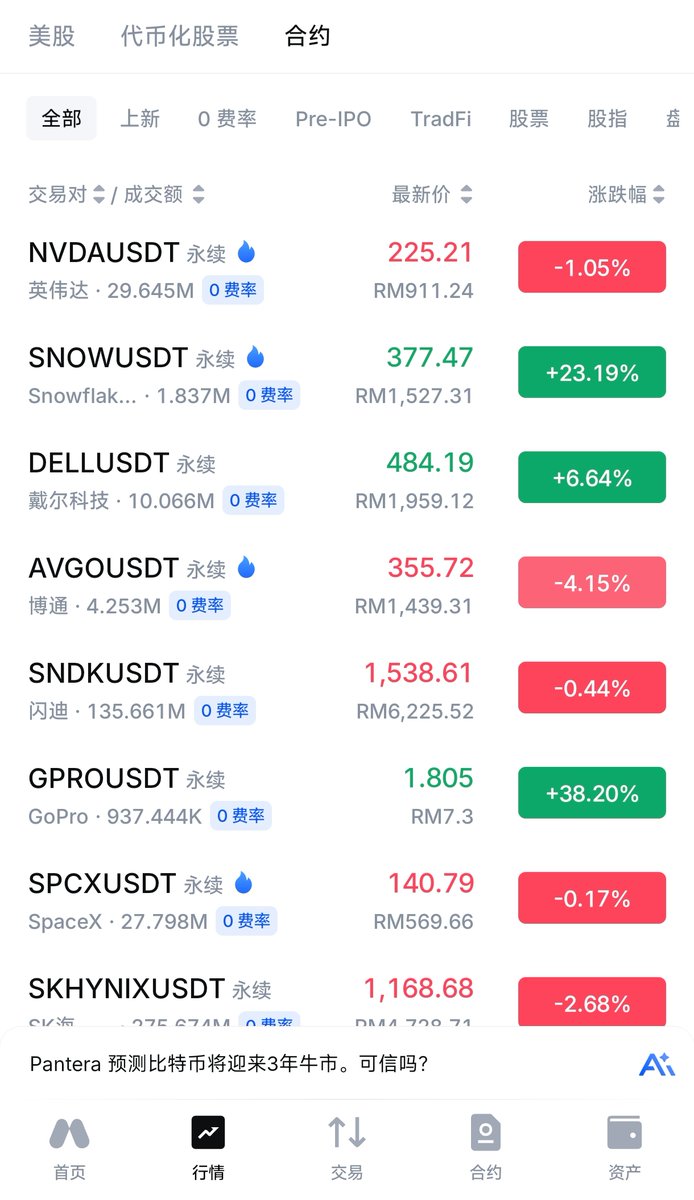
For those looking for leverage, to capture event-driven market fluctuations, or to hedge, they can trade over 300 types of stock futures including U.S., Hong Kong, Korean, and Japanese stocks.
▌Tokenized Stock
For those who merely want exposure to price fluctuations, they can trade over 200 types of tokenized stocks directly with USDT, generally close to 24/7, unaffected by the opening and closing times of U.S. stocks.
The essence is breaking down the ownership, leverage, and price fluctuations of traditional stocks into different needs, all packaged within the interface for crypto users.
Users can smoothly transition from trading crypto to trading stocks without leaving the CEX, even holding real company shares.
Route two: Creating demand on-chain with Meme
The pairing of on-chain meme coins and stock tokens follows a completely different route.
It does not aim to satisfy existing demands, but rather creates new ones.
The mechanism is very simple.
When everyone trades meme coins, the transaction fees generated no longer go to the platform or project parties, but transform into stock tokens, locked in the community treasury.
The more active the meme trading, the more stock tokens are accumulated in the treasury, ultimately belonging to the entire community.
Thus, the distinction between the two is clear.
CEX is: What you want, I provide.
Meme coin-stock pairing is: No one uses tokenized stocks? Then I will leverage the popularity, gameplay, and hype of memes to attract people and also bring liquidity to stock tokens.
These two routes are not oppositional, but complementary.
2/ How else can on-chain stocks be played?
With stock assets in hand, what new play can be layered on top?
Currently, there are two very insightful concepts.
@XenBH's conditional market concept: not only knowing “will it happen,” but also “how significant is the impact”
Prediction markets usually only provide a probability.
For example, “Will the U.S. allow Nvidia to sell advanced AI chips to China?”
The prediction market says: there’s a 30% chance it will be allowed.
But for investors, just knowing the probability is not enough. They care more about:
If this happens, what will happen to Nvidia's stock price?
If it doesn't happen, what will happen then?
The conditional market is designed to answer this question:
If allowed (Yes) → Nvidia's stock price may reach $260
If not allowed (No) → Nvidia's stock price may reach $203
Thus, the market no longer only says “will it happen,” but directly tells you what happening or not happening means.
Narrative tokens: turning one stock into a story tree
@lmrankhan's concept suggests not to squeeze all expectations into one stock token, but to turn each trending story that the company can evoke into an independent tradable market.
For example, SpaceX.
The underlying can have one stock token representing the overall value.
But around SpaceX, there are always various hot topics: the Mars plan, Starship launch, asteroid mining…
In this way, each narrative token becomes the market for that specific story.
All the expectations that would originally be carried by one stock have been broken down into a complete story tree.
Narrative tokens can have expiration dates. At expiration, holders have two choices.
Choice one: Redeem.
Destroy the narrative token and proportionally withdraw underlying stock tokens from the treasury.
Choice two: Roll into the next narrative.
Instead of redeeming and exiting, roll your rights into the next hot topic narrative of this company, gaining priority to participate in the new market.
3/ Conclusion: This door has just been pushed open
CEX is focused on productizing and systematizing traditional stocks to serve existing traders.
The blockchain is about maximizing crypto-native gameplay and composability to attract completely new users.
The two roads are destined to coexist in the long run and will learn from each other.
Conditional markets, narrative tokens, and many more yet-to-be-thought-of ways will all be built upon these attempts.
#MEXC0808

免责声明:本文章仅代表作者个人观点,不代表本平台的立场和观点。本文章仅供信息分享,不构成对任何人的任何投资建议。用户与作者之间的任何争议,与本平台无关。如网页中刊载的文章或图片涉及侵权,请提供相关的权利证明和身份证明发送邮件到support@aicoin.com,本平台相关工作人员将会进行核查。


