CoinW Research Institute
Recently, the most notable change on the Robinhood Chain is that Memes have started to directly form trading pools with stock tokens, that is, Meme play. For instance, AI/NVDA, BONER/HIMS, and SPACEHOOD/SPCX pair the Meme with stock tokens of Nvidia, HIMS Health, and SpaceX, respectively. Users can still place orders using ETH or stablecoins, and the trading tool will first convert to stock tokens when the price is more favorable before entering the coin-stock trading pool. As a result, Meme gains popularity, and the stock tokens gain inventory in the trading pool, fee treasury, and more on-chain uses. This new play also accelerates the entry of issuance, market making, and lending tools into the Robinhood Chain.
This wave of enthusiasm has led to increased trading along the entire chain. Currently, DeFiLlama data shows that the Robinhood Chain has locked assets of approximately $735 million, stablecoins scale of about $797 million, and 24-hour DEX transactions of approximately $1.572 billion, with transaction volume in the past week increasing by about 89.5% compared to the previous week. At present, the circulating market value of PONS is approximately $311 million, pure Meme represented by CASHCAT is about $270 million, and coin-stock Meme represented by AI is approximately $293 million. Among them, Pons generated about $4.22 million in fees in the past 24 hours; the AI/NVDA main pool has only about $6.3 million in liquidity but carries about $31.2 million in daily transactions. The high trading volume, high valuation, and shallow liquidity occurring simultaneously explain why the market has rapidly heated up and indicate that prices can be easily affected by a small amount of marginal funds.
What are the main plays on the Robinhood Chain now
Coin-stock Meme led by Long.xyz
Long.xyz is one of the leading platforms for issuing coin-stock pairs on the Robinhood Chain, operated by an independent team. The creator first selects a Robinhood stock token as the pricing and pairing asset, then establishes a trading pool of Meme with that stock token, resulting in combinations like AI/NVDA and BONER/HIMS. When users buy using stablecoins or ETH, the smart routing will only adopt the two-step conversion of stablecoin or ETH—stock token—Meme when the ultimate amount received is greater. The platform's so-called liquidity lock mainly restricts the project side from withdrawing the entire trading pool; the stock tokens in the pool will still flow in and out with buying and selling and will not automatically become assets redeemable by Meme holders. Dune data shows that currently, Long.xyz has a daily trading volume exceeding $22.2 million, accounting for about 72.1% of the day's trading volume on related launch platforms, and is about 2.6 times the total trading volume of other launch platforms. Subsequently, platforms such as Bankr and Pons have also begun to support similar combinations, and coin-stock Meme has gradually become a new favorite in the market.
Pons and leading tokens capture main traffic
Pons is a comprehensive Meme launch platform, covering a broader range than coin-stock pairing. The platform combines the creation of tokens, initiation of trading, and organization of liquidity into one, and the current mechanism uses about 80% of the protocol fee revenue for repurchasing and burning PONS, while the remainder is used for infrastructure and team operations. Defillama data shows that the current market value of PONS is about $311 million, the platform's 24-hour trading volume is about $93.8 million, and daily fees are about $4.22 million, making it one of the main traffic entrances to the Robinhood Chain. However, this $4.22 million is not all owned by Pons; most of it will be allocated to token creators, leading to an actual revenue of about $840,000, which only accounts for about 20% of the total fees, significantly lower than the total fee amount. Currently, about 80% of Pons’ protocol revenue is used for repurchasing and burning PONS, with the rest for infrastructure and team operations. Meanwhile, CASHCAT forms a pure Meme narrative due to Robinhood's early brand name, and AI has become a coin-stock Meme representative through the Nvidia theme. The current market value of both has reached parity with PONS. The three represent the platform token, pure Meme, and coin-stock Meme, indicating that current funds are still gathering around issuance and short-term trading.
Market making lending and treasury continue to extend plays
As trading heats up, stock tokens are also placed into liquidity positions, automated market making treasury, and early lending markets. Users can deposit stock tokens alongside USDG into the trading pool, bearing the price fluctuations of both assets while sharing trading fees; the treasury attempts to automatically adjust positions to reduce frequent operations by ordinary users. Official Robinhood explanations show that these stock tokens adopt a universal format, allowing for trading, lending, and other applications; they are issued by Robinhood's Jersey subsidiary and belong to tokenized debt securities that provide corresponding stock or ETF economic exposure, with holders having no shareholder rights in the underlying companies. Morpho has already emerged as a market for collateralizing stock tokens, Vynex attempts to package market making positions into transferable shares, and LongX is still testing leveraged stock tokens. However, at this stage, the segments that truly achieve scale are still issuance and trading, while lending, treasury, and multi-layer combinations are in the early experimental stages.
Where is the innovation in coin-stock Meme
Meme presents a new narrative combining crypto and US stocks
Traditional Memes often use ETH or stablecoins for pricing, while coin-stock Meme replaces one side of the trading pool with stock tokens. Users can still place orders using ETH or USDG stablecoins in the aggregated trading tool; when the stock pairing pool offers better prices and depth, the system will first exchange for NVDA, HIMS, or SPCX stock tokens in the same on-chain transaction, then use stock tokens to buy Meme. When selling, the path runs in reverse, with users not strongly perceiving the intermediary steps, while stock tokens have already undertaken the bridging, pricing, and settlement functions, but the specific path may change with quotations, and some orders may also directly pass through the stablecoin or ETH trading pool.
Meme enthusiasm drives trading of stock tokenization
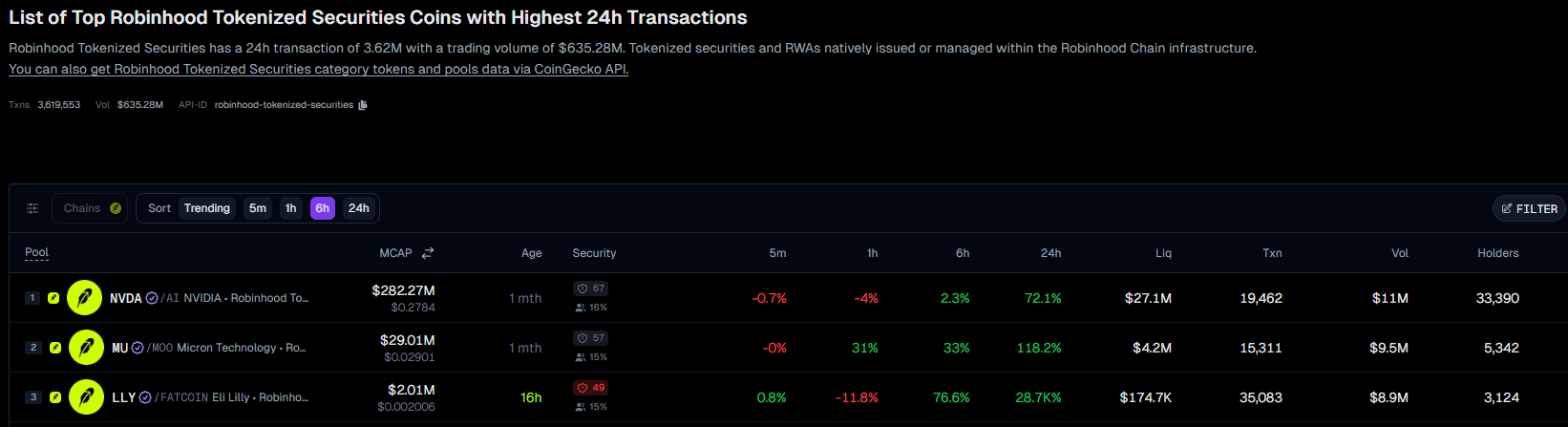
After stock tokens went on-chain, the core issue faced early on was not whether they could be issued but rather that the on-chain circulation supply and trading depth were still insufficient, meaning users may not actively enter stock token trading pools. Recently, the new narrative of Meme on the Robinhood Chain has changed this, with some Meme issuance platforms beginning to treat stock tokens as pricing assets. When users buy Meme, the trading path will pass through pools of stock tokens such as NVDA, MU, LLY, thus channeling speculative flows into stock token trading. According to the latest dynamic data from GeckoTerminal, the 24-hour trading volume of the Robinhood Tokenized Securities category is about $635 million, with approximately 3.626 million transactions; during the same period, the entire Robinhood Chain had a 24-hour trading volume of about $2.36 billion, with about 10.38 million transactions. By the same data source measure, the stock token-related pools account for about 26.9% of the DEX transaction volume on the entire Robinhood chain.
Coin-stock Meme has the potential to open more imaginative space
In the coin-stock Meme model, the innovation of stock tokens is not only reflected in the trading paths but also starts to enter the underlying asset structure of DeFi. For example, with pairing like NVDA/AI, MU/MOO, LLY/FATCOIN, when project parties or LPs establish trading pools, they need to provide both Meme tokens and corresponding stock tokens simultaneously, thus integrating stock tokens into LP positions, becoming both the pool bottom assets and liquidity inventory in the trading pool; if the project parties further lock LPs, it is not the price of stock tokens that gets locked but the project's authority to withdraw the entire liquidity pool. More importantly, in projects that introduce stock token fees and treasury mechanisms like AI, the more active the trading, the more likely some fees will continue to settle as stock token reserves. If project parties or community treasuries hold LP positions, they will also indirectly hold exposure to corresponding stock tokens; if these assets further enter lending, yield treasuries, and collateral markets, stock tokens may expand from being intermediate assets in trading to LP constituent assets, treasury reserves, and DeFi collateral. Thus, Meme opens up not just the liquidity but the possibility of establishing sustained on-chain asset purposes for stock tokens.
Is the trading loop of coin-stock Meme established
How a coin-stock trade is completed
Taking AI/NVDA as an example, the main trading pool for AI directly uses Nvidia stock token NVDA as the other side of the asset. If a user holds USDG or ETH and buys AI through an aggregated trading tool, when the AI/NVDA pool offers a better final price, the trading tool will first convert the funds to NVDA, then use NVDA to buy AI; when selling, it is completed in the opposite direction. In this way, a transaction seemingly just buying and selling Meme will actually change the quantity of NVDA and AI in the pool. Currently, the AI/NVDA main pool has about 11,200 NVDA and 13.36 million AI, with a pool liquidity of about $6.3 million, indicating that stock tokens have directly become inventory for this kind of Meme trading.
AI has also designed a stock reserve mechanism outside the trading pool. According to the project's official rules, creator fees generated from buying AI are collected in NVDA, with 80% entering the community treasury; fees generated from selling are collected in AI, with half burned and half permanently locked. Currently, the community treasury holds about 762.6 NVDA, worth about $168,000, and also holds small quantities of stock tokens from MSFT, TSM, AMD, ASML, and others. It is essential to distinguish between two types of assets: NVDA in the trading pool flows in and out with trades, while NVDA entering the community treasury forms a relatively stable asset reserve.
Leading trading pairs capture the majority of trades
From the current trading situation, coin-stock Meme has already formed real trades, but the trading is clearly concentrated in a few popular trading pairs. The AI/NVDA main pool has a 24-hour trading volume of about $31.2 million and liquidity of about $6.3 million; MOO/MU has about $9.5 million in trades and liquidity of about $1.6 million; FATCOIN/LLY has about $8.9 million in trades but only about $176,000 in liquidity. Especially FATCOIN/LLY, its trading volume far exceeds the pool's liquidity, indicating that some coin-stock Meme currently still show characteristics of high turnover and shallow liquidity, and a small amount of marginal funds can cause substantial price fluctuations. Therefore, to determine whether the market is truly mature, one must not only look at trading volume and estimate market value but also simultaneously observe the liquidity in the pool, independent traders, and stock token inventories.
Source:https://www.geckoterminal.com/category/robinhood-tokenized-securities
Time lag in trading amplifies price deviation
Another more practical issue arises from the unsynchronized trading times. Stock tokens can circulate on-chain all day, but ordinary users cannot independently increase the supply of stock tokens, new supplies have to be completed by institutions authorized to participate in the primary market. This means that after the US stock market closes, Memes can still be traded, but if a large number of buy orders simultaneously require a particular stock token and the existing on-chain inventory is limited, the new supply may not keep pace, which could cause the stock token itself to temporarily detach from the original stock price.
BONER/HIMS has already encountered this situation, as BONER continued to trade and absorbed a large amount of HIMS stock tokens while HIMS's underlying stock had already closed. The trading on-chain remained active, and the limited inventory drove its on-chain price to rise to $132.64, while the previous closing price for Hims & Hers's underlying stock was only $28.84. When new HIMS stock tokens entered the chain the following Monday, the price returned to around $30. This case more accurately illustrates that the part of the on-chain stock token market that can be significantly influenced by Meme funds is still smaller than the real US stock market. At the same time, the latest financial report from Hims & Hers indicates that the actual circulating Class A and Class V shares together exceed 233 million, while on-chain there were only tens of thousands of HIMS, showing a significant scale disparity. Thus, the market's claim that coin-stock Meme pressures Wall Street is currently more an imagination of future transmission mechanisms; what needs to be observed is whether sustained Meme buying ultimately forces an increase in stock token supply and further forms actual new demand for the underlying stocks.
Conclusion
The core change of coin-stock Meme is integrating stock tokens, originally mainly used for price mapping and holding, further into the issuance, trading, and liquidity structure of Meme. Stock tokens begin to take on roles such as trading pool inventory, LP constituent assets, and fee treasury reserves, while Meme provides stock tokens with high-frequency trading and promotional traffic that traditional RWA products find difficult to obtain. Cases represented by AI/NVDA have already proven that this combination is not just a conceptual level; Meme trading can truly change the inventory of stock token pools and, through the fee mechanism, settle a part of stock tokens into community treasuries.
However, based on the current data, coin-stock Meme is still at a stage where trading activity leads asset accumulation. Transactions related to stock tokens on the Robinhood Chain have formed a considerable scale, with leading trading pairs such as AI/NVDA, MOO/MU, and FATCOIN/LLY reaching trading volumes in the tens of millions of dollars daily, while some pools have liquidity only a small fraction of the trading volume, showing characteristics of high turnover, shallow liquidity, and concentration in leading tokens simultaneously. This means the current market can rapidly generate trading volume and valuation but cannot judge whether new funds of equal scale are entering stock tokens. To determine if this model can be sustained, it will be more important in the future to observe the net balances of stock tokens in trading pools and treasuries, the new issuance of stock tokens, independent trading users, and whether uses in lending and collateral can expand synchronously.
In the long term, what truly deserves attention in coin-stock Meme is whether on-chain demand can transmit to new stock token supplies and even underlying assets. The weekend trading situation of BONER/HIMS has shown that when the US stock market closes while on-chain trading continues, limited stock token inventory may show significant price deviations, but currently, the major pressure is still on the on-chain stock token market rather than the real stock market. Only when Meme continuously creates net buying demand, promotes more stock token issuance, and further settles stock tokens into LP, treasury reserves, and collateral, can this funding flywheel possibly shift from short-term trading narratives to more stable RWA demands. At this stage, coin-stock Meme has verified new trading scenarios, but it is still some distance from forming a complete closed loop that can sustainably impact traditional asset demand.
免责声明:本文章仅代表作者个人观点,不代表本平台的立场和观点。本文章仅供信息分享,不构成对任何人的任何投资建议。用户与作者之间的任何争议,与本平台无关。如网页中刊载的文章或图片涉及侵权,请提供相关的权利证明和身份证明发送邮件到support@aicoin.com,本平台相关工作人员将会进行核查。