——From tokenized stocks to on-chain application ecosystems, how Robinhood connects brokerages, the crypto market, and RWA
Author: AiPlot Research Institute
Positioning: RWA / In-depth analysis of digital asset markets
If Robinhood's recent moves are only understood as “launching a Layer 2 and listing some stock tokens,” it underestimates what the company truly aims to achieve.
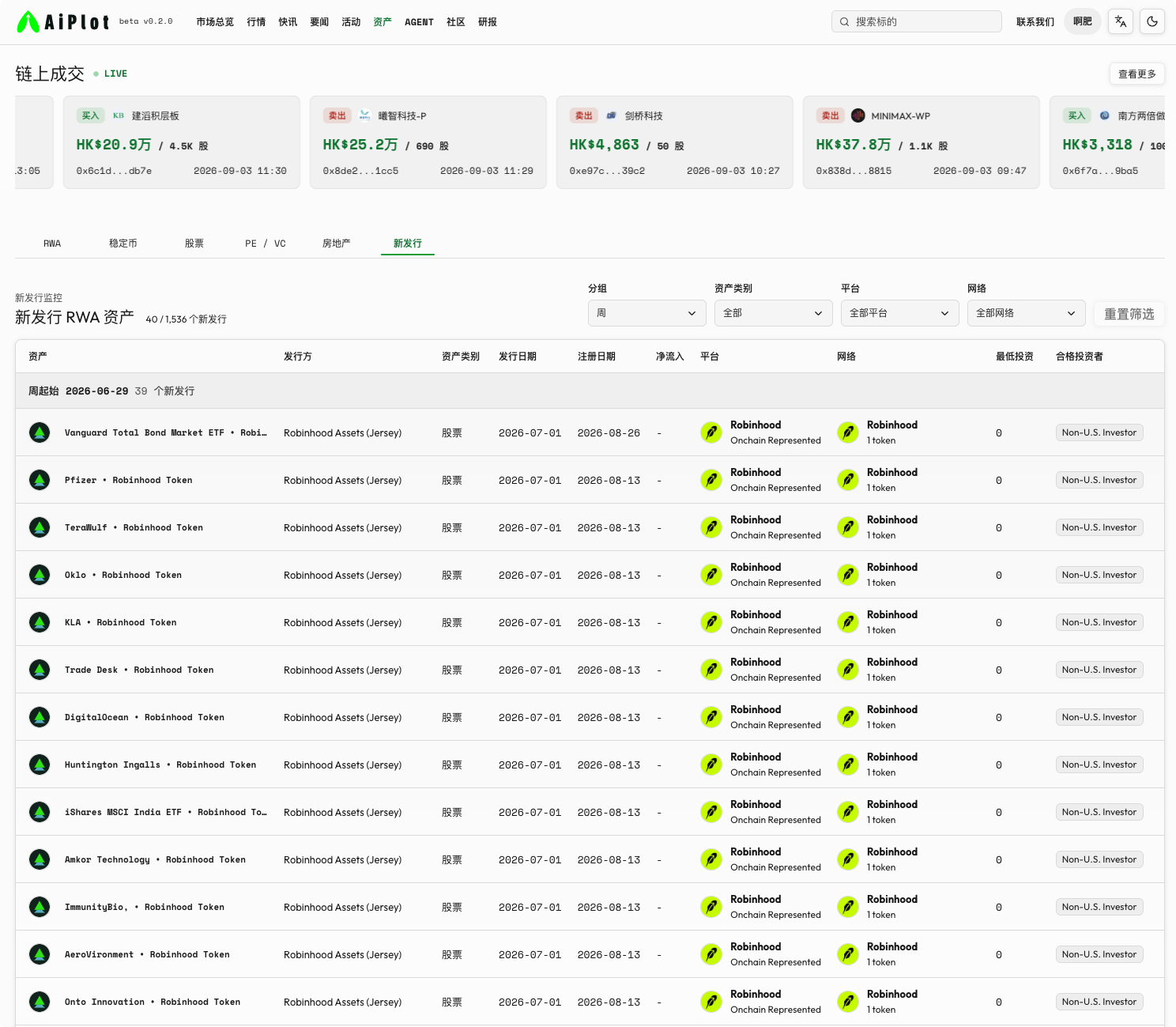
Robinhood's larger strategy is to integrate the traditional brokerage user entry points, stocks and ETFs as real-world assets, trading habits from the crypto market, and on-chain lending, market-making, and application ecosystems into a new asset distribution network.
The key issue here is not whether “stocks can be tokenized.” Technically, tokenized stocks are no longer a novelty. The real question worth studying is: once stocks, funds, and other real-world assets enter crypto accounts, can they acquire new trading paths, new sources of liquidity, and new financial uses?
From this perspective, Robinhood is not simply moving traditional financial products onto the blockchain; it is attempting to rebuild the entire chain from issuance to usage of real assets.
1. Robinhood's True Ambition: Turning "Investment Accounts" into an Asset Operating System
The core function of traditional brokerages is to allow users to buy, sell, and hold financial assets such as stocks, ETFs, and options. The core function of crypto wallets is to enable users to hold tokens and transfer, trade, lend, and combine assets across different protocols.
Robinhood is attempting to merge these two systems.
In 2025, Robinhood announced that it would offer over 200 US stocks and ETF tokens to eligible users in Europe, stating that it would support the trading, bridging, and self-custody of tokenized real assets through its own Layer 2 in the future. In 2026, Robinhood announced the launch of the Robinhood Chain public mainnet, positioning it as a Layer 2 aimed at financial services and tokenized real assets, integrating infrastructure such as Uniswap, Chainlink, and BitGo on-chain.
This indicates that Robinhood's goal is not to add a new category of trading, but to change the environment in which assets exist.
In traditional brokerage accounts, stocks are mainly used for buying, selling, and long-term holding; in on-chain accounts, assets can theoretically become liquidity in trading pools, collateral for lending protocols, margins in derivative markets, or underlying assets for automated strategies. Assets shift from passive holdings into a set of financial components that can be called upon by programs.
Therefore, the strategic significance of Robinhood Chain is not just to reduce trading costs. It is more like building a financial operating system specifically for real assets: assets can be issued, users can access them, protocols can combine them, and developers can continue to build applications around the assets.
2. First Innovation: Bringing Familiar Stocks into Crypto Accounts
A long-standing issue facing RWA is the high cost of user education. Government bonds, money market funds, and private credit products may have clear financial value, but ordinary users may not understand their structures; in contrast, Nvidia, Apple, Tesla, and the S&P 500 are assets users are already familiar with.
Robinhood chose to start with stocks and ETFs, effectively leveraging existing market recognition. Users do not need to first understand an entirely new token economics or accept a foreign project's value narrative. They understand familiar public companies, just with a change in how they access these assets and the means of trading them.
Robinhood currently describes Stock Tokens as tokenized products related to over 190 stocks and ETFs, emphasizing their discoverability and tradability across wallets, decentralized exchanges, and centralized exchanges. From a product logic perspective, this is akin to combining the market recognition of traditional securities with the digital accounts of crypto assets.
For users, the changes primarily manifest in three ways. First, the entry point for accessing assets expands from traditional brokerages to digital wallets and crypto trading interfaces. Second, assets can be managed in the same account alongside stablecoins, other tokens, and on-chain applications. Lastly, the use cases for assets extend beyond buying and selling to include collateralization, lending, market-making, and strategy combinations.
This does not mean that tokenized stocks automatically possess the same legal rights as regular stocks. Robinhood explicitly states that Stock Tokens are tokenized debt securities issued by Robinhood Assets (Jersey) Limited, offering economic exposure to the underlying securities but not granting investors direct legal or beneficial rights to the underlying securities.
This distinction is very important. The innovation in RWA is not about flattening all legal differences but about connecting the economic performance of traditional assets to blockchain accounts and financial applications through new product structures. Users may receive economic exposure, profit distribution, and on-chain composability, but not traditional stock registration rights.
3. Second Innovation: Robinhood Attempts to Solve the Distribution Challenge of RWA
Past RWA projects often emphasized issuance but relatively neglected distribution. A product can be tokenized, but without enough users, trading scenarios, and liquidity, it ultimately remains just an on-chain certificate.
Robinhood's advantage lies in its established retail financial brand, trading interface, and user reach capabilities. It does not need to start from scratch to educate all users on what stocks are, nor does it need to first establish an unfamiliar trading brand. It can embed tokenized assets into its existing investment and crypto product system, then expand the usage of assets through the on-chain ecosystem.
This is also the reason for the recent emergence of numerous applications within Robinhood's on-chain ecosystem. According to several industry observations from users, ecosystem projects have already covered areas such as token issuance platforms, stock reflection, asset baskets, liquidity management, stock collateral lending, social trading, and agents. The quality and sustainability of these projects still need to be individually evaluated, but collectively they reflect a new distribution mechanism: using crypto-native propagation and incentive methods to help real assets acquire on-chain users.
For example, some projects create liquidity pools from meme tokens and tokenized stocks; some convert trading fees into stock-like assets and distribute them to holders; others attempt to combine multiple tokenized stocks into a basket or use tokenized assets as lending collateral. The commonality among these mechanisms is that they no longer treat RWA as a terminal product that can only be bought and held but instead embed it at the heart of on-chain activities.
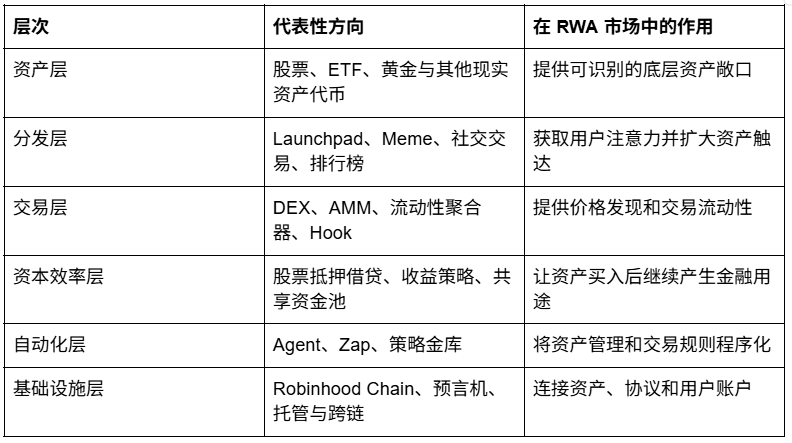
From a market structure perspective, this is a model where “asset distribution unfolds around assets.” Meme, launchpad, and social trading serve an attention and user distribution function; stock tokens represent exposure to real assets; DEX, lending protocols, and liquidity tools serve trading and capital efficiency functions; Robinhood Chain aims to be the infrastructure that supports these modules.
Functional Layering of the Robinhood Chain Ecosystem
4. Third Innovation: Transforming Stocks from "Holdings" into "Financial Legos"
In traditional finance, a stock mainly conveys rights to price appreciation, dividends, and corporate governance. Once on-chain, stock-like assets have the opportunity to become richer financial building blocks.
The first use case is collateralization. Users can lend stablecoins using tokenized stocks or ETFs as collateral without selling their stock exposure. The second use case is market-making. Stock tokens can form liquidity pools with stablecoins or other tokens, and participants earn fees by providing liquidity. The third use case is composition. Users can combine multiple stock tokens into a basket product, gaining diversified exposure. The fourth use case is automation. AI agents or strategy contracts can automatically adjust asset allocations or manage liquidity based on price, volatility, trading volume, and user-set rules.
In its official announcement in 2026, Robinhood clearly stated that eligible users could use Stock Tokens as collateral for on-chain lending and trading, and conduct related transactions through applications such as Uniswap, Lighter, Rialto, Arcus, and 1inch. This indicates that Robinhood's understanding of Stock Tokens has surpassed the concept of “replicating stock prices on-chain.”
The true goal is to enable real assets to enter the application layer of DeFi.
Of course, the stronger the composability of assets, the more complex the product structures become. Whether tokenized stocks can be freely transferable, whether they are accessible to all investors, whether they possess direct beneficial rights to the underlying stocks, how dividends are handled, and how corporate actions are synchronized must all be analyzed individually. Robinhood has also clearly distinguished this new generation of Stock Tokens from Classic Stock Tokens: the latter tracks the prices of stocks and ETFs through blockchain derivative contracts and cannot be transferred to other wallets or platforms.
Therefore, when researching Robinhood's RWA, it is not accurate to simply say "Robinhood brought stocks onto the chain." A more precise statement is: Robinhood is launching on-chain products of stock-like assets with different legal and technical structures, gradually trying to make some of these products possess wallet holding, on-chain trading, and DeFi composability.
5. Fourth Innovation: Robinhood Chain is Not an Ordinary Public Chain, but a Control Layer for Distribution and Applications
Why does Robinhood need to build its own Layer 2? If the goal is merely to issue stock tokens, it could theoretically utilize Ethereum, Arbitrum, or other mature networks. The significance of a self-built chain is that Robinhood seeks to have stronger product control capabilities.
First, a proprietary chain can be designed with transaction, compliance, and permission management modules that are more suitable for financial assets. Second, Robinhood can connect user accounts, wallets, assets, and on-chain applications into the same product system. Third, on-chain trading, lending, liquidity, and application activities can generate unified data and ecosystem feedback, rather than being scattered across multiple external networks.
Robinhood officially describes its Chain as a permissionless Layer 2 focused on financial services and tokenized real assets, emphasizing fast block times, DeFi primitives, on-chain user connections, and developer environments. This conveys an important signal: Robinhood is not satisfied with merely being a sales channel for RWA; it seeks to become the infrastructure for RWA to continue circulating and being utilized after issuance.
The business logic can be summarized in a chain: more users lead to more transactions, more transactions attract more developers, more applications create more asset usage scenarios, and more assets, in turn, enhance the user value and liquidity of the chain.
This fundamentally differs from traditional brokerages' business models. Traditional brokerages monetize mainly through trading, interest, asset management, and value-added services; on-chain infrastructure can further capture value from trading fees, liquidity services, lending, application deployment, and ecosystem assets.
However, this path also means that Robinhood faces more complex challenges: it must simultaneously manage compliance for securities products, on-chain wallet security, cross-chain risks, smart contract risks, market manipulation, and investor protection issues. A new system and technical design are still needed to reconcile the openness of public chains with the regulatory requirements of financial products.
6. What Really Matters in the Robinhood Ecosystem is Not the Quantity of Memes, but the "Asset-Application" Relationship
The large number of meme and application tokens currently appearing on Robinhood's chain may lead external observers to simply categorize it as another speculative market. However, focusing solely on token prices overlooks a more significant change within the ecosystem: some projects are redesigning on-chain financial products around tokenized stocks.
For instance, stock-pairing memes direct attention and liquidity towards stock tokens; stock reflection mechanisms convert trading fees into stock-like assets; basket protocols combine various stock exposures into a new token; and lending protocols attempt to use stock tokens as collateral. Although these mechanisms are still in their early stages, potentially accompanied by high volatility and serious speculation, they at least pose a long-term value question: how can real assets leverage crypto-native mechanisms to achieve greater distribution and usage efficiency?
This relates directly to the “cold start” problem for traditional financial assets on-chain. If a tokenized stock exists only within a restricted platform, users can buy it, but it's hard to use it in other scenarios. Conversely, if it can enter trading pools, lending markets, asset baskets, and automated strategies, it may gradually transform from a product into a class of foundational assets.
The scaling of RWA ultimately depends on whether assets can continue to gain application after issuance. Issuance merely maps real rights onto the chain; application determines whether assets maintain ongoing trading demand and capital efficiency.
7. Robinhood's True Competitor May Not Be Another Brokerage
On the surface, Robinhood's competitors may be other platforms offering stock tokens, crypto exchanges, or traditional brokerages. However, in the longer term, what it is truly competing for may be “who can become the default gateway for global asset distribution.”
In the future, users may no longer strictly differentiate between brokerage accounts, crypto wallets, and bank accounts but hope to access stocks, stablecoins, government bonds, ETFs, gold, and other assets through a single interface, completing transactions, holdings, lending, and payments within the same system.
In this scenario, the key to competition is no longer merely commissions or the number of assets but a combination of the following four capabilities: first, whether it can provide real assets that users understand and trust; second, whether it can distribute assets compliantly to users in different regions; third, whether it can enable assets to enter richer on-chain applications; fourth, whether it can hide on-chain complexity behind a simple user experience.
Robinhood's advantage is that it possesses financial branding, retail distribution, crypto products, and on-chain infrastructure. Its risk, however, is that the complexity among these businesses might also compound. Stock tokens, on-chain lending, DEX, and meme ecosystems are not naturally complementary modules; they need to establish genuine connections regarding legal rights, market liquidity, and risk control.
8. How AiPlot Should Observe RWA Ecosystems Like Robinhood
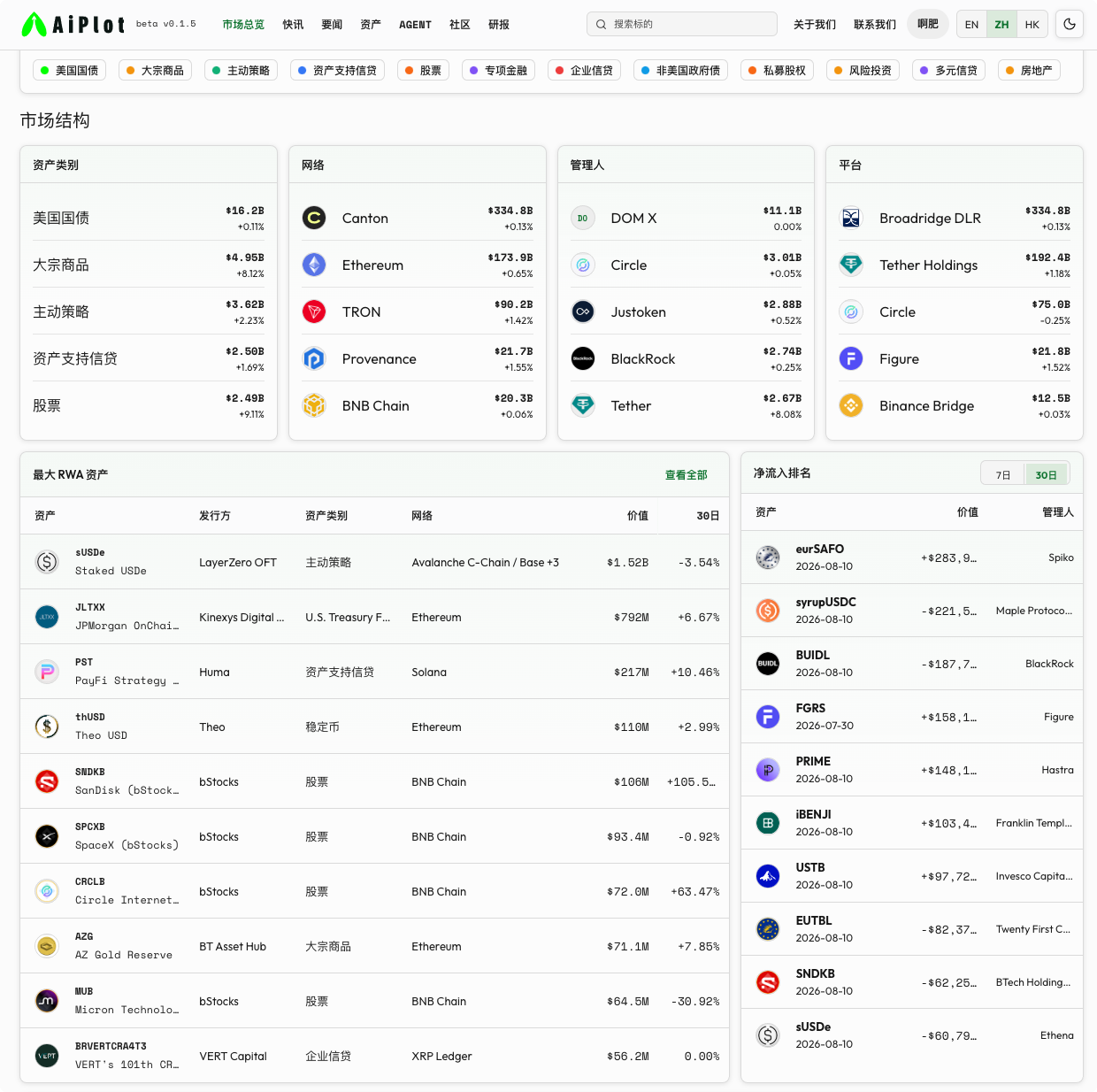
The case of Robinhood demonstrates that future RWA research cannot simply track “which assets have been tokenized” but also needs to monitor what market structures have formed after assets enter the on-chain realm.
For stock-like RWA, at least the underlying securities, issuing entities, product legal structures, transferability, supporting networks, number of holders, on-chain transfer volume, trading venues, liquidity pools, lending protocols, and related derivatives should be observed simultaneously. For an ecosystem, a further analysis of the relationship between assets and applications is needed: which protocols truly utilize RWA, which merely leverage the RWA narrative to attract traffic, and which assets have sustainable on-chain activities.
This is precisely where AiPlot can provide value. AiPlot's RWA market intelligence should not merely stop at asset directories but help users connect real companies, tokenized products, issuing entities, blockchains, trading markets, and DeFi protocols together.
The Robinhood case is especially suitable for observation in this manner. Users can start with a stock code and further trace whether it has multiple tokenized versions, on which chains it is distributed, by which institutions it is issued, how many holders it has, whether it has entered lending and DEX, and what liquidity relationships it has formed with memes or other on-chain assets.
The value of this type of data is that it can help market participants differentiate among three distinct types of growth: the first type is assets genuinely acquiring new users and trading scenarios; the second type is assets merely migrating between different chains; the third type involves the generation of numerous speculative tokens around assets, yet the underlying RWA does not gain corresponding real use.
9. Conclusion: Robinhood is Advancing RWA from “Products” to a “Distribution Network”
The importance of Robinhood lies not in whether it is the first company to launch stock tokens, nor in how many popular tokens have appeared on its chain in the short term. What truly warrants attention is that it is attempting to place several key aspects of RWA into the same framework: the brand and supply of traditional assets, brokerage-level user entry, trading methods from the crypto market, on-chain application ecosystems, and dedicated infrastructure aimed at financial services.
If this path holds, the nature of RWA will change. Assets will no longer just be packaged into a token waiting for users to buy but can be distributed to wallets, enter trading pools, serve as collateral, combine into indices, connect to agents, and continually generate new financial uses across multiple applications.
This is where true financial innovation occurs: not changing the name of assets, but altering the ways assets enter the market, are traded, and are used.
Robinhood's attempts are still in their early stages, and the specific legal rights of products, investor qualifications, underlying support, transferability scope, and on-chain liquidity must be verified individually. However, from an industry trend standpoint, it has raised a sufficiently important question: will future brokerages not just be sales channels for assets but become the operating systems for real assets to enter the on-chain financial system?
If the answer is affirmative, then Robinhood Chain is not an ordinary public chain project, but rather a public experiment in which traditional financial institutions compete for the next generation of asset distribution gateways.
The ultimate goal of RWA is not to provide an additional token version of stocks but to allow stocks, funds, and other real assets to enter a more open, composable, and efficient financial network.
For more data and analysis, please follow AiPlot:
📖 Community Communication:
-Telegram:
https://t.me/+IIYMcJigBAo4Mjg1
This content represents only the author's personal views and does not reflect the position of this platform. The viewpoints, conclusions, and suggestions in the article are for investors' reference only and do not constitute any investment advice related to this platform. The market carries risks; invest with caution.
免责声明:本文章仅代表作者个人观点,不代表本平台的立场和观点。本文章仅供信息分享,不构成对任何人的任何投资建议。用户与作者之间的任何争议,与本平台无关。如网页中刊载的文章或图片涉及侵权,请提供相关的权利证明和身份证明发送邮件到[email protected],本平台相关工作人员将会进行核查。