Hyperliquid's Q2 2026 financial report, at first glance, is almost flawless.
HIP-3 has driven rapid growth in RWA perpetual contracts for stocks, indices, and commodities: quarterly transaction volume reached $213 billion, accounting for 32.2% of Hyperliquid's total transaction volume; two quarters ago, this ratio was only 1.8%. Meanwhile, Hyperliquid's cumulative protocol revenue has exceeded $1 billion.
However, flipping the title over and looking further down reveals a counterintuitive phenomenon: there are more trading categories, RWA transactions are more active, but the revenue left by the protocol has not increased simultaneously.

A set of broad quarterly data used by third-party research indicates that the relevant revenue indicators dropped from $356.7 million in Q3 2025 to $295 million, $217.5 million, and $201.8 million in Q2 2026; calculated from the peak, the decline is approximately 43.4%.
This is where this financial report is truly worth studying.
The biggest contradiction for Hyperliquid right now is not about "whether there is growth," but rather how much value can be retained within the protocol and for HYPE holders after the ecological activities grow.
Don't rush to conclusions: On-chain "revenue" has at least four different metrics
Hyperliquid is not a publicly traded exchange that discloses profit and loss statements according to unified accounting standards. Different data platforms classify Fees, Total Economic Value, Protocol Revenue, and Token-holder Revenue differently, so seeing $201.8 million, $182 million, $169.37 million, and $142.88 million in the same quarter does not necessarily mean that someone calculated incorrectly.
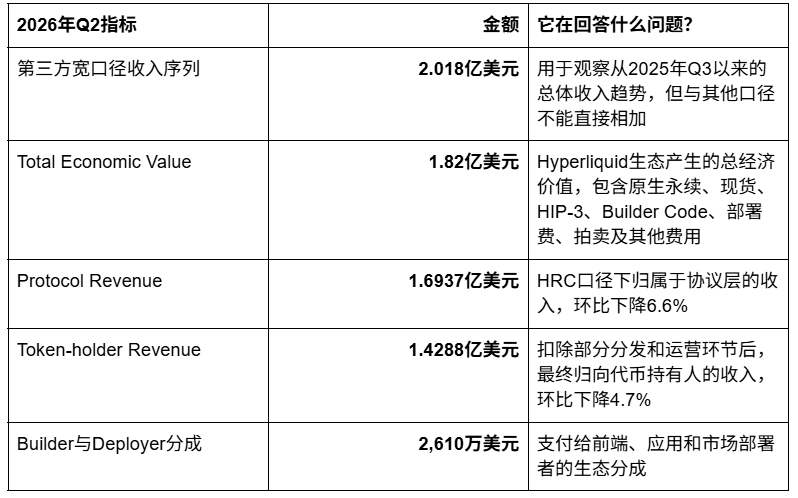
The key here is not to argue about which number represents "true revenue," but to first clarify three things: how much the entire ecosystem has created, how much the protocol has retained, and how much the HYPE holders have finally received.
Mixing these three questions together makes it easier to create the illusion of a "platform-wide explosion" as transaction volume increases.
Why hasn't revenue kept pace? HIP-3 is not the only reason, but it is the most critical variable
The decline from the peak in Q3 2025 was influenced by the overall cooling of the crypto derivatives market, weakening native perpetual transactions, increased competition, and Hyperliquid's proactive changes to its business model.
The role of HIP-3 precisely explains why platform activity later became active again, yet the revenue curve did not rise synchronously as before.
In the past, Hyperliquid resembled a vertically integrated exchange: the platform offered products, order books, and front-ends while capturing most of the economic value. After the launch of HIP-3, third-party teams holding a certain amount of HYPE could deploy their own perpetual markets, choose assets, oracles, and risk parameters while sharing related trading fees.
This mechanism brought about Trade[XYZ] and a plethora of stocks, indices, commodities, and pre-IPO assets, shifting Hyperliquid from "a trading product" to "an infrastructure where others can open trading markets."
However, "openness" does not come for free.
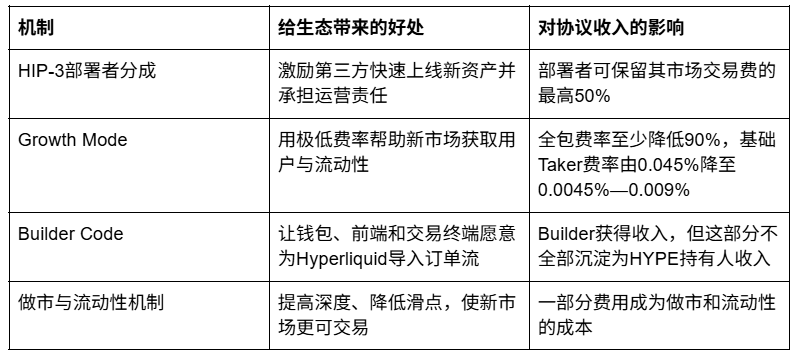
There’s also an easily overlooked detail: standard HIP-3 does not mean that Hyperliquid's revenue was directly cut by half.
In some standard configurations, the total fees paid by users may exceed those of the native perpetual, further split by the protocol and deployers, so the base income gained by the protocol per dollar in transactions may not significantly decrease. What truly compresses the average fee rate is Growth Mode and an ever-increasing amount of trading value shared by third-party front-ends, deployers, and liquidity participants.
In other words, HIP-3 is not digging an endless pit in the financial report, but is actively paying a market supply fee and distribution fee.
Is HIP-3 a "profit loophole" or a strategically sound concession?
Without deployers like Trade[XYZ], Hyperliquid might struggle to cover US stocks, Korean stocks, indices, precious metals, energy, and the Pre-IPO market simultaneously with just its core team of a few people.
From this perspective, rather than obtaining 100% of the revenue from a non-existent market, it may be better to earn part of the revenue from a new market. Third-party teams are responsible for finding assets, building markets, and driving traffic, while Hyperliquid provides the order book, margin system, and settlement layer, with both parties sharing the added value—this is the most common way to expand a platform-based business model.
Kyle mentioned in an interview with Jeff Yan that the Hyperliquid team does not view trading fees as team profits, but prefers to leave value within the community and ecosystem; Jeff also compared this choice to early Amazon, which focused on building a long-term market position rather than prioritizing short-term profits.
Another segment of Wu's interview reveals the same product philosophy: Jeff is more interested in creating previously non-existent mechanisms from 0 to 1, rather than replicating a proven exchange. The permissionless deployment of HIP-3 is a representative example of this thinking.
However, long-termism can only explain why concessions are made, it cannot prove that concessions will necessarily be effective.
Whether a subsidy is worthwhile ultimately still needs to answer three questions: Is the new transaction an incremental event that would not have happened originally? Can users brought in by low fees stay long-term? Can the growth of the ecosystem scale outpace the decline in revenue per dollar in transactions?
There is currently a clear risk: third-party research indicates that Trade[XYZ] accounts for over 90% of the open interest in HIP-3. This implies that while HIP-3 has found a successful model, it has not yet fully demonstrated its replicability. If RWA prosperity heavily relies on a single deployer, then Hyperliquid has a large customer, but it may not have formed a complete platform network yet.
What traders should focus on instead of transaction volume
In the past, evaluating a trading platform often revolved around transaction volume as the most conspicuous data. But as Hyperliquid opens its order book and liquidity to third parties, transaction volume can only indicate how much business has passed through here, not how much value the platform has retained from that business.
To assess whether HIP-3 is healthy, one must at least look at the following indicators together.
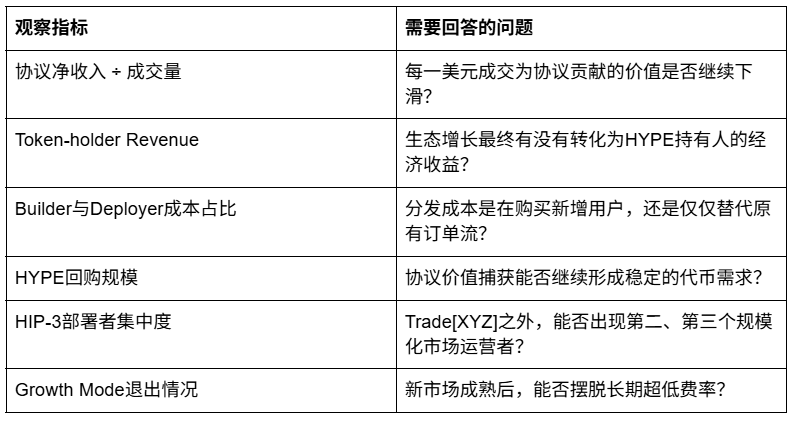
Thus, the "pitfall" revealed by Hyperliquid's Q2 financial report is not that HIP-3 inherently has issues, but that the market continues to use the old exchange's transaction volume metrics to analyze a platform-based protocol in transition.
HIP-4 does not correct this path, but is instead set to double down
If Hyperliquid believes that fee diversion is a mistake, the most reasonable action would be to tighten permissions, raise fees, and reclaim the market back into official hands.
But HIP-4 is doing the exact opposite.
According to official documents and AiCoin's compilation of the latest testnet changes, HIP-4 adds three key pieces to the Outcome market: each deployer must register an independent venue to clarify market ownership and settlement responsibilities; Builder Code can apply to both buying and selling sides, making it easier for wallets, information platforms, and trading terminals to earn income through order flow distribution; semanticRestriction encodes the semantic boundaries of market templates into rules, penalizing market violations clearly.
The protocol is responsible for the order book, collateral, and settlement; deployers are responsible for creating markets; Builders are responsible for bringing users; and verifiers are responsible for enforcing rules.
This indicates that Hyperliquid does not aim to be a super exchange that handles all products but rather a financial network that allows different teams to establish markets, build front-ends, and earn income.
HIP-3 applies this model to stocks, indices, and commodities; HIP-4 is set to replicate it for elections, sports, policy, and other event trading. The ecosystem will thus become larger, but the questions of "who gets the revenue, and how much the protocol retains" will also become increasingly important.
What does this change mean for traders?
When Hyperliquid only had one official front-end and a few crypto perpetuities, tracking price and funding rates may have sufficed. However, in the HIP-3 and HIP-4 era, assets, deployers, oracles, market rules, and order entry points are all rapidly increasing, and the information gap will expand from "price fluctuations" to the real liquidity and funding behavior behind different markets.
This is precisely the phase where AiCoin's mobile app can play a more significant role.
In AiCoin, users can observe the HYPE and Hyperliquid ecosystem assets using professional candlestick charts, track smart money to determine whether whales are betting on RWA growth or retreating when income data weakens; they can also validate whether the so-called "transaction volume explosion" corresponds to actual positions or high turnover under low fees by combining open interest, funding rates, and transaction changes. After confirming the trading logic, they can swiftly execute via the mobile app connected to Hyperliquid, managing risk exposure across different assets on one interface.
This is not to predict every price rise and fall but to avoid misinterpreting "ecological growth" as "protocol profit must necessarily increase" by focusing solely on an attractive title.
By using the AiCoin exclusive link to enter Hyperliquid and using the invitation code AICOIN88, you can receive a 4% fee rebate according to the activity rules:
Exclusive Entry:
https://app.hyperliquid.xyz/join/AICOIN88
Final judgment
Hyperliquid's Q2 financial report does not overturn the success of HIP-3 but reminds the market to redefine "success."
The proportion of RWA transactions has risen from 1.8% to 32.2%, proving that Hyperliquid is no longer limited to crypto perpetuities; yet, the inability for protocol revenue and holder income to rise synchronously indicates that this expansion did not come without costs.
HIP-3 is not a profit loophole but an investment in market supply and distribution. The real question is not whether Hyperliquid has spent money, but whether the revenue it let out today can be exchanged for a liquidity network that is harder to replace tomorrow.
If the answer is yes, then the current decline in the take rate may be the cost that had to be paid before platformization; if the new activities continue to rely on ultra-low fees and a single deployer, with protocol net income still lagging behind transaction growth, then attractive trading volume alone cannot support long-term valuations.
Therefore, when looking at Hyperliquid, one cannot only consider how much it has transacted today but also evaluate who ultimately profits from these transactions.
AiCoin User Exclusive Benefits
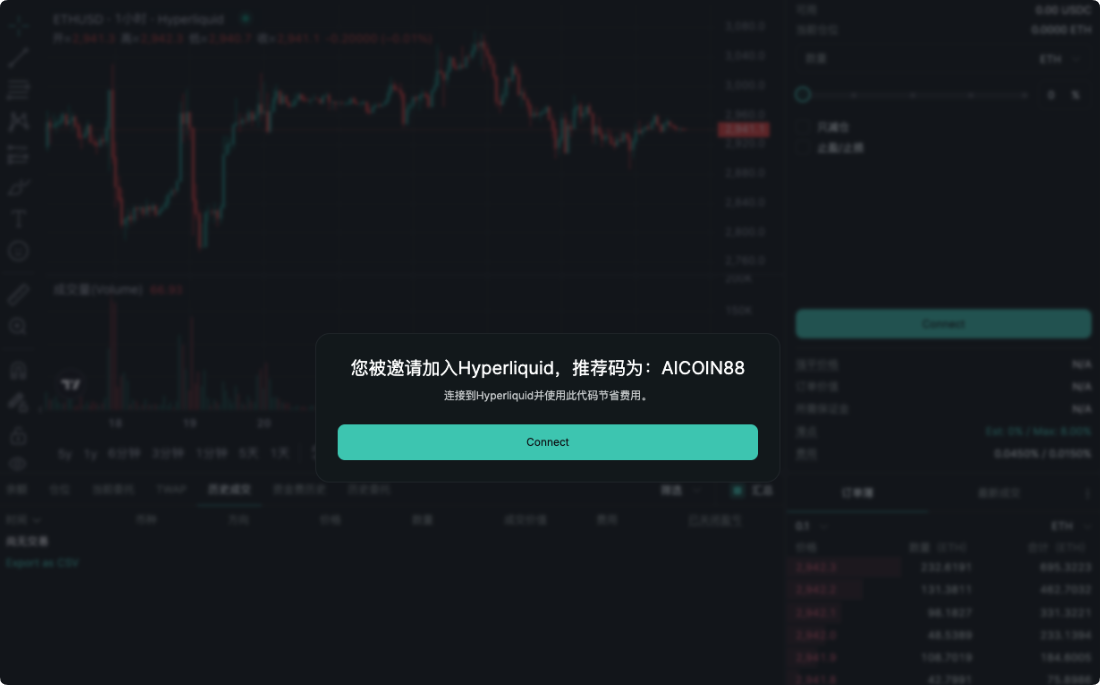
👉 Input the invitation code AICOIN88 when binding your Hyperliquid account to enjoy a 4% fee rebate.
🔗 Exclusive registration link:
https://app.hyperliquid.xyz/join/AICOIN88
📖 Beginner's Guide:
- "AiCoin PC Hyperliquid Authorization Trading Guide":
https://www.aicoin.com/zh-Hans/article/514197
- "AiCoin Mobile Hyperliquid Authorization Trading Guide":
https://www.aicoin.com/zh-Hans/article/541383
- "Zero-Basis Entry! Hyperliquid First-Time Trading Ultra Detailed Illustrated Guide":
https://www.aicoin.com/zh-Hans/article/510225
📖 Community Communication:
-Telegram:
-Discord:
-AiCoin Group Chat:
https://www.aicoin.com/link/chat?cid=N6OVMor5g
The content of this article represents only the author's personal views and does not represent the platform's position. The views, conclusions, and suggestions in the text are for investors' reference only and do not constitute any investment advice related to this platform. Investing in US stocks still requires self-assessment of market risks, regulatory risks, and compliance with local laws and regulations (especially foreign exchange controls, overseas investment declarations, etc.).
免责声明:本文章仅代表作者个人观点,不代表本平台的立场和观点。本文章仅供信息分享,不构成对任何人的任何投资建议。用户与作者之间的任何争议,与本平台无关。如网页中刊载的文章或图片涉及侵权,请提供相关的权利证明和身份证明发送邮件到support@aicoin.com,本平台相关工作人员将会进行核查。