Original | Odaily Star Daily (@OdailyChina)
Author|jk
From August 27 to 28, 2026, the Solana network completed its first truly binding on-chain governance vote in history, marking the official shift of Solana's governance model from "validator off-chain signal consultation" to "stake-weighted on-chain voting."
This was the first time institutional investors, publicly traded companies, and ordinary stakers confronted each other directly in the same voting process. Among the three proposals, two were passed with high votes, while the fee reform plan aimed at increasing SOL burn volume failed to surpass the two-thirds approval threshold.
What are the three proposals?
This vote was conducted under the newly launched SGP (Solana Governance Proposal) framework, which officially came into effect on July 1, 2026, replacing the previous informal, validator-only off-chain signal consultation mechanism. The biggest change in the new framework is the introduction of the "delegator override right": even if tokens are delegated to a certain validator for staking, the actual token holders can still override that validator's voting choice, thereby alleviating the old problem of inconsistent interests between validators and ordinary token holders to some extent.
The three proposals on the voting table were:
SGP-0001 "Solana Constitution," which established the basic rules of the entire governance framework, including quorum (one-third of the stake participating) and approval threshold (two-thirds majority). This proposal was ultimately passed smoothly with approximately 86% support, about 2% opposition, and about 12% abstention.
SGP-0002 "Double Deflation" (corresponding technical proposal SIMD-0550), raised Solana's annual deflation rate from 15% to 30%, accelerating the time for the network to reach a terminal inflation rate of 1.5% from around 2032 to around 2029, and is expected to cumulatively reduce the issuance of SOL by approximately 18.9 million within the next six years.
The passage process of this proposal was thrilling: about 70 minutes before the voting ended, due to the largest validator under the crypto exchange Kraken temporarily changing its position from support to opposition for its approximately 8.9 million SOL, the proposal momentarily lagged behind by approximately 58 million SOL. However, at the last moment, Kraken flipped approximately 8.1 million SOL back to support, and institutional investor Galaxy also switched from abstention to support in the last few minutes. Coupled with some delegators in the Jito staking pool overriding parts of their delegated positions, SGP-0002 ultimately passed with exactly 67.00% support, only slightly exceeding the two-thirds threshold by about 0.33 percentage points, passing with great suspense.
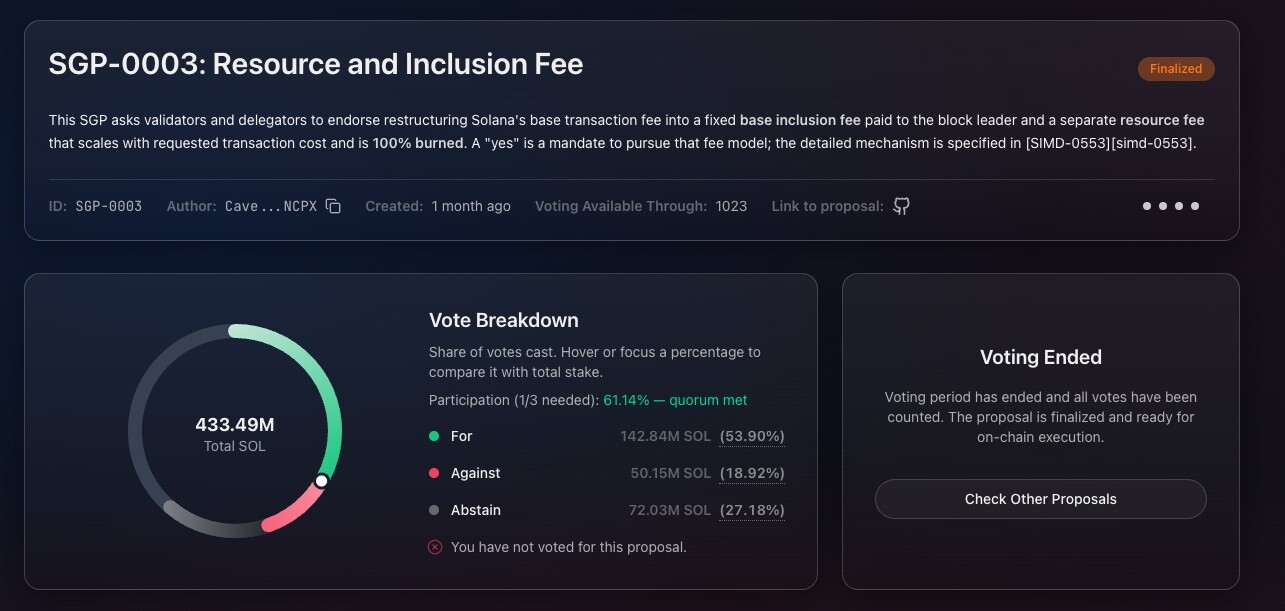
SGP-0003 "Resource and Access Fee Proposal" (corresponding technical proposal SIMD-0553) failed to pass. The final vote count showed that the support votes accounted for 53.90%, opposition votes accounted for 18.92%, and abstention votes reached 27.18%. Although the voting participation rate met the threshold for a quorum, the support rate fell far short of the two-thirds approval line.
SGP-0003 failed to pass, source: Solana
What did the rejected burning proposal suggest?
The rejected SGP-0003 is not what some external reports described as "burning treasury funds" or "burning MEV revenue"; it actually targeted the most basic transaction fee structure of the network. Currently, every transaction on the Solana network requires a uniform fee of 5000 lamport for each signature, half of which is directly burned, while the other half goes to the validator that produces the block.
SGP-0003 proposed to split this fee in two: one part fixed at 2500 lamport as the "access fee," fully payable to the block-producing node; the other part as a "resource fee," with fluctuating pricing based on the actual computational resources consumed by the transaction, this part of the fee would be fully burned and not distributed to any party.
The original intention of this design was to make heavy users who occupy more on-chain computational resources bear higher costs, while retaining more value in the protocol itself through burning, rather than letting it flow to block-producing nodes. According to the analysis firm 21Shares, once this plan is implemented, the daily burning volume of SOL will rise from the current approximately 648 to between 7500 and 9000, which, based on then-current prices, represents nearly a 14-fold increase in daily burning value.
However, even when estimated at the upper limit, this burning volume remains far lower than the current daily new issuance of about 60,000 SOL, thus this proposal would not immediately make SOL a deflationary asset, but would significantly increase the deflationary pressure.
Deflation benefits price increase, why did it fail?
Upon examining the reasons for SGP-0003's failure, the opposition votes were not the main reason; the true determining factor was the high abstention rate of 27.18%.
According to the voting rules established by the "Solana Constitution," abstention votes, while counted towards the participation needed to reach a quorum, are also included in the denominator of the support rate calculation formula, which means the more abstention votes there are, the higher the effective threshold that must be crossed for approval. The abstention proportion of SGP-0003 was clearly higher than the other two proposals, and the collective abstention of large validator nodes essentially influenced the final result.
Some calculations show that if the abstention votes were recalculated by excluding them from the denominator, the "deciding staking" support rate of SGP-0003 would reach approximately 74%, which could have passed smoothly. This algorithmic difference subsequently evolved into a public dispute over the interpretation of voting rules: Michael Hubbard, CEO of SOL Strategies, publicly stated that there were discrepancies between the constitutional text and the calculation standards described in pre-vote communications, asserting that under the rules participants were originally informed, this proposal should have been deemed passed. However, he also admitted that despite procedural objections, he personally believed that the proposal's failure might be a better outcome.
According to reports citing on-chain data from certain sources, the decentralized trading protocol Jupiter, lending protocol Drift, publicly listed company Forward Industries, and staking service provider Anagram Staking were believed to have cast opposition votes; the staking service provider Everstake was believed to have abstained; while staking service providers Figment, Staking Facilities, P2P.org, and institutions such as Helius, OtterSec, Solana Compass, Blueshift, Temporal which had already voiced support during the prior signal consultation phase, as well as the first publicly listed SOL treasury company in the U.S., DeFi Development Corp (DFDV), were believed to have cast support votes.
Nasdaq-listed company publicly opposed, but most projects in the field supported
In this voting, what attracted the most attention was the public statement from the Nasdaq-listed company The Solana Company (stock code HSDT). This digital asset treasury company, headquartered in Philadelphia and operating an institutional-grade validator business in the Asia-Pacific, publicly stated its position a few days before the vote: supporting the constitutional proposal, while voting against both the deflation proposal and the burning proposal.
Chairman and CEO Joseph Chee stated that based on the company’s communication experiences with various institutional investors, the issuance rate itself is rarely seen as an obstacle for institutions entering the cryptocurrency space; what truly deters institutions is whether the network's economic parameters can remain stable and reliable over several years. With the governance framework just launched, the first formal voting cycle simultaneously adjusting the two core and most stable economic parameters of the network (issuance rate and fee structure), he believed the risk was too high and might actually slow the pace of institutional entry.
Regarding the deflation proposal, Chee specifically pointed out that staking rewards are considered a financial statement item that needs to be predicted, disclosed, and audited for many SOL holders, and can even be seen as part of operational cash flow. The company does not wish to see this originally certain and predictable issuance schedule being reopened for discussion. As for the burning proposal, his statement was even more direct: the current transaction fee is a known fixed constant, allowing financial institutions using the Solana network to budget in advance; once the transaction cost is transformed into a floating value without the ecosystem having fully adapted, it essentially shifts the cost estimation risk onto end-users and operators.
According to media disclosures of the financial report data, the revenues generated from staking the SOL held by the company accounted for as much as 99.4% of its total income in the second quarter; the company generated over 30,000 SOL from staking that quarter and chose to auto-restake, but due to depreciation caused by the drop in SOL asset prices during the same period, the company still recorded approximately $30 million in net losses.
Solana co-founder Anatoly Yakovenko publicly expressed support for the general direction of the proposal, interpreting his vote in favor as an authorization of the proposal's direction, while the specific technical implementation details could be refined in subsequent technical proposals. However, he also admitted that SGP-0003's "one-time bundled proposal had a bit too much content," leaning towards splitting it into several simpler and more focused independent proposals for separate voting in the future, such as separating the part replacing the fixed signature fee from the discussion of how to determine the floating rate.
Austin Federa, co-founder of the decentralized infrastructure project DoubleZero and former member of the Solana Foundation, cited data showing that the application layer of the Solana ecosystem captured approximately 93% of the total value generated on-chain, while the base network layer itself received only the remaining 7%. In his view, a mechanism proportionate to the consumption of computational resources, which fully burns a portion of costs, can redirect more value that originally flowed to application layers or block-producing nodes back to the protocol itself.
This voting also rarely exposed the position differentiation among the digital asset treasury (DAT) companies within the Solana ecosystem, which typically hold and stake large amounts of SOL as part of their corporate balance sheet, and should be most sensitive to changes in network economic parameters. DeFi Development Corp clearly supported the two economic proposals; The Solana Company explicitly opposed; another Nasdaq-listed infrastructure and treasury company, SOL Strategies, publicly called the deflation proposal "premature" and raised procedural objections to the vote counting method of the burning proposal; while Forward Industries, which has prominent institutional shareholders including Multicoin Capital, Galaxy Digital, and Jump Crypto, was reported to have also voted against the burning proposal.
After the vote, SOL welcomes a long-awaited monthly gain
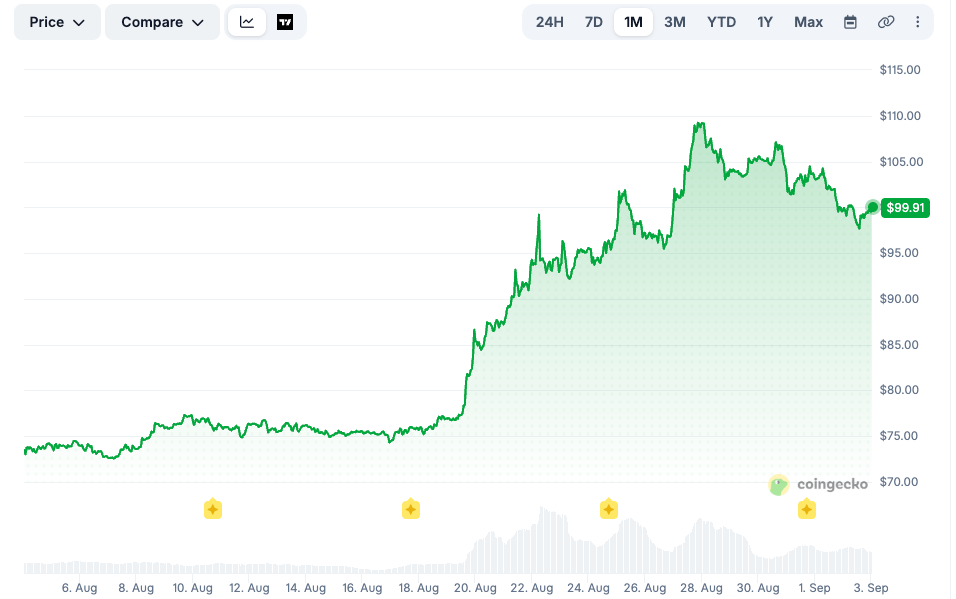
The process of this governance vote coincided with SOL's price emerging from a slump. According to market data, SOL reached a high of $110.38 on the day of the vote, August 27, marking the strongest price performance since the end of January that year, and ultimately closed around $106 at the end of August, with a monthly increase of about 46%, ending a previous ten-month downward trend, recording a long-awaited monthly gain.
Solana monthly performance, source: Coingecko
This round of increase also benefited from the strong inflow of funds into exchange-traded funds (ETFs), with the cumulative net inflows of related SOL ETFs reaching approximately $1.322 billion, and the total assets under management of this category reaching about $1.49 billion; of which the net inflow on August 27 alone reached $60.91 million, the third-highest daily inflow since the launch of this category of products. Among the funds that flowed in that day, the relevant SOL ETF products under asset management company Bitwise accounted for about 66% of the share, with its management scale also surpassing the $1 billion mark, holding approximately 9.3 million SOL, with Goldman Sachs Group being the largest institutional holder disclosed in its information.
Will the rejected burning proposal be brought back to the table again?
Although it did not pass this time, from the statements of various parties, it is almost a high-probability event that the burning proposal will be resubmitted in a revised form and voted on again, though no official re-voting timetable has been announced yet.
As mentioned earlier, Yakovenko has clearly called for splitting the original proposal into several simpler independent proposals for separate handling; while the opposing party's representative The Solana Company has also stated they would be willing to reassess their position as long as the revised proposal retains a fixed minimum transaction fee. It is understood that the technical proposal corresponding to the burning proposal, SIMD-0553, had previously passed the technical review by the core development team Anza and another validator client team Firedancer, indicating that once this proposal regains governance authorization, its technical implementation speed could theoretically be quite rapid.
In other words, we might soon see a Solana with significantly increased deflationary pressure.
免责声明:本文章仅代表作者个人观点,不代表本平台的立场和观点。本文章仅供信息分享,不构成对任何人的任何投资建议。用户与作者之间的任何争议,与本平台无关。如网页中刊载的文章或图片涉及侵权,请提供相关的权利证明和身份证明发送邮件到support@aicoin.com,本平台相关工作人员将会进行核查。


