Original | Odaily Planet Daily (@OdailyChina)
Author | Asher (@Asher_ 0210)
In just two months since its launch, Robinhood Chain has become one of the fastest-growing public chains with the highest community discussion heat.
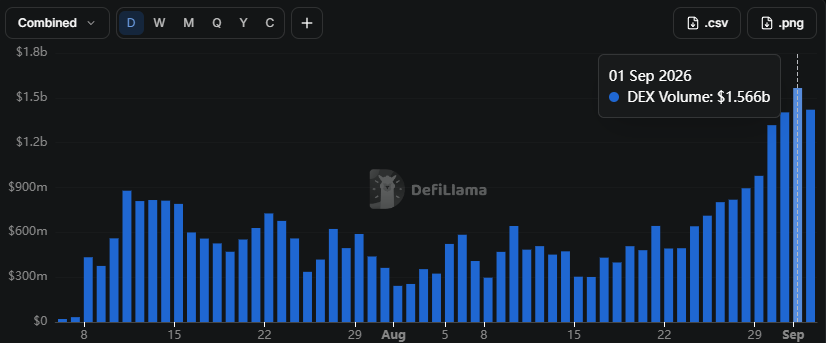
DefiLlama data shows that on September 1, Robinhood Chain DEX's transaction volume surpassed $1.5 billion, briefly exceeding Ethereum, BNB Chain, and Base; the on-chain TVL also grew from under $100 million at its launch to nearly $800 million.
Since Robinhood Chain has not yet issued a native token, for crypto investors who are optimistic about continued growth in users, assets, and transaction volume on this chain, on one hand, they can focus on popular projects on Robinhood Chain (read more: Which projects on Robinhood Chain have secondary investment opportunities?); on the other hand, with a substantial influx of funds, projects providing trading, lending, and underlying infrastructure for Robinhood Chain may also gain users, income, or token demand.
So, what protocols are the continuously growing transaction volume and funds on Robinhood Chain flowing into? And which tokens have truly captured the growth dividends of this chain?
Odaily Planet Daily will analyze the value connections between UNI, MORPHO, LIT, ARB and Robinhood Chain in this article (ETH, while it serves as the Gas and settlement asset of the chain, has limited incremental impact relative to its volume and will thus not be included in the discussion).
Uniswap occupies the main trading share on Robinhood Chain, and protocol fees drive token burn
Robinhood Chain has not built its liquidity system from scratch but has directly introduced Uniswap V2, V3, and V4. The Robinhood team positions Uniswap as the main public liquidity protocol on the chain, and most DEX transactions on Robinhood Chain are also completed through Uniswap. Therefore, regardless of whether the hype on Robinhood Chain comes from meme coins, protocol tokens, or stock tokens, the growth in trading scale will primarily translate into trading volume and fee revenue for Uniswap.
Since July, Robinhood Chain has become one of the most important sources of income for Uniswap. In July, Uniswap's daily fee once reached about $5.16 million, of which about $4.38 million came from Robinhood Chain, accounting for nearly 85%. As of today, Uniswap's protocol revenue in the last 30 days was $9.19 million, with Robinhood Chain contributing $4.36 million, accounting for 47.4%.
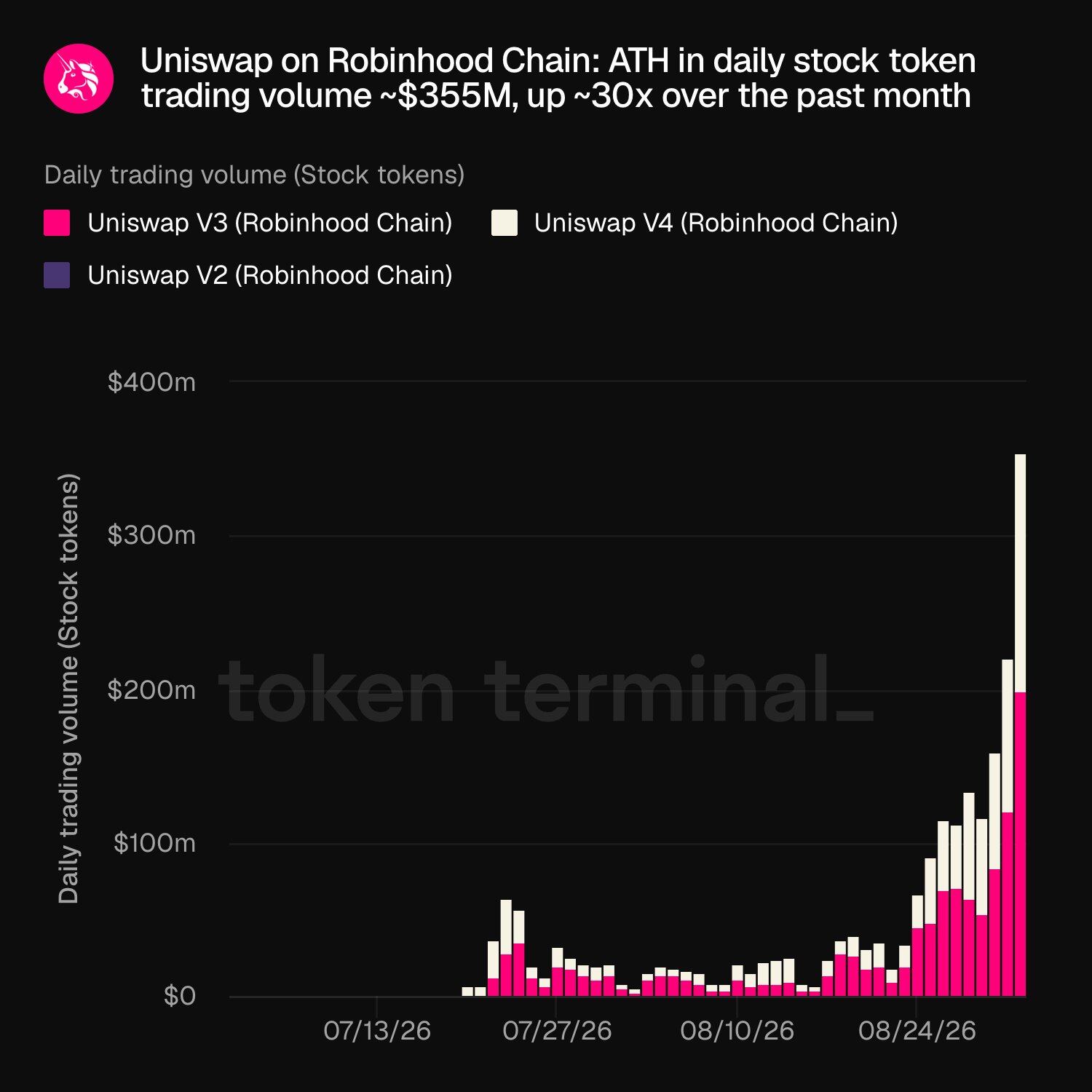
In addition to native assets such as meme coins, Robinhood Chain is bringing a new RWA trading increment to Uniswap. Approximately six weeks after Robinhood Chain's launch, the cumulative trading volume of stock tokens processed by Uniswap reached $1.5 billion; as of today, its daily trading volume of stock tokens further rose to $355 million, a 30-fold increase compared to a month ago. As the scale of stock token trading expands, the trading volume and fees Uniswap can obtain are also increasing synchronously.
The increase in Uniswap's revenue, combined with the implementation of the UNIfication proposal at the end of 2025, will officially initiate Protocol Fees, using this portion of revenue for continuous UNI burns, transforming UNI from a "pure governance asset" to an asset clearly tied to protocol usage and revenue.
As of August 31, approximately 110 million UNI had been burned. Of this, 100 million came from a one-time treasury burn at the implementation of UNIfication, and the continuous burning generated by the protocol fee mechanism has reached about 10 million UNI. Recently, with the growth in protocol revenue, the burn rate has accelerated further, with multiple trading days in August seeing over 100,000 UNI burned in a single day; on August 21, about 150,000 UNI were burned in one day, valued at about $590,000, setting a new single-day burn record since the mechanism was implemented.
Lighter becomes the perpetual contract entry for Robinhood Wallet
When the Robinhood Chain mainnet launched, Lighter was directly embedded in Robinhood Wallet, becoming the entry point for perpetual contracts within the wallet. Compliant users no longer need to switch to other DeFi front ends to trade Lighter’s perpetual contracts within the wallet. Moreover, Lighter officials stated that they will provide 11 million LIT as incentives for the Robinhood community, allowing double points for transactions through Robinhood Wallet.
Unlike ordinary protocol deployments, the perpetual contracts on Robinhood are provided by Lighter, which offers underlying trading services and uses USDG as the margin and pricing asset. Lighter founder Vladimir Novakovski previously revealed that the two parties share the income from this part of the business 50:50, with Lighter's share used for LIT buybacks.
DefiLlama data shows that Lighter’s perpetual contracts on Robinhood Chain have a cumulative trading volume of approximately $5.07 billion, with about $4.97 billion in the last 30 days and approximately $1.75 billion in the last 7 days. During the same period, Robinhood Chain contributed about $741,000 in fees and $537,000 in protocol revenue to Lighter.
Compared to deploying contracts solely on Robinhood Chain, Lighter directly connects to the user entry and order flow of the wallet. If Robinhood users' demand for perpetual contract trading continues to rise, Lighter's income and LIT buyback scale will also grow accordingly.
Morpho serves as the lending infrastructure behind Robinhood Earn
On July 1, the day of the Robinhood Chain mainnet launch, Robinhood also launched the on-chain yield product Robinhood Earn, choosing Morpho as the underlying lending protocol. Users can directly purchase USDG within the Robinhood App and then deposit USDG into the Morpho Vault managed by Steakhouse Financial through a self-custodied wallet to earn yield. For ordinary users, the front end remains Robinhood, but the funds actually enter Morpho.
Within less than two weeks of Robinhood Earn's launch, the deposit scale broke $100 million and further exceeded $250 million in early August. With continuous inflows of capital, Robinhood Chain quickly grew to become Morpho's third-largest market, with an overall scale only second to Ethereum and Base.
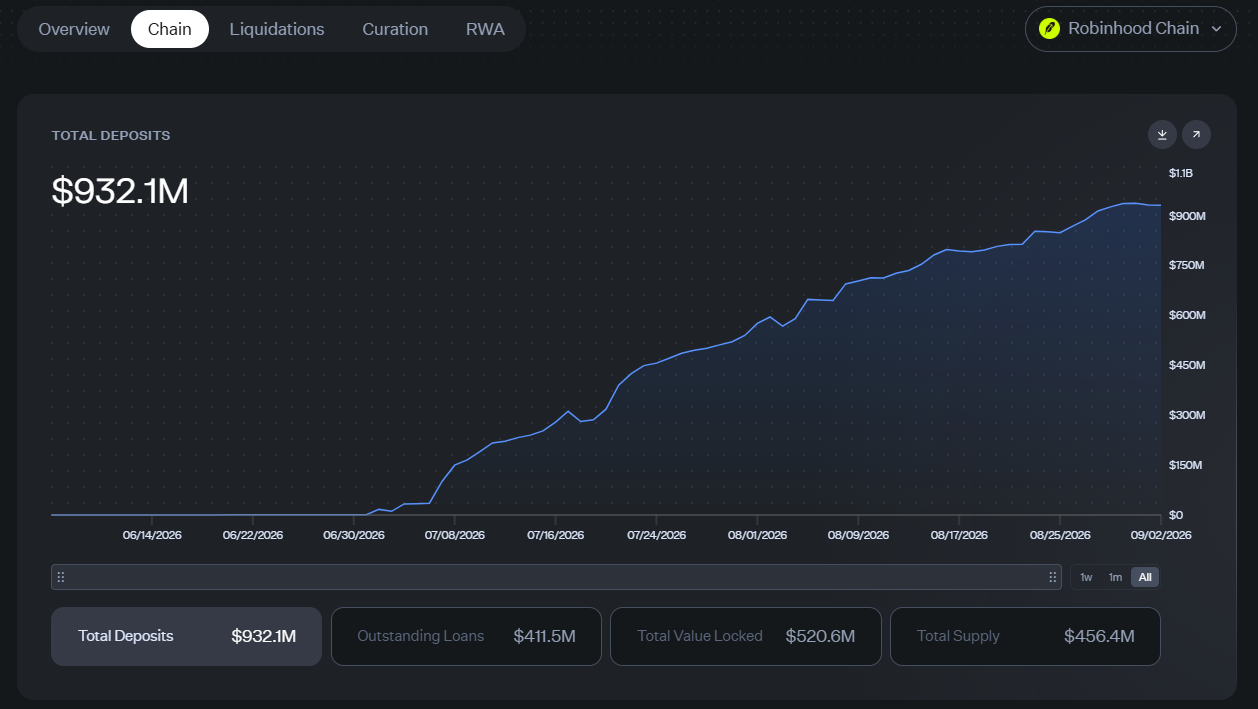
Morpho official data dashboard shows that Morpho currently has total deposits of about $932 million on Robinhood Chain, with outstanding loans of approximately $412 million, and a TVL of about $521 million.
However, unlike UNI, which can directly capture the transaction growth of Robinhood Chain through protocol fees and burn mechanisms, currently, most of Morpho's revenue still flows to lenders. Although the protocol has already built in the Protocol Fee switch, it has not yet been activated; therefore, the growth brought by Robinhood Chain primarily manifests in terms of capital scale and lending demand, without directly translating into MORPHO's value capture.
After Robinhood embedded Morpho into its Earn product, the former handles the user entry while the latter provides the underlying lending infrastructure. As Robinhood Earn continues to scale up, Morpho's lending and borrowing scale is also expected to grow in tandem; if Protocol Fees are activated in the future, this growth may further translate into protocol revenue.
10% of Robinhood Chain's revenue flows into the Arbitrum ecosystem
Unlike Uniswap, Morpho, and Lighter as applications on Robinhood Chain, Arbitrum provides more foundational blockchain infrastructure.
Robinhood Chain itself is built on Arbitrum Dedicated Blockchains as an Ethereum Layer 2, operating Arbitrum Nitro and using Ethereum for data availability and settlement. According to the revenue-sharing mechanism of the Arbitrum Expansion Program, Robinhood Chain must return 10% of the net protocol revenue to the Arbitrum ecosystem, with 8% going to ArbitrumDAO Treasury and the remaining 2% to Arbitrum Developer Guild.
So far, Robinhood Chain has contributed approximately $1.3 million to the Arbitrum ecosystem, of which $1.04 million has entered the ArbitrumDAO Treasury; in the last 30 days alone, it contributed about $665,000, of which $532,000 belongs to the DAO.
However, this income is currently not directly allocated to ARB holders, nor is there a corresponding ARB buyback or burn mechanism. Therefore, Robinhood Chain's value capture of ARB is significantly weaker than that of UNI. Compared to short-term revenue, Robinhood Chain's more important significance for Arbitrum is proving that this technology stack can already support on-chain business for large financial institutions. If more institutions choose Arbitrum to build independent chains in the future, Arbitrum DAO can continue to obtain revenue shares from it.
免责声明:本文章仅代表作者个人观点,不代表本平台的立场和观点。本文章仅供信息分享,不构成对任何人的任何投资建议。用户与作者之间的任何争议,与本平台无关。如网页中刊载的文章或图片涉及侵权,请提供相关的权利证明和身份证明发送邮件到support@aicoin.com,本平台相关工作人员将会进行核查。


