Just 100 days after replacing Powell, the new Fed chair personally chosen by Trump began discussions about "interest rate hikes."
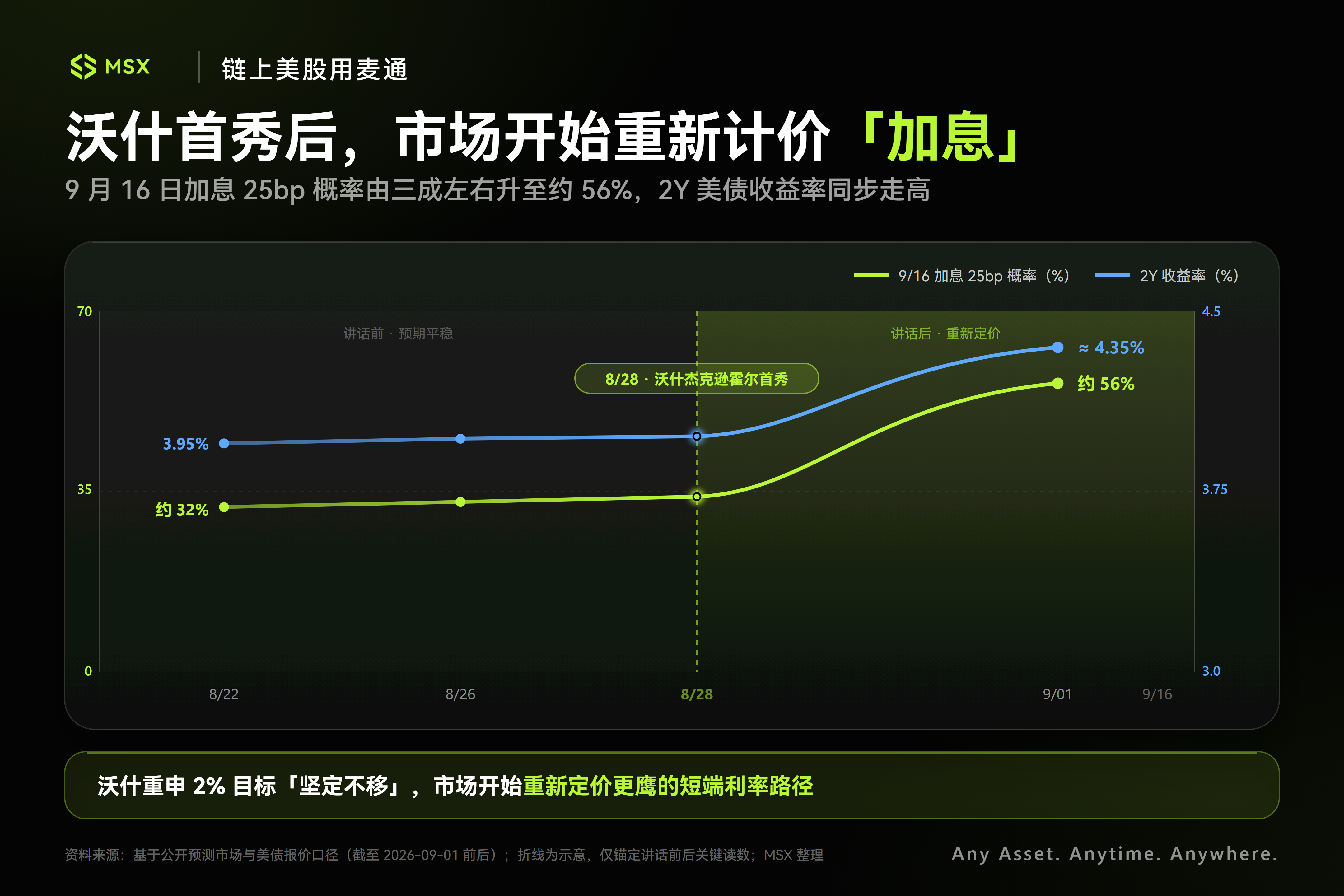
On August 28, Kevin Warsh made his debut at Jackson Hole, clearly reaffirming that the 2% inflation target is "unwavering," and the data is insufficient to prove a "meaningful improvement" in inflation trends.
As soon as the "hawk" remarks were made, the market quickly repriced.
As of the time of writing, the probability in the prediction market for a 25bp interest rate hike on September 16 suddenly surged to around 56%; prior to this, the number hovered just above 30%.
What’s more ironic is that Trump did not publicly lash out at Warsh, as he did with Powell in the past; instead, he rarely stated that he "very much respects" Warsh, saying, "He will do what he must do."
This raises a more interesting question: Is Warsh behaving so hawkishly now preparing to part ways with Trump?
The answer may be quite the opposite.
1. The closer they are, the less they can appear to be on the same side
Looking solely at Warsh's speech at Jackson Hole, it is difficult to link him with the "low-interest-rate Fed chair Trump wanted."
He emphasized that inflation remains too high and proposed extremely hawkish restructuring for the Fed's operational paradigm over the past twenty years: unconventional policies like QE should only be used in genuine crises, and the Fed should reduce its "feeding-the-market type of communication."
For a long time, Wall Street has become accustomed to closely monitoring the dot plot, press conferences, and leaks, then guessing whether the next meeting would result in a hike or a cut.
Warsh clearly finds this deeply unappealing.
In his view, when the market waits every day for the Fed to reveal "how to make the next deal," and the Fed in turn judges the economy based on market prices, the entire system devolves into a self-reinforcing "Hall of Mirrors."
Ultimately, Warsh, who served as a Fed governor over 20 years ago, contrasts sharply with the data-driven, dot-plot reliant technical bureaucrats since Bernanke's era. He resembles a reformist attempting to reshape the central bank’s operational logic from the outside.
From this perspective, Warsh’s current "hawkish" stance is transparent: at the beginning of his term, to rapidly restore his policy credibility.
After all, for a chair personally selected by Trump, once the market begins trading on the "loss of Fed independence," surging long-term Treasury yields and uncontrolled inflation expectations will quickly backfire on the economy.
Similarly, for Trump, a chair who can first prove to be "disobedient" may actually be more capable of truly lowering rates in the future.
In fact, as early as last year, the MSX Research Institute discussed Warsh as a candidate for Fed chair.
His emergence from the list of candidates stems from having a resume recognized by traditional Wall Street and the Fed system, along with a closely positioned network to Trump (read more in “The Fed 'Successor' Reversal: From 'Loyal Dove' to 'Reformist', Has the Market Narrative Changed?”).
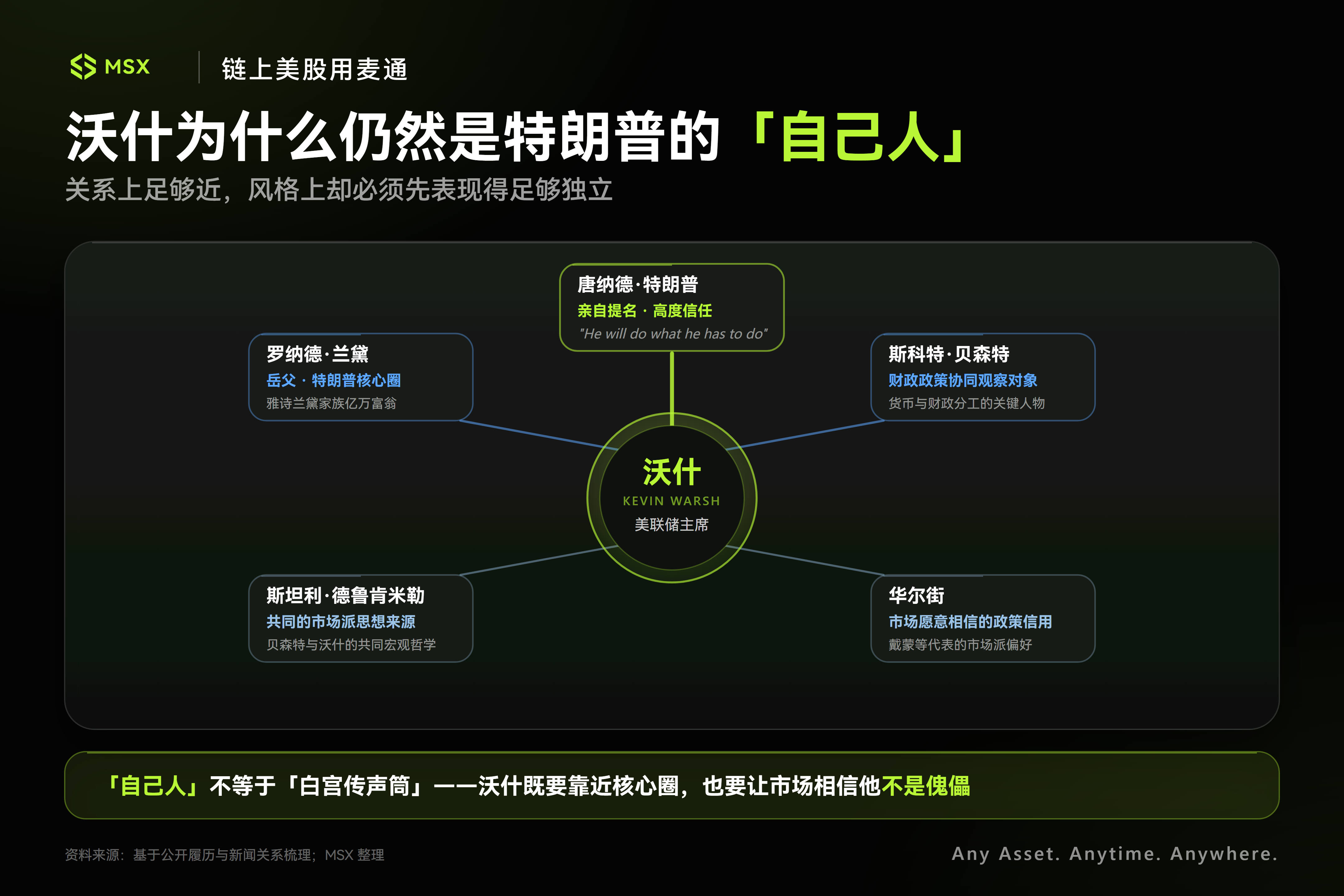
Warsh's father-in-law, Ronald Lauder, head of the Estée Lauder family, had known Trump since their time at Penn and has maintained a private relationship, being one of Trump’s important allies in politics and business.
Looking a level higher, Warsh and current U.S. Treasury Secretary Yellen share an interesting common source of market-oriented thought:
Stanley Druckenmiller.
Yellen worked for the Soros Fund for a long time and was deeply influenced by Druckenmiller, while Warsh, after leaving the Fed, also maintained a very close relationship with Druckenmiller and became his business partner.
Strictly speaking, they are not traditional "disciple brothers," but today's most important monetary and fiscal policy positions in the U.S. happen to be held by two individuals deeply influenced by Druckenmiller's market philosophy, which is undoubtedly quite interesting.
Today, the fact that Trump can publicly say "I respect him" indicates that, at least for now, Warsh still belongs to that "allowed to show independence" insider.
From another perspective, the more he can prove he is not Trump’s puppet, the greater his room for maneuvering will be when real easing is needed in the future.
2. "Open Hawk, Hidden Dove," Is AI Rewriting the Traditional Rate-Cut Script?
Therefore, one way to understand Warsh is as "short-term hawkish but reserving the option for long-term easing."
The so-called "open hawk, hidden dove" does not mean that Warsh has decided there will definitely be a rate cut in the future; currently, there is no evidence to support such a judgment.
More precisely, Warsh has proposed a new possibility regarding AI: "The potential for substantially higher growth is on the rise," meaning if the U.S. economy maintains higher growth while bringing down inflation, the Fed need not wait for the economy to weaken significantly before cutting rates.
This captures the essence of "open hawk, hidden dove," and this path outlines three steps.

1. Re-establish inflation credibility
The biggest constraint Warsh currently faces is inflation above the 2% target. In this environment, rash easing could not only re-stimulate demand but also lead to a rise in long-term inflation expectations.
Therefore, regardless of whether a rate hike happens in September, Warsh must first convince the market that 2% is not just a slogan, and if necessary, the Fed is indeed willing to hike again.
This is why September 16 is particularly important.
Prior to this, employment data and the CPI released on September 11 will determine whether Warsh has enough reason to truly translate the hawkish message from Jackson Hole into policy action.
If inflation remains sticky while employment stays resilient, then a rate hike in September is not out of the question; conversely, if the data quickly weakens, Warsh can easily choose not to hike.
Only by first establishing this credibility can future rate cuts be more easily interpreted as "normal easing allowed by inflation," rather than "political rate cuts under pressure from the White House."
2. Wait for supply-side to truly open up room for rate cuts
Next, what is truly worth observing is whether AI productivity can shift from a narrative to macro data.
This was also one of the most easily overlooked keywords in Warsh’s speech at Jackson Hole: AI.
Warsh spent a considerable amount of time discussing whether AI is becoming a new factor of production and whether it can ultimately lead to sustained productivity improvements.
The underlying logic is highly significant.
If AI, capital expenditures, energy expansions, and regulatory easing truly enhance the U.S. economy's supply capacity, a combination that Trump would hope to see could emerge — strong growth with declining inflation.
This differs completely from rate cuts driven by past recessions. For the stock market, it could even represent a more comfortable environment than traditional cuts, meaning EPS continues to grow while the discount rate begins to decline.
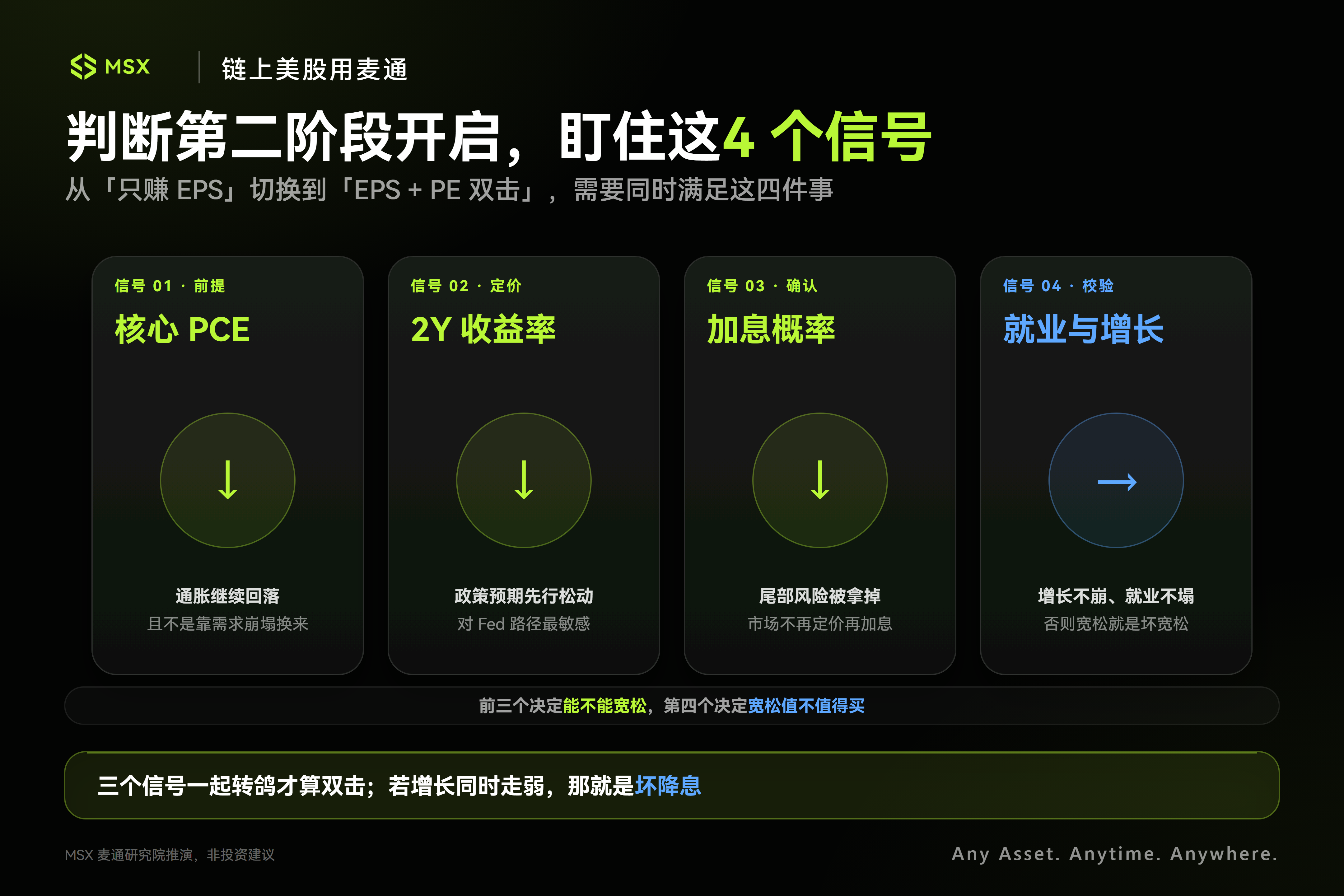
If the PCE falls, the 2-year Treasury yield declines, and the economy and employment do not collapse significantly, the market trades may shift from "economic recession → interest rate cut" to "productivity improvement → inflation decline → soft landing or even no landing easing."
3. Redefining the division of labor between fiscal and monetary policy
This is also a very noteworthy line between Warsh and Yellen.
The ultimate goal for both may significantly overlap: neither wants U.S. long-term financing costs to spiral out of control.
However, their methodologies do not completely align.
Yellen is more inclined to proactively influence the long-end financing environment through Treasury buybacks of long-term bonds, adjusting market structures, etc.; while Warsh clearly believes more in market pricing and opposes the Fed’s long-term large-scale balance sheet interventions in the bond market.
Therefore, rather than interpreting it as a conspiracy to "lower rates," it would be better understood as a new policy division of labor, where the Treasury handles the structure and liquidity of the long-end Treasury bond market, while the Fed tries to refocus its main policy tools back onto short-term rates.
If this combination really comes to fruition, the U.S. could usher in a very different easing cycle from the past decade: first maintaining inflation and long-bond market credibility, then lowering short-term policy rates once conditions become favorable, while keeping the Fed's balance sheet relatively restrained.
This might be the actual place where "open hawk, hidden dove" is truly worth trading.
Today's hawk does not mean they will always remain a hawk in the future; conversely, the bolder they are today as a hawk, the more the market may trust them when the need to pivot to dovish arises in the future.
3. If the logic holds, what should the U.S. stock market be trading?
For us, whether Warsh is really an insider of the White House is not that important.
What matters is where the money will go first and then next, if his macro logic gradually comes to fruition.
MSX Research Institute believes that rather than simply breaking the market into three scenarios of "hike / no hike / cut," it is better to understand it as three potential trading phases that may unfold sequentially.

The first trade is to first trade AI's "profits."
At this stage, interest rates remain high, and the Fed is even discussing hikes again. The most comfortable assets now are not those companies most eager for the Fed to cut rates soon.
Instead, it's those companies that can absorb valuation pressure through their self-generated profit growth even if high rates persist.
This is why, in the first phase, high-quality AI leaders and the infrastructure chain formed around AI Factory are still worth paying attention to.
This includes AI chips, hyperscalers, data centers, networks, storage, and power and energy infrastructure. Their biggest commonality is that their profit growth is fast enough to offset the valuation pressure brought by high discount rates.
So, at this stage, the market is truly trading EPS upgrades; as long as the AI CapEx can be effectively transformed into revenue, profits, and free cash flow, it will be easier to continue obtaining funding in a "Higher for Longer" environment.
Conversely, those long-duration growth companies that have only long-term narratives and have not yet formed stable profits will still face pressure from high rates.
This also means there will continue to be differentiation within AI, with profitable AI and non-profitable growth stories increasingly becoming different assets.
The second trade is to next trade AI's "valuations."
Here, one can focus on the signals of PCE falling + 2Y Treasury yield breaking down + Fed rate hike probabilities rapidly declining.
If these three signals appear simultaneously, and if employment and economic activity show no obvious collapse, the market is likely to start believing that the economy is still doing well, corporate profits are still rising, but inflation has allowed the Fed to stop tightening and even prepare to shift to easing.
At this stage, those AI leaders that have seen price increases in the first phase may face a second revaluation, as before, their rise was mainly supported by EPS increases, and now it starts to change to EPS increases + declining discount rates.
Profit upgrades + PE expansion could represent the most comfortable phase in the entire AI trading.
Because corporate earnings haven’t undergone drastic revisions during traditional contraction cycles, but the valuation side begins to gain support from declining interest rates.
Of course, from this perspective, AI leaders are not just assets of the first phase; they likely span both the first and second phases.
They earn profits in the first phase and then make money from valuations in the second phase.
The third trade is when it’s time for "easing Beta."
When the downtrend in rates is clearly confirmed, capital may then spread from AI leaders to the periphery, and assets that have been most suppressed by high capital costs in recent years will undoubtedly gain greater valuation elasticity.
This includes Russell 2000 (IWM), REITs (XLRE), homebuilders (XHB, ITB), biotech (XBI), certain regional banks (KRE), and high beta crypto (COIN, MSTR), among others.
The main difference between these assets and those from the first phase is that they do not purely depend on economic growth but rather need capital costs to truly decrease.
For example, small-cap stocks are more reliant on bank loans and capital market financing; REITs and the residential real estate chain are highly sensitive to financing costs; biotech is a typical long-duration asset; high beta crypto assets are particularly sensitive to changes in dollar liquidity and risk appetite.
Conversely, if Warsh continues to be hawkish and the USD and real yields strengthen concurrently, they could also become some of the most sensitive assets to changes in liquidity.
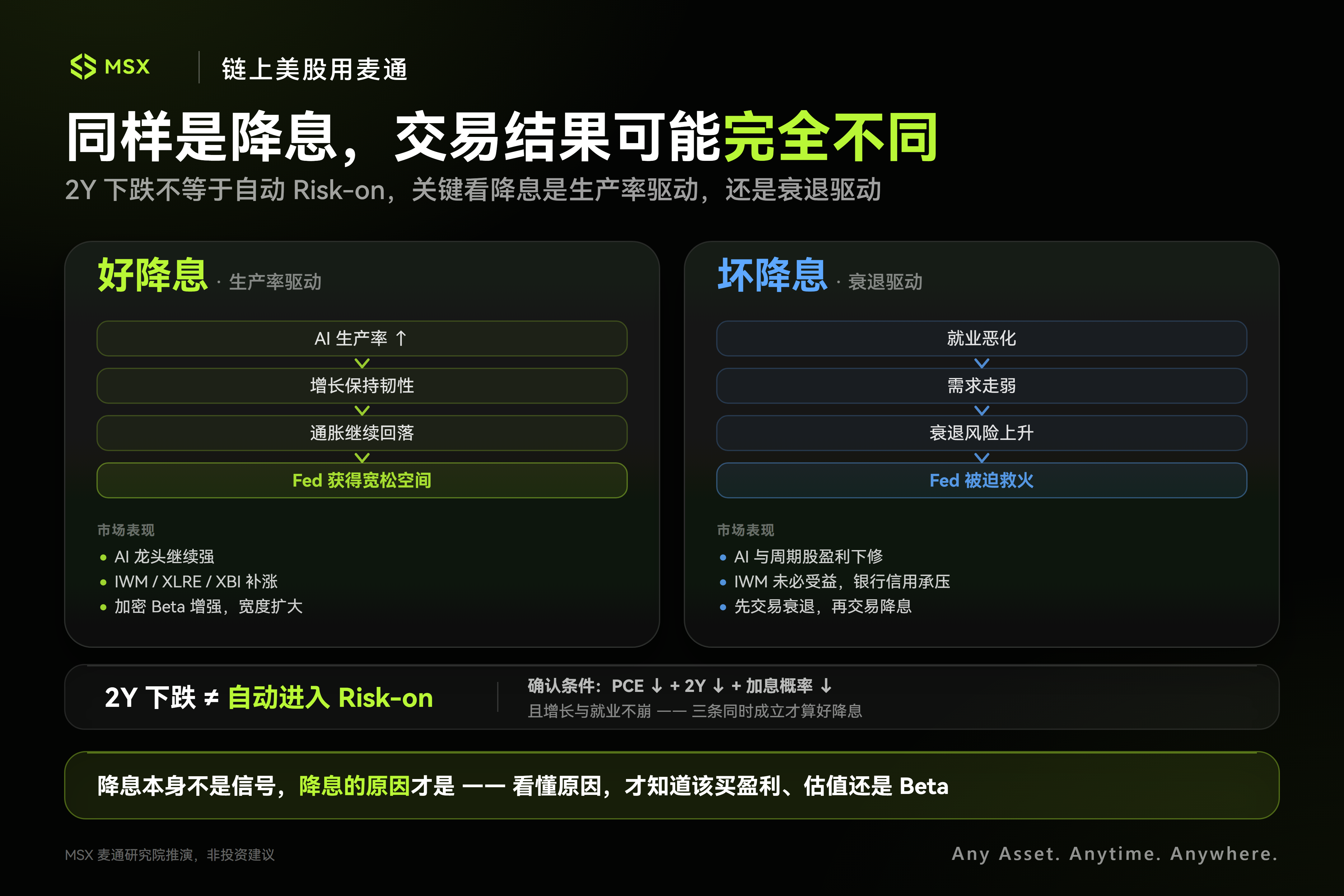
Ultimately, not all "rate cuts" warrant buying the same batch of assets; if the future unfolds as "AI productivity increases → growth remains resilient → inflation declines → Fed gains rate cut space," this would represent the most ideal "good rate cut."
During this time, one could see AI leaders continuing strong while small caps, REITs, biotech, and crypto beta catch up, significantly broadening the market.
However, if the future consists of "employment suddenly deteriorating → economic recession → inflation decline → Fed is forced to cut rates," this is an entirely different "bad rate cut."
Even if the 2Y Treasury yield drops rapidly in that situation, small caps, regional banks, and cyclical stocks may not immediately benefit, because the market might first price in earnings downgrades and credit risks.
These are two completely different scenarios.
In conclusion
Warsh is clearly far from an "outsider."
He has served as a Fed governor, experienced the 2008 financial crisis, and has immersed himself in both Wall Street and U.S. policy circles for many years.
If the Fed over the past 20 years is viewed as an increasingly precise machine reliant on models, forward guidance, and market communication, then today’s Warsh indeed resembles a disrupter ready to come in and do great work.
Say less, commit less, use less QE, and let the market reprice itself — except nobody knows whether the outcome will be good or bad.
For Trump, a Fed chair who can persuade the bond market that "I am definitely not a political puppet" will have the confidence to truly lower the benchmark rate in the future.
This is why Warsh’s current hawkishness can ironically create room for all his future trump cards.
From September 16 to the upcoming dates of October 28 and December 9, in the coming three months, we will soon reveal what the first complete script of the Warsh era truly looks like.
免责声明:本文章仅代表作者个人观点,不代表本平台的立场和观点。本文章仅供信息分享,不构成对任何人的任何投资建议。用户与作者之间的任何争议,与本平台无关。如网页中刊载的文章或图片涉及侵权,请提供相关的权利证明和身份证明发送邮件到support@aicoin.com,本平台相关工作人员将会进行核查。


