In the past, watching the market was the most headache-inducing: staring at the charts every day, yet always feeling like I couldn’t do it.
Whenever BTC rose, I was afraid of missing out, wondering whether to chase; when it just fell, I felt an opportunity had come, but when it came time to place an order, I would still hesitate: “Will it drop further?”
I looked at a bunch of candlesticks, but in the end, I was still relying on my feelings. I wanted to chase when it rose, wanted to scoop when it fell, and was afraid of missing out when it was sideways.
After listening to Teacher Zhu Shan from Huiying Community's live stream on the evening of August 30, I realized that when I used to watch the market, my eyes and mind were focused solely on the ups and downs.
Every day, I was asking: “Is it going to rise or fall next?”
Very rarely did I look seriously: “Where is the price actually right now?”
Once I changed my perspective, I realized many market movements didn’t need to be guessed so eagerly.
First find the position, then see how the price behaves when it gets there.
1. BTC made me start paying attention to “where the price has gone”
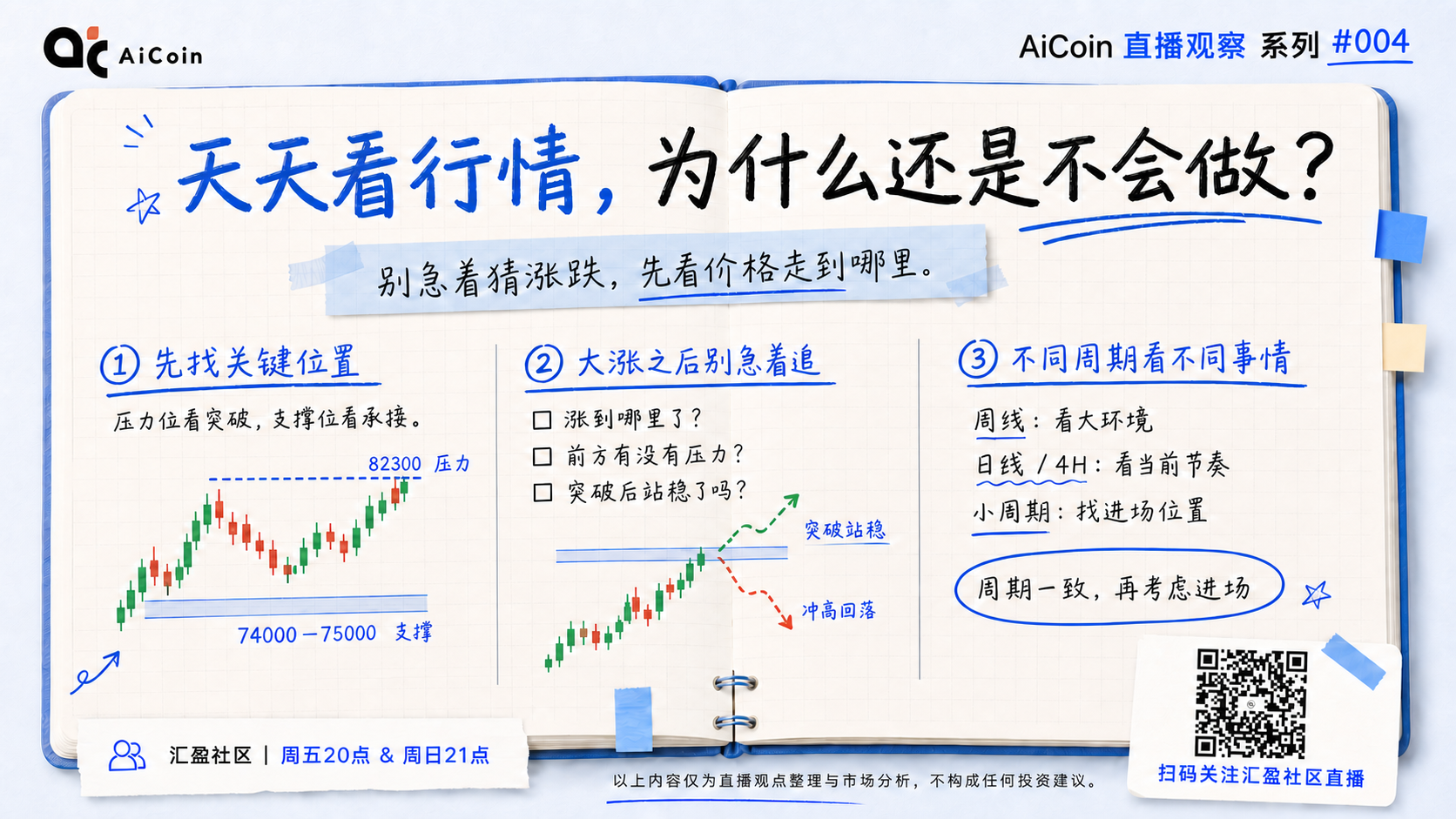
When analyzing BTC in the live stream, the teacher repeatedly mentioned a key level: around $82,300.
From a broader cycle perspective, the upward structure of BTC is still intact, but the pressure here is quite evident.
If it breaks through and holds, we can continue to watch around $93,000; if it struggles to get through, we need to be cautious of the market entering a correction.
In the past, when I saw this kind of analysis, I would probably only remember: “Break through 82,300, look for 93,000.”
Looking back now, what’s truly worth watching is the price reaction near 82,300.
- Can it hold after breaking through?
- Is there volume support?
- Or is it just a brief breakthrough before quickly falling back?
If it starts to correct, the $74,000-$75,000 area below is also worth observing.
This allowed me to understand, for the first time, what “watching the position” truly means.
Arrive at resistance, see if it can break through; arrive at support, see if there is buying interest.
Numbers are just a reference; how the price behaves when it gets to this level is what we need to focus on next.
2. When seeing a big rise, don’t rush to chase
This was also a mistake I used to easily make.
When a large bullish candlestick suddenly appeared, my first reaction was : “Is it about to start?”
Then as it kept rising, I got more anxious: “If I don’t buy now, will it be too late?”
Finally, I would make a shaky move and buy in.
But if the price just happened to reach a recent high or an important resistance level, things wouldn’t be that simple.
Rushing to break through resistance while continuing to increase volume is one kind of trend; pushing up and then quickly dropping back is another kind.
In the future, when I see a sudden surge, I plan to pause first and ask:
- Where has it risen to now?
- Is there previous resistance at this position?
- Did it hold after breaking through?
First clarify these questions, then decide whether to take action.
3. Different time frames focus on different things
In the past, I also had a habit: if the weekly chart looked bullish, I felt I should go long.
Then I would jump into the 15-minute chart looking for a buying point, and just as I entered, the short-term would start to pull back.
In the end, I would wonder: “The direction was clearly right, so why am I still losing?”
After breaking down the different time frames in the live stream, this question became easy to understand.
- The weekly chart looks at the big environment.
- The daily and 4-hour charts observe the current rhythm.
- Smaller time frames then seek specific entry positions.
So just because the weekly chart is bullish, doesn’t mean every bullish candlestick on the 15-minute chart is worth chasing. A short-term pullback also doesn’t mean a major trend has reversed.
Often, it’s not that the market is particularly complicated, but that I was mixing the information from several time frames together.
4. ETH made me truly realize: sometimes, it’s better to do less in the market
The fluctuations of ETH also left a deep impression on me.
In the past, when I saw the price moving back and forth within a range, I felt there were many opportunities: shorting at the top and going long at the bottom.
However, when I actually tried to trade, it often turned into: just as I tried to short, the price would rise; just as I tried to long, the price would drop.
After several rounds, both sides would be exhausted.
What was mentioned in the live stream as “mutual destruction of longs and shorts” was something I had only heard before, but this time I truly understood.
Volatile markets may not appear to fluctuate much, yet they can easily wash out those who trade frequently.
So now I remind myself: when I don’t understand, I can refrain from trading.
The market presents opportunities every day, but not every segment is suitable for participation.
5. Moving forward, I plan to watch the market this way
After listening to this live stream, I set myself a relatively simple process:
Step 1: First, look at the larger time frames.
First judge whether it’s an uptrend, downtrend, or sideways movement.
Step 2: Find key positions.
Mark out previous high and low points, as well as positions of repeated resistance and support.
For example, key levels to focus on for BTC this time:
around 82,300 and 74,000-75,000.
Step 3: Wait for the price to reach the positions.
Until it gets there, don’t rush to place a bet.
Step 4: Observe how the price reacts.
Whether it breaks through, meets resistance, pulls back to hold, or breaks through then falls back.
Step 5: Then decide whether to trade.
If the structure, position, and my trading cycle align, then consider entering.
When reviewing daily trades, don’t just look at whether I made or lost money; ask a further question: “Why did I enter here?”
If I made a mistake, observe whether it was due to the direction being wrong, the position being incorrect, or entering too early.
6. My biggest change: starting to accept “waiting for answers”
In the past, I believed that being able to analyze the market meant I could predict the next move.
Now I realize that what’s truly useful is knowing what I’m waiting for.
When BTC is near 82,300, I know to observe for breakout and stability; when it returns to 74,000-75,000, I know to check for support;
If there’s a sudden short-term surge, I know to first see if it has reached a resistance level; when the market enters a range, I also know it’s not necessary to participate in every fluctuation.
First observe the cycles, then find the positions, wait for the price to express itself, and then decide.
This method sounds simple, but for someone who used to always think about “whether it will rise or fall next,” it’s already a huge change.
Don’t rush to prove that you are right; first, observe what the market is actually doing.
- If the resistance hasn’t broken through, just wait.
- If the support hasn't been confirmed, just wait.
- If the structure hasn’t formed yet, it’s also okay to wait.
Sometimes, understanding why I’m not trading is also a form of progress.
【Huiying Community】 Live Broadcast: Fridays at 8 PM & Sundays at 9 PM
The content above is organized from 【Huiying Community】’s latest live broadcast, where Teacher Zhu Shan analyzed multi-cycle trends, key support and resistance for BTC and ETH, and short-term trading rhythms. This article only extracts parts suitable for beginner traders to understand and review.
If you want to continuously follow the latest market situations and analyses, you can follow the AiCoin official website live broadcast on Fridays at 8 PM & Sundays at 9 PM.
Quick booking:
https://www.aicoin.com/zh-Hans/live
Huiying Community| Fridays at 8 PM & Sundays at 9 PM
🎙️ Live room:
https://meeting.tencent.com/p/9640132127
【AiCoin Group Chat】 Search for Huiying Community or click on the group link to join:
https://www.aicoin.com/link/chat?cid=onjrNpKn6
The above content is merely a summary of viewpoints from the live broadcast and market analysis and does not constitute any investment advice. The cryptocurrency market is highly volatile, please make your own judgment and manage risks effectively.
免责声明:本文章仅代表作者个人观点,不代表本平台的立场和观点。本文章仅供信息分享,不构成对任何人的任何投资建议。用户与作者之间的任何争议,与本平台无关。如网页中刊载的文章或图片涉及侵权,请提供相关的权利证明和身份证明发送邮件到[email protected],本平台相关工作人员将会进行核查。