The original text is from James Lavish,
Compiled by|Odaily Planet Daily Qin Xiaofeng(@QinXiaofeng888)
Editor's note: Strive (NASDAQ: ASST) independent board member and hedge fund manager James Lavish recently published an article analyzing whether the Federal Reserve can negotiate to lower interest rates? (Note: Strive currently holds 23,156 BTC, making it the fifth largest BTC holder among publicly listed companies.)
He believes that although Federal Reserve Chairman Walsh insists during his Jackson Hole speech that he will not provide forward guidance, he has caused significant market changes through the intensive release of signals. He reiterated the 2% inflation target "remains unchanged" four times, mentioned "inflation" thirty times, and frankly stated that the responsibility for high inflation lies with the central bank itself. The market immediately repriced: short-term Treasury yields rose (the one-year climbed to 4.13%), while long-term yields briefly fell, creating a flattening curve similar to 'Operation Twist'—but no policy tools were used throughout, relying solely on words, which can be seen as a "verbal operation twist."
However, long-term yields completely reverted their declines before closing, as the bond market recognized that real pressure came from the supply side: more than $10.5 trillion in U.S. debt maturing over the next year needs refinancing, plus about $2 trillion in new deficits. The Treasury had previously attempted a "Treasury twist" by expanding long-term bond repurchases, but the effect was fleeting. Walsh's comments temporarily lowered inflation expectations (break-even rates fell), but could not change the reality of the debt flood.
Gold, silver, and Bitcoin responded sharply (gold fell 3.7% that day) as tightening expectations weighed on non-interest-bearing assets. However, the article pointed out that the current market volatility mainly revolves around "interest rate issues" (the reaction to the Federal Reserve), while the long-term challenge is the "supply problem"—the latter will not disappear with a few words. Investors should distinguish between the two and pay attention to the Fed's meeting in September, the Bank of Japan's decision, and the subsequent developments in the Treasury's repurchase window.
Below is the original text, compiled by Odaily Planet Daily, Enjoy~
——————
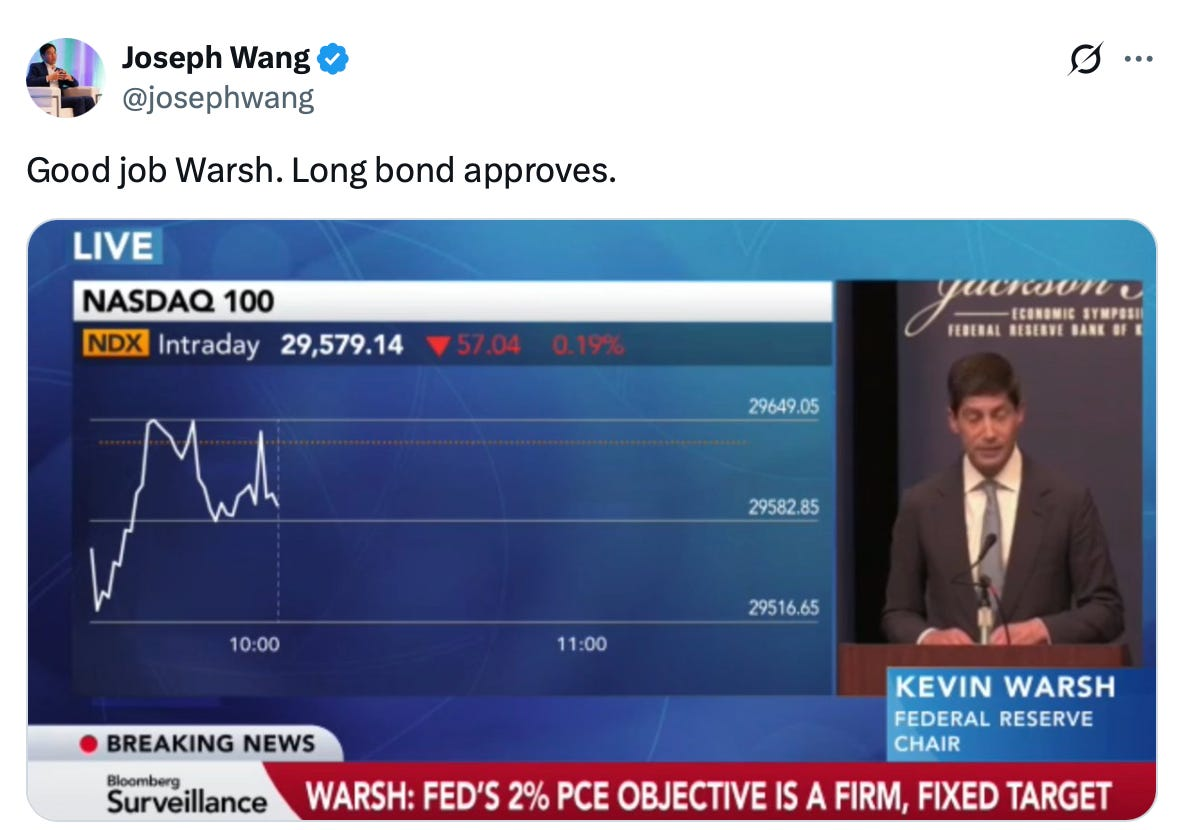
Whether you are a professional investor or an amateur, you likely heard about Walsh's speech last Friday. It was delivered at Jackson Hole, Wyoming—in a completely informal environment, standing at the formal Federal Reserve podium. This is the venue for the Fed's annual retreat, officially named the Federal Reserve Economic Symposium.
It is affectionately referred to on Wall Street as a "junket for central bank presidents." But what we don't know is what he was really going to say. Especially because Walsh has consistently insisted that the Fed should no longer provide forward guidance to the market.
Nevertheless, the market was full of anticipation and heating up, even though most people—economists, investors, and commentators alike—thought that since he wasn't planning to offer guidance, this speech would probably just be a bunch of empty words. But they were disastrously wrong.
Because as soon as Walsh opened his mouth, the market began to react almost immediately.
U.S. Treasury bonds experienced significant volatility, as Joseph Wang pointed out above, long-term bonds liked what they heard. Meanwhile, store-of-value assets—such as gold, silver, and even Bitcoin—were hammered within minutes.
The question is: was this intentional? Did Walsh deliberately want the market to react this way? If so, why? More importantly, why did some bonds reverse much of their rises before the end of the day? Most importantly, what does this mean for our own investments and portfolios?
These are all good questions, important questions, and I will answer them one by one.
What Did Walsh Actually Say
For someone who insists on not revealing any information to the media anymore, Walsh seemed to say a lot on Friday.
Let's start with this clever phrase: “...there should be no misunderstanding: the Federal Reserve's 2% price stability target—as measured by the personal consumption expenditures (PCE) price index—is a firm, fixed target.”
His mention of PCE is not surprising, as it has long been the Fed's preferred inflation measure and has remained high for years. Currently, it stands at 3.7%.
The chairman reiterated that the Fed's target is 2% and that it will not change.
As he stated: “The responsibility for persistently high inflation over the last 65 months rests squarely with the central bank.”
Just do the math: 65 months is roughly five and a half years. Walsh is almost taking responsibility for the Fed. He knows he wasn’t in charge back then; he knows we know he wasn’t in charge then; he’s here to clean up after us. What a nice guy.
Forward guidance reappeared in the speech: “Here’s a brief outline of what I’m talking about this morning. You can call it an outline...you can call it a roadmap...just don’t call it forward guidance.”
He concluded with a determined attitude: “What I commit to standing here today is discipline, not a determination.”
He also said: “Economic literature has long characterized its distorting effects: a funhouse mirror problem. If the market substantially relies on guidance from the Fed while the Fed relies on market prices, we are all more likely to miss new changes…more likely to be caught off guard when things turn…more likely to error in policy making.”
In other words, if the market focuses on guessing what the Fed will do while the Fed is concerned about what the market expects, then both are feeding off each other.
A nearly perfect circular reference. Therefore, no one responds to the real economy itself. This makes all economic data nearly useless.
Anyhow, Walsh said he hopes the Fed will be quieter while seeking cleaner feedback. His original words were: “The Fed needs clear market signals, as unfiltered as possible.”
For some reason, when I watched the speech and heard him repeatedly say that 2% is the inflation target and that it will not waver, a certain movie scene flashed in my mind.
Some of my older readers might recall the movie “Cool Hand Luke” starring Paul Newman. In a famous scene, a chain gang of prisoners is working outside, and the guard captain—Strother Martin—after beating Luke (Paul Newman) stands next to him and says: “The problem here is that we have a failure to communicate. Some people you just can’t reach. So you get what we had last week here, that’s the way he wants it. Well, he got it. I don't like it any more than you do.”
In other words, Luke’s refusal to yield only brings more severe punishment, just like the beating they just witnessed. And Luke does indeed break down. Later in the film, there’s a scene where he tells them he has come to terms with it, which frustrates everyone around him. But it didn’t last. He turned back into Luke.
Perhaps long bonds are Luke here. Maybe what Walsh really wants to convey is that the bond market refuses to acknowledge that the Fed has a new chairman who is determined to control inflation. Therefore, in Friday’s speech, Walsh said "2%" four times and "inflation" thirty times.
And the market took a heavy hit because of it. What was the result?
Before the speech, the federal funds futures market priced the probability of a rate hike in September at around 36%. By the end of the day, this probability rose to 57%.
Moreover, looking ahead two years, the expected number of rate hikes increased from 1.8 to about 2.4. This means an extra two-thirds of a rate hike—entirely because of a speech that never clearly indicated the direction of interest rates.
Remember, every rate hike—if it actually happens—will directly impact the costs that you, I, and every company in the nation need to pay to borrow money.
Now, whenever the Fed speaks, trading floors will crank up the volume, listening intently to almost every word until the speech ends. Then we will be bombarded with analysis and interpretations from economists and commentators for the rest of the day.
Friday was an upgraded version of that.
The respected Bloomberg economist Anna Wong summed it all up in one sentence.
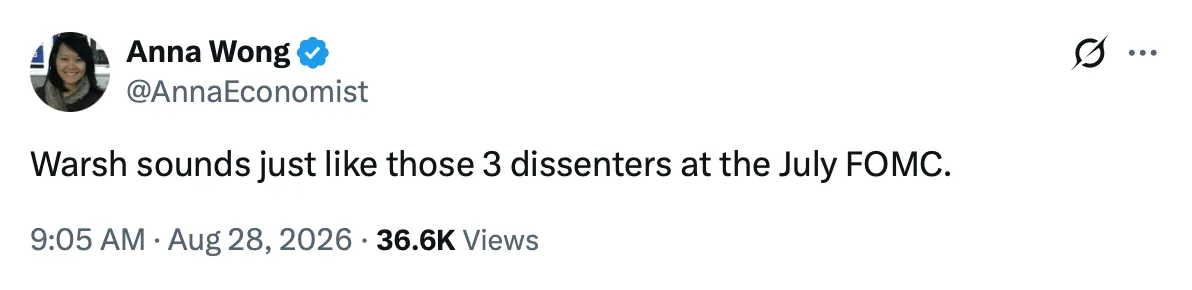
Remember, at the Fed's July meeting, the vote was 9 to 3 to keep rates unchanged, while the three dissenters wanted an immediate rate hike. So regarding her view—I agree—the chairman now seems to be aligning with those three.
For long-time readers of mine, none of this is particularly surprising, as we delved deeply into how Walsh uses his voice back in July. Our conclusion back then was essentially: He is publicly adopting a hawkish tone, perhaps to protect his own reputation, then refusing to commit to anything to leave himself all avenues of retreat.
This is evidently the same script he employed on Friday. Because although he did not mention rate hikes at all, the market immediately began pricing in a rate hike.
The question now is, will they really raise rates in September?
Even though the market now leans towards "yes," I don’t think so because I feel Walsh wants maneuvering room. He wants to maintain the status quo and not take any substantial action until seeing more data. At least that’s how I see it.
Interestingly, the federal deficit was never mentioned, nor was national debt, the Fed's balance sheet, or the long end of the curve. The word “Treasury” only appeared once throughout the speech, and merely as an example of markets they will be watching.
Of course, this is not surprising, especially since it was a one-way speech with no Q&A session.
However, given the enormously high levels of debt, these are the exact questions we wish someone would have asked him.
This is an extremely important point that we’ll explore further later.
But first, let’s discuss the market’s reaction and how powerful Walsh's words—at least temporarily—have been.
Verbal Operation Twist
First, a bit of historical background. Don’t worry, we’ll be brief, but this will help in understanding what happened on Friday.
We need to go back to 1961 when the Kennedy administration faced a problem. They wanted short-term interest rates to be high because funds were flowing abroad seeking higher yields. Raising domestic short-term rates would help keep money at home, investing in the U.S. market rather than flowing overseas. Additionally, they wanted long-term rates to remain low because that is what U.S. businesses, consumers, and homebuyers are actually borrowing at, and the economy needed a boost.
They were very eager to achieve this, so the Fed and the Treasury acted in concert.
They sold short-term government bonds and used the cash to buy long-term bonds. Remember, selling will lower bond prices and raise yields, while buying does the opposite. Thus, at the front end of the curve, yields will rise, while at the back end, yields will fall.
This operation was initially dubbed a “gentle push,” as the plan was to gently push long-end rate down while keeping short-end rates up. Later, someone cleverly pointed out that the yield curve itself was rotating around its midpoint and likened it to a hugely popular song at that time, Chubby Checker’s “The Twist.”
And thus, this Fed/Treasury operation was named “Operation Twist.”
So, was Operation Twist effective? Kind of, as long-term rates dropped about 15 basis points, or 0.15%. Not nothing, but it wasn’t a huge help either.
Fast forward to the post-financial crisis period when the Fed implemented this operation again in 2011—“Operation Twist” Season Two. This time they achieved about a 0.25 percentage point effect. Again, not nothing, but at a significant cost for such a small change.
Anyway, that’s the play. Raise one end of the curve while lowering the other, without touching overnight rates.
You might be wondering why they are doing this today?
Simply put, high short-term rates will make the Fed appear serious about tackling inflation. Low long-term rates will lower the costs of mortgages, auto loans, and corporate borrowing.
The problem is, if bond buyers identify that you're executing an Operation Twist, they instinctively know it ultimately leads to more money printing and consequently, more inflation.
Thus, I believe that both Walsh and Bassett are asking themselves and each other the question: how can Operation Twist be executed in a less obvious manner?
This is the way.
Nine days before Walsh stood at the Wyoming podium, Scott Bassett doubled the scale of the Treasury's long-term bond repurchases and then went on CNBC to say, “this is called the Treasury twist.”
Note, not “Operation Twist,” since that implies Fed involvement which suggests more money printing. It should be clear that this operation indeed costs money. Real money, spent to buy real bonds in the open market.
What about the Fed? Like we said, the Fed was not involved in the Treasury twist.
And on Friday, Walsh did not buy any bonds. He did not sell any bonds. He did not let overnight rates change a basis point. He still has another two and a half weeks until he can do that.
At least without undertaking emergency intermeeting operations—which would look panicked. Any new Fed chair would not want to send that signal.
So how can one convey a serious attitude toward inflation without any policy? With words. He just spoke, spoke, spoke.
- “2%.” Four times.
- “Target.” Twice.
- “Inflation.” Thirty times.
And then the market reacted. Took the bait. Took the bait.
During the speech, the ultra-short end—that is, notes maturing before the next Fed meeting—barely moved, but look at the performance of the other parts of the curve.
First, the short end.
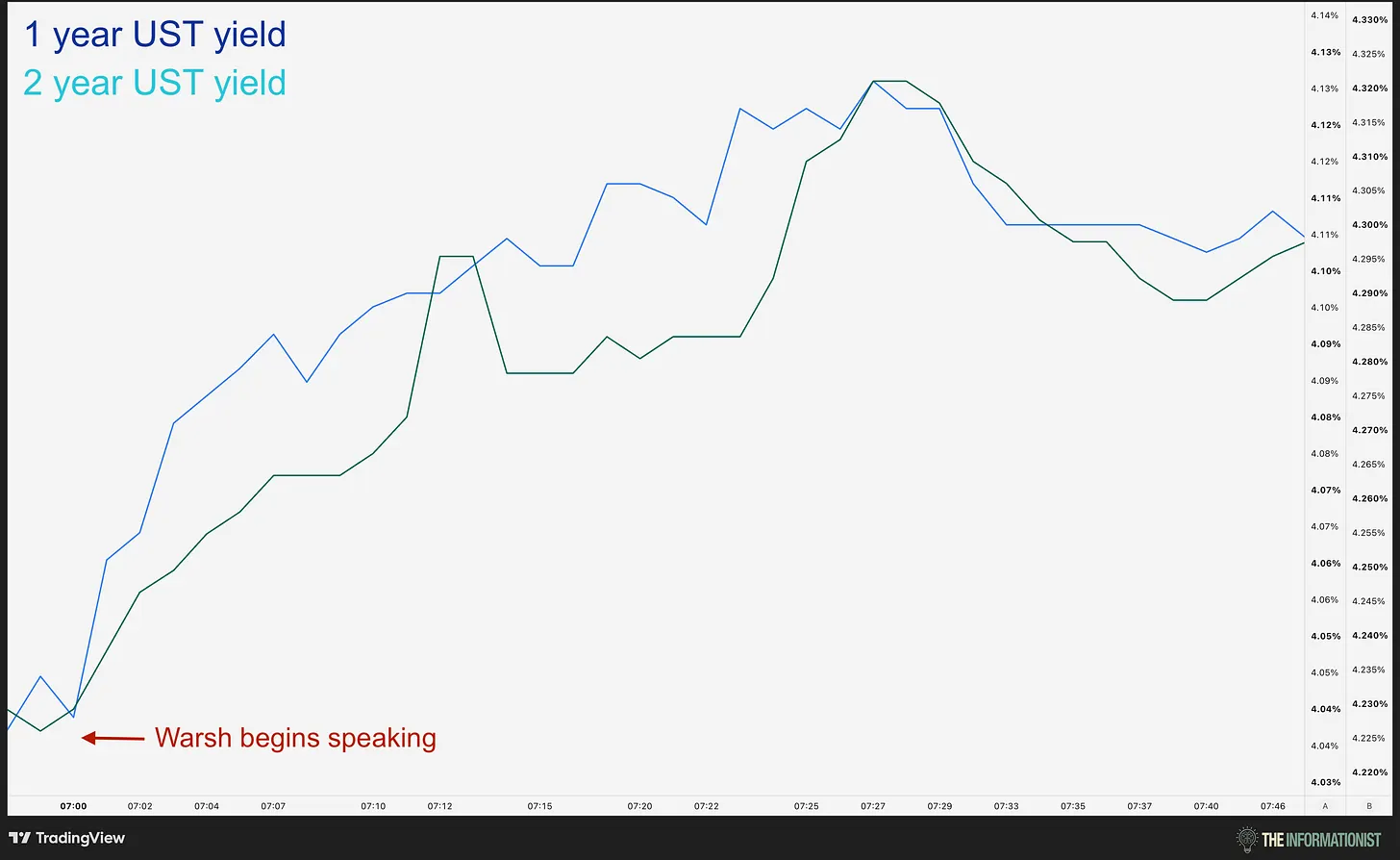
With each mention of the word “inflation,” the one-year yield slightly rose, moving from 4.04% to a peak of 4.13% by the end of the speech. Roughly equivalent to a third of a Fed rate hike (25 basis points).
The two-year rose by 10 basis points. About 40% of a full Fed hike.
Meanwhile, the 30-year Treasury yield dropped from 5.21% before the speech to 5.16% before the end of the speech. The 20-year was almost identical.
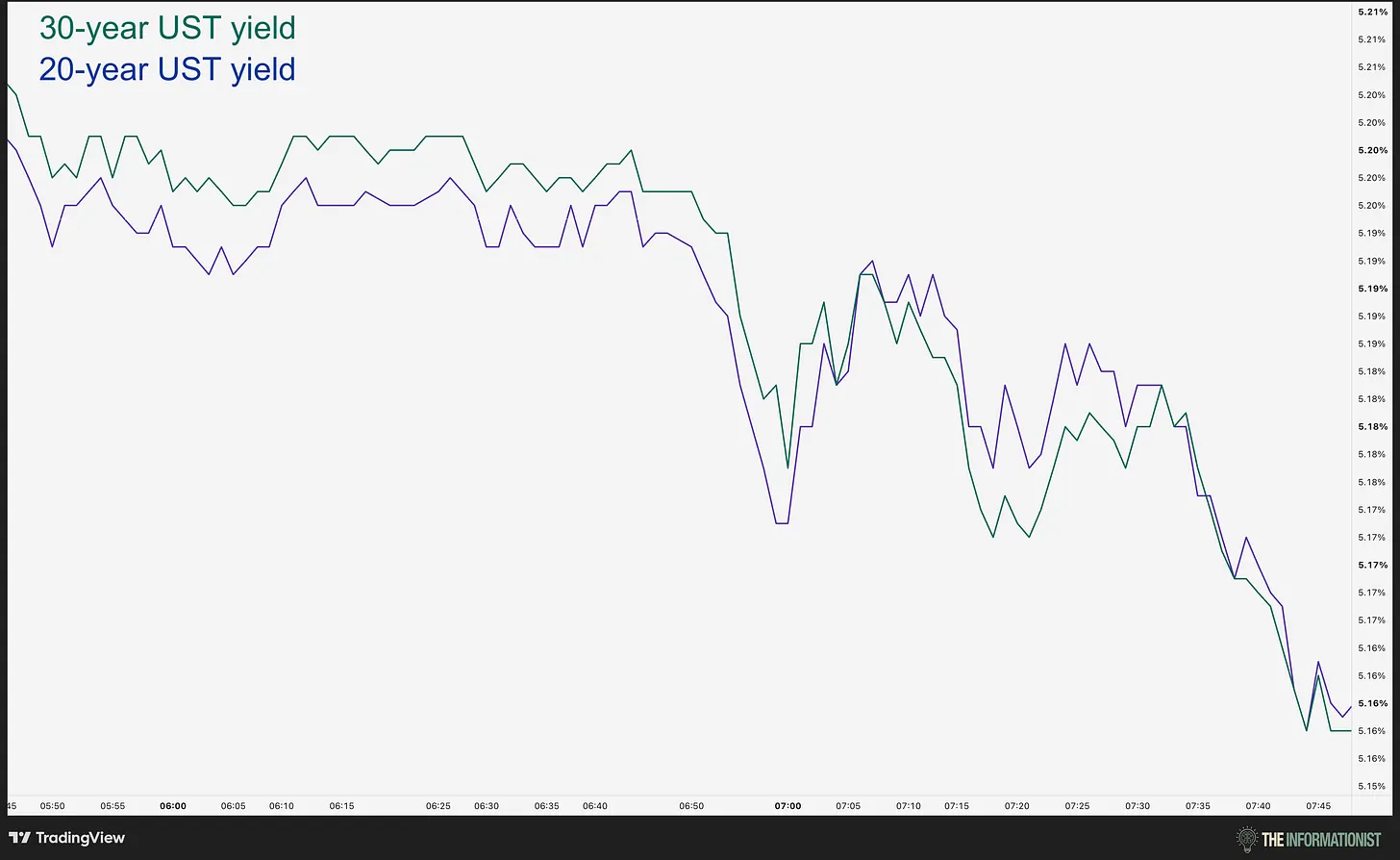
In other words, during the chairman's speech, the market reaction was for short-end yields to rise and long-end yields to fall.
I have been in this business for many years, and this is one of the clearest live market repricings I can remember. But this time it didn’t cost a penny, just words. Particularly with the heavy repetition of a certain word. So we have to call it a “verbal operation twist.”
In those few hours that morning, it operated perfectly in the way Walsh intended. But of course, the bond market—just as it always ultimately does—returned to reason.
The Parts He Cannot Control
So what did all these words buy Walsh? To answer this question, we need to look at it from three different angles, each telling us different information.
Let’s start with the twist itself. You can actually see it happening in real-time as he spoke. The question is whether it persisted. Below is the spread between the 30-year and 2-year yields from that day.
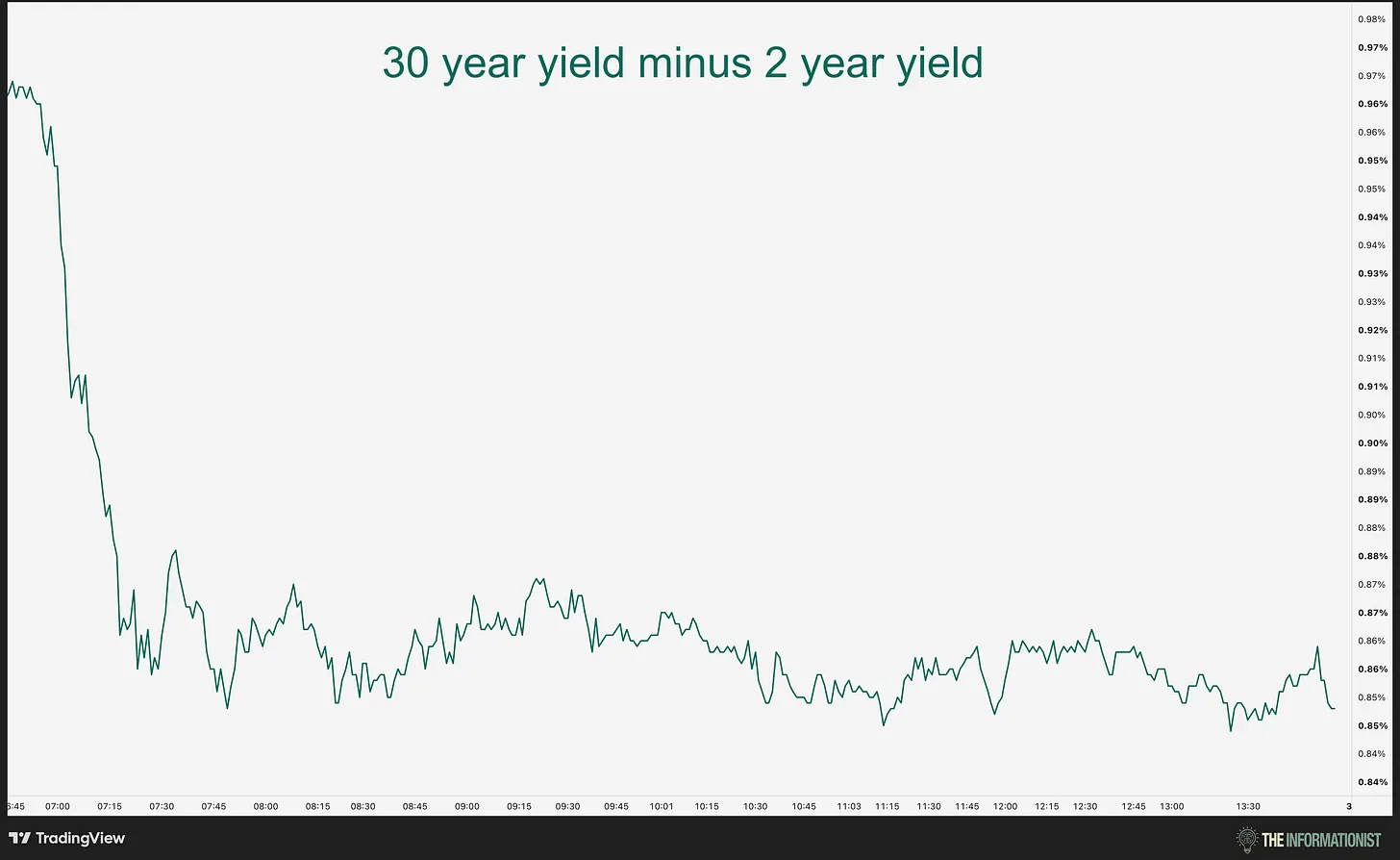
As you can see, within 20 minutes of the speech starting, it sharply narrowed from about 0.96 before the speech to about 0.86, and then it just sat there. All morning. All afternoon. Until the close. It narrowed by 10.7 basis points from Thursday. Bond investors call this “flattening,” and for reference, a ten basis point flattening in a single day is quite a significant move.
Okay, now let’s look at the second angle.
Remember the ten-year break-even inflation rate? That’s right, it’s the market’s prediction of average inflation levels for the next ten years. We’ve talked about it a lot recently because it’s the best real-time inflation expectation reading we can get.
As Walsh himself said on Friday: “Ensuring inflation expectations do not de-anchor is the Fed’s responsibility.”
Alright, let’s take a look at those expectations.
On Thursday, the ten-year break-even inflation rate closed at 2.3335%. By Friday morning at 8:45, it had slightly risen to 2.3406%.
Walsh began his speech at 10:00; 20 minutes later, it dropped to 2.3118%.
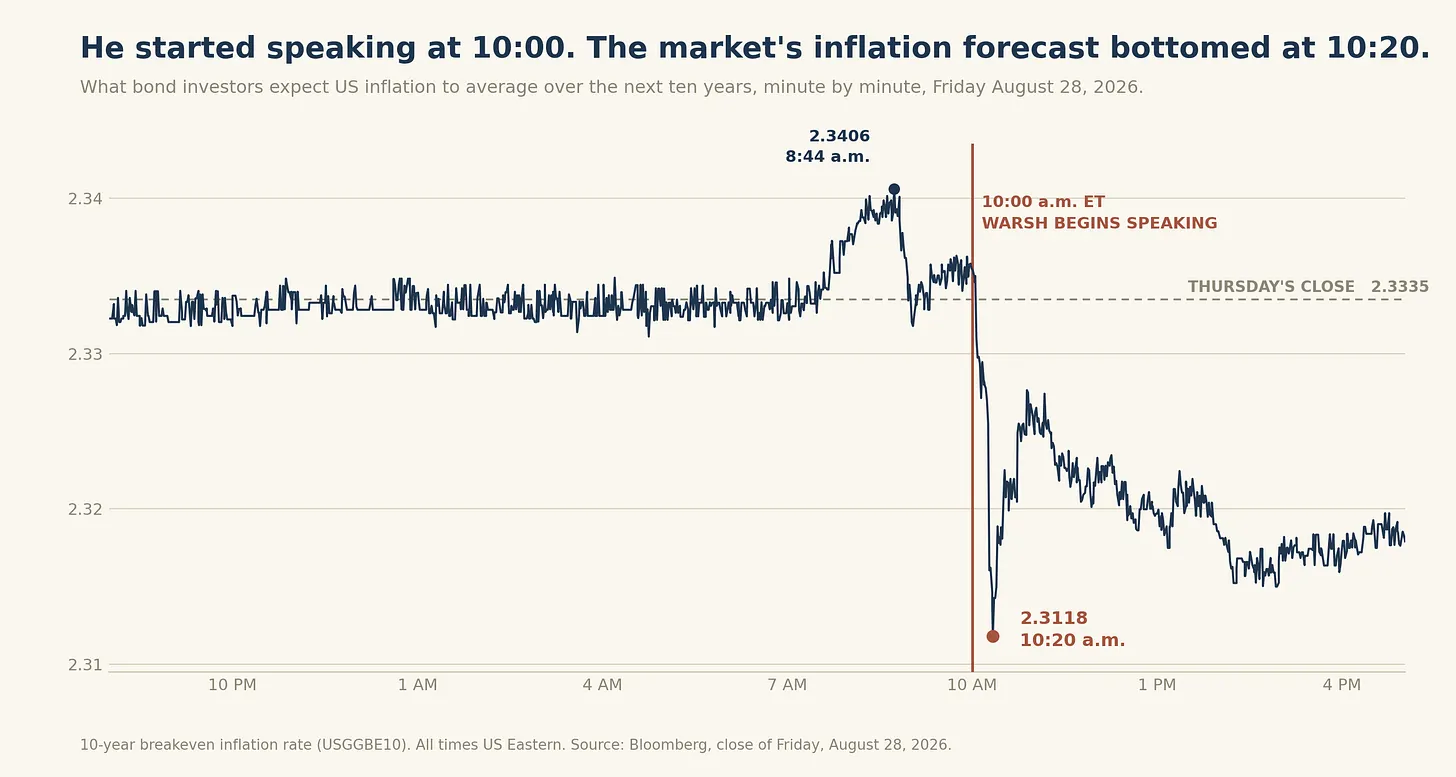
This spread did not recover either, closing at 2.3175%, lower than its starting point, remaining there throughout the afternoon.
Good. Both aspects align.
This leads to the third angle. The 30-year Treasury closed at 5.210% on Friday, right back to the level it was before he started speaking, up 1.5 basis points from Thursday.
It’s not just the 30-year. By Friday's close, each Treasury and note had a higher yield for that day. The one-year rose 12.6 basis points, tapering down progressively to the 30-year which rose just 1.5 basis points. This is also the reason the flattening ultimately held. The front end rose significantly and remained elevated while the back end saw almost no change.
Now, let’s summarize. Short-term yields rose because investors expect the Fed to raise rates in response to and in combat against inflation. The break-even inflation rate—which is the market’s expected inflation—fell a few basis points. The 30-year Treasury yield initially fell, then rose, ultimately closing higher.
The question is, if investors expect the Fed to respond to inflation, why are they demanding higher rates in the future?
I know you're going to ask because the cost of renting money has increased. The cost of renting money refers to the return that buyers demand to lock money in for thirty years. This is the additional part above their inflation expectations. Bloomberg's model priced it at around 1.45% on Thursday. And the five-year average is about 0.47%, which means current prices are roughly three times the recent norm.
Here are two facts. This number hit a five-year high on August 17, and the Treasury announced on August 19 that it would double the scale of long-term bond buybacks, just two days apart.
My guess is that the Treasury has someone who is watching the same expected data screens, which brings us back to Scott Bassett.
Two people, two completely different tools, nine days apart.
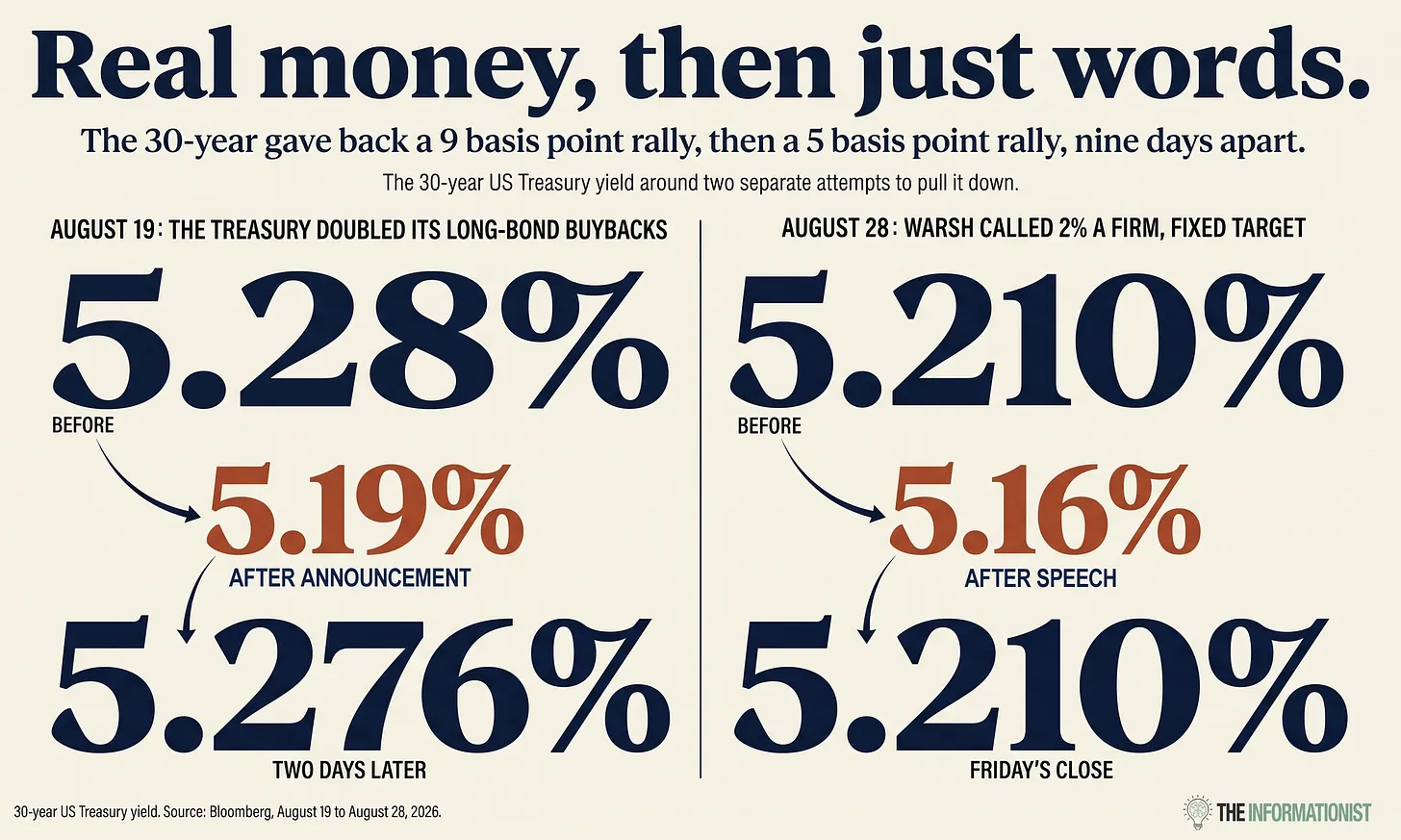
Bassett acted first, choosing the route of spending money. Real money, buying real bonds in the open market. The 30-year rose 9 basis points after he announced it, only to give it all back within two days. Then Walsh acted, choosing to use words. The 30-year dropped 5 basis points while he spoke, only to give it all back before closing, finishing at 5.21, returning to the starting point.
Nearly the same back and forth, nine days apart. Look, either way, the U.S. Treasury has to sell those bonds. We’ve done that arithmetic repeatedly over the years, and again last Sunday, so I won’t dwell on it here.
But there is one critical number. More than $10.5 trillion in existing debt is set to mature and needs refinancing, plus about $2 trillion in new deficit borrowing, all within the next year—that's the amount that must be sold. It has to be sold, regardless of whether inflation is 3.7%, 5%, or 2%.
The bottom line is that inflation promises cannot shrink the deficit, cannot redeem maturing bonds, and cannot conjure new buyers for the impending new wave of debt.
We still need old buyers and new buyers to show up at every auction from now until the end of 2027 to pick up these bonds. If you can see this tsunami of debt coming, you would be smart to ask for a bit more interest.
This brings us back to the original question of today: can the Fed talk rates down?
Friday proved that Walsh could convince the front end, could persuade the market's inflation expectations to fall, and keep them down. At least for a day. But the long end walks its own path.
What This Means for Your Money
So what did Friday do to the assets you might hold?
First, let’s talk about the hardest hit. Gold hit a high of $4,625.30 per ounce at 10:00 AM Eastern Time—the moment he started speaking. It closed the day at $4,453.67, down $171.63 from the high, a drop of 3.7%. Silver did the same at the same time. A high of $71, closing at $66.37, down $4.63 from the high, a drop of 6.5%. Both metals started to decline at 10:00 and bled throughout the day, both closing near their intraday lows. Bitcoin followed a roughly similar pattern that day, peaking at $79,775 and closing at $77,384.
Gold, silver, and Bitcoin are all viewed as assets to hold during currency devaluation; they are core to devaluation trades. They all do not generate yield, so higher yields typically lead to some selling of these assets. This was somewhat expected, especially when the market tells you inflation expectations are waning.
Let’s return to what was just said. The Treasury still needs to unload over $10.5 trillion in maturing bonds within the next 12 months, plus about $2 trillion in deficit borrowing. Nothing has changed here, and to my knowledge, it never will.
Remember the yen? On Friday, the yen closed at 160.09 against the dollar. On the same day, the Japanese Ministry of Finance announced the total amount of official intervention: ¥15.4 trillion in the four weeks ending August 26, approximately $9.7 billion.
This is their largest four-week intervention in history. Interventions can change prices; only policy can change trends. After four weeks and ¥15.4 trillion, the yen returned above 160. When September comes around, keep this in mind.
Now, what can we do with this information?
Here’s how I personally think about it, essentially the same way I’ve thought about it for the past four years.
When the government has to sell so many bonds, the value of the money it prints tends to only move in one direction over time. Friday did not change this; it just put it through a rough afternoon.
So the next time you see long-term yields soar—which you will—before you hear a word from any commentator or analyst, ask yourself one question.
Is this an interest rate problem or a supply problem?
An interest rate problem is the market's reaction to the Fed, which reflects on the front end of the curve. A supply problem is the market's reaction to the flood of bonds coming, as reflected on the back end of the curve.
It appears that Friday's volatility was almost entirely a reaction to interest rate issues. As the day progressed, the supply problem revealed its ugly head. Do not worry; you will soon have the opportunity to ask again.
The next Fed meeting is on September 15 and 16, with the interest rate decision on the 16th. Interestingly, the Bank of Japan meets on the following 17th and 18th. The expanded Treasury repurchase window opens on September 9 and lasts until November 4.
This means we have three opportunities in less than a month to ask the same question.
免责声明:本文章仅代表作者个人观点,不代表本平台的立场和观点。本文章仅供信息分享,不构成对任何人的任何投资建议。用户与作者之间的任何争议,与本平台无关。如网页中刊载的文章或图片涉及侵权,请提供相关的权利证明和身份证明发送邮件到support@aicoin.com,本平台相关工作人员将会进行核查。


