Original author: 0xLonglife
The Robinhood Chain trenches continue to be hot. Data shows that in the two months since its launch, the Robinhood Chain has reached a total of 463 million transactions, with 12.08 million active wallets, a cumulative trading volume of 52 billion USD on DEX, and nearly 594,000 meme coin trading targets on-chain.
Fees are the most honest emotional indicator of a chain: the accumulated gas on the Robinhood Chain has reached 4274 ETH; DefiLlama data shows that the daily gas fees on Robinhood Chain have risen from about 56,000 USD on August 23 to about 3.75 million USD on September 1. Profits are generated because trading volume has increased, and also because this chain is not cheap; the community has started to complain that “transaction fees are getting more expensive,” with some even complaining that transaction fees exceed those of the Ethereum mainnet.
High trading fees are certainly not good for traders, but from another perspective, isn’t it a good thing for the farmers who are most familiar with LP from DeFi Summer six years ago?
So we want to see, in this fee environment, whether it is better to continue fighting in the trenches PvP or to choose high-quality pools to form LP.
Why are the fees high?
The Robinhood Chain is an L2 of the Arbitrum series, and fees consist of two parts:
L2 execution fee: on-chain execution fee;
L1 data fee: the cost of sending transaction data to Ethereum for data availability.
The official documentation states that the L1 data fee will vary with Ethereum’s congestion and calldata size. Therefore, ordinary transfers and complex swap/launchpad transactions are not on the same cost level. Transactions on platforms like Pons and long.xyz generate more calldata and contract calls, where gas is just the first layer of cost. It can be said that the token issuance platform acts as an amplifier for the user’s fee expenditure.
For example, with Pons: Pons charges 0.0005 ETH for token issuance, V1 swap charges 1%; V2 has a default curve fee of 1%, and creator tax can reach up to 10%; even after the token graduates, the Uniswap v4 hook can still charge 1%. The fee distribution includes protocols, creators, PONS buybacks and burns, meme token buybacks and burns, Uniswap/LP, etc. Even Pons itself posted yesterday admitting that in the past 24 hours, Pons was the platform with the highest user-paid fees among launchpads on the chain.
Thus, the "high" of the Robinhood Chain is high on three levels: on-chain gas, token transaction taxes, miscellaneous fees, and the repeated costs of failures in high-frequency PvP.
Taking microduck as an example, suppose a user buys this token with ETH worth 1000 USD. The aggregator's transaction path should be: WETH--USDG--NVDA--microduck. In this path, at every step calculated with the most mainstream pools, the user will incur over 20 USD in transaction costs during the buying phase, mainly from the Pons V2 hook fee and creator tax (both 1%).
Similarly, if microduck rises by 50% and is then sold, the transaction costs exceed 30 USD. Ultimately, a transaction that shows a 50% floating profit, theoretically yielding 500 USD, actually nets 437.3 USD after accounting for costs of about 62.7 USD.
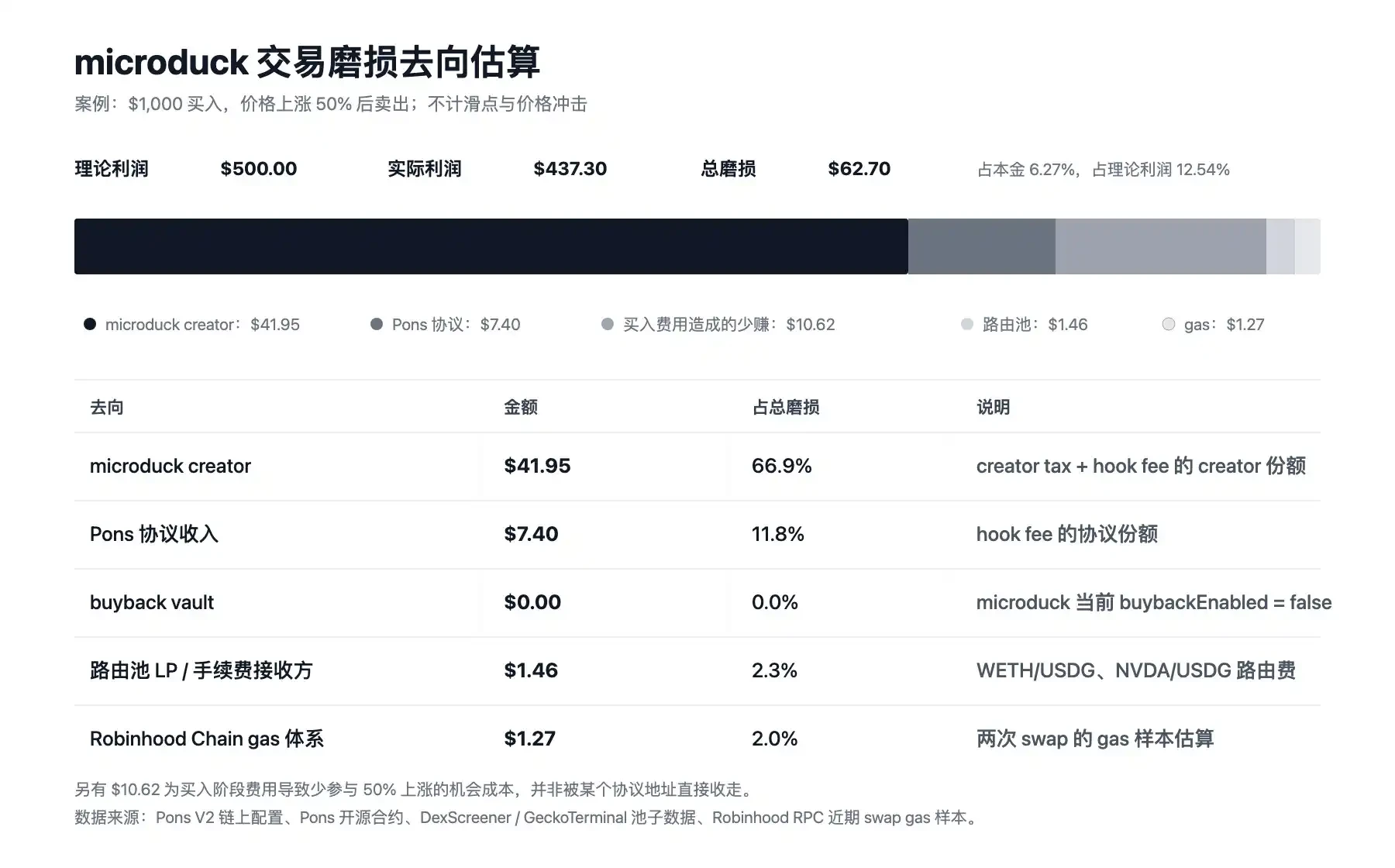
In this way, investors struggle to pounce on a golden dog, only for 12.54% of the profits to be siphoned off by the trading intermediaries.
The Actual Win Rate of Trench PvP
Many think that the trenches are a game of information disparity. But after fees have risen, it resembles a cost control game more.
Dune data shows: In the past 30 days, among traders who sold memecoins on the Robinhood Chain:
Profitable addresses: 479,514;
Loss-making addresses: 716,383;
Loss ratio: about 59.9%;
To be honest, the above profit-loss ratio is commendable in the current market environment where crypto has not completely turned bullish. However, the current data includes the profit and loss situation from the first 50 days on the Robinhood Chain in simple models. With capital flowing madly into the RH chain, community feedback indicates that the trench difficulty has entered hell mode, with foreign Twitter accounts daily claiming they have been scammed; the subsequent profit-loss address ratio may further worsen.
Moreover, the consistently high on-chain fees exacerbate a paradox of PvP: the higher the fees, the higher the win rate threshold for small accounts; the heavier the taxes, the greater the increase needed for short-term trading. Ultimately, trenches offer opportunities, but they demand that you be earlier, faster, and more precise than most, all while paying increasingly higher friction costs. Over time, as costs rise, it becomes more challenging for low win rate speculative strategies to succeed long-term.
Alternative Pools for Setting Up LP
Thus, choosing to carve out a niche by finding quality LP pools gradually shows its cost-effectiveness. Because, PvP earns money from opponents, while LP earns money from the order of trades themselves.
Combining the main meme stock hype of this round in RH chain, and referring to Robinhood Chain pool data, I have selected a few pools worth observing:
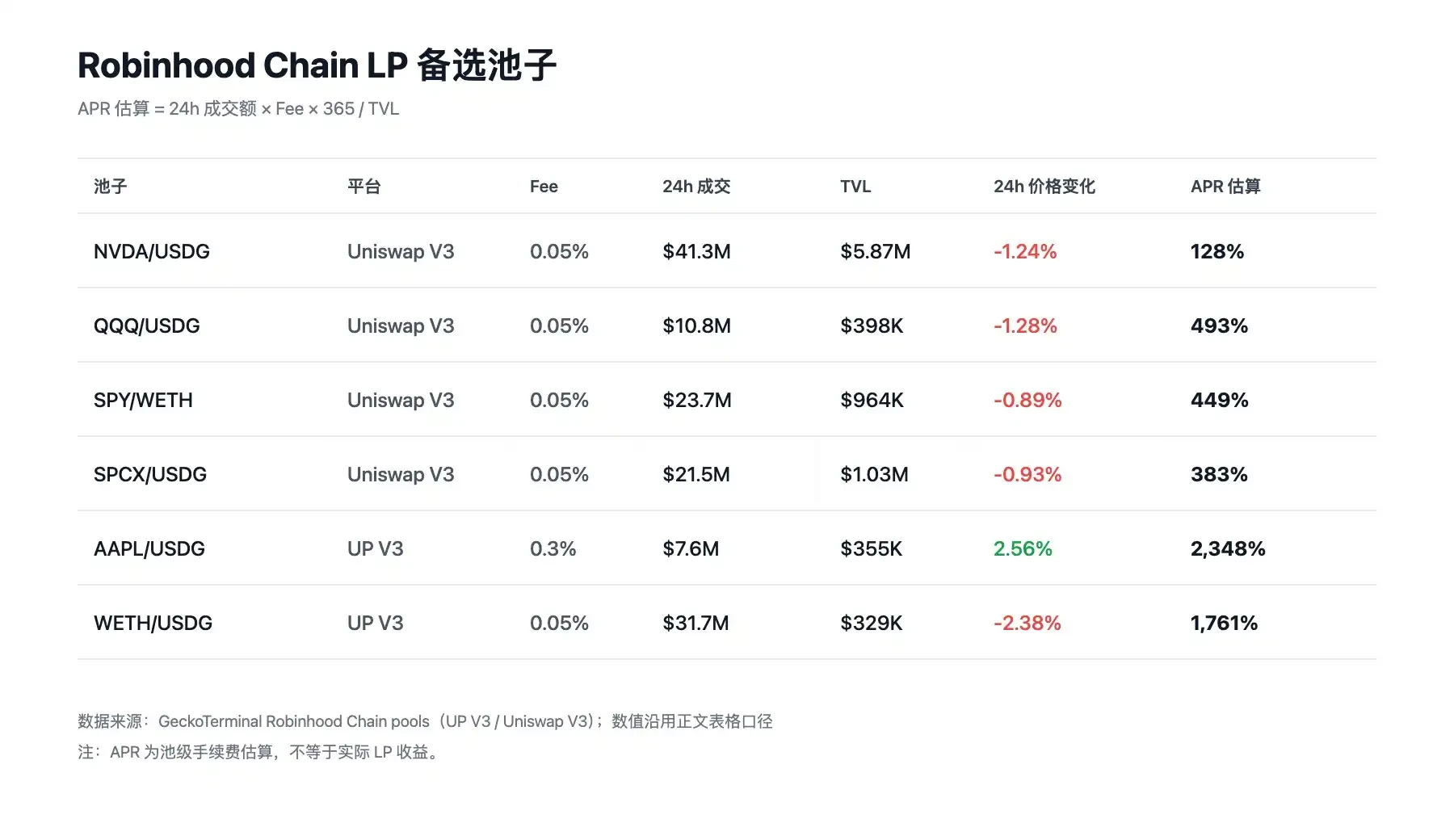
It is necessary to explain the reasons behind the data: Most coins issued by platforms like Pons are stock tokens, and most users do not hold these tokens in large quantities. Therefore, in the trading process, the routing will take an extra step, and that extra step is where we earn the excess returns.
It should be noted that as a native ve(3,3) protocol on the RH chain, the AAPL/USDG and WETH/USDG APR on UP look very high, but the TVL is relatively low, and the sustainability of returns will need continued observation.
Of course, another approach is to choose promising infrastructure projects on the RH chain for long-term holding and LP formation. Investors are advised to focus on projects that have delivered existing products and are native protocol projects on the RH chain. For example, the previously mentioned ve(3,3) protocol Up, benefited from the recent rapid increase in token valuations, and the protocol’s token is currently paired with WETH on that platform, with an APR as high as 21950%.
In addition, OHM (OlympusDAO)-like protocols NET, the officially recognized stock dividend protocol Index, and the native order book DEX Mancer on the RH chain, are all projected to perform well in the long term, barring unforeseen events; their maximum mainstream pool APRs are currently 2341%, 1261%, and 1059% respectively.
Finally, there are savvy on-chain degens who follow the "evil cultivator route," leveraging the high volatility of popular meme coins and LP scarcity by customizing high-fee LPs on Uniswap V4, riding the on-chain FOMO sentiment for good returns. For instance, the recently explosive Rabbit token saw someone create a USDG pool with an 8% fee; this pool's TVL reached 328,000 USD, and it transacted 239,000 USD in 24 hours, ultimately earning 19,000 USD, with an APR of 2124%.
However, this feels a bit like another form of meme speculation, betting that it won’t quickly plummet to zero.
In summary, the operational mindset for the Robinhood Chain in the current situation seems to need a revision. In a low-fee era, trenches can tolerate high-frequency trial and error; in a high-fee era, every click becomes a chip. For ordinary users, the win rate of PvP stands only at about 40%, eroded further by gas, platform fees, slippage, and failed trades. In contrast, selecting quality stock tokens or index tokens to form LP effectively positions oneself on the fee side of trading traffic.
I believe that in the current environment of rapidly rising fees on the Robinhood Chain, the more cost-effective strategy isn’t to indiscriminately charge into the trenches but to participate with small positions in high-certainty narratives and use major positions to screen for high volumes, more stable prices, and LPs with not too thin TVLs.
The trenches profit from directional judgment amidst chaos. LP profits from the chaos itself.
免责声明:本文章仅代表作者个人观点,不代表本平台的立场和观点。本文章仅供信息分享,不构成对任何人的任何投资建议。用户与作者之间的任何争议,与本平台无关。如网页中刊载的文章或图片涉及侵权,请提供相关的权利证明和身份证明发送邮件到support@aicoin.com,本平台相关工作人员将会进行核查。