CoinW Research Institute
On August 28 at 22:00 Beijing time, Federal Reserve Chair Kevin Warsh delivered a keynote speech titled "In Our Time" at the Kansas City Fed's annual economic policy symposium. This meeting is not an official interest rate meeting and will not directly announce a rate hike or cut, but it is often seen as an important window for the Fed to signal its policy direction, making the market particularly sensitive to Warsh's wording. An important backdrop is that a week before the speech, the U.S. Treasury, under the leadership of Besant, attempted to lower long-term Treasury yields by expanding the buyback of long-term U.S. Treasuries. The market interpreted this operation as a form of "invisible YCC," meaning that while no official yield curve control was announced, interventions in the yield curve were happening in practice. It is this concern over dollar credit, fiscal discipline, and policy boundaries that spurred a strong rebound last week in gold and Bitcoin, which are considered "hedge assets against the dollar system." Therefore, the key point of Warsh's speech is not just "whether there will be a rate hike in September," but also how he responds to Treasury interventions in the bond market and how he maintains the Fed's policy independence. After the speech was released, U.S. stocks, bonds, and cryptocurrency markets quickly repriced, essentially assessing a larger question: whether the Fed will still adhere to an independent policy framework focused on anti-inflation when the Treasury attempts to lower long-term rates.
The most crucial signal from this speech is that Warsh firmly refuses to provide the market with clear "forward guidance" and continues to adhere to a strong hawkish policy framework. The Fed will not tell the market in advance "there will definitely be a rate hike or cut next," but will decide based on changes in inflation, employment, and financial conditions. Warsh emphasized that the Fed's 2% inflation target will not change, and policymakers will only have reason to be reassured when underlying inflation can "clearly and at a sufficient speed" return to near the target; otherwise, the Fed still "has work to do." This statement sounds mild, but in the language of the market, it effectively lowers expectations for rate cuts and significantly raises the possibility of a rate hike in September. After the speech, the dollar index rebounded strongly, short-term U.S. Treasury yields rose quickly, and Treasury bond prices came under pressure and fell; previously rising gold and Bitcoin, driven by the narrative of "invisible YCC," also quickly retreated. For ordinary investors, if inflation remains stubborn, the Fed may continue to raise rates or maintain higher rates; the higher the interest rates, the more attractive low-risk assets like Treasury bonds become; the returns required by funds on high-risk assets like stocks, tech stocks, and cryptocurrencies will also increase. The market is not trading on "rates already having been raised," but is pricing in a greater probability of rate hikes and the Fed's continued maintenance of its own independence.
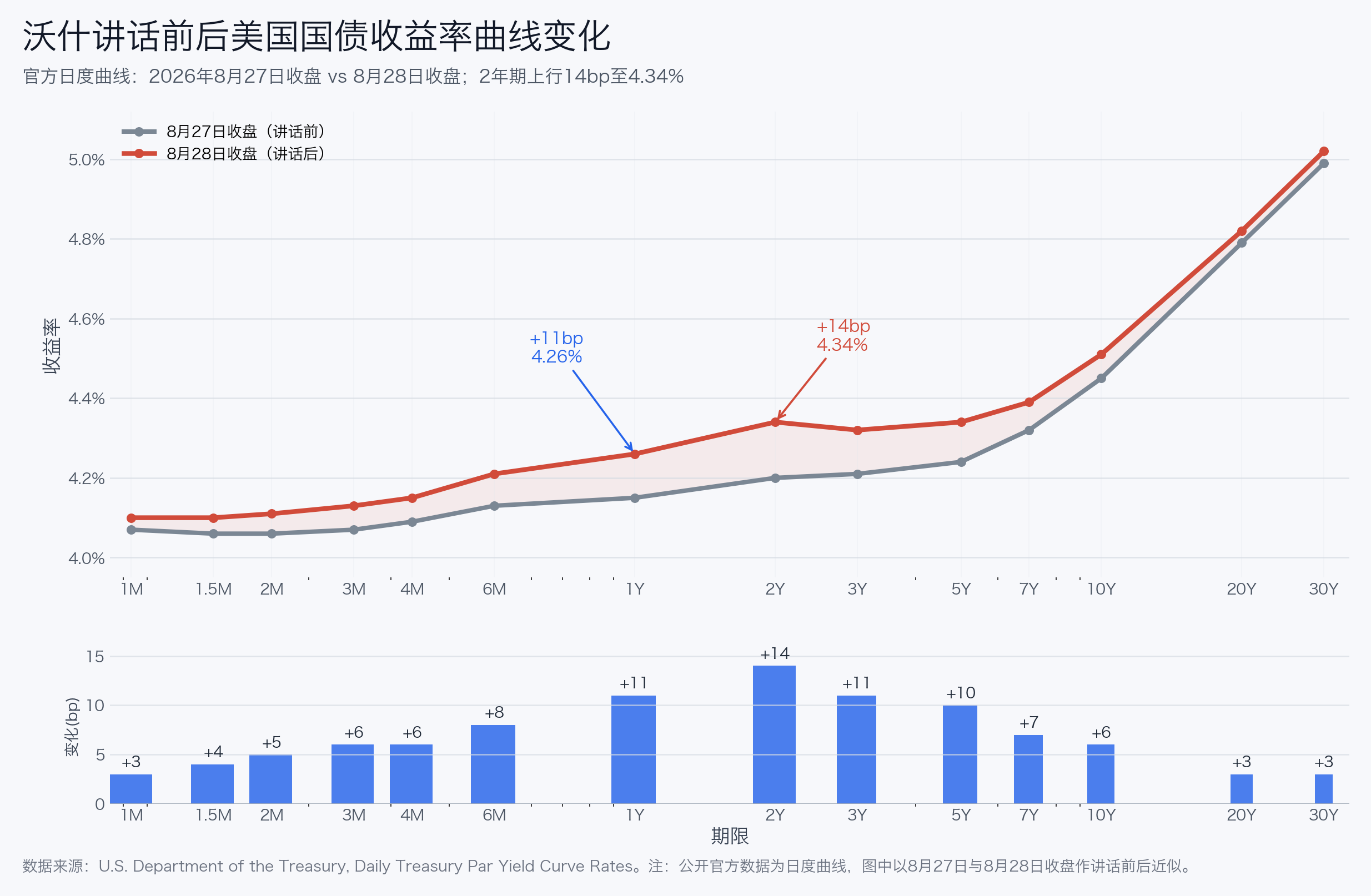
The most direct reaction after the speech was in the bond market. The 2-year U.S. Treasury yield surged on the day, rising to about 4.35%, as investor expectations for the short-term policy rate path quickly turned hawkish. According to market reports, the probability of a rate hike in September rose from about 35% before the speech to nearly 57%-60%. Investors had previously been betting that the Fed would take a wait-and-see approach, but Warsh's remarks alerted the market that as long as the upcoming employment and inflation data do not show a significant cooling, a rate hike in September could again become one of the baseline scenarios.
Source: CoinW Research Institute
The performance of U.S. stocks was "moderately under pressure," rather than experiencing a panic sell-off. On August 28, the S&P 500 index closed down about 0.2%-0.3%, the Nasdaq index fell about 0.5%, and the Dow Jones index was nearly flat, only slightly down about 9 points. On the surface, the overall decline was not large, but interest rate-sensitive sectors have shown significant pressure, especially in AI and semiconductors: the Philadelphia Semiconductor Index dropped 3.47% on the day, closing at 11,469.66 points, significantly underperforming the Nasdaq and S&P 500. Technology stocks are more sensitive because their valuations rely more on future growth expectations, and high interest rates lower the discounted value of future cash flows; semiconductors, meanwhile, are a sector that has risen significantly and has high trading congestion in the current AI market, making it more prone to concentrated profit-taking after U.S. Treasury yields rise quickly and expectations for rate hikes increase. However, the U.S. stock market did not experience a panic sell-off, indicating that the market has not fully turned pessimistic. AI profitability, corporate profits, and previous upward momentum are still supporting risk appetite, although the "handbrake" of interest rates has been tightened slightly.
In contrast, the crypto reaction was more direct. Bitcoin briefly fell to about $78,400 during the speech, then continued to be under pressure and fell below $78,000; when passing the closing criteria, BTC was about $77,399, with a daily drop of about 3.6%, while ETH was about $2,428, down about 3.3%. Cryptocurrencies lack stable cash flow as a valuation anchor and rely more on liquidity, risk appetite, and leveraged capital. When U.S. Treasury yields rise, the dollar strengthens, and expectations for rate hikes increase, short-term funds often withdraw from high-volatility assets first. Before the speech, BTC had strengthened due to ETF inflows and a recovery in risk appetite, breaking through the $80,000 level. Warsh's speech acted like a brake on the market, but it does not directly change the long-term narrative. The direction that will truly decide the future path is the upcoming key data sets and policy nodes: the U.S. August non-farm payroll report will be released at 20:30 Beijing time on September 4, the August CPI will be released at 20:30 Beijing time on September 11, and the August PCE price index will be released at 20:30 Beijing time on September 30; simultaneously, the market will continue to monitor oil price changes and U.S. Treasury yield trends, especially around the Fed's meeting on September 16, as their impact on inflation expectations and dollar liquidity could be further amplified.
The core message conveyed by Warsh at Jackson Hole is that the Fed is willing to endure short-term economic and market pressures to lower inflation and will not easily align with the market's narrative of "policy easing." For gold and Bitcoin, the logic of "hedging against the risks of the dollar system" that dominated the previous trading stage has not disappeared, but has become less solid. Once the Fed re-emphasizes independence and the priority of anti-inflation, with the dollar index rebounding and Treasury yields rising, gold and Bitcoin will be pulled back from being viewed as "safe and hedge assets" to being reconsidered in a pricing framework of "non-yielding assets/high-volatility assets in a high-interest-rate environment." For U.S. tech stocks, first, the rise in discount rates will compress the valuations of growth stocks, reducing the present value of future earnings; second, AI capital expenditures are still in a high-intensity expansion phase, with data centers, chips, computing power, and power infrastructure requiring ongoing financing, while high interest rates will raise the cost of CAPEX financing. If the data continues to be strong and inflation shows insufficient cooling, risk assets may continue to oscillate; only if employment weakens or inflation retreats more clearly might the market re-trade hopes for "policy easing."
免责声明:本文章仅代表作者个人观点,不代表本平台的立场和观点。本文章仅供信息分享,不构成对任何人的任何投资建议。用户与作者之间的任何争议,与本平台无关。如网页中刊载的文章或图片涉及侵权,请提供相关的权利证明和身份证明发送邮件到support@aicoin.com,本平台相关工作人员将会进行核查。