Packaging is Becoming a New Performance Enhancement Layer
Semi-conductor packaging is evolving to a stage where, in the near future, how semiconductor components are packaged will play an important role in determining the overall "performance" of products or systems. High-performance computing (HPC) benefits from keeping logic chips and memory chips closer to each other. TSMC describes CoWoS as an important foundation for HPC and AI, as it allows logic chips to be placed in the same package as high-bandwidth memory. Hybrid bonding is the next step toward this goal. Hybrid bonding eliminates traditional micro-bumps and directly bonds copper pads to the surface of the surrounding dielectric material, achieving higher interconnection density, lower latency, and better thermal characteristics. The semiconductor industry can no longer rely solely on transistor miniaturization for most performance gains; in the future, a larger proportion of performance improvements will need to be realized through how these dies are assembled together.
Due to the aforementioned trends, the control of economic benefits in the semiconductor industry may also undergo significant changes. In the past, most of the value created by packaging equipment primarily focused on increasing throughput, reducing costs, and improving yield rates. However, as hybrid bonding and other technologies that enhance overall packaging performance emerge, equipment manufacturers may find that customers are increasingly constrained by whether the equipment can efficiently complete specific assembly functions. As generations of semiconductor architectures require more die placement, stricter alignment precision, and better thermal management capabilities, the value of the equipment required per package may rise at a rate higher than that of semiconductor shipment growth.
Therefore, this presents a broader industry opportunity. According to SEMI's data, as demand for AI-related applications continues to expand in the semiconductor back-end supply chain, sales of assembly and packaging equipment are expected to continue growing until 2028. Although the opportunities faced by BE Semiconductor (BESIY) are narrower and of overall lower value compared to the broader industry opportunities, they still hold considerable worth. Besi focuses on providing equipment needed for precision placement in semiconductor packaging, where multiple chiplets need high-precision alignment at extremely small interconnection distances without sacrificing speed or yield. As the number of dies placed in each package increases and interconnection sizes continue to shrink, the complexity of the precision placement process will also increase, creating more opportunities for Besi.
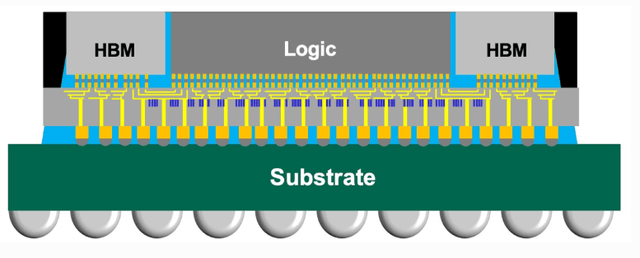
[Original Image Location: TSMC CoWoS-S Cross-Section (TSMC)]
Besi Controls Key Nodes in Precision Processes
According to Besi's 2026 Investor Day presentation materials, the company holds approximately 70% market share in the serviceable market it has defined, excluding TCB, wire bonding, cutting, and other categories; meanwhile, the company's share in the die attach market will reach 49% by 2025, and 83% in the advanced die placement market. This market position stems from the company’s longstanding investments in motion control, machine vision, increased throughput, and process reliability. Hybrid bonding further amplifies the value of these investments. Solder-based connections have a certain degree of self-alignment capability during the reflow process because the surface tension of the molten solder can pull components back into the correct position. In contrast, hybrid bonding does not have this solder-driven self-alignment, therefore it typically requires stricter pre-bond alignment and process control to avoid placement errors. Consequently, customers need equipment that can provide nearly the cleanliness of front-end processes while simultaneously delivering back-end processing speed and precision.
In addition to enhancing its existing product portfolio through hybrid bonding, Besi has further widened its "moat" by collaborating with Applied Materials. This partnership can offer customers surface treatment, measurement, and process control, while Besi continues to develop and deliver high-speed precision placement and bonding solutions. Additionally, the Kinex platform, co-developed by Applied Materials and Besi, integrates wet cleaning, plasma activation, bonding, and in-situ measurement into a single production process, thereby reducing the need for transferring wafers and dies between different equipment.
Applied Materials has also acquired a 9% strategic stake in Besi, further strengthening the partnership. Besi currently disclosed that the company has 21 hybrid bonding customers, with applications spanning logic chips, memory chips, co-packaged optics, and consumer electronics. While having 21 hybrid bonding customers does not guarantee large-scale orders in the future, it clearly establishes a broader potential order pipeline compared to relying solely on two leading logic chip customers.
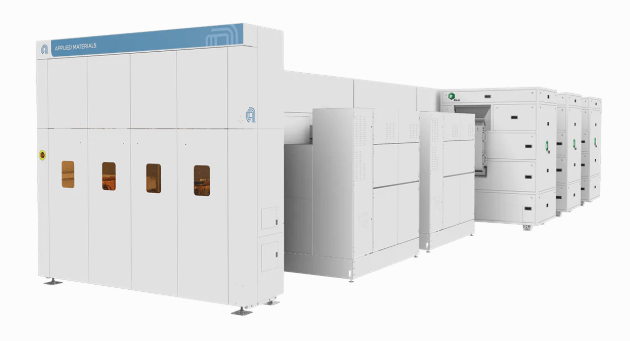
[Original Image Location: Co-developed Kinex Platform (Applied Kinex)]
Three Demand Curves Can Rise Simultaneously
The most important point of this investment logic is that Besi does not need to rely on a single technology transformation. Many AI packages are still using traditional technologies in logic chips, memory chips, bridging dies, and optical devices, including flip-chip, thermal compression bonding, and high-precision die placement. Beyond these existing technologies, as logic chip designers begin to stack cache and computing dies, hybrid bonding creates another category of equipment opportunities. The next generation of high-bandwidth memory is likely to form a second large-scale market. Additionally, co-packaged optics may create a third significant market, as network engineers aim to place optical engines closer to switching chips and accelerators. Since Besi provides equipment across multiple stages of the packaging assembly process, the company has numerous potential sources of growth, allowing successes in other business areas to offset delays in any one architecture.
To achieve the financial model established by management for 2030, Besi expects annual revenues to reach between 1.7 billion and 2.2 billion euros, while operating margins reach between 45%-55%. These projected figures account for both the established traditional advanced packaging business and the growing sub-micron precision business. Given the increasing size and complexity of AI package dimensions, this plan is credible. An increase in the number of chiplets implies more die placement steps, and photonic devices require extremely precise alignment. Hybrid bonding systems can create both equipment sales revenue and service revenue. The company’s goal is not to earn revenue from every dollar of packaging costs, but to be the best equipment supplier at the most accuracy-sensitive node in the entire packaging process.
Orders Have Entered Mass Production Stage
The latest quarter indicates that the company is currently entering the early stage of mass production ramp-up, and not just experiencing a temporary peak in R&D demand. Quarterly revenue has reached 249.9 million euros, up 68.7% year-on-year. Orders have reached 292.9 million euros, up 128.8% year-on-year. Gross margin has increased to 65.7%, and net margin has reached 35.6%. There is broad demand across data centers, photonics, hybrid bonding, and AI power management applications. Management has also provided guidance for the next quarter, expecting revenue to grow by an additional 10%-15%, while gross margins are expected to fall between 63%-65%.
The real significance of this growth is that it belongs to high-quality growth. The structure of order growth is very critical: current orders remain above revenue, which is very favorable for order conversion in the next stage. Improved product mix has also led to increased gross margins. Despite significant increases in research and development expenditures, net margins have also improved because revenue growth is outpacing fixed costs. Management expects a slight sequential decline in gross margins in the next quarter due to product mix changes. Furthermore, Besi's flexible manufacturing base in Asia enables it to scale up production without taking on significant additional fixed cost burdens like larger front-end equipment companies.
Profit Growth Is Sufficient to Absorb Valuation Premiums
Based on the company's own guidance rather than forecasts from other institutions, I expect this fiscal year’s revenue to be around 1 billion euros. This forecast assumes that fourth-quarter revenue will see only very moderate growth compared to the median guidance for the third quarter. My baseline scenario predicts that next fiscal year’s revenue will be around 1.4 billion euros, with a net margin of 39%, resulting in a net profit of approximately 540 million euros. After currency adjustments based on current rates, the corresponding EPS per ADR is about $7.8. The additional revenue in my forecast is approximately half derived from hybrid bonding and advanced thermal compression bonding technologies, while the rest comes from growth in die attach activities, photonic business, and a partial recovery in conventional mainstream markets.
My model does not adopt the upper limits of management's long-term framework. Instead, I assume gross margins remain at the mid-60% level while expense growth rates are lower than revenue growth. These assumptions are consistent with Besi's performance in the recent quarter and align with Besi's business model, as the company has a scalable manufacturing system in Asia. The core lever driving profit improvement is not through aggressive price increases but rather by allowing high-value products from high-precision equipment to scale through a cost structure that has already borne the bulk of necessary R&D and service investments.
At a reference stock price of approximately $223, BESIY is currently trading at slightly less than 30 times my forward earnings forecast. According to Seeking Alpha, BESIY's historical EV/EBITDA multiple is about 58 times. Using the same metric, Kulicke & Soffa is around 40 times, AMAT around 38 times, and LRCX around 45 times. The average valuation multiples of these companies over the past five years are approximately 24 times, 19 times, and 22 times, respectively, while BESIY has averaged around 40 times over the past five years. Although all four companies are currently above their respective five-year averages, BESIY's absolute historical valuation is still significantly higher than its peers. Additionally, BESIY's current historical earnings reflect weaker periods from the last cycle, whereas the current order situation indicates a distinctly better product mix.
If I apply an approximately 35 times price-to-earnings ratio to my forward earnings forecast, I can arrive at a target price of about $275 for BESIY, approximately 23% higher than the aforementioned reference stock price. This valuation multiple is indeed slightly above the historical earnings multiples of the broader semiconductor equipment industry, but considering Besi’s faster growth prospects, significantly higher profit margins, and direct involvement in the hybrid bonding market, I believe this valuation premium is justified. Therefore, the current valuation supports a "Buy" rating rather than a "Strong Buy" rating.
Verification Conditions for Investment Logic to Fail Are Clear
Besi faces the biggest risk from the timing of hybrid bonding technology achieving widespread mass production adoption. Compared to thermal compression bonding, hybrid bonding has the potential for superior technical performance, but due to cost differences between the two, many memory chip manufacturers may continue to use thermal compression bonding longer than initially expected. Furthermore, some memory chip manufacturers may delay ramping up production of hybrid bonding products, and the scale application of logic chips might only be limited to a few large manufacturers. Any of these scenarios could prolong the time needed for Besi to achieve large-scale sales of high-margin hybrid bonding equipment.
In addition to the timing risk of Besi's business ramp-up, the company also faces execution risks. For example, Besi is increasing supply, service, and manufacturing capacity before hybrid bonding achieves broader adoption. If Besi's equipment ultimately has yield rates lower than expected, throughput improves more slowly than anticipated, or there is a significant delay in the qualification of the integrated Kinex hybrid bonding process, these new capabilities may not be fully utilized. Additionally, specialized bonding equipment manufacturers like ASMPT and Kulicke & Soffa may also compete, potentially narrowing the gap with Besi in terms of precision and total ownership costs. Fluctuations in exchange rates, trade restrictions, and potential declines in mobile or industrial demand could further suppress Besi's growth potential. The ADRs of Besi traded in the US are still over-the-counter, meaning their trading spreads and liquidity may not be as favorable as those on the Amsterdam exchange. As mentioned earlier, these are significant risks that cannot be overlooked in a cyclical industry.
As previously mentioned, if the following three conditions occur by 2027, I would consider my investment logic to have failed. First, revenue does not exceed 1.2 billion euros. Second, orders are below revenue for at least two consecutive quarters. Third, while demand for AI-driven applications continues to grow, net margins decline back to the low 30% range. If these situations occur, then based on the current reference stock price, the company’s forward price-to-earnings ratio would exceed 40 times, but there would not be enough growth to support that valuation. Therefore, a positive outlook for Besi still requires evidence of stronger order conversion, sales growth within a broader customer base, and continuous improvement in operational leverage.
Risk and Reward Still Tilt Upwards
Semi-conductor equipment company Besi is not a cheap stock, but it is one of the few equipment suppliers positioned at the precision bottleneck formed by increasing interconnection density and rising thermal requirements within the AI chip stack. From the company's recent performance, advanced packaging technology has started to drive business growth. Future developments in hybrid bonding, next-generation storage technology, and co-packaged optics may continue to push this demand growth. However, as mentioned earlier, the current valuation limits the reasonable "margin of safety" I can obtain, but I believe that the combination of technical leadership, increased customer acceptance, and profit leverage is sufficient to support a "Buy" rating.
免责声明:本文章仅代表作者个人观点,不代表本平台的立场和观点。本文章仅供信息分享,不构成对任何人的任何投资建议。用户与作者之间的任何争议,与本平台无关。如网页中刊载的文章或图片涉及侵权,请提供相关的权利证明和身份证明发送邮件到support@aicoin.com,本平台相关工作人员将会进行核查。


