Trump takes over Venezuela's 65 billion barrels of oil, the impact on the US and global oil prices
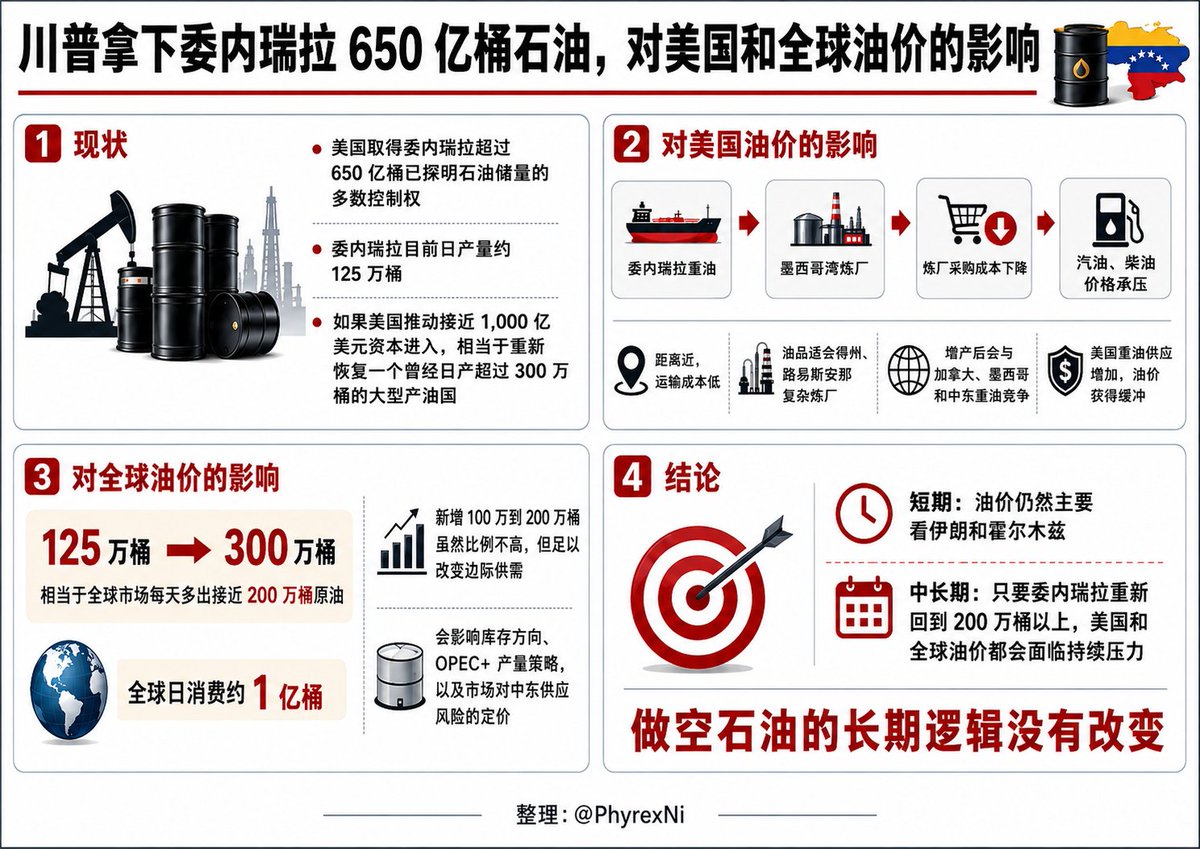
Trump has just announced that the US has gained majority control over Venezuela's proven oil reserves of over 65 billion barrels. Although this portion of oil will not immediately increase market supply.
Venezuela's current production is only about 1.25 million barrels per day. If the US indeed pushes nearly 100 billion dollars of capital into Venezuela, it would mean starting to restore a large oil-producing country that once had a production exceeding 3 million barrels per day.
For the US, Venezuela's biggest advantage in oil is its proximity, and the oil is just right for US Gulf Coast refineries.
US shale oil is generally light, and many complex refineries in Texas and Louisiana have long required heavy crude oil, so despite US oil production, they still need to import a large amount of heavy oil daily. Venezuela is right across from the Caribbean Sea, with low transportation costs, and a large amount of crude oil is already entering the US.
If future production continues to recover, it will increase the supply of heavy oil to US refineries while competing with Canada, Mexico, and Middle Eastern heavy oil, creating pressure on refinery procurement costs, gasoline, and diesel prices.
For global oil prices, if Venezuela recovers from the current 1.25 million barrels to 3 million barrels, it would mean an additional close to 2 million barrels of crude oil per day in the global market.
The global daily consumption is about 100 million barrels; adding 1 to 2 million barrels is not a lot, but oil prices are very sensitive to marginal supply and demand. This scale is already enough to change inventory direction, OPEC+ production strategies, and the market's pricing of Middle Eastern supply risks.
In the short term, oil prices still depend on Iran and Hormuz. In the medium to long term, as long as Venezuela returns to above 2 million barrels, US gasoline prices will gain more cushioning, and the global oil market will have a new supply source at the million-barrel level, creating sustained pressure on oil prices.
Therefore, from a long-term perspective, the ceiling for rising oil prices is actually very limited. It is not very meaningful to say one should short at highs now. Even if Hormuz is blocked, oil prices will slowly decline, and shorting oil remains a very correct choice.
@Gate Crypto, US stocks, Hong Kong stocks, Korean stocks, gold, CFD, one-stop trading for prediction markets
免责声明:本文章仅代表作者个人观点,不代表本平台的立场和观点。本文章仅供信息分享,不构成对任何人的任何投资建议。用户与作者之间的任何争议,与本平台无关。如网页中刊载的文章或图片涉及侵权,请提供相关的权利证明和身份证明发送邮件到support@aicoin.com,本平台相关工作人员将会进行核查。


