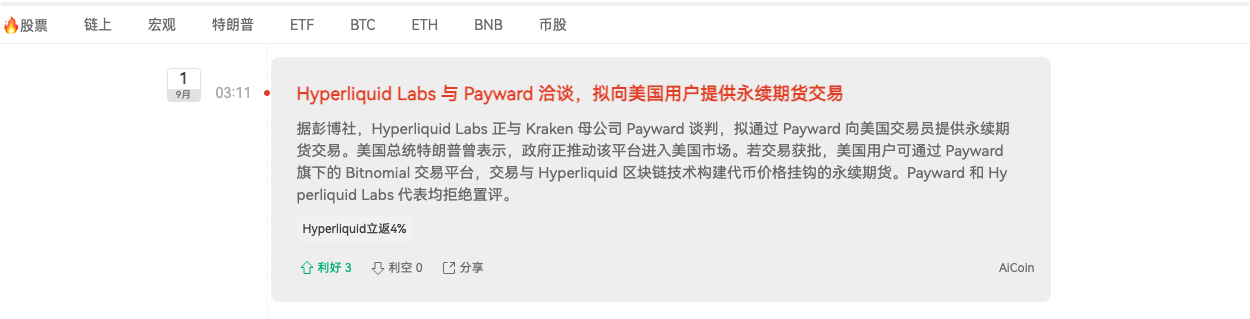
——Looking at the Unexpected Development of RWA and Institutional Opportunities in Hong Kong from Bitcoin Asia 2026
Author: AiPlot Research Institute
Data Observation Period: August 2026
The most important signal released by Bitcoin Asia 2026 is not the short-term market performance of a particular project or cryptocurrency, but rather a shift in the focus of industry discussions: the market is beginning to move from "Does blockchain have value?" to "Which financial activities will migrate to the chain first, and who can provide credible migration infrastructure?".
1. Beyond Events: A Public Discussion on Financial Migration
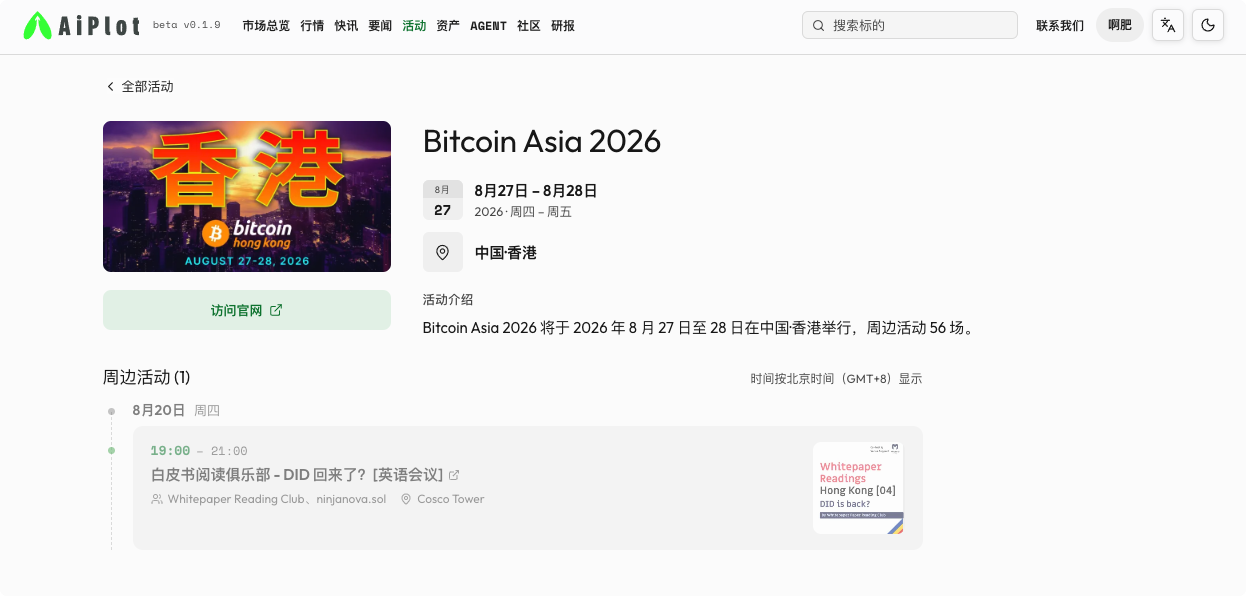
From August 27 to 28, 2026, Bitcoin Asia 2026 was held in Hong Kong. AiPlot information shows that the conference was connected to 56 surrounding events, covering topics such as Bitcoin, Web3, digital assets, and the tokenized market. From the scale of the event and the content of the discussions, Hong Kong is becoming an important window for observing the on-chain transition of traditional finance in the Asian digital asset industry.
According to AiPlot’s summary, several interconnected judgments were emphasized: Over the next decade, payments, stablecoins, artificial intelligence, Agentic Finance, and tokenized infrastructure will continue to be built; the development speed of RWA may exceed previous market expectations; stablecoins are essentially a manifestation of fiat currencies on-chain; and Hong Kong's advantages lie in its existing funds, talent, regulation, liquidity, and global connectivity.
If these viewpoints are viewed in isolation, they may be interpreted as optimistic statements from the industry; however, when combined, they point to a deeper judgment: The core of the next round of Web3 competition is no longer solely about vying for crypto-native users but about competing for the gateways to the on-chain migration of financial assets, financial institutions, and financial processes.
Therefore, the value of Bitcoin Asia 2026 is not just that it hosted an industry conference, but it clarifies one question: Can Hong Kong convert the financial capabilities accumulated over decades into the issuance, settlement, distribution, custody, and secondary liquidity capabilities of on-chain assets?
2. RWA Surpassing Expectations Does Not Mean “All Assets Will Be Tokenized”
The market often simplifies RWA as "tokenizing real assets." Although this definition is easy to spread, it fails to explain the real changes currently happening in the market.
Strictly speaking, RWA comprises at least four different layers. The first layer is the underlying assets themselves, such as government bonds, fund shares, stocks, commodities, or private credit. The second layer is legal rights, meaning whether the on-chain tokens represent ownership of the assets, fund shares, income rights, claims, or just a certificate promised for redemption by the issuer. The third layer is the issuance and custody structure, including who holds the assets, who calculates the net value, how redemptions are completed, and what entry conditions investors need to meet. The fourth layer concerns on-chain transfers, cross-chain distribution, collateralization, and trading.
These four layers jointly determine whether an RWA product genuinely possesses financial attributes. A token can be freely transferred on-chain without automatically guaranteeing ownership of the underlying assets; a product claiming to "anchor to a certain asset" does not equate to the holder possessing unconditional redemption rights. The essence of RWA is not to symbolize assets but to reorganize a set of rights relations originally dispersed among legal contracts, custody systems, registration institutions, and trading platforms into programmable financial products.
This is also why the growth speed of RWA could exceed some market expectations: it does not require waiting for the entire financial system to migrate at once but can begin with highly standardized, highly liquid, easily verifiable, and easily valued assets. Short-term government bonds, money market funds, mainstream stocks, and certain fund shares are often more suitable as the first batch of on-chain assets than real estate or complicated private placement assets.
The Four-Layer Structure of RWA Products
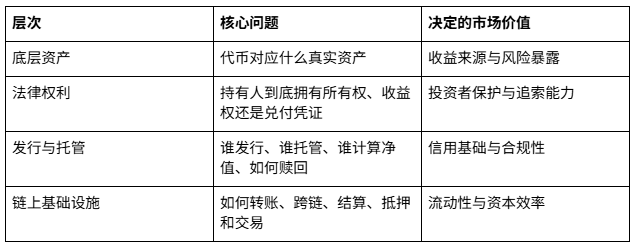
Therefore, the true meaning of "RWA development surpassing expectations" is that more and more assets are beginning to meet the conditions for standardization, verification, distribution, and continuous trading, rather than all real assets completing tokenization in the short term.
3. Why Stablecoins are the Starting Point for RWA Discussions
If RWA is understood as the expression of real-world value on-chain, then stablecoins are the most mature and widely used type of on-chain real asset. They combine the fiat currency pricing unit with blockchain transfer and settlement capabilities, providing a trading medium and liquidity foundation for other tokenized assets.
This explains a frequently overlooked fact: RWA is not a new track that emerges after stablecoins; stablecoins themselves are an early result of the on-chain transformation of the real financial system. As stablecoins expand from being a tool for crypto trading settlement to payments, cross-border remittances, corporate cash management, and on-chain collateral, on-chain finance begins to possess a monetary layer that connects with the real economy.
However, the development of stablecoins also indicates that asset migration to the chain does not mean the disappearance of regulatory boundaries. The "Stablecoin Regulation" in Hong Kong came into effect on August 1, 2025. The Hong Kong Monetary Authority clearly stated that issuing stablecoins pegged to fiat currency in Hong Kong is a regulated activity that requires licensing; at the same time, licensed issuers must also comply with regulatory, anti-money laundering, and anti-terrorist financing requirements.
The significance of this system is not merely "issuing licenses for stablecoins." More importantly, it incorporates reserve assets, redemption arrangements, governance structures, and risk management into the regulatory framework, thereby establishing a credit layer for on-chain assets that can be understood and scrutinized by institutions. This is crucial for RWA: only when the underlying assets, issuers, and redemption mechanisms can be identified can on-chain liquidity have the opportunity to transform from short-term speculation to long-term allocation.
The increasing likelihood of more countries pushing for the on-chain transformation of their currencies also means that the competition for RWA will not indefinitely remain within the dollar system. The on-chain conversion of the euro, Hong Kong dollar, renminbi, and other fiat currencies will introduce new issues of multi-currency liquidity, cross-border settlement, and exchange rate risk management. At that point, truly valuable market infrastructure will not merely display the price of an asset but will identify the relationships between different currencies, legal jurisdictions, and different issuance structures.
4. Hong Kong's Advantage: Not "Regulatory Easing," but Comprehensive Financial Elements
Hong Kong's competitive advantage in the Web3 space should not be simply described as "crypto-friendly" or "regulatory openness." From the perspective of financial infrastructure, Hong Kong's more valuable advantage is that it already has a relatively mature capital market, an international banking and asset management system, the ability to connect domestic and global markets, and a relatively clear regulatory path for digital assets.
The Hong Kong Securities and Futures Commission stipulates that centralized virtual asset trading platforms operating in Hong Kong or actively marketing to Hong Kong investors must obtain licenses and be subject to regulation. For security tokens and non-security tokens, the platforms are subject to regulatory arrangements under the Securities and Futures Ordinance and anti-money laundering and anti-terrorism financing regulations, respectively. This means that Hong Kong is not attempting to detach digital assets from the existing financial order but is trying to incorporate different types of digital assets into an identifiable and accountable market structure.
For RWA, this structured regulation is more important than merely pursuing trading volume. RWA participants typically include asset managers, custodial banks, auditing institutions, trading platforms, market makers, compliance service providers, and end investors. Any missing link may cause the asset to remain in the pilot issuance stage without forming a sustainable market.
The Hong Kong government's promotion of tokenized green bonds exemplifies this path of "financial capability migration." The issuance scale of the third batch of digital green bonds announced by the Hong Kong government in November 2025 was approximately HKD 10 billion, covering Hong Kong dollars, renminbi, US dollars, and euros; the total subscription amount for the four currencies exceeded HKD 130 billion. This issuance also introduced a tokenized central bank currency settlement option and adopted digital token identifiers and bond data classification standards to improve interoperability between digital systems and traditional capital markets.
The most noteworthy aspect here is not the issuance amount itself but three institutional signals. First, tokenized bonds are beginning to move from concept validation to large-scale issuance. Second, digital bonds are not designed as completely isolated from traditional financial infrastructure; rather, they retain connections to traditional market participants, clearing, and settlement systems. Third, digital identities, legal entities, bond terms, and settlement currencies have started to be integrated into a single identifiable data framework.
This indicates that Hong Kong's potential opportunity lies not in reinventing a financial system but in gradually transforming trusted entities, financial products, and compliance processes within the existing system into programmable, interoperable on-chain modules.
5. What Hong Kong Really Needs to Solve is Not “Whether There Are Policies” but Whether a Market Closed Loop Can Be Formed
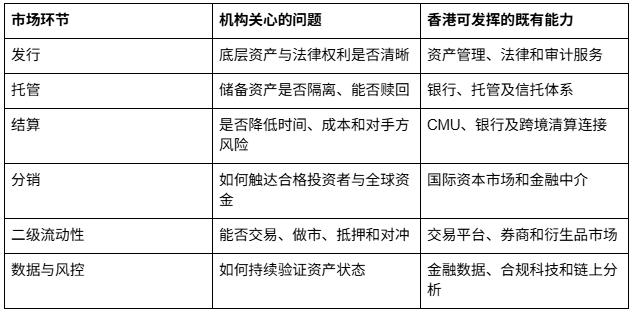
Policy certainty is merely the starting point for the development of RWA, not the endpoint. To transform Hong Kong's institutional advantages into market advantages, at least four levels of closed loops need to be completed.
First is the asset issuance closed loop. Issuers must clarify the underlying assets, legal rights, investor entry conditions, custodial institutions, and redemption mechanisms. Without this information, tokenization is just packaging and not an auditable financial product.
Second is the settlement closed loop. If asset tokenization still relies on a large number of manual operations offline, on-chain efficiency cannot be realized. The connections between digital bonds and tokenized currencies, custodial systems, and traditional clearing networks will determine whether institutions are willing to migrate more assets on-chain.
Third is the liquidity closed loop. Asset issuance does not equal having a market for the asset. RWA needs market-making, trading, collateralization, lending, and risk management mechanisms to transform from one-time issuance into a continuously circulating financial market. Especially for security tokens, investor entry, whitelist management, and secondary market trading rules must advance synchronously with liquidity design.
Lastly is the data closed loop. The data for RWA does not only include prices and market values but also includes issuers, underlying assets, legal jurisdictions, regulatory frameworks, on-chain deployments, holders, transfer volumes, redemption frequencies, cross-chain distributions, and DeFi usage. Only by compiling all this data can market participants determine whether an asset's growth comes from genuine allocation, cross-chain migration, short-term arbitrage, or internal adjustments by the issuer.
RWA Market Closed Loop and Hong Kong's Potential Entry Point
6. From "Asset On-Chain" to "Asset Network": The Next Stage of RWA
The early narrative of RWA was "moving assets to the blockchain"; the next stage is closer to "establishing a network around assets." Within this network, the same underlying asset may be packaged into different products by different issuers, deployed on different blockchains, and circulated through various trading platforms, lending protocols, and cross-chain bridges.
This will introduce a new complexity to the market: the increase in the number of assets does not necessarily equate to improved market efficiency. On the contrary, the more issuers, blockchains, and complex product structures there are, the greater the need for a data layer that penetrates the asset surface. Market participants need to know who issued a particular token, whether there exists a clear redemption mechanism, which chains it circulates on, whether the holders are concentrated, the authenticity of transfer volumes, whether it has entered DeFi, and whether there are cross-platform price differences.
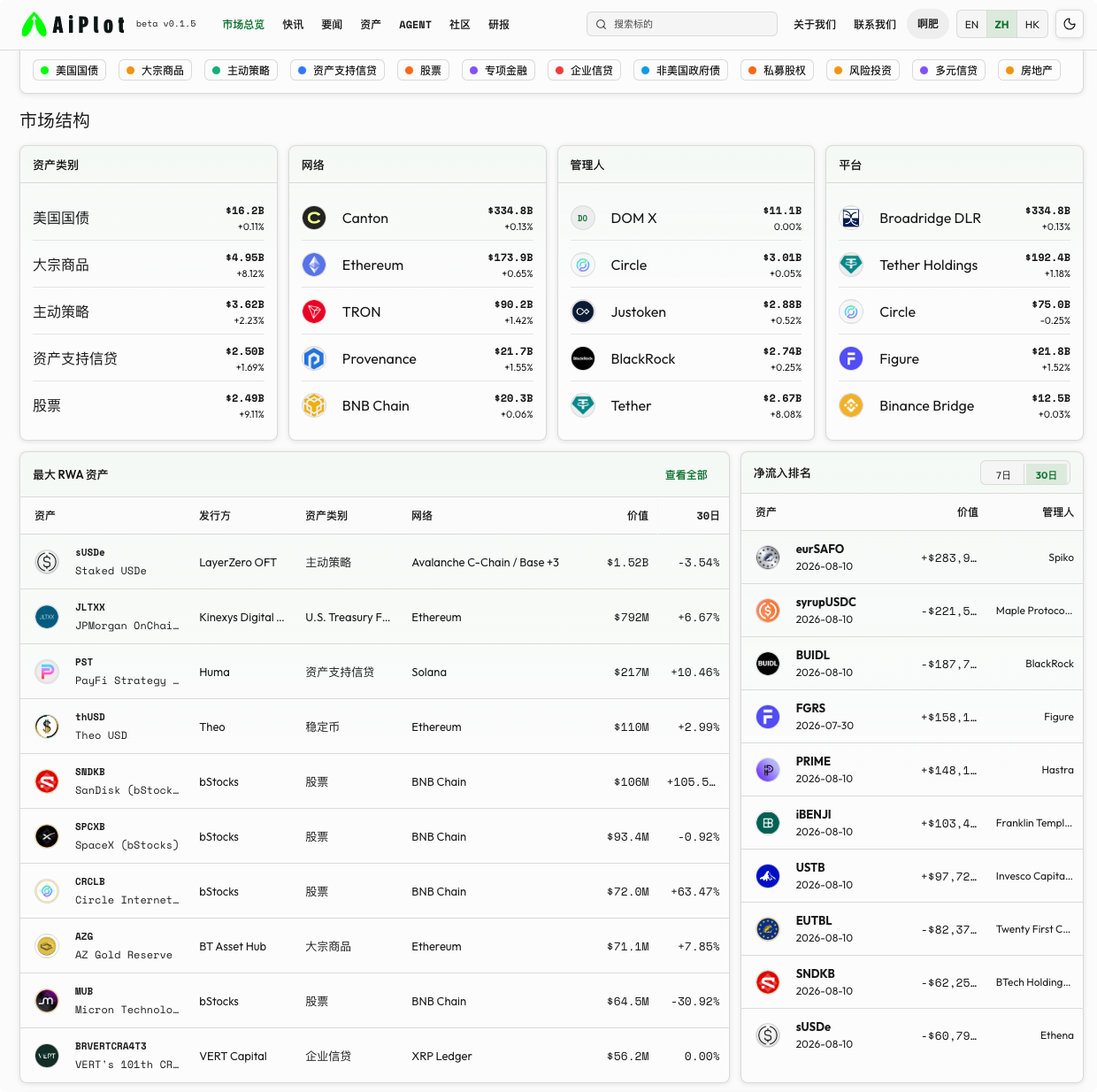
In this sense, AiPlot's positioning has real value. The AiPlot event page positions itself as an RWA and market intelligence platform that covers the USA, Hong Kong, and the tokenization market. For an emerging asset network, the platform’s value should not merely list asset names but help users connect news events, traditional companies, issuers, on-chain assets, and market liquidity.
For instance, viewpoints from an industry conference might impact the attention to a certain type of asset; a regulatory rule might alter the compliance pathways for issuers; a traditional financial product that completes tokenization might be distributed across multiple chains; once it enters lending protocols or perpetual markets, its risk structure will again change. Only by placing this information within the same research framework can users determine whether "asset on-chain" is merely a marketing event or an emerging financial market.
7. Conclusion: Hong Kong’s Opportunity Lies in Becoming the “Connecting Layer” of On-Chain Finance
The industry sentiment presented by Bitcoin Asia 2026 is not hard to understand: in the next decade, more assets, funds, and financial infrastructures are likely to migrate on-chain. However, this does not mean that all markets will be replaced by crypto-native protocols, nor does it imply that traditional financial institutions will abandon their existing systems. The more likely outcome is that a new connecting layer will form between the two systems.
Hong Kong’s opportunity comes from this connecting layer. It is neither merely replicating the U.S. digital asset market nor just building a trading venue for crypto assets, but utilizing its own accumulation in funds, law, regulation, custody, asset management, and cross-border connectivity to transform traditional financial products into an asset network capable of being issued, settled, distributed, and managed on-chain.
Yet, this competition will ultimately not be decided by slogans. What truly determines whether Hong Kong can succeed is its ability to continually answer several specific questions: Are the legal rights to the assets clear? Are the issuers verifiable? Is the on-chain liquidity authentic? Can investors exit? Are different chains and markets interoperable? Can regulatory requirements be implemented at the product and data levels?
From the perspective of industry research, the most noteworthy change in RWA is no longer "What will be tokenized next?" but Which assets can achieve a balance between compliance, liquidity, and data transparency, ultimately forming a sustainable asset network?
This is also the core that AiPlot needs to continue tracking: when the financial advantages of the real world start to migrate on-chain, market participants will need not more noise but market intelligence that helps them see asset structures, funding flows, and institutional changes clearly.
The second half of RWA is not to turn more assets into tokens, but to ensure that these tokens genuinely possess verifiable rights, sustainable liquidity, and financial infrastructure that can be utilized by institutions.
For more data and analysis, please follow AiPlot:
📖 Community Communication:
-Telegram:
https://t.me/+IIYMcJigBAo4Mjg1
The content of this article reflects the author's personal views and does not represent the stance of this platform. The viewpoints, conclusions, and suggestions within the text are for investor reference only and do not constitute any investment advice related to this platform. The market has risks; investment requires caution.
免责声明:本文章仅代表作者个人观点,不代表本平台的立场和观点。本文章仅供信息分享,不构成对任何人的任何投资建议。用户与作者之间的任何争议,与本平台无关。如网页中刊载的文章或图片涉及侵权,请提供相关的权利证明和身份证明发送邮件到support@aicoin.com,本平台相关工作人员将会进行核查。