This article is written by Tiger Research. Cryptocurrency exchanges are leveraging perpetual contracts to penetrate traditional assets such as stocks and commodities. The trading volume of perpetual contracts linked to Korean stocks has reached 307 trillion won within just a few months. This report outlines the rise of offshore liquidity and the conditions that South Korea needs to fulfill in order to participate in this market.
Core Conclusions
- Cryptocurrency exchanges are rapidly entering traditional assets like stocks and commodities through perpetual contracts.
- The trading volume of perpetual contracts linked to Korean stocks is approximately 307 trillion won over a few months, indicating a significant rise in the importance of offshore markets.
- South Korea needs to allow enterprises access to domestic crypto exchanges, establish a formal derivatives framework, and strengthen the infrastructure for won-pegged stablecoins.
Cryptocurrency Exchanges are Entering Traditional Markets
Cryptocurrency exchanges are no longer limited to digital assets. Bitcoin and Ethereum once dominated trading on these platforms, but products linked to traditional assets like stocks and commodities are rapidly increasing.
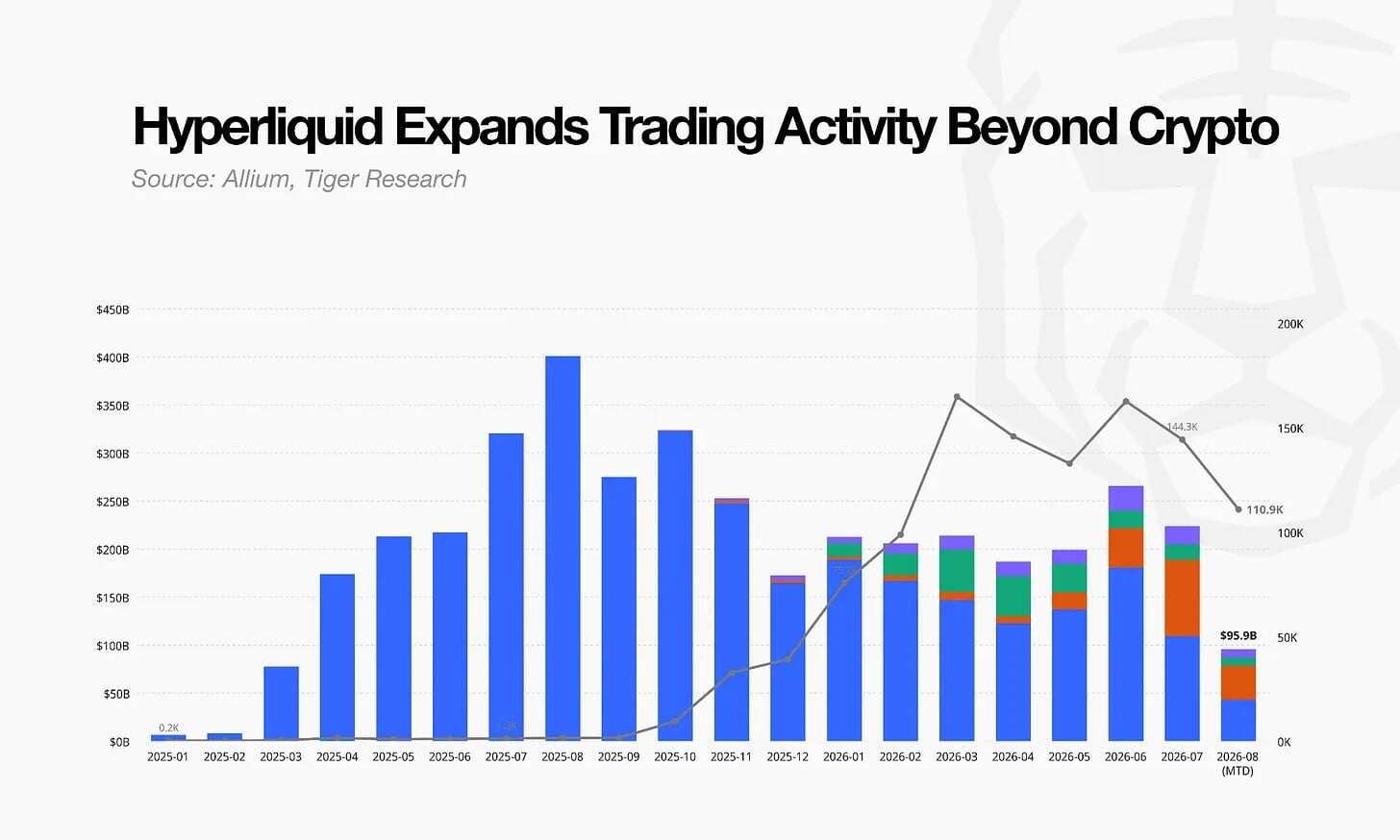
The decentralized exchange Hyperliquid is seeing a continuous rise in the proportion of traditional asset-linked products in its trading structure for 2026, and the number of users trading these products is also increasing. The infrastructure originally built for crypto trading is transforming into a new venue for traditional financial markets.
Driving this change are perpetual contracts. These derivatives allow investors to gain price exposure without holding the underlying asset. Unlike traditional futures, they have no expiration dates and do not require physical delivery.
As a result, exchanges can relatively easily launch products linked to stocks and commodities, and cryptocurrency exchanges have found a viable path: extending from digital assets into traditional markets.
South Korea is No Exception: Korean Stock Trading is Flowing Offshore
South Korea is at the center of this change. Offshore cryptocurrency exchanges are actively trading perpetual contracts linked to core Korean stocks such as Samsung Electronics and SK Hynix. These products can be traded overnight and on weekends, and they have high leverage, providing a new exposure to Korean stocks for South Korean investors and global funds. An offshore market that can trade Korean stock price fluctuations without being restricted by Korean trading hours is rapidly taking shape.
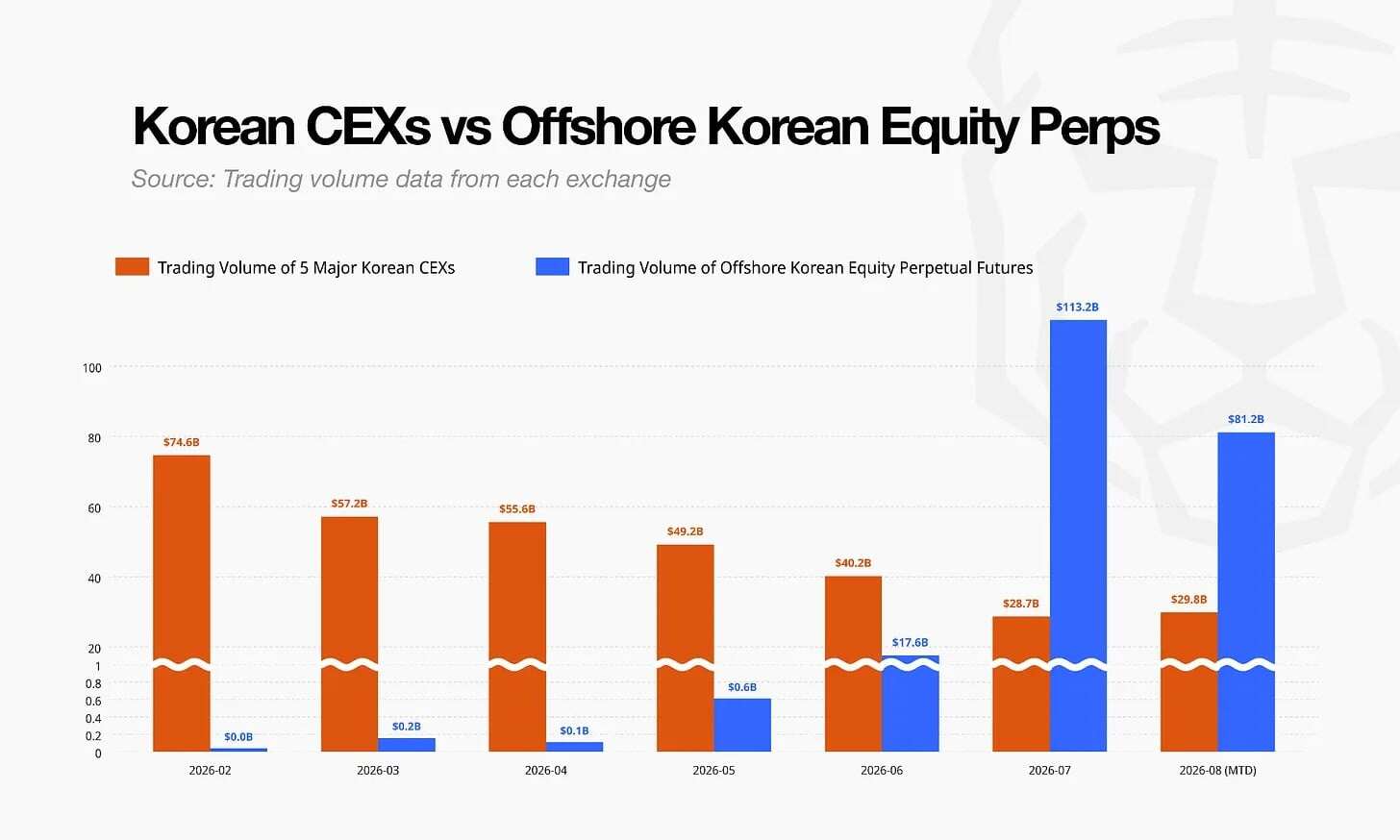
Scale is growing quickly. From February to August 2026, the cumulative trading volume of perpetual contracts linked to Korean stocks reached about 307 trillion won. In August alone, the volume hit 166 trillion won, nearly four times the trading volume of 42 trillion won from South Korea's five major cryptocurrency exchanges during the same period. In just a few months, the offshore perpetual market linked to Korean stocks has surpassed the size of the main domestic cryptocurrency markets in South Korea.
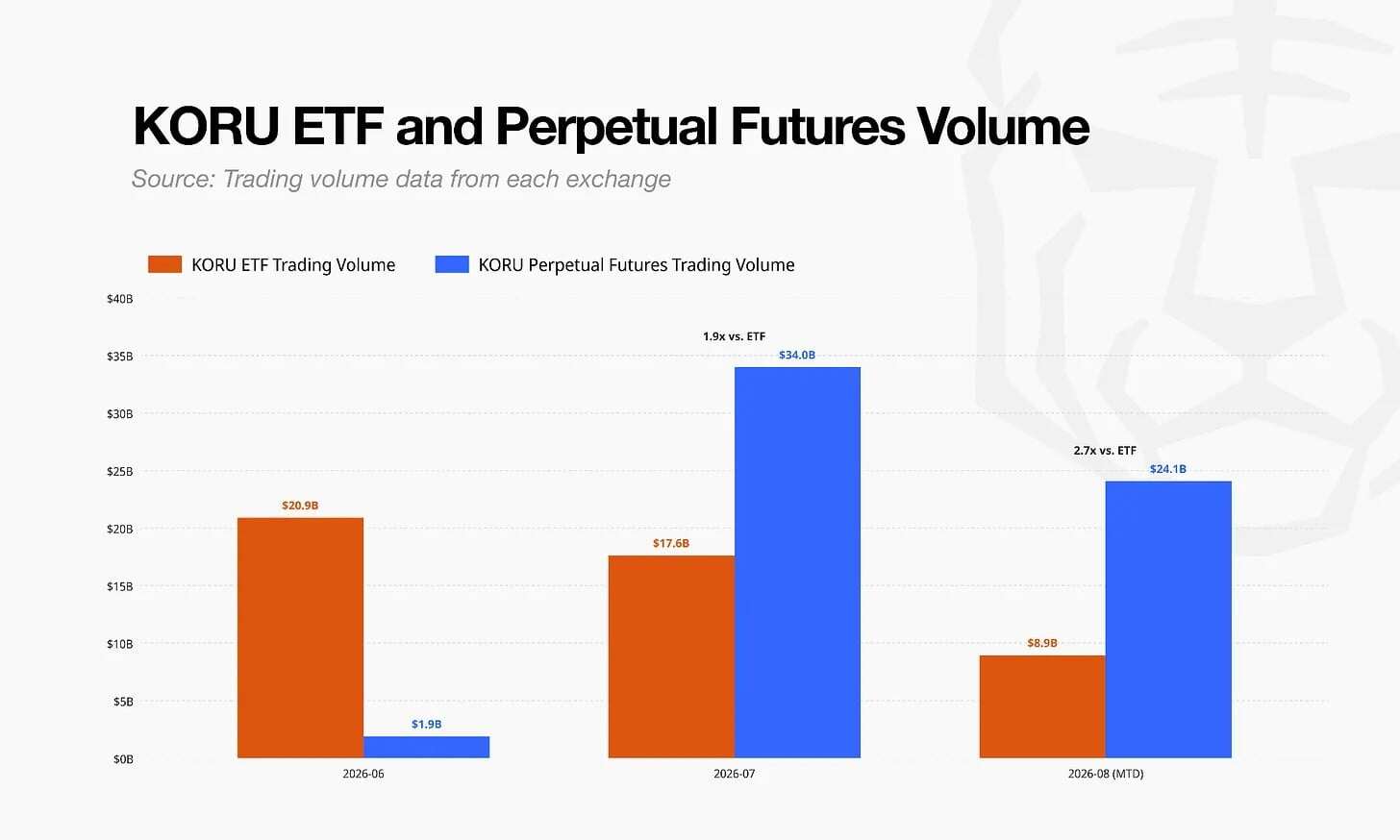
For some products, the trading volume of perpetual contracts has already far exceeded that of corresponding ETFs. In August 2026, the trading volume of perpetual contracts linked to the three times leveraged U.S. stock ETF for Korea (KORU) was about 24.1 billion USD, while the KORU ETF itself had a trading volume of 8.9 billion USD, making the former about 2.7 times that of the latter. This means that derivatives trading has already surpassed the ETF itself. Once derivatives trading exceeds the underlying market, the offshore venue could play a larger role in price discovery.
More critically, the offshore derivatives market can also impact the spot market in reverse. Market makers providing liquidity for perpetual contracts will hedge their exposure through buying and selling related stocks or ETFs. The higher the trading volume of derivatives, the more of these hedging transactions occur; they are also magnified during significant price fluctuations. This movement of funds will ultimately transmit to spot prices.
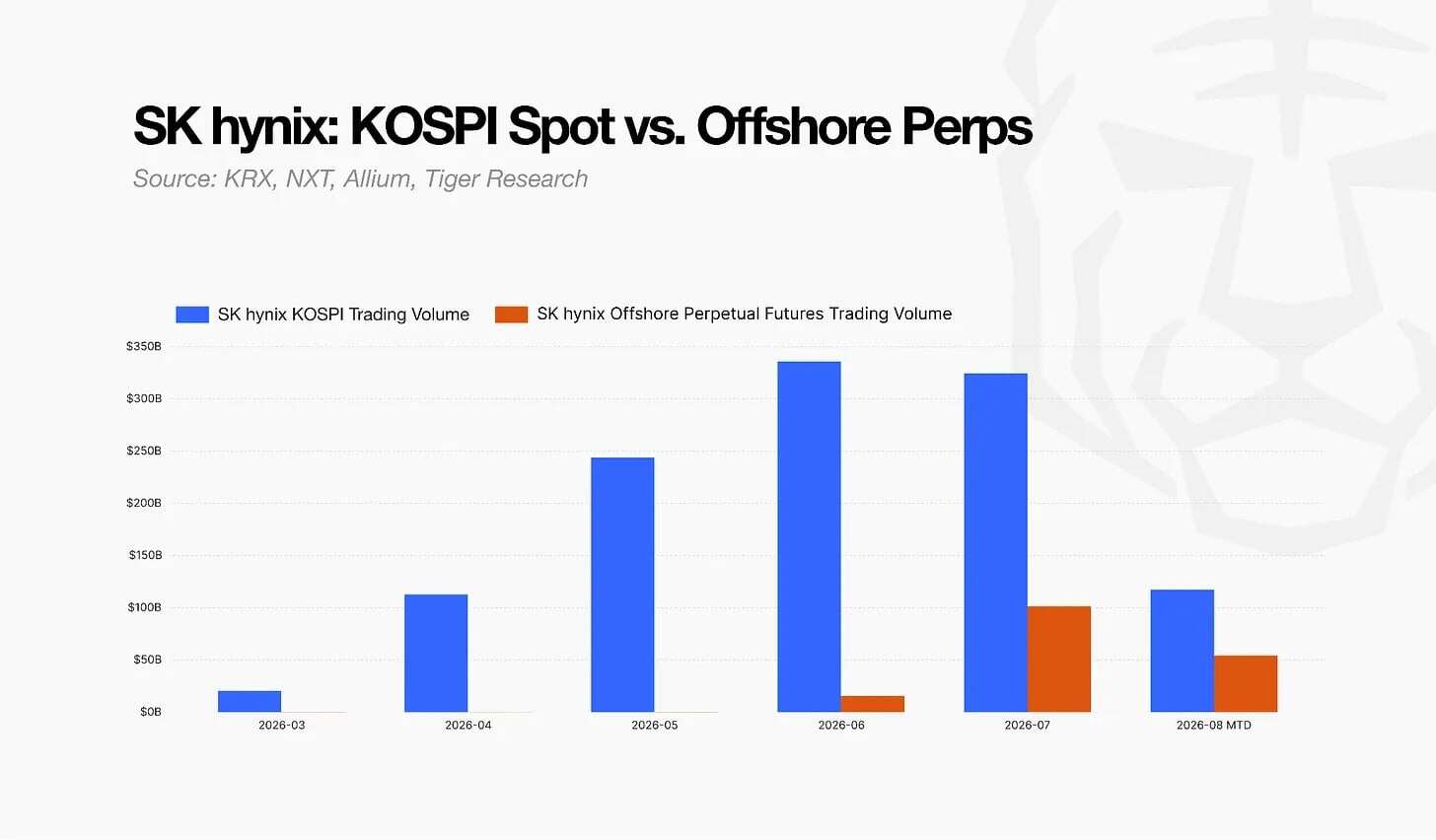
This structure could form a "tail wagging the dog" scenario: derivatives do not follow spot; rather, derivatives drive spot. For large-cap stocks like SK Hynix, the spot trading volume is still significantly larger, limiting the impact for now. However, the gap between derivatives and spot trading volumes is quickly narrowing, and this trend deserves continued attention.
The Global Market is Changing, Liquidity is Becoming Offshore
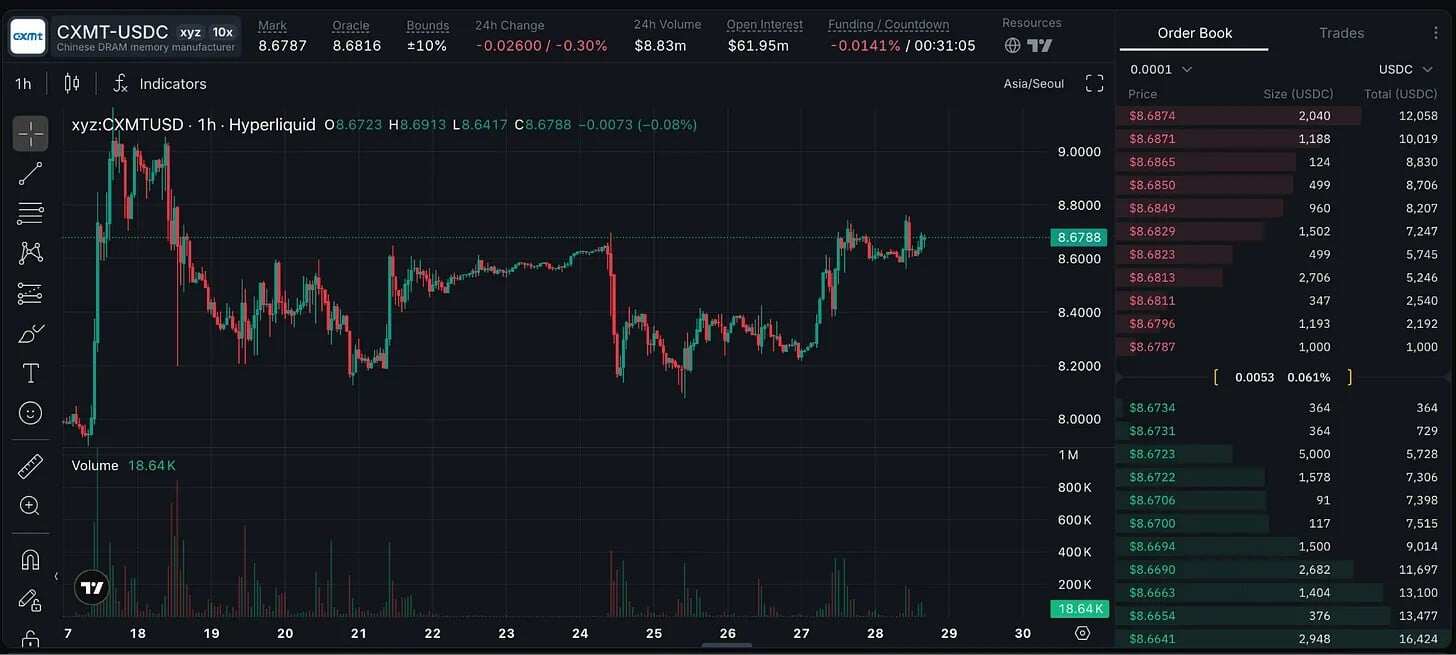
Korean stock offshore trading is not a phenomenon unique to South Korea. Perpetual contracts are rapidly spreading onto stocks and indices in places like Korea, Japan, and China, extending beyond listed companies. Offshore venues have launched perpetual contracts linked to unlisted companies like Anthropic and have introduced products linked to an unlisted Chinese memory chip company, Changxin Memory Technologies (CXMT). Assets that were previously difficult to trade through traditional securities markets are entering the perpetual contract market. What investors can trade is rapidly blurring traditional boundaries.
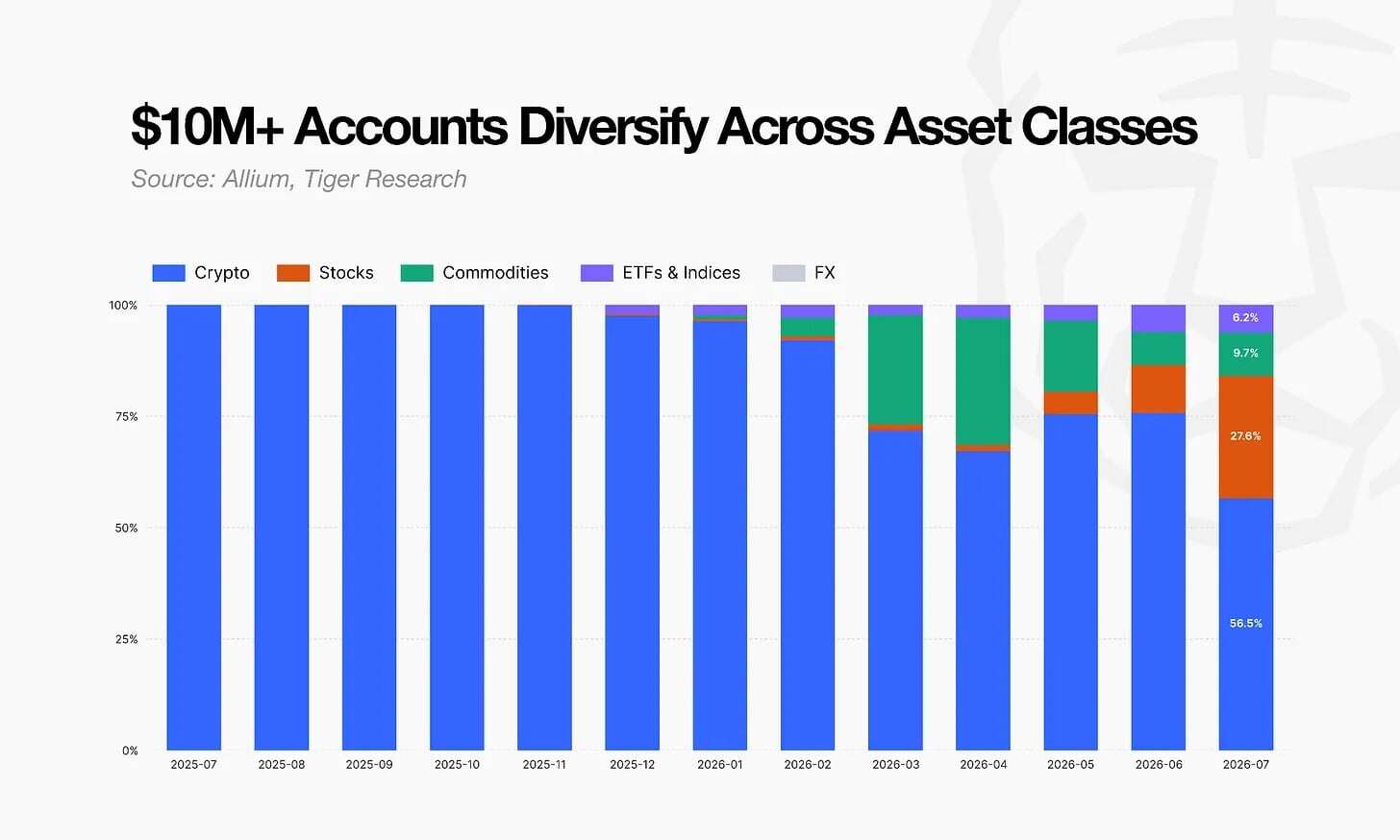
Participants are also changing. In accounts on Hyperliquid with assets exceeding 10 million USD, the proportion of trading in traditional assets like stocks and commodities is quickly rising. The Wall Street Journal has also reported that professional traders on Wall Street are using perpetual contracts outside regular trading hours and on weekends. This market was once dominated by crypto investors, but it is now beginning to attract professional traders and investors managing large sums of money.
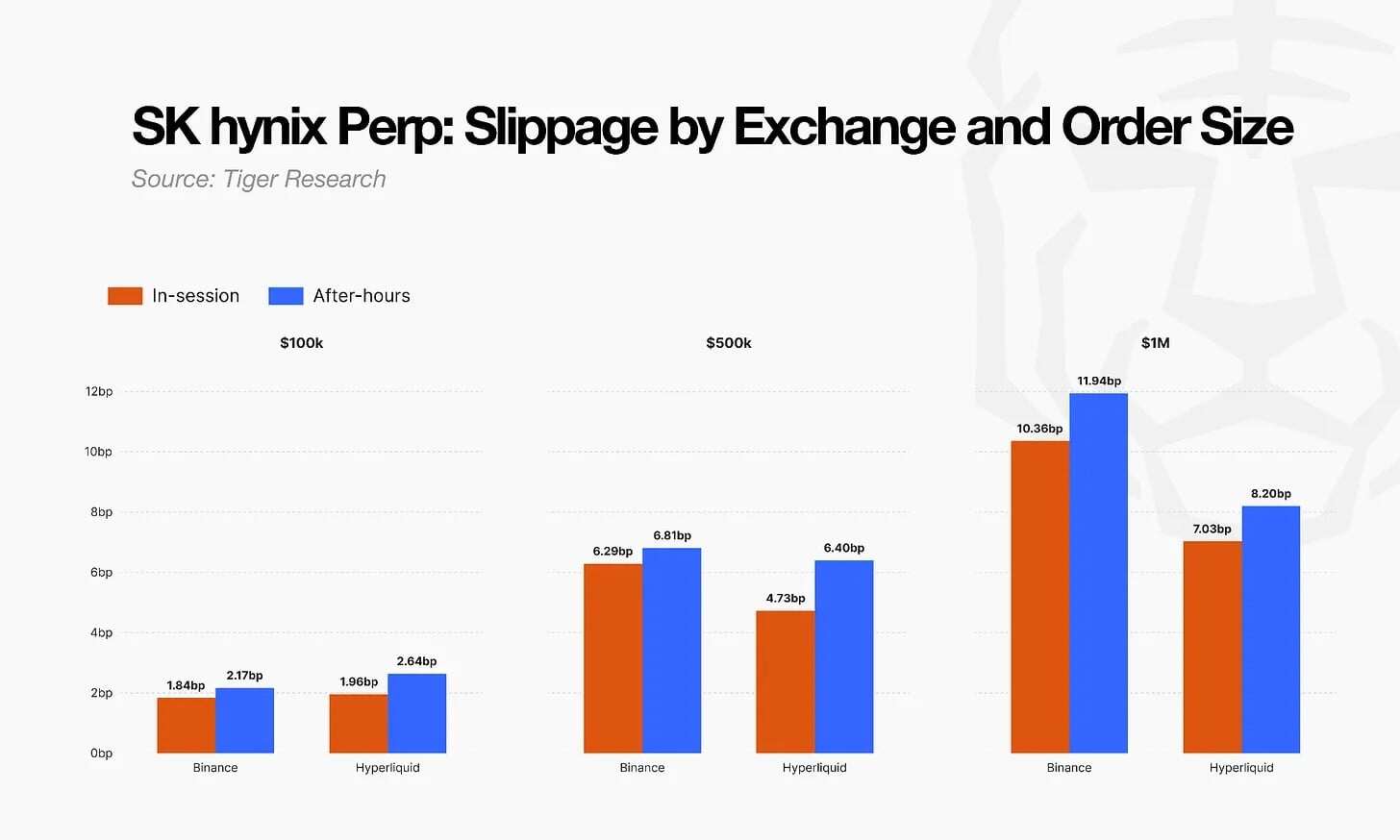
Liquidity itself is also worthy of attention. According to the average over the last 15 days, the slippage on a 1 million USD transaction in SK Hynix perpetual contracts is only in single-digit basis points. Even outside regular trading hours, slippage remains relatively low. This indicates that even when the South Korean stock market is closed, there is enough depth in this market to accommodate large orders. Perpetual contracts are no longer just about "extending trading hours," but are growing their own liquidity.
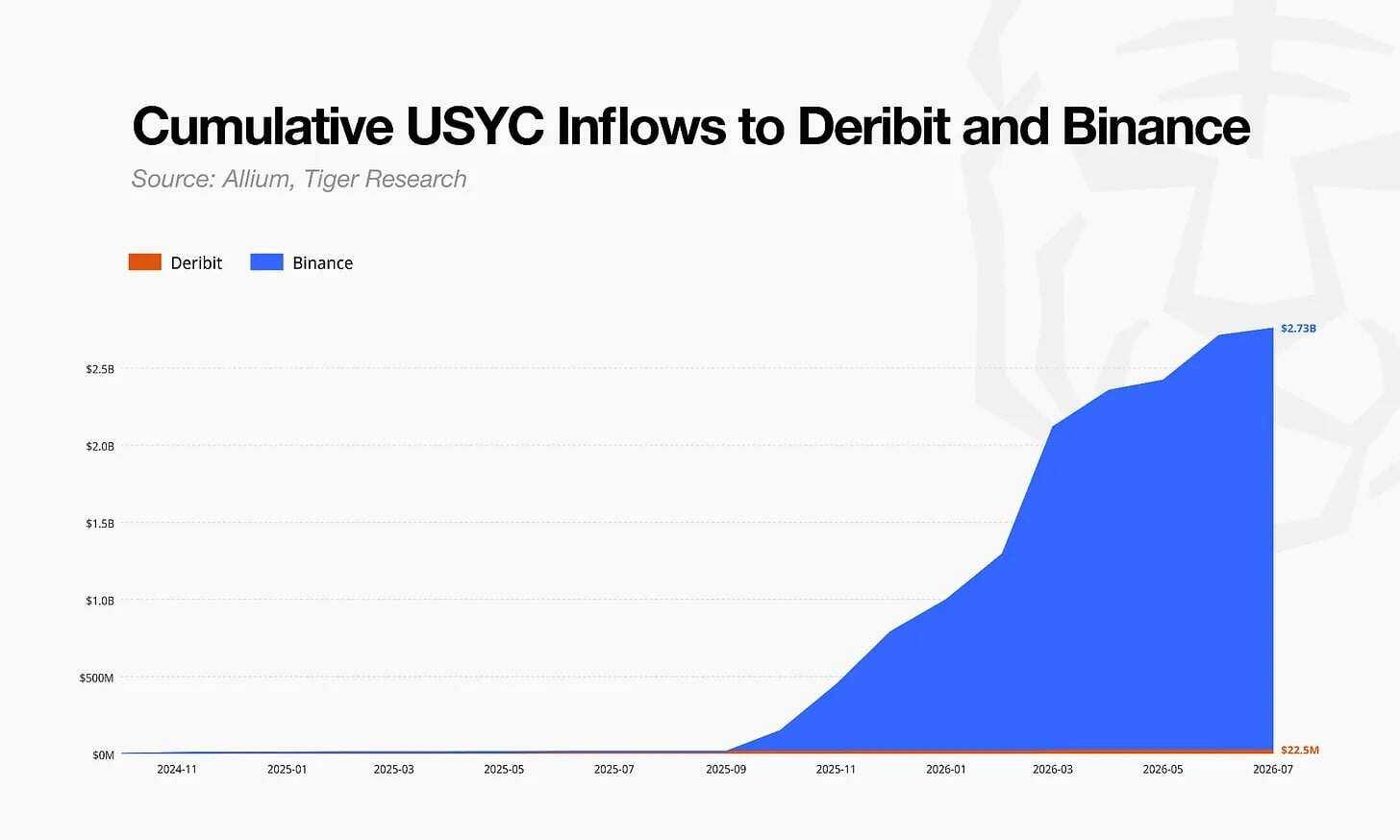
The funds used for trading are also changing. Some global exchanges have accepted tokenized U.S. Treasury bonds as collateral, including BlackRock's BUIDL and Hashnote's USYC. Over the past year, the cumulative amount of USYC transferred to exchanges was approximately 2.75 billion USD. Not all of this is used as collateral for derivatives, but institutions can hold familiar U.S. Treasury-like assets to be used as trading collateral when needed. Traditional financial assets are beginning to serve as collateral in these new markets, creating a new channel for funds between traditional finance and the new trading market.
What we are seeing now is not just the expansion of the crypto market into traditional assets. An offshore market that can trade Korean stock prices without going through the won, domestic brokers, or the South Korean exchange is rapidly growing. Tokenized U.S. Treasury bonds play the role of collateral here, and professional traders and large fund management institutions have already entered the scene. The change is not limited to trading targets; the participants and forms of funding are being rewritten.
The trading volume of perpetual contracts linked to Korean stocks has reached 307 trillion won. This figure indicates that changes are happening rapidly. However, 307 trillion won does not represent the size of a mature market; it is merely the current scale of a market that is still taking form. If more assets become tradable and institutional funds enter on a large scale, offshore liquidity may continue to amplify. The market structures that have traditionally been segmented by national borders and trading hours, as well as the methods through which funds move across markets, could all be rewritten.

The Offshore Market is Growing, What Role Can South Korea's Financial Industry Play?
South Korea can restrict its domestic investors from trading these products, but it is difficult to stop the growth of the offshore market itself. Some global exchanges, including Binance, will restrict perpetual contract trading for accounts identified as South Korean users through KYC. However, the market linked to Korean stocks can still continue to expand through overseas investors and global funds. The reality is that South Korean regulations restrict the participation of domestic investors and financial institutions more than they do the offshore market itself. Even if domestic demand is suppressed, trading and liquidity may still grow overseas.
Therefore, South Korea should not only focus on blocking this trend but should also turn the growth of the new market into an opportunity for its financial industry. South Korea is not without a starting point: domestic cryptocurrency exchanges. Although they cannot directly launch perpetual contracts linked to stocks in the short term, they already have experience operating a 24-hour digital asset market and have a considerable user base. These conditions can support the extension into new markets. Global cryptocurrency exchanges are rapidly entering traditional assets, and South Korea should also examine the rules and market structures necessary to support this transition.
It’s not just the trading infrastructure that's insufficient. South Korea also needs businesses to be able to enter the market, a derivatives regulatory framework, and payment and settlement infrastructure denominated in won. Business accounts can introduce the professional funds needed for market-making, hedging, and arbitrage, as well as supplement liquidity. A formal framework for derivatives such as perpetual contracts is needed to support products linked to a wider range of assets. Payment and settlement tools like won-pegged stablecoins can lower the access threshold for overseas investors, facilitating the inflow and outflow of funds. These are not isolated regulatory issues; they are supportive conditions necessary for market operation.
What South Korea needs is a framework that allows these elements to operate in coordination, not piecemeal fixes. In this way, South Korean cryptocurrency exchanges will have the opportunity to move beyond simple crypto trading and connect a wider range of assets with global liquidity. Trading linked to Korean assets is already growing rapidly offshore. The real question is not how to stop this growth, but how much position the South Korean financial industry can occupy in this market.
免责声明:本文章仅代表作者个人观点,不代表本平台的立场和观点。本文章仅供信息分享,不构成对任何人的任何投资建议。用户与作者之间的任何争议,与本平台无关。如网页中刊载的文章或图片涉及侵权,请提供相关的权利证明和身份证明发送邮件到support@aicoin.com,本平台相关工作人员将会进行核查。


