In the past six months, the most frequently heard phrase in the OpenClaw community is: "Is the lobster done for?"
This open-source AI Agent project, which gained significant attention earlier this year, is visibly losing momentum, with user attrition and a decline in contributor enthusiasm compared to when it was launched. Just as everyone was getting used to its quietness, on August 30, it released the largest update in its history—933 contributors, over 16,000 Pull Requests, accounting for half of the total merge volume in the project's history.
The title of the official blog is interesting, called "OpenClaw 2.0, Accidentally"—the accidental 2.0. Team member Hannes Rudolph said they initially only intended to do two things: simplify installation and improve the browser side. But upon revising, they found that everything underneath needed to change along with it, and after seven weeks of digging, they emerged with a 2.0.
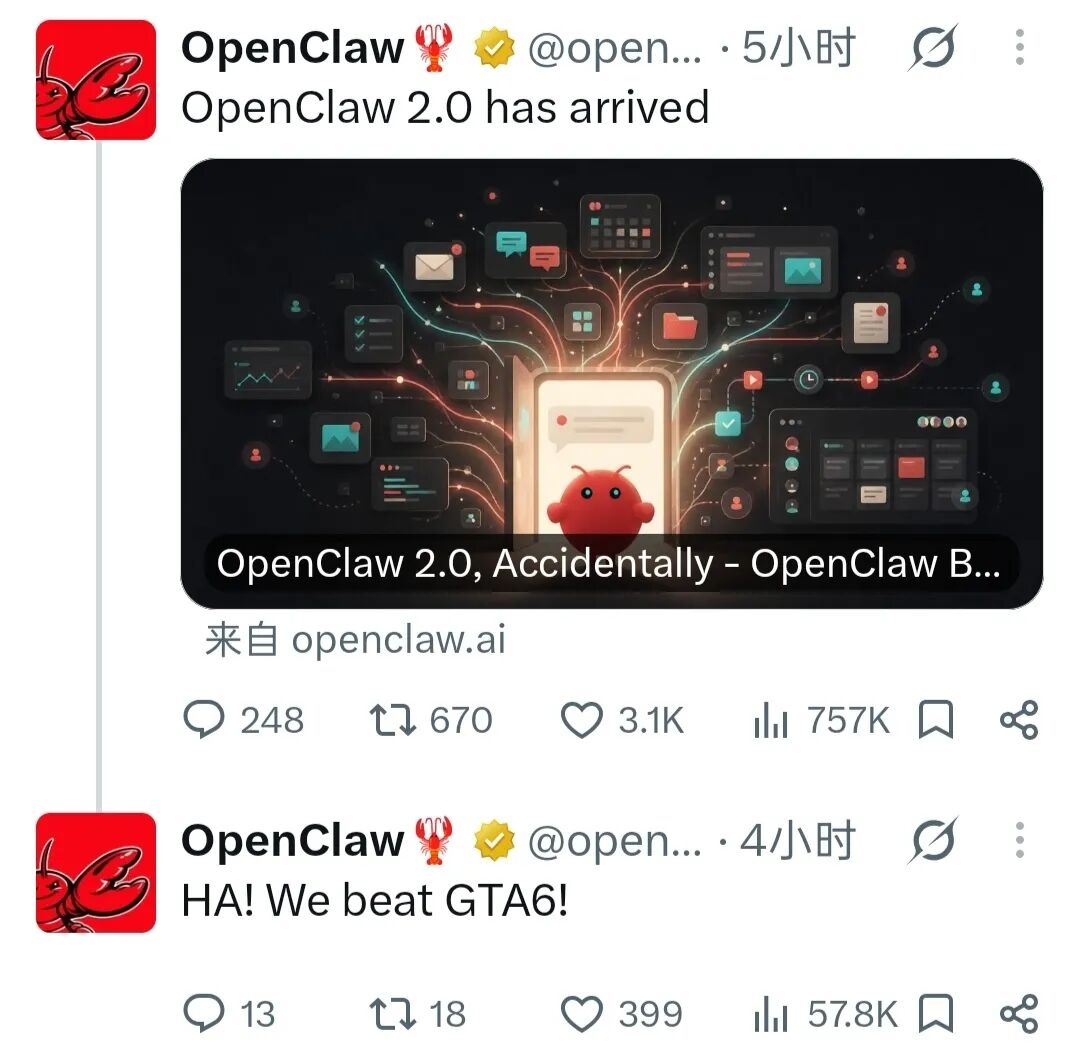
The official joke is that it's faster than GAT 6.
To know, in the previous 230 days, OpenClaw released 106 versions, averaging one or two every couple of days. This time, after nearly seven weeks of silence, it wasn’t idle; it was switching engines.
From "Geek Lego" to "Out of the Box"
Early OpenClaw was extremely friendly to geeks—models, gateways, plugins, channels, and skills could all be configured individually. But for ordinary people, every added degree of freedom meant another barrier to entry.
The installation for 2.0 has been entirely redesigned: it first scans what you already have on your computer—subscriptions to ChatGPT or Claude, API Keys, and locally running Ollama models—reusing anything that can be reused, validating responses before saving; the rest of the configurations don’t require forms, you just chat with the Agent to complete the setup.
The browser side has also been completely rewritten, opening directly into conversations, with files, approvals, terminals, and Git changes all displayed alongside the chat. The official startup time was reduced from 1.6 seconds to 575 milliseconds, and the number of page requests dropped from 140 to 45.
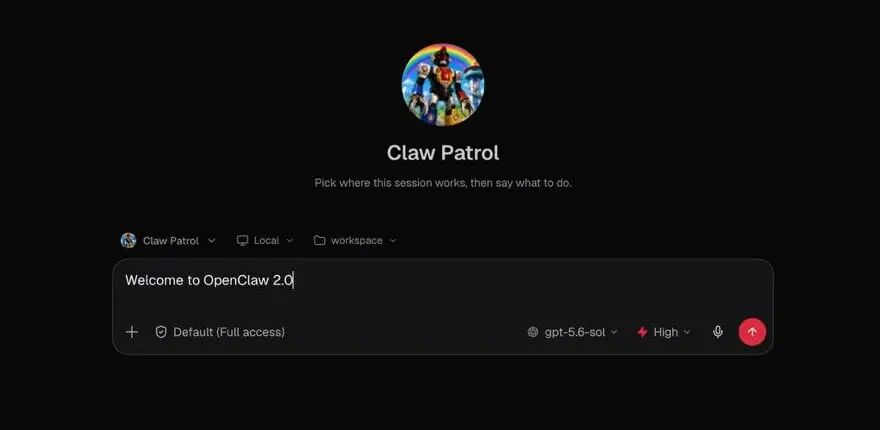
A bigger change is that the lobster has started to "grow up": conversation logs have moved from files into SQLite; tasks can migrate between your computer, paired devices, and cloud Workers, with idle cloud instances automatically going to sleep, and waking up when a message arrives; the new "shared cloud session" allows colleagues to take over tasks your Agent is handling with full context—turning the lobster from a solo electronic pet into a tool for collaborative work.
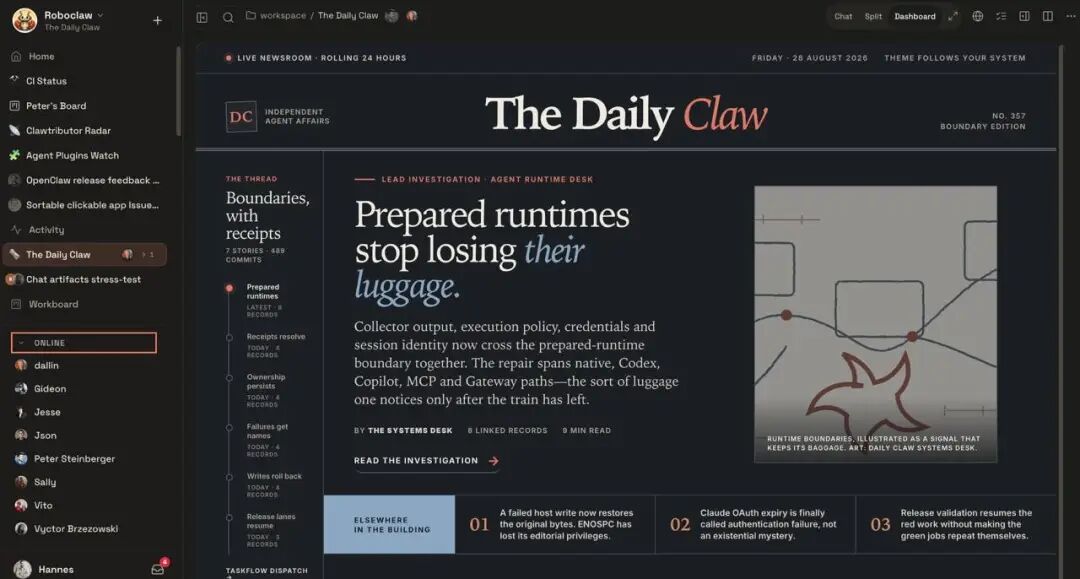
A user-built dashboard located within a shared multi-user OpenClaw workspace.
But the real signal is those "not fun" changes
Whether a project is a toy or infrastructure depends not on what it can showcase, but on whether it is willing to take responsibility for the dirty and hard work.
OpenClaw has quite a black history: in March of this year, analysis by Cisco Talos and Kaspersky found that 36% of skills on the ClawHub marketplace contained prompt injections; during the same period, over 155,000 OpenClaw instances were directly exposed on the public internet.
In 2.0, security has finally become a product feature: the gateway defaults to binding only to the local loopback address, unfamiliar private messages require a pairing code, a new security audit command performs a one-click check, key masks no longer enter chat logs, and Incognito mode conversations do not persist. Most interesting is the "honesty"—the documentation for the multi-user collaboration feature states plainly: these controls "are neither tenant isolation nor security boundaries"; one gateway is one trust domain. They even cite data from crowdsourced attack arenas to remind you: even if the breach rate for Claude Opus 4.5 is only 0.5%, the probability of existing defenses being breached remains above 80% when facing adaptable human attackers.
Being bold enough to actively tell users "this is not a security boundary" in the release notes is a hundred times more credible than claiming "absolutely safe." Such a self-limiting statement is something only done when a demo shifts to becoming a production tool.
Conclusion: Internet celebrities will fade, infrastructure will remain
2.0 cannot solve all of OpenClaw's problems. You still need to understand concepts like model vendors, API Keys, and gateways; plugin migration and version upgrades still require manual effort. Domestic platforms like WorkBuddy integrate PPTs, spreadsheets, and multi-Agent collaboration into a unified workspace, while Q&A Office offers direct web access. For those who just want to get work done, closed-source bundles are indeed more reassuring.
However, the closing line of the official blog makes the route clear: "We don’t sell anything, and we don’t ask you to entrust the future to any company, a model, or an AI vendor—because OpenClaw is open source and belongs to the people who use it and build it."
The lobster is destined not to be a mass-market product. It is more likely to shrink into a professional tool for developers, automation enthusiasts, and teams with private deployment needs—transforming from an electronic pet of public interest to personal infrastructure that requires serious maintenance.
There’s nothing wrong with that. Trendy toys go through waves of change, while infrastructure, once laid, will remain.
Seven weeks without a release does not mean it’s done for; the lobster is shedding its shell. Once the shell is shed, its claws will be even stronger.
免责声明:本文章仅代表作者个人观点,不代表本平台的立场和观点。本文章仅供信息分享,不构成对任何人的任何投资建议。用户与作者之间的任何争议,与本平台无关。如网页中刊载的文章或图片涉及侵权,请提供相关的权利证明和身份证明发送邮件到support@aicoin.com,本平台相关工作人员将会进行核查。


