28.63%, is the Okta single-day increase after earnings.
22.58%, is the CRM increase from yesterday.
20.50%, is the CRWD increase on the same day.
The three companies used a round of earnings reports to prove that AI software is indeed making money.
(Image source: ChatGPT generated)
Ladies, put down the urgent and slow tasks at hand; the priority now is to re-evaluate the software stocks in the AI era.
Instead of being killed by the capabilities of large models, they have become even stronger.
Since mid-July, we have been intensively analyzing software stocks, releasing video articles one after another, with the core focus being the reconstruction of valuation logic for software stocks in the AI era. Those who missed out should quickly catch up:
In this article, we will systematically review the new analytical logic for AI era software stocks, as well as the signals released by several key earnings reports this week.

New Logic for Software Stock Valuation: How Deep is the Integration with AI?
The "software apocalypse theory" was widely discussed before, essentially revolving around the same question: Will AI make people no longer need them?
At present, it seems that not only does this theory not hold, but AI has also provided new business growth channels for software companies.
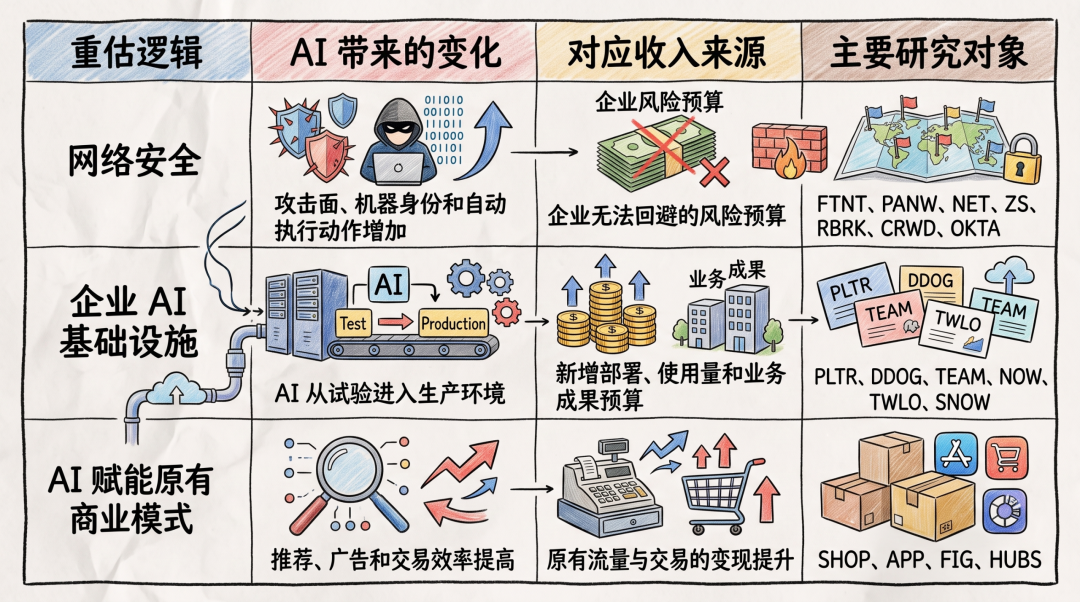
Previously, we consolidated a framework, categorizing software stocks in the AI era into three main levels:
(Image source: Gemini generated)
Our previous judgment was that cybersecurity is currently the clearest direction to secure enterprise budget paths. This appears to be entirely valid; "Guarding AI" is the most direct application line at present.
AI Agents bring more machine identities, interface calls, and automated actions, leading to a rapid increase in entry points that enterprises need to protect. For every AI system added, identity verification, access control, traffic detection, data protection, and recovery capabilities must also be increased in tandem. These expenditures are driven by risk, making it difficult for enterprises to delay; thus, platforms that control networks, identities, data, and recovery points gain stronger pricing power.
Enterprise AI infrastructure and AI amplification of existing business models are the other two main lines.
On one hand, enterprises need to purchase data governance, observability, permission management, and business execution systems. Whether related companies can benefit depends on their products' ability to truly enter production processes and convert scale, usage, and business outcomes into revenue. On the other hand, platforms like Shopify (SHOP) and AppLovin (APP) have already captured transaction, merchant, or advertising data; AI can enhance recommendation, delivery, and operational efficiency, thus increasing revenue per transaction or per unit of traffic.
Cybersecurity Narrative Realized: OKTA, CRWD
On Thursday, the earnings reports from Okta and CrowdStrike triggered a collective surge in the cybersecurity sector. The latest earnings reports released an important signal:
As AI Agents, machine identities, and automated attacks rapidly increase, enterprises have not cut security budgets; rather, they are signing larger, longer-term platform contracts.
Okta (OKTA): Orders have warmed up first, and AI identities open up upside valuation space
Okta delivered an earnings report that grew beyond market expectations, causing its stock price to surge nearly 30% on the day after the earnings report. The market is trading on the indicators of order recovery, sustained improvement in profitability, and the potential new growth curve that AI Agent identity governance could form.
Positive signals from the order side: Q2 FY27 revenue was $805 million, up 11% year-on-year; subscription revenue was $793 million, a growth of 12%; and non-GAAP EPS reached $1.05. More importantly, RPO grew by 17% to $4.858 billion, and cRPO increased by 14% to $2.585 billion, both significantly faster than revenue growth, indicating that new contracts, renewals, and long-term contract demand are improving, providing support for revenue in the coming quarters.
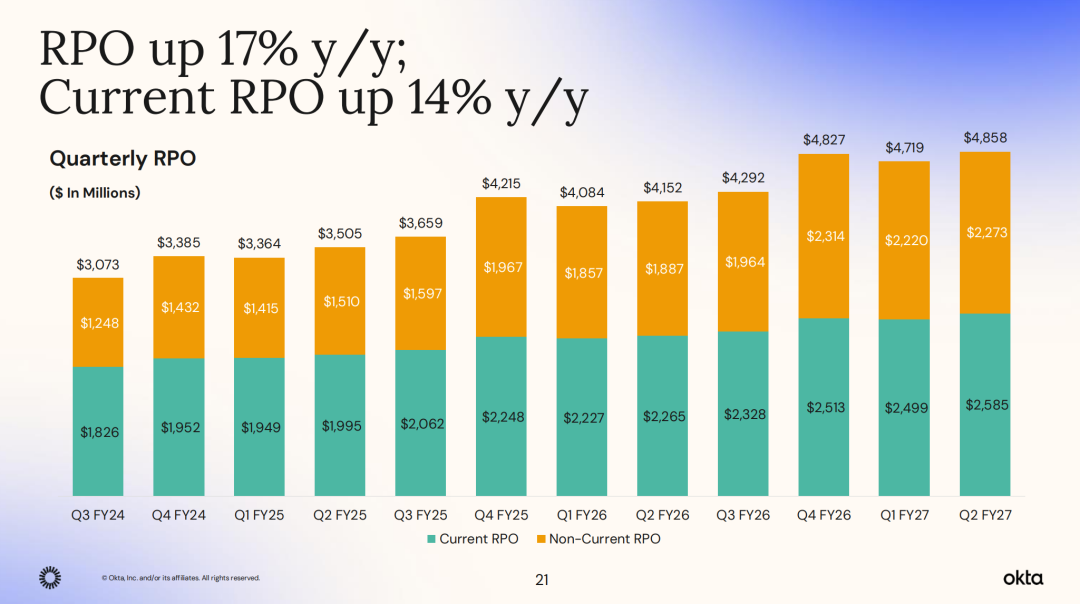
(Image source: OKTA)
Strengthened Revaluation Logic for Profitability: Non-GAAP operating margin reached 28.2%, with a free cash flow margin of 28.1%, an increase of 5.8 percentage points year-over-year; full-year revenue guidance was raised to $3.216 billion—$3.226 billion, with free cash flow margin expected to reach 28%—29%. While maintaining low double-digit growth, Okta has shifted from merely pursuing scale to focusing on high-quality growth, with cash flow improvement providing a more solid lower limit for valuation.
AI is the variable worth observing the most: AI Agents are expected to create a significant number of service accounts, Tokens, API connections, and MCP connections; enterprises need to continuously complete identity registration, authorization, auditing, and revocation. Okta has a critical control point in identity authentication and permission execution, having launched Agent Registry, Token Vault, MCP authentication, and non-human identity governance. If in the future they charge according to the number of Agents, machine identities, or API calls, the company is likely to break through the traditional employee seat growth limit.
Future focus on validating growth sustainability: Microsoft can bundle basic identity functionality at a low price through corporate agreements, and Okta must rely on vendor neutrality, cross-cloud integration, and more comprehensive identity governance to maintain its premium. Future monitoring will need to include NRR, cRPO, and AI revenue: if NRR remains at 107% for a long time, and cRPO growth rate continues to decline from this quarter's 14%, and the company still does not disclose the number of AI customers or incremental ARR, then a profit margin above 28% is more likely to indicate that the business has entered a maturity phase. Conversely, if non-human identity and AI Agents begin to bill independently and drive NRR back above 110%, Okta's positioning is expected to shift from "low growth, high cash flow identity vendor" to an AI security growth stock.
XINGPT

CrowdStrike (CRWD): Net new ARR hits record, platform expansion further accelerates
In a previous video about software stocks, we noted that judging whether CrowdStrike can really secure enterprise security budgets requires closely monitoring new ARR, cash efficiency, and Falcon Flex client expansions. This quarter's earnings report shows that these three indicators have continued to improve overall, indicating that the previously proposed platform logic is being realized.
Enterprise new budget continues to accelerate: Last quarter's end ARR was $5.51 billion, with a net new ARR of $256 million for the season; by the end of this quarter, ARR has risen to $5.841 billion, up 25% year-on-year, and net new ARR further increased to $333 million, a year-on-year growth of 51%, setting a historical high. RPO has also risen from $7.2 billion in the same period last year to $10.7 billion, an increase of about 49%, indicating that clients are not only increasing current purchases, but also signing larger and more long-term platform contracts.
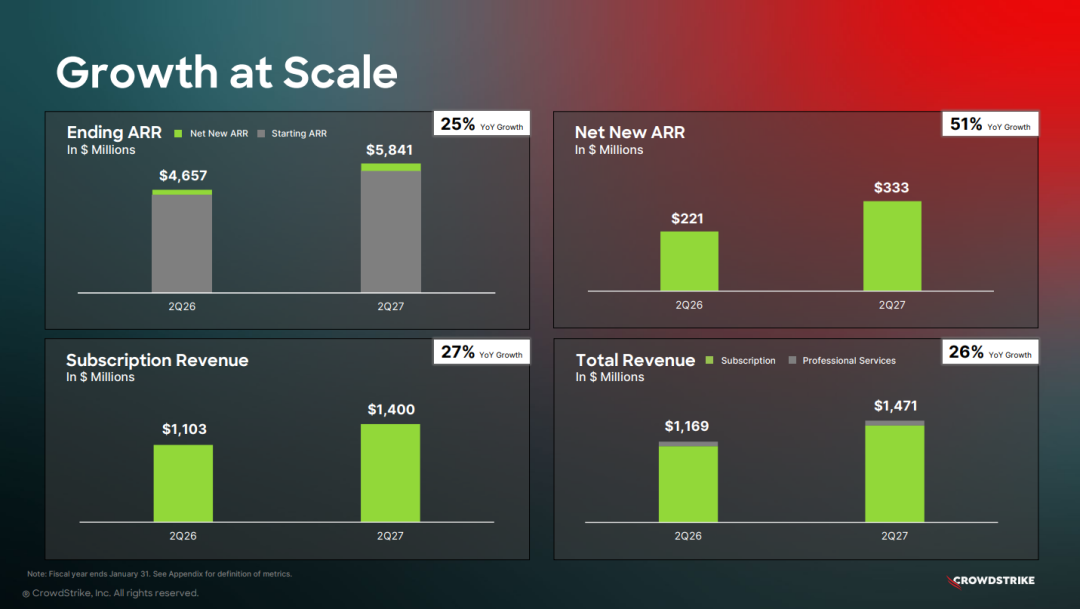
(Image source: CRWD)
Expansion logic of Falcon Flex validated: Last quarter, Flex clients contributed over $1.9 billion in ARR, this quarter has increased to $2.29 billion, a year-on-year growth of 101%, with the number of clients exceeding 2,900. The number of additional Re-Flex clients has also increased from 480 to over 630; clients transitioning from standard contracts to Flex have seen an average ARR increase of over 40%, indicating that Flex is not just about locking in orders early at a discount, but clients are indeed increasing security spending as they activate more modules.
AI security has begun to contribute actual revenue: Cloud security ARR exceeded $905 million, growing 29%, Next-Gen SIEM ARR exceeded $695 million, growing 60%, and Next-Gen Identity ARR exceeded $585 million, growing 33%; AIDR ARR approached three times in sequential quarterly growth. Rather than merely launching AI products, CrowdStrike has begun to prove that AI detection and response can lead to genuine payment. Its endpoint Agents, real-time threat data, and automated isolation capabilities also form security control points that are hard for AI to directly replace.
Future focus on Flex revenue realization and quality of earnings: This quarter's revenue grew by 26%, the free cash flow margin was 26%, and the Rule of 40 reached 52%; non-GAAP operating margin increased from 22% to 25%. As Palo Alto Networks and Microsoft accelerate platform integration, CrowdStrike must continue to prove that Flex contracts can be converted into actual usage, renewals, and cash flow to support the market's premium on platform leaders.
AI Software is Actually Making Money: CRM
Salesforce (CRM) this quarter's earnings report proves that AI Agents have not consumed existing software usage, while Agentforce is also starting to generate usage and orders.
CRM’s stock price rose over 22% after earnings, reflecting the market's shift to reduce the probability of "AI destroying the SaaS seat model" and reassessing the possibility of the company transitioning from per-user billing to "seat + usage" billing.
However, after excluding the newly acquired enterprise data management platform Informatica, the growth rate of core subscription revenue is average; whether the new usage model can actually lift the overall growth rate of the company is crucial for the next stage.
Improvement in orders but revenue growth supported by acquisitions: Q2 FY27 revenue was $11.345 billion, a year-on-year growth of 11%; subscription and support revenue was $10.82 billion, a growth of 12%; cRPO reached $33.5 billion, growing 14%, accelerating by 1 percentage point quarter-on-quarter, and Q3 cRPO guidance also reached about 14%. However, this quarter's revenue includes a contribution of $456 million from Informatica, equivalent to about 4.5 percentage points; excluding acquisitions, the growth rate of core subscription revenue is approximately 6%—7%. Therefore, forward-looking order indicators are improving, but they do not directly indicate that the core business has accelerated.
Agentforce opens the growth model of "seat + usage": Agentforce ARR reached $1.5 billion, a year-on-year growth of over 240%; combined with Data 360, the total ARR is close to $3.9 billion. Q2 Agentic Work Units grew by 97% quarter-on-quarter, MCP weekly call volume increased sixfold, while human application usage remained stable, indicating that AI Agents are creating new consumption on top of traditional seat revenue. If the capacity of Agents and data calls begins to be charged at scale in the future, Salesforce is likely to break free from a growth model that purely relies on employee numbers.
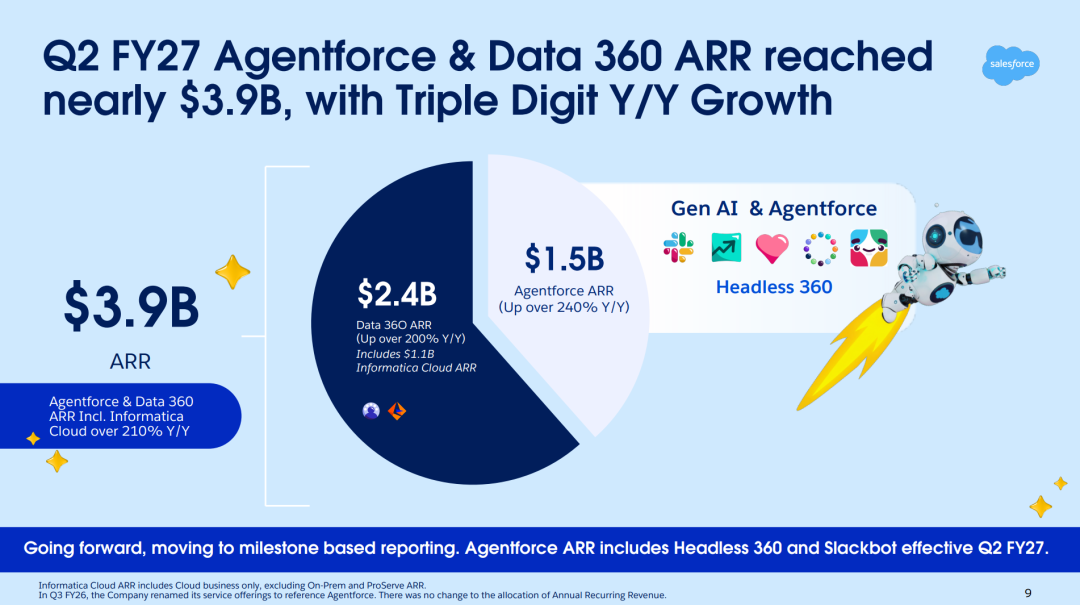
(Image source: CRM)
Data and customer base reinforce AI commercialization barriers: Enterprise customer records, permissions, sales processes, and service actions have long been stored in Salesforce; Agents running through third-party interfaces like Claude still ultimately need to call Salesforce's data and business logic. The value of Agentforce lies in transforming this data into executable actions, while Data 360 is responsible for unifying and governing the data. Morgan Stanley pointed out that this season saw the addition of about 2,000 paid production customers, with a quarter-on-quarter growth of 70%, and high-end Agentforce SKU orders doubling quarter-on-quarter, with 50% of the orders coming from existing clients adding capacity. This indicates that the existing customer base is becoming the cross-selling channel for AI.
AI growth has not yet offset concerns about traditional business slowdown: Core sales business grew 9%, customer service business grew 5%, accounting for 7% including Agentforce; however, marketing and e-commerce business declined 1%, and data analytics and systems integration business declined 6%. This indicates that AI growth is currently mainly concentrated in Agentforce and the data platform, and has not widely driven the recovery of traditional products. Future observation is needed to see if Agentforce can improve the average revenue per client for core products, as well as if the weaker traditional business can stabilize.
In Conclusion
Amid the AI boom, software stocks have transformed from being bystanders to beneficiaries.
Okta, CrowdStrike and Salesforce’s earnings reports collectively illustrate that AI has not simply replaced existing software budgets; rather, it has created more machine identities, secure connections, data calls, and automated tasks.
However, we still maintain our previous viewpoint that opportunities in software stocks are differentiated; companies that are more deeply integrated with AI and can convert usage into orders, ARR, and cash flow will be favored by investors.
As the Q2 earnings season comes to an end, the next focus will be on Palo Alto Networks and Snowflake’s earnings reports.
This round of software stock value re-evaluation has already spread from individual stocks to the entire sector.Palo Alto Networks and Snowflake’s earnings reports will further validate whether the trend can continue, and whether funding can expand from security SaaS to data infrastructure and more application software companies.

Distill AI
免责声明:本文章仅代表作者个人观点,不代表本平台的立场和观点。本文章仅供信息分享,不构成对任何人的任何投资建议。用户与作者之间的任何争议,与本平台无关。如网页中刊载的文章或图片涉及侵权,请提供相关的权利证明和身份证明发送邮件到support@aicoin.com,本平台相关工作人员将会进行核查。


