The South Korean crypto industry may be completely absent from perpetuals, prediction markets, stablecoins...
Written by: @100y_eth
Translated by: AididiaoJP, Foresight News
The glory days of the South Korean crypto market seem to have passed. However, for global protocols, South Korea remains a market worth paying attention to.
Indeed, during the recent long bear market, the trading volumes on exchanges such as Upbit and Bithumb have dropped significantly. But once market sentiment slightly improves, the trading volume can rebound by 2.5 to 3 times in a short period. This indicates one thing: the retail liquidity in the South Korean crypto market returns very quickly.
But the industry itself is another matter.
Compared to the past, the South Korean crypto ecosystem has lost much of its attractiveness. During the bull market in 2021, South Korea was quite significant in the global crypto circle: a solid investor base, an active community, with various companies and projects continuously emerging, from public chains, DeFi, blockchain games, NFTs, to infrastructure and wallets.
Everything changed after the collapse of Terra in 2022.
The on-chain world is moving towards two extremes
While the South Korean crypto industry is slowing down, the global blockchain industry has taken quite an interesting path.
The peak of Bitcoin in 2025 is almost twice that of the peak in 2021. However, the native on-chain products that surged in 2021 and 2022 have not kept pace with growth.
The overall market clearly has expanded. The question is: who is really enjoying the dividends?
The answer is quite simple—one category is driven by speculative demand, and the other links crypto to the real economy.
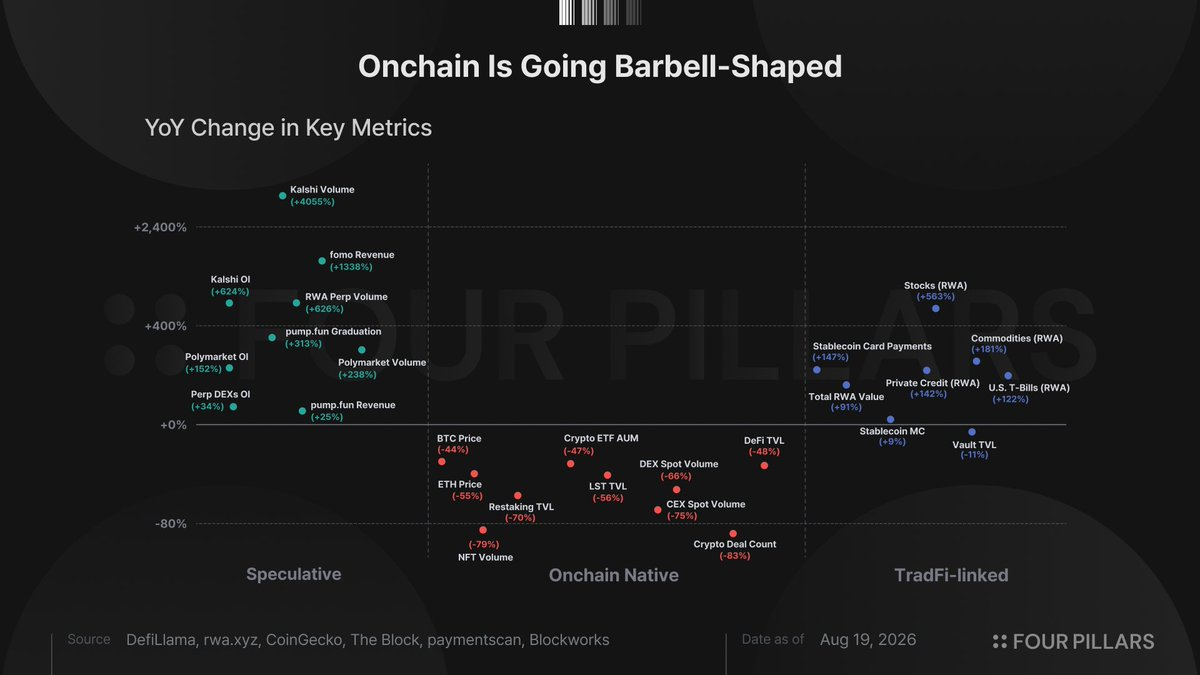
Not long ago, when the market was still hovering at low levels, year-on-year data clearly told the story: the locked value in DeFi has plummeted, and the trading volumes of both decentralized and centralized exchanges, liquidity staking token locks, NFT transaction values, and crypto financing counts have also visibly decreased.
In other words, the native on-chain products that defined the market in the last bull run have seen declines even worse than Bitcoin, which serves as the factual benchmark for the market.
On the other hand, even in such a tough market, there are still a few sectors that are booming.
Perpetual contracts (Perps) and prediction markets thrive on speculative demand; stablecoins and RWA connect crypto to the real economy.
Therefore, this round of the blockchain industry is indeed experiencing growth. But the form of growth is more critical—it has taken the shape of a dumbbell: one end is speculation, and the other is the integration with the real economy.
The South Korean blockchain industry is falling behind
Perpetual contracts, prediction markets, stablecoins, and RWA are the four directions in the global blockchain industry that are growing the fastest in this round.
What about South Korea? How many of these four sectors can truly thrive locally?
Zero.
Currently, the South Korean blockchain industry does not have a legitimate path to operate in any of these four directions.
Perpetual contracts: South Korea does not have clear laws prohibiting perpetual contracts. However, the Financial Supervisory Service adopts a very conservative attitude towards credit provision related to crypto assets. Under the current legal framework, there is no legal basis for conducting crypto derivatives business domestically.
Prediction markets: In South Korea, prediction markets are generally classified as illegal gambling. Recently, the Korea Communications Commission has also blocked domestic access to Polymarket.
Stablecoins: The enactment of the "Digital Asset Basic Act," which is expected to regulate stablecoins, has been repeatedly delayed. Currently, businesses issuing and circulating stablecoins still lack legal basis.
RWA: Although South Korea has an STO framework, it is highly tied to "fragmented investment products," which is not the same as what is typically referenced globally as RWA. There is currently no regulatory framework for RWA in South Korea. Recently, regulators stated that tokens issued overseas based on South Korean securities and sold only to overseas investors are unlikely to be considered violations of the "Electronic Securities Act." However, the limitations for South Korean institutional investors to truly enter RWA products remain clear.
Perpetual contracts are a trading innovation that emerged from the crypto market itself. The Singapore Exchange has already launched Bitcoin and Ethereum perpetual futures, and the U.S. Commodity Futures Trading Commission has also approved KalshiEX's Bitcoin perpetual futures.
Prediction markets are another form of innovation—it can transform almost anything in the world into a tradeable interface. Recently, it has also begun to show potential as a hedging venue and even a next-generation insurance product.
Stablecoins and RWA are different again. They have detached from the sentiments of the crypto market and independently achieved product-market fit, becoming the underlying infrastructure of the next generation of finance.
These innovations have barely occurred in South Korea.
Thus, a strange paradox emerges: the gap between South Korea and the global market today is actually larger than it was in 2021.
This does not mean that no one is taking action. The regulatory framework remains unclear, but financial institutions are already preparing for stablecoin businesses; in terms of RWA, some participants have chosen to issue products overseas first.
South Korea still has a clear advantage: once the regulatory environment is in place, the speed at which this market can develop the industry may surpass that of most countries.
It is hoped that South Korea can quickly provide a clear regulatory framework for perpetual contracts, prediction markets, stablecoins, RWA, and related sectors. Only then will it genuinely reopen the growth space for the South Korean blockchain industry.
免责声明:本文章仅代表作者个人观点,不代表本平台的立场和观点。本文章仅供信息分享,不构成对任何人的任何投资建议。用户与作者之间的任何争议,与本平台无关。如网页中刊载的文章或图片涉及侵权,请提供相关的权利证明和身份证明发送邮件到support@aicoin.com,本平台相关工作人员将会进行核查。


