Source: BIT Securities
Upon waking up, the US stock market once again collectively thanked Nvidia.
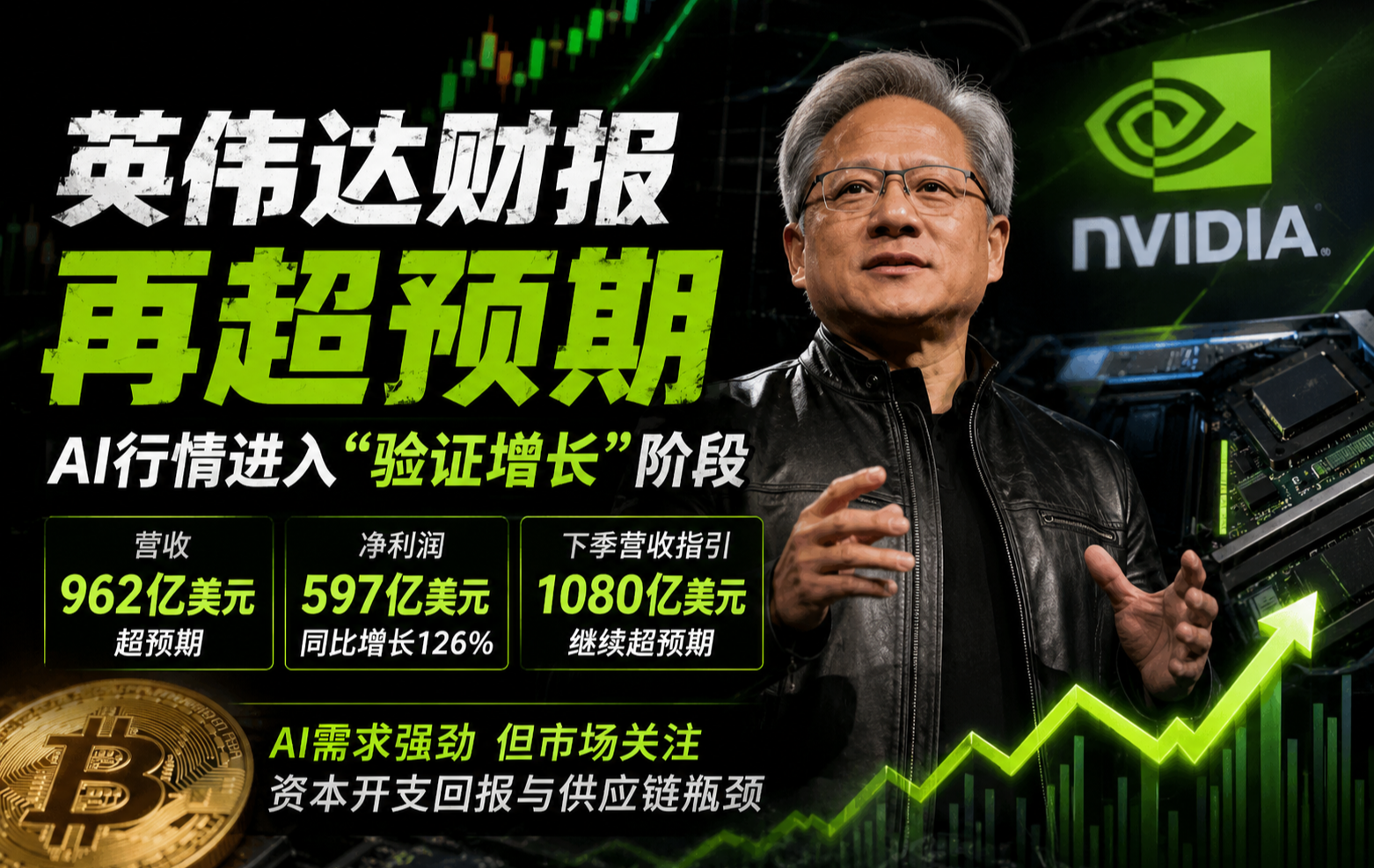
After the US stock market closed, Nvidia announced its latest financial report. The data presented in this report is impressive with no flaws: revenue of $96.22 billion, exceeding the expected $92.17 billion, a year-over-year increase of 106%; adjusted EPS of $2.22, higher than the expected $2.09, a year-over-year increase of 120%; Q3 guidance set at $108 billion, continuing to exceed market expectations.
What is even more noteworthy is that according to GAAP, Nvidia's net profit margin for this quarter is approximately 62%, meaning that about $62 of every $100 in revenue is converted into net profit.
1. Stunning report card, but the market was initially aesthetically fatigued
Logically, this kind of financial report deserves a surge in stock price. However, after the announcement, Nvidia's stock actually dropped by about 4% in after-hours trading.
The reason is not hard to find: the AI narrative has been weak for a while, and the market has begun to feel aesthetically fatigued by "exaggerated report cards". Surpassing expectations for a single quarter? Been there. Upgraded guidance? Seen that. A fatigued market wants something new.
The turnaround occurred during the conference call.
CFO Kress first threw out the first bomb: providing preliminary guidance for FY2028 with a revenue growth of about 70%—far exceeding Wall Street's prior expectation of about 44% to 45%. Then, Jensen Huang personally added fuel to the fire: the actual demand growth is far more than 70%, close to 100%, and without supply constraints, this number would be "much higher." He also elevated the narrative to a climax: the development of AI has reached a tipping point, no longer an experimental technology, but a revenue-generating productivity—now, computing power equals money.
With just a few words, the stock price instantly reversed from a decline to an increase, soaring more than 5% in after-hours trading, with the storage chip and optical communication sectors also rising collectively, reigniting enthusiasm for AI trading.
2. Behind the frenzy, a bill on credit
However, the extent of this after-hours surge is worth breaking down.
The main driver for Nvidia's rise this time was Huang's remarks, not the report itself. What the market fears most is the "AI growth bottleneck," and what Huang did was push the timetable for realizing this bottleneck back by a year—thus, what the market started trading is not just a single quarter surpassing expectations, but rather profit upgrades for the next one to two years.
In the short term, this is certainly a shot in the arm. But looking further ahead, this is prepaying future expectations: the pressure on gross margins has not disappeared, and the risk of AI clients purchasing cards via financing remains, just temporarily covered by a polished conference call.
Next, whether the Q3 guidance of $108 billion and next year's outlook can be fulfilled as expected will become the test hanging over Nvidia's stock price. The more confident the statements, the stricter the review will be.
3. Another batch of Wall Street money is eyeing assets outside the US stock market
While the US stock market is vying for a new phase of the AI narrative, another group of investors on Wall Street has quietly found new prey outside of the US stock market.
This time they abandoned the old "either/or" mindset, opting to bet on both gold and Bitcoin simultaneously. In the past five trading days, ETFs tracking these two asset types together attracted about $7 billion, setting a historical record—several of the largest gold and Bitcoin funds have surged to the forefront of the US ETF capital inflow rankings this week.
Driving this scene is the recent macro pressure from US Treasuries. Both gold and Bitcoin have risen simultaneously, and this capital flow has also been interpreted by some market participants as a signal of the warming "currency depreciation trade": under the backdrop of escalating fiscal pressure and loosening financial conditions, those scarce assets with limited supply are becoming increasingly attractive.
This logic being reignited is reshaping the asset allocation landscape for investors.
4. In conclusion
Last night's market was actually an intersection of two lines.
One line is in the reports: Nvidia proves with a 62% net profit margin and $108 billion guidance that the AI cash machine is still roaring; however, the turnaround in after-hours trading relies entirely on Huang's words, indicating that the pricing of this wave of market activity has shifted from "realized performance" to "unrealized promises"—the elasticity has increased, and tolerance for errors has decreased.
The other line outside the reports: gold and Bitcoin have been simultaneously bulk bought, indicating that a considerable portion of capital has begun preparing for a new world.
One line is the faith in AI, while the other line is the defense against fiat currency. The simultaneous strengthening of both lines may suggest a new trading narrative for the entire market moving forward.
Disclaimer: This article is written by an external author, and the content represents the author's personal views, not the stance, views, or investment advice of BIT. The market analysis, data, and judgments mentioned are for reference only and do not constitute any recommendation or offer for investment, trading, or other financial products. The market carries risks; investments should be made cautiously.
免责声明:本文章仅代表作者个人观点,不代表本平台的立场和观点。本文章仅供信息分享,不构成对任何人的任何投资建议。用户与作者之间的任何争议,与本平台无关。如网页中刊载的文章或图片涉及侵权,请提供相关的权利证明和身份证明发送邮件到support@aicoin.com,本平台相关工作人员将会进行核查。