Last week, the market was bustling with excitement for the whole week. How is everyone feeling now? Unknowingly, BTC has been fluctuating around $80,000. There are still quite a few friends stuck in it, with some distance from their previous break-even high point. Today, let's look back and review the ins and outs of this wave of market activity, to see which key information we may have overlooked. Let's talk about why the whales chose to exit the market, and whether there will be another surge in the market after this round.
Market movements driven by policy will be more rapid than usual. Let’s directly get to the point.
Returning to today’s core question: does this wave of increase signify the start of a bull market? From my perspective, several conditions that are often seen at the beginning of a bull market have appeared: policy expectations are beginning to ferment, ETF funds are continuously following up, and mainstream cryptocurrencies are collectively strengthening. The necessary elements have already emerged. However, we are still lacking the final confirmation point, which is whether the $80,000 level can be held steadily, and whether there will be new policy announcements to push it further.
When talking about policy, we cannot avoid the White House meeting.

When the news first broke, market sentiment was all about emotion. The president, regulatory agencies, leading exchanges, and Wall Street institutions sitting at the same table gave the market a direct feeling: the crypto industry’s position has changed, being formally placed on the negotiation table of U.S. financial policy.
After a week of settling down, what really stirred the market was Trump's push for Congress to pass the CLARITY Act. To put it simply, this act aims to clarify the boundaries of crypto regulation. Which cryptocurrencies fall under SEC jurisdiction, which are under CFTC jurisdiction, what conditions must trading platforms meet to be compliant, and what rules must projects follow when issuing tokens.
Many people think these regulatory texts are far removed from the market, but in reality, they directly determine whether large funds dare to enter. When institutions allocate BTC and related financial products, the most important thing is whether the rules are clear and whether the regulations can change on a whim. The clearer the rules, the more confidence institutions have to enter the market; this is the true core that ignited the market from the White House meeting.
Whether this Act can be implemented is likely to become clearer in September, and objectively speaking, the probability of it passing is not high. Capital markets have always traded on expectations; movement does not require the act to be implemented. What is truly worth watching is whether this matter will continue to change regulatory directions, ETF fund flows, interest rate expectations, and institutional allocation willingness. The news is merely a trigger; the movement of funds is the final outcome.
This round of soaring is unavoidably linked to U.S. Treasury bonds, and during the same period, gold is also strengthening for this reason. As of August 2026, the scale of U.S. debt has surpassed $40 trillion. Remember a simple logic: the more debt owed, the heavier the burden of interest to pay.
The yield on U.S. Treasuries can be understood as the cost of borrowing for the U.S. government. When yields rise, it means the cost of borrowing is increasing. If long-term yields remain high, the market will worry about U.S. fiscal pressure. This concern being transmitted to various assets raises a practical question: if the purchasing power of the dollar continues to be under pressure, where should the money go?
Looking at our platform's index is very intuitive, with the ten-year U.S. Treasury yield right before our eyes. The logic of gold is easy to understand: it is not bound to corporate operations, nor does it rely on the credit of a single country. Once the market begins to worry about debt and inflation risks, funds will flock to gold for risk-averse allocation.
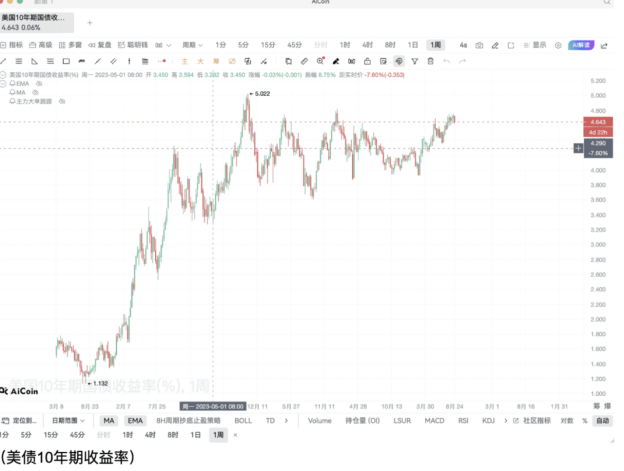
The logic of BTC adds another layer: its constant total supply makes many institutional investors view it as digital gold. In the context of rising U.S. debt pressure, assets with scarce supply naturally come under consideration from funds.
The White House meeting sparked the first fire in the market, and the real pressure from U.S. debt reinforced the underlying logic of market allocation to gold and BTC. The former stirs market sentiment, while the latter supports mid-term narratives. To put it honestly, America's approach is one where the more it borrows, the more it dares to continue borrowing; fundamentally, it is still playing economic leverage.
The CLARITY Act, the delineation of responsibilities between SEC and CFTC, and institutional participation in the crypto market—these topics have been placed back on the table. The market has finally received a policy narrative that can convince large funds to enter, which is exactly what the market has been lacking for a long time.
IBIT welcomed a large influx of capital last week, with a single-day net inflow reaching $600 million. As BTC pulled upward, ETF funds continuously entered the market, providing solid buying support for this surge. Market sentiment can also be felt from the performances of mainstream coins: BTC initiated the rise, followed closely by ETH and SOL, with funds no longer confined to Bitcoin, beginning to spread across the entire crypto sector. However, whether this bull market can solidify depends on whether subsequent buying can hold up.
Once the positive news has been fully digested by the market, ETF inflows slow down, and policy enters a lengthy waiting period, it’s entirely normal for BTC to fluctuate around high points. There’s a large number of latecomers who chased in at this position, and many chips have also cashed out after taking profits; price adjustments are just the norm in the market.
Right now, we can only say that we have seen the prelude signals of a bull market.
Let’s talk about how to view BTC and gold moving forward. For BTC to push further, two things cannot be avoided. The continual clarification of the U.S. regulatory framework will gradually alleviate institutional concerns; and ETF funds must maintain inflows for the high price to have continued support.
Daily monitoring can focus on several dimensions: spot ETF net inflows, which represent the attitudes of traditional institutional funds; the inflow and outflow data of BTC on exchanges, which can help gauge short-term selling pressure; the holding changes of on-chain whale addresses to understand the real operations of large funds, with ETF data being especially valuable for reference.
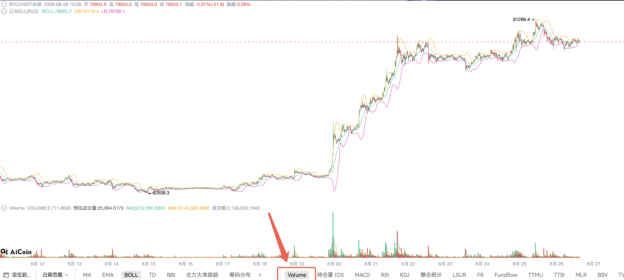
To summarize BTC’s current situation: there is upward space, but final confirmation depends on the sustainability of subsequent funds. Don't just fixate on individual green candles; after the rise, whether there's continuous buying following up is paramount. Do you remember where to observe the trading volume I mentioned during the live broadcast? It's this position.
The rhythm of the gold market is much smoother than that of BTC, but the supporting logic is solid. As long as the U.S. debt issue remains unresolved and Treasury yields remain high, the market will continue to worry about the purchasing power of the dollar, and gold will remain on the list of alternative investments.
Moving forward, focus on the U.S. Dollar index and Treasury yields. When the dollar weakens and Treasury risks repeatedly ferment, gold will have upward support; when the dollar strengthens again and long-term Treasury yields substantially decline, gold is likely to enter a period of adjustment.
When comparing the two, the differences are clear. BTC is highly linked to policy changes and ETF funds, leading to violent fluctuations; gold tends to follow the dollar, Treasury, and financial risks, resulting in a much milder market rhythm.
Next, we need to track several major movements from the U.S. Senate's voting action in mid-September and monitor the progress of the bill. From the Treasury side, we should closely watch the trends in Treasury yields. The U.S. Treasury has announced that starting from September 9, it will expand long-term Treasury buyback operations, covering until November 4 of this quarter’s refinancing window. Looking ahead, whether the buyback scale will continue to increase or whether funds from the Treasury account will be used to stabilize the bond market is crucial. If long-term yields remain high, it indicates that the market still harbors concerns about U.S. debt and inflation.

Lastly, watch the U.S. Dollar index. When the dollar weakens, the narratives of gold and BTC markets are more likely to develop; when the dollar rebounds strongly, the entire market needs to exercise more caution.
There are live broadcasts every day, and you’re welcome to keep following the AiCoin partners! Book in advance below👇
https://www.aicoin.com/zh-Hans/live/list?tab=upcoming
Join our community to discuss and become stronger together!
Official Telegram community:
AiCoin Chinese Twitter:
Aster rebate:
https://www.asterdex.com/zh-CN/referral/9C50e2
Hype rebate:
https://app.hyperliquid.xyz/join/AICOIN88
Binance rebate:
https://jump.do/zh-Hans/xlink-proxy?id=3 Invitation code: aicoin668
Coinbase rebate:
https://jump.do/xlink?checkProxy=true&proxyId=25 Invitation code: Y8L23JL
免责声明:本文章仅代表作者个人观点,不代表本平台的立场和观点。本文章仅供信息分享,不构成对任何人的任何投资建议。用户与作者之间的任何争议,与本平台无关。如网页中刊载的文章或图片涉及侵权,请提供相关的权利证明和身份证明发送邮件到support@aicoin.com,本平台相关工作人员将会进行核查。