In recent days, the market has been discussing a question:
Is AI nearing its end?
Capital expenditure is too high, too many GPUs are being purchased, when will AI companies truly make money… various "bubble theories" are starting to emerge again.
But when I saw TSMC's July revenue, I felt that this matter is not that simple.
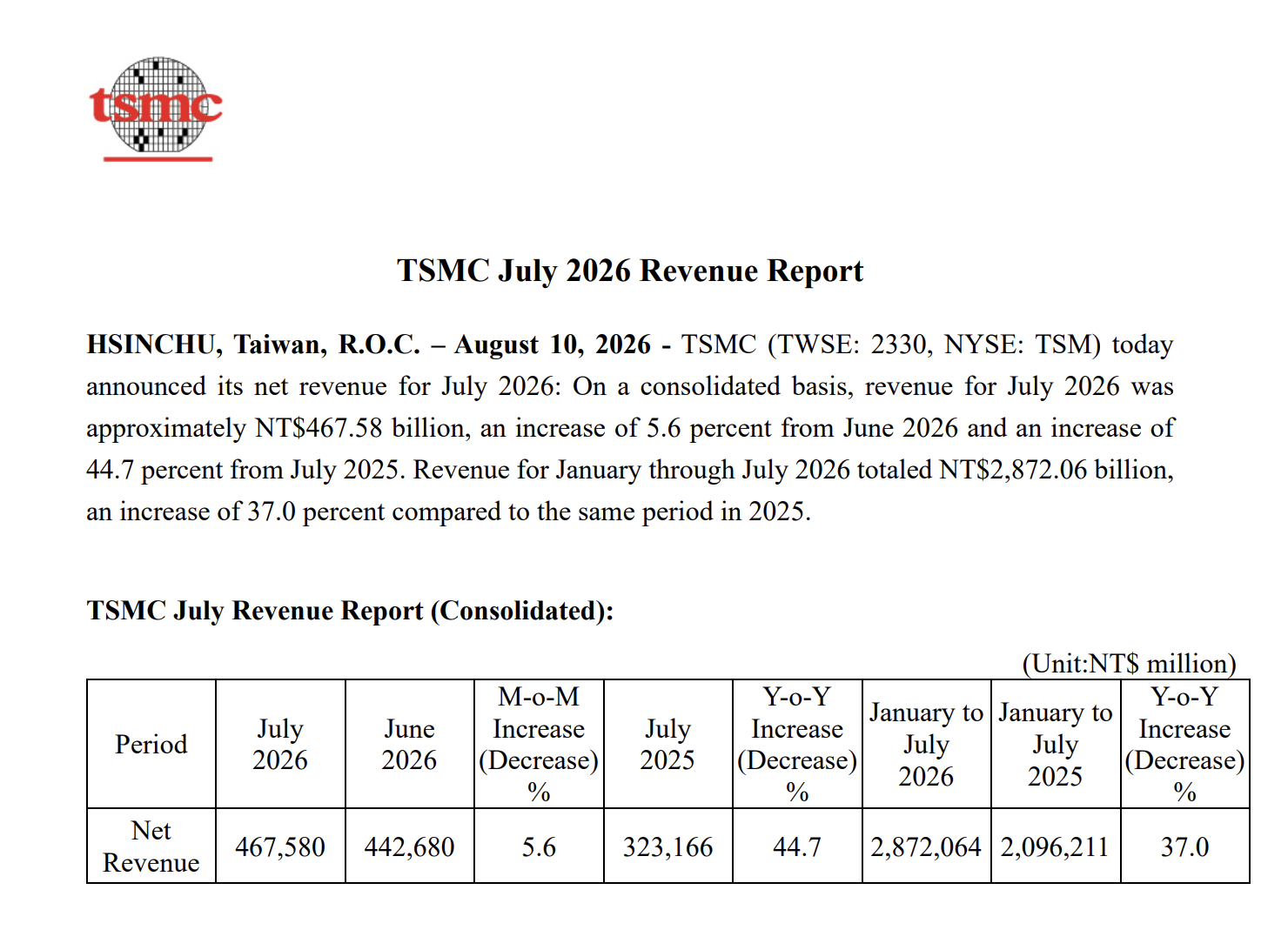
July revenue 467.58 billion New Taiwan dollars, a year-on-year increase of 44.7% and a month-on-month increase of 5.6%.
The cumulative revenue for the first seven months is 2.87 trillion New Taiwan dollars, a year-on-year increase of 37%.
What’s worth watching is not “new record high”.
But rather: When the market begins to worry about AI peaking, the industry chain that is closest to hardware demand is surprisingly still accelerating.
I think these two signals together are much more interesting than just staring at NVIDIA's stock price.
Don't rush to give AI the death penalty
The market is currently trading on how much money AI companies can make in the future.
But TSMC is making money from the money these companies have already spent.
NVIDIA is making GPUs, AMD is making chips, and Google, Microsoft, and Meta are also frantically stacking computing power.
Once the chip is designed, someone has to produce it.
Therefore, TSMC's data has the advantage of being closer to real demand.
You can say that a certain AI application has yet to find a business model, or you can say that a particular AI company's valuation is too high.
But chips have been ordered, production capacity has been allocated, and some have even entered production; this is no longer just a PPT.
So I won't say that "AI definitely has no bubble" just because of this set of data.
But at least for now: AI hardware demand has not obviously dropped.
What AI is currently stuck on is not just GPUs
In the past, when people talked about AI, the first response was NVIDIA GPUs.
Now, looking deeper into the industrial chain, another aspect is becoming increasingly important: advanced packaging.
No matter how strong the GPU is, if HBM cannot keep up and data transmission cannot keep up, the computing power cannot be unleashed.
So now, what AI chips are really competing on is whether the entire system can be produced: advanced process, HBM, advanced packaging, and finally large-scale production.
This also explains a rather interesting phenomenon: the capital market is starting to discuss whether AI is overheated, but the industrial chain is still busy addressing the "is production sufficient" problem.
This at least indicates that AI has not reached the stage where "demand suddenly disappears."
What we should really worry about is whether GPUs can be recovered
TSMC making money does not mean that there is no AI bubble.
In fact, I think the real concern is not "GPUs cannot be sold."
But rather: Can these GPUs ultimately be recovered?
For example, a tech company spends $10 billion to build an AI data center.
Of course, this $10 billion will make a bunch of companies profitable: GPUs, wafers, HBM, servers, data centers, electricity…
From the perspective of the industrial chain, this money is real.
But what about a few years later?
If computing power continues to increase but does not generate sufficient revenue, then problems will arise.
At that point, the market will no longer look at: "Does AI still need GPUs?"
But rather: "Are these GPUs worth that much money?"
I believe this is what truly needs to be monitored following this round of the AI market.
Why do I pay more attention to TSMC?
Because it has a very comfortable position: it does not need to guess who will ultimately win.
NVIDIA continues to expand, and it accepts orders. AMD expands, and it accepts orders. Google, Microsoft, and Meta continue to develop their own AI chips, and it still might receive orders.
Simply put: Regardless of which AI company ultimately comes out on top, as long as the advanced computing market continues to expand, TSMC has the opportunity to profit from it.
This is the so-called “selling shovels.” Although it's an old story, it is still relevant in the AI era.
Of course, good performance does not mean that the stock will definitely rise. Making money and stock valuation are two different matters.
The real intersection between AI and Crypto is computing power
In the past, when discussing Crypto, people thought of computing power as mining.
Now AI is also frantically competing for computing power. GPUs, data centers, electricity, these things are becoming the basic resources that both AI and Crypto need to compete for.
Therefore, I think what is truly worth looking at regarding “AI + Crypto” is not just piecing together a concept.
But rather: computing power itself is becoming increasingly valuable.
AI training requires computing power, AI inference requires computing power, decentralized AI requires computing power, and DePIN is also trying to connect realistic resources such as computing and storage to the blockchain.
But do not oversimplify this. TSMC's revenue increase does not mean that a specific AI conceptual coin will definitely rise.
There is still a gap that involves business models, real demand, and cash flow.
What’s really worth watching is who can actually retain this part of value as the demand for computing power increases.
What should we really focus on next?
So looking back at TSMC's 467.58 billion New Taiwan dollars in revenue, I am actually reluctant to simply label AI as "bubble" or "no bubble."
I care more about this change:
The market starts to doubt the future of AI, but the industrial chain is still frantically expanding production for AI's present.
These two signals have not yet completely aligned.
So at least for now, I will not decide that this round of the computing cycle is over based solely on the words "AI bubble."
What I should focus on next is: When will AI companies' revenue begin to lag behind the investment in computing power?
If one day we see "GPUs continue to be added, data centers continue to be built, but revenue and cash flow are clearly lagging,” it would be much more convincing to talk about AI cycles peaking.
Until then, I will continue to monitor these less glamorous data:
wafers, advanced packaging, HBM, servers, data centers, electricity.
Because the real market often does not start or end from the hottest places.
It's the same for Crypto
Of course, BTC and ETH need to be watched.
But if the next round of the digital economy really continues to revolve around computing power, then:
Who is providing computing power, who is consuming computing power, and who can continue to profit from the growth in computing power demand
might be more worth studying than chasing the next hot coin.
This is also why I have recently been paying more attention to the intersection of infrastructure between AI and Crypto.
Not because the words “AI concept” are particularly appealing, but because computing power is becoming an increasingly important production resource.
If you also want to translate these industry logics into actual trades, rather than just chase hot coins daily, you can start by preparing your trading tools.
If you don't have a Binance account, you can register one.
https://jump.do/zh-Hans/xlink-proxy?id=3
(Invitation code: aicoin668, enjoy 10% commission rebate)
Moving forward, regardless of whether it's BTC, ETH, or AI and computing-related assets, at least prepare entry points for the market and trading.
We cannot control when the market will give us opportunities.
But whether you are prepared when opportunities arise is something you can control.
👉 First register with Binance, prepare your tools, and wait for opportunities.
Finally, I still want to reiterate:
Don’t rush to guess who will win in AI.
First, see who can ensure they will make money regardless of who wins.
This may be the true takeaway from TSMC's 467.58 billion revenue.
Join our community to discuss and grow stronger together!
Official Telegram community:
AiCoin Chinese Twitter:
Binance benefits group:
https://www.aicoin.com/link/chat?cid=gmLgwvKD1
Risk Disclaimer: Investing in US stocks still requires you to bear market risks, regulatory risks, and compliance risks with local laws and regulations (especially foreign exchange controls, overseas investment declarations, etc.). This content is only for market observation sharing and does not constitute investment advice. The crypto market is highly volatile; please participate within your risk tolerance.
免责声明:本文章仅代表作者个人观点,不代表本平台的立场和观点。本文章仅供信息分享,不构成对任何人的任何投资建议。用户与作者之间的任何争议,与本平台无关。如网页中刊载的文章或图片涉及侵权,请提供相关的权利证明和身份证明发送邮件到support@aicoin.com,本平台相关工作人员将会进行核查。