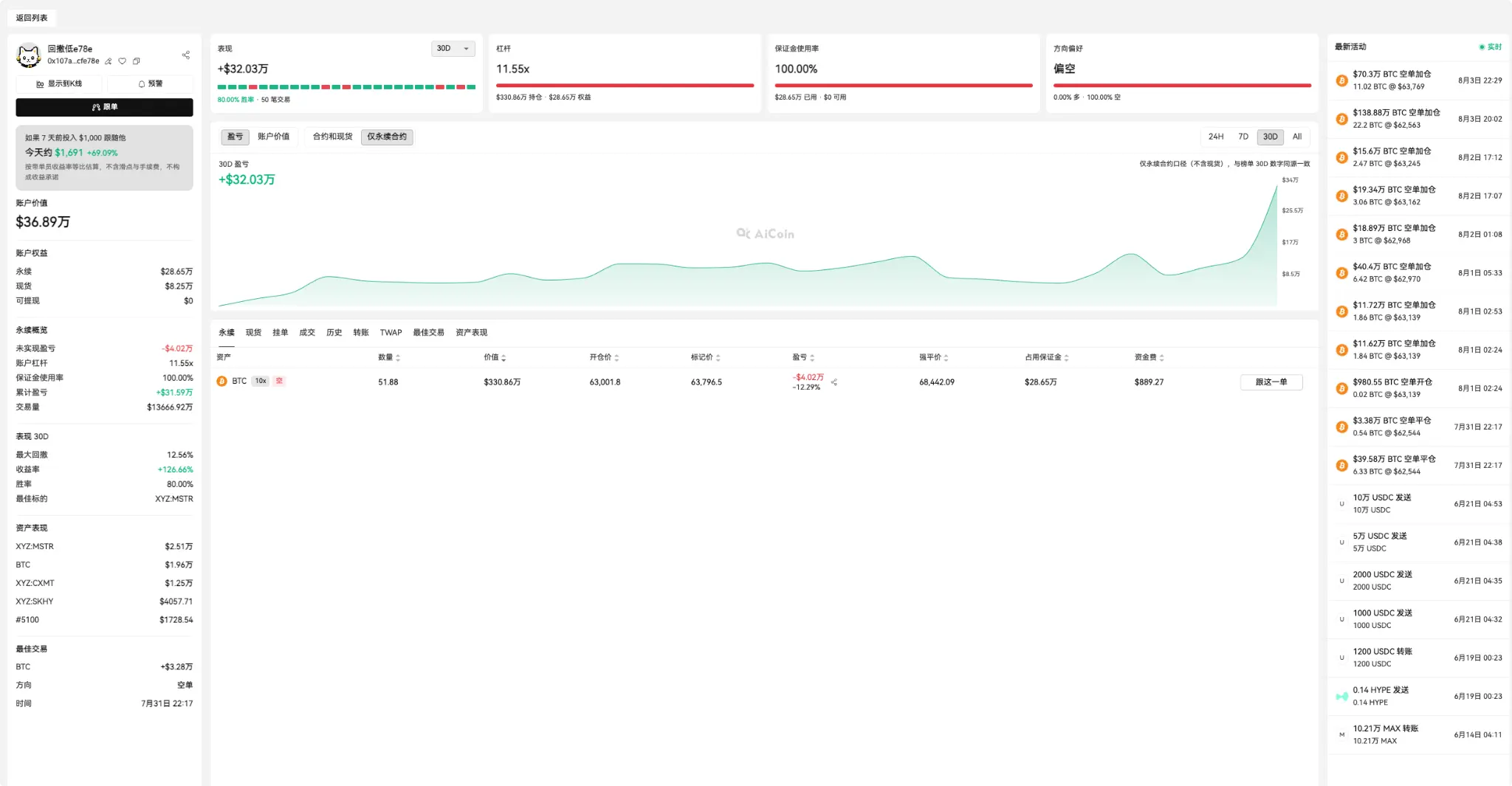
On August 4, 2026, about 8 hours before the monitoring screenshots from on-chain analyst EmberCN went viral, two addresses marked as "suspected to be related to a16z" acted almost simultaneously, transferring a total of approximately 979,000 HYPE to the decentralized exchange Hyperliquid and completing the staking process. Multiple Chinese media outlets estimated that the corresponding capital volume was approximately 53.53 million USD based on the market price at the time. This string of transaction hashes, which was originally just a technical detail, was quickly packaged into a narrative of "suspected institutional bet on HYPE" in the continuous retelling by media such as Deep Tide TechFlow, BlockBeats, and PANews: the platform, tokens, and staking incentives were all clearly visible, with the only missing element being the true entity behind the addresses. As of the writing of this article, a16z had made no public confirmation or denial regarding whether these addresses belonged to them or whether they authorized the team or related entities to participate in the Hyperliquid staking. The pseudonymity of the on-chain data combined with media tags creates a natural ambiguity in the judgment of "suspected institutional addresses," amplifying compliance anxiety under information asymmetry. Since the early 2020s, major global regulators have included DeFi trading, lending, and staking in their sights, from the EU's MiCA to the US's enforcement against unregistered yield products, testing the boundaries of licensing and investor protection. Today, this massive staking labeled "institutional participation" by public opinion is being used by compliance teams and regulatory observers as a new case study to discuss what position platforms like Hyperliquid occupy within the existing framework and to what extent traditional funds can rely on "suspected" rather than "confirmed" identity vague spaces when operating on-chain. In the tightening regulatory environment of the 2020s, this large-scale staking, which has not yet received official confirmation, is placing the compliance boundaries for institutions using DeFi in front of all participants.
On-chain Evidence Exposes Institutional Silence: Disclosure Boundaries Torn Open
The narrative of "suspected a16z betting on HYPE" did not begin with an announcement, but with a series of addresses. On-chain analyst EmberCN first threw out monitoring results on social media: two addresses transferred approximately 979,000 HYPE to Hyperliquid and completed the staking in a short time, estimated by multiple media outlets to be about 53.53 million USD. They were labeled "suspected to be related to a16z" not because the entities self-reported but based on cross-inferences from past transaction paths, sources of funds, and external clues — the addresses had previously interacted with some known institutional wallets and exhibited similar operational trajectories during specific fundraising or governance events, which were then linked by analysts and media as "possibly belonging to the same funding system." The on-chain data itself can be verified: the time, amount, and destination platform are recorded in the blockchain, but from "where this money came from" to "which institution this money belongs to," there is an inference chain relying on historical behavior patterns and multiple labels, with the risk of being mismarked or overly interpreted. As of August 4, 2026, the involved institutions had not provided any confirmation or denial, making "suspected" both a protective umbrella for reporting and a revealing point of the inherent incompleteness of on-chain intelligence in identity recognition.
When comparing this scene to traditional securities markets, the contrast is striking. Major shareholders and fund holdings under existing systems typically have clear legal disclosure thresholds and unified information channels, with the market accustomed to confirming "who is buying and how much" through regulatory filings, exchange announcements, or official documents. Most tokens, including HYPE, have not yet been uniformly classified as financial products subject to similar disclosure constraints in major jurisdictions. The result is: positions valued in the tens of millions of dollars can only circulate in social media and press releases through on-chain browsers and analyst inferences. For compliance teams, the problem is no longer just "are these addresses a16z," but rather "in the absence of official silence, can on-chain evidence be regarded as a factual basis sufficient to trigger the institution's disclosure obligations or regulatory communications?" Since the early 2020s, global regulators have strengthened AML, investor protection, and licensing requirements for DeFi staking and yield products, but when faced with such a large on-chain stake initiated by "suspected institutional addresses," it remains to be seen whether they treat it as a new sample worthy of investigation or merely as gray information insufficient to enter formal procedures. This choice itself is redrawing the boundary of when on-chain positions transition from "market rumors" to "regulatory facts."
Hyperliquid Staking Business Stands in a Licensing Gray Area
Hyperliquid is publicly positioned as a decentralized trading platform, while HYPE is the native token designed around this platform, supporting staking within the ecosystem to gain some form of network participation or incentives. Under typical scenarios, HYPE staking is understood as contributing computing power and funds for protocol governance, market making, or liquidity provision, and sharing incentives according to the rules. However, this recent staking of approximately 979,000 HYPE, estimated at over 53.53 million USD, has not publicly disclosed its lock-up period or yields structure; externally, one can only see the result of "funds being sent to Hyperliquid and currently staked," but cannot intuitively determine this from contract parameters, resulting in a direct blank in the regulatory context regarding the nature of the business.
The issue is that once the platform designs predictable yield distribution, re-staking, or other value-adding mechanisms around HYPE staking, it could be viewed by different regulators in traditional finance classifications as three distinctly different things: first, a "trading venue" that facilitates transactions and arranges positions; second, a "custodian" that holds and utilizes assets on behalf of users; and third, an "asset manager" that actively manages pools and helps users pursue returns. Since the early 2020s, regulatory bodies in various countries have started to explore rules for DeFi trading, lending, and staking activities, with some jurisdictions requiring any entity offering yield products or custody services to obtain corresponding licenses or complete registration. However, there is significant uncertainty about which type of license applies to staking businesses like Hyperliquid that emphasize "decentralization." When on-chain analysts lay out the large staking behavior of two addresses suspected to be related to a16z, this uncertainty becomes more than just a philosophical debate within the tech community; it forces regulators and platforms to make clearer choices between "is this a financial service requiring a license, or is it still a technical function viewed as internal incentives of the protocol?”
Suspected a16z Entry: Lessons for Compliance Teams
If we temporarily assume this position of around 53.53 million USD, 979,000 HYPE, to be an institutional action labeled as "suspected a16z addresses," what is truly pushed into the spotlight is the gap of traditional compliance frameworks in DeFi scenarios. For regulated professional investment institutions subject to supervisory constraints and LP oversight, the first challenge is the boundaries of asset custody and responsibilities: in protocols like Hyperliquid, there are no familiar custodial contracts, no formally provided compliance terms by the platform, and the keys are held by the institution itself, with staking certificates only reflecting on-chain status. This means that compliance teams must reinterpret "who is holding assets," "who is the service provider," and how internal risk control can verify and record each on-chain operation; otherwise, in subsequent audits and LP inquiries, it will be difficult to clarify whether this position is compliant custodial assets or regarded as high-risk self-managed positions.
The second hurdle is the delineation of responsibilities regarding anti-money laundering (AML) and sanctions compliance. Regulated institutions must meet the AML/KYC requirements of the local regulatory authorities for any cryptocurrency asset allocation, while DeFi protocols typically do not provide traditional customer identification or source due diligence; counterparties are merely strings of addresses and liquidity pools. For large stakes initiated by pseudonymous addresses, compliance teams must explain: how the source of funds is verified off-chain, how the on-chain paths connect with internal client profiles and sanctions lists, and whether such staking yields will be viewed by regulators as financial services requiring additional licensing in the context of EU MiCA and existing US enforcement regarding some unregistered yield products.
What truly causes headaches for institutional legal departments are issues related to financial reporting and regulatory submissions. In traditional financial systems, how to classify this staking asset completed on Hyperliquid — as a financial instrument, a derivative, or a certain type of "protocol participation right" — has not yet found a unified answer across global institutions, and the valuation methods (at market price, by models, or discounted) and how yields are recognized in financial statements directly affect regulatory submissions and LP risk perceptions. In contrast, when institutions engage in centralized trading platforms, they can often rely on the platform's KYC processes, custody terms, and written agreements to split AML responsibilities, custody responsibilities, and valuation bases into specific legal documents; once they shift to protocols like Hyperliquid that emphasize decentralization, all these processes must be completed by the institutions in a "on-chain interaction + off-chain self-certification" model. This is the real task that global compliance teams must face after the appearance of positions suspected to be a16z-level.
EmberCN and Chinese Media: A Practice of Grassroots On-chain Regulation
In this on-chain event of suspected a16z participation in HYPE staking, EmberCN took the lead in completing the "evidence collection" phase: by tracking large token flows, he publicly disclosed the funding paths and staking actions of two addresses on social media, transforming behaviors that originally existed only in blockchain data into narratives that could be discussed by the public. Following this, Chinese media such as Deep Tide TechFlow, BlockBeats, and PANews processed this on-chain observation into news articles, recounting the scale of about 979,000 HYPE, roughly 53.53 million USD, along with the label "suspected a16z address," pushing a discovery that originally belonged only to professional analysts into the field of institutional compliance teams, project parties, and ordinary readers within hours. Analysts provided on-chain details, and media handled the dissemination and labeling; this combination is almost a spontaneous "grassroots on-chain regulation exercise" completed by market participants.
The positive effect of this exercise is very direct: in the absence of official information and the silence of the subjects behind the suspected institutional addresses, the market can still rely on publicly available on-chain data to quickly form preliminary recognition of significant position changes and potential compliance risks, providing references for internal risk control, external valuation, and policy discussions. However, the cost is equally clear — on-chain addresses are essentially just pseudonymous identifiers, and any attempt to bind them to real institutions relies on a comprehensive inference from past transaction paths, sources of funds, and external clues, inherently carrying the possibility of misjudgment; once a "suspected institutional address" is repeatedly cited by media, the lack of a unified standard for address labeling can easily subject related entities to reputational risks and media judgment before they have even spoken. In recent years, global regulatory agencies have introduced blockchain analysis firms in the areas of AML and sanctions compliance; in the future, they will either further integrate methods similar to "grassroots on-chain regulation" to establish procedural rules for address attribution, label correction, and data usage, or conversely set boundaries for disorderly labeling and excessive inference. The process of oscillating between these two directions will profoundly reshape the division of roles among institutions, analysts, and media in the regulatory landscape of DeFi.
Looking at the Distance Between DeFi and Regulation Through One Stake
Returning to this staking of approximately 979,000 HYPE: as of August 4, 2026, it remains at the level of "suspected a16z address" in on-chain evidence, with no confirmation from any subject or formal classification given by any regulatory authority regarding Hyperliquid or related staking business. This perfectly exposes the information disclosure and compliance regulatory gray area for institutions using DeFi — the pseudonymity of addresses makes attribution judgments highly reliant on transaction paths and external clues, and once labels disseminate, public opinion and compliance pressure will precede factual determination. As institutional funds entering DeFi have become a given reality while licensing and product classifications from various jurisdictions remain inconsistent, such events force all three parties to explore concurrently: under what licensing frameworks institutions should disclose on-chain exposures, what business boundaries platforms should design staking and yield structures within, and how regulators can extend existing frameworks like MiCA and US enforcement experiences for yield products to technical regulation of on-chain behaviors. It can be anticipated that future rule evolution surrounding "institutional participation in DeFi" will at least unfold along three lines: licensing applicability, information disclosure standards, and on-chain data regulation. This suspected a16z staking may very well be repeatedly cited as a typical case, but whether it is written into compliance guidelines or viewed as an over-interpretation sample will depend on the direction of the next round of regulatory and industry negotiations.
Join our community to discuss together and become stronger!
AiCoin exclusive Hyperliquid benefits: https://app.hyperliquid.xyz/join/AICOIN88
AiCoin exclusive Aster benefits: https://www.asterdex.com/zh-CN/referral/9C50e2
On-chain Telegram community: https://t.me/AiCoinWhaleData
On-chain community: https://www.aicoin.com/link/chat?cid=N6OVMor5g
AiCoin on-chain Twitter: https://x.com/aicoinwhaledata
免责声明:本文章仅代表作者个人观点,不代表本平台的立场和观点。本文章仅供信息分享,不构成对任何人的任何投资建议。用户与作者之间的任何争议,与本平台无关。如网页中刊载的文章或图片涉及侵权,请提供相关的权利证明和身份证明发送邮件到support@aicoin.com,本平台相关工作人员将会进行核查。