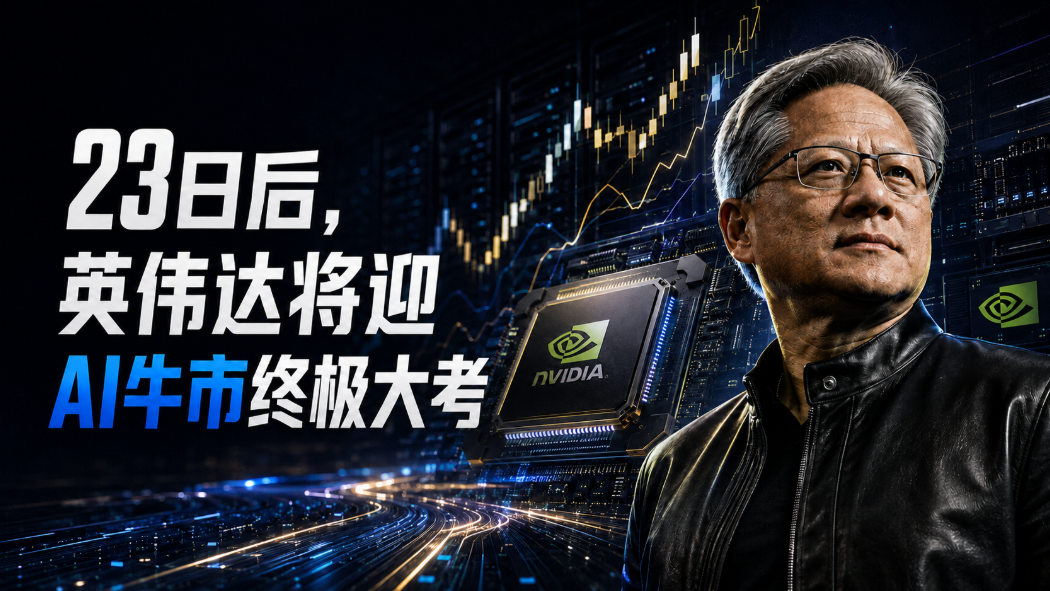
On August 26, after the US stock market closes, Nvidia will announce its second-quarter earnings for the fiscal year 2027. There are 23 days left until the financial report is revealed, but the market's test has already started early.
In the previous quarter, Nvidia achieved revenue of $81.6 billion, a year-on-year increase of 85%; of which, data center revenue reached $75.2 billion, a year-on-year increase of 92%, accounting for over 90% of total revenue. For this quarter, the company's revenue guidance is $91 billion, with a fluctuation of 2% up or down. If the midpoint of the guidance is reached, Nvidia’s quarterly revenue will exceed $90 billion for the first time.
However, for Nvidia today, "meeting expectations" may no longer be sufficient.
As the company’s market value approaches $4.9 trillion, the market has long anticipated optimistic expectations for continued expansion of AI capital expenditures, large-scale deployment of Blackwell, and sustained high growth in data center demand. Even if revenues set new records, any slight weakness in next quarter's guidance, data center growth rate, or gross margin could trigger “realization of gains.”
The most noteworthy aspect of this financial report is whether global AI capital expenditures can continue to support Nvidia's growth. Tech giants like Microsoft, Alphabet, and Meta are still significantly increasing their investments in data centers, but high capital expenditures are quickly consuming cash flow. If the commercialization of AI products cannot keep pace with infrastructure investments, the market will sooner or later demand that tech companies reduce spending, and Nvidia, being at the top of the industry chain, may feel pressure first.
Additionally, the ramp-up progress of Blackwell (Nvidia's next-generation AI chip architecture), the shipment rhythm of Rubin (Nvidia’s next generation AI chip architecture), and whether customers delay purchases due to product iterations will also directly impact market judgments. Nvidia's business in China is a potential variable: the previous guidance of $91 billion did not account for revenue from Chinese data center computing, and if relevant products resume delivery, it could bring extra increments, but there remain significant uncertainties regarding export licenses, import policies, and local chip alternatives.
Gross margin cannot be overlooked either. Last quarter, Nvidia's non-GAAP gross margin was about 75%, and it is expected to maintain this level this quarter. If revenue grows but gross margin declines significantly, it may indicate that the company is sacrificing higher supply chain and systems integration costs for scale expansion.
Therefore, on August 26, it is not sufficient to only look at whether revenue exceeds $91 billion; it is also crucial to observe six signals: data center revenue, next quarter's guidance, gross margin, Blackwell demand, Rubin progress, and the management’s assessment of the sustainability of AI capital expenditures.
This financial report affects not just Nvidia. If performance and guidance significantly exceed expectations, sectors such as semiconductors, servers, optical modules, and AI concept assets may receive support; if growth slows noticeably, the market may reassess the return on investment for the entire AI industry, further impacting the Nasdaq and global risk appetite.
After 23 days, Nvidia needs to prove not only that it can still grow but also that the wave of AI capital expenditures that has continued for over three years is still far from its peak.
Seize AI market opportunities, trade US stocks and crypto assets on Bitget
Register through the exclusive AiCoin channel for a 10% commission rebate:
https://jump.do/zh-Hans/xlink-proxy?id=6
免责声明:本文章仅代表作者个人观点,不代表本平台的立场和观点。本文章仅供信息分享,不构成对任何人的任何投资建议。用户与作者之间的任何争议,与本平台无关。如网页中刊载的文章或图片涉及侵权,请提供相关的权利证明和身份证明发送邮件到support@aicoin.com,本平台相关工作人员将会进行核查。