Original author: Li Dan
Original source: Wall Street Insight
The explosive performance of Changxin Technology, the leading domestic storage chip manufacturer, on its first day of trading on the A-share market is becoming a new variable for the global memory chip sector.
On Monday, U.S. stocks saw memory chip stocks plunge significantly, becoming the biggest drag on the market. SanDisk (SNDK) fell more than 10% during trading, dropping approximately 14.6% when it hit its daily low in the early session, and has cumulatively dropped 47% from its historical high on June 22, with a market value erosion of about 170 billion dollars over the past month; SK Hynix ADR (SKHY) also saw a drop of around 10%, while Western Digital (WDC) and Seagate Technology (STX) both fell by over 9% and 8% respectively, and Micron Technology (MU) dropped over 7% at one point.
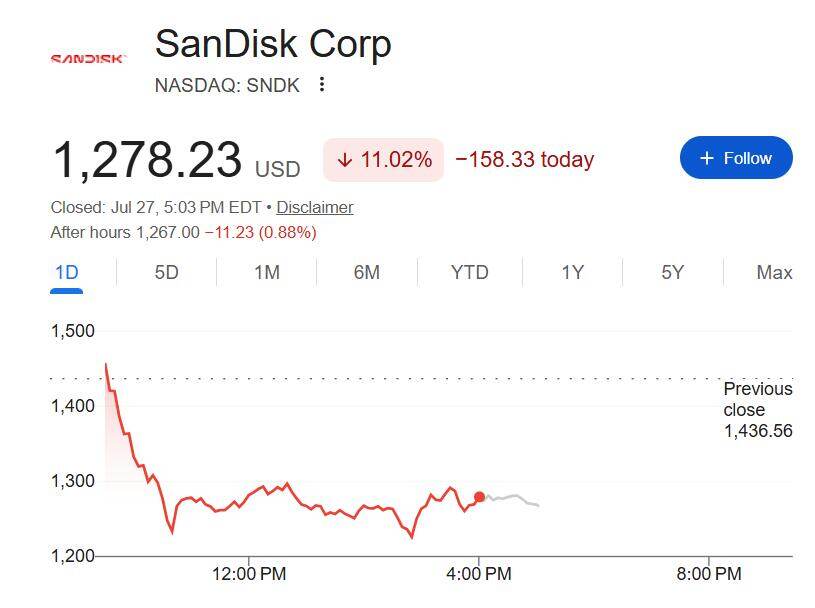
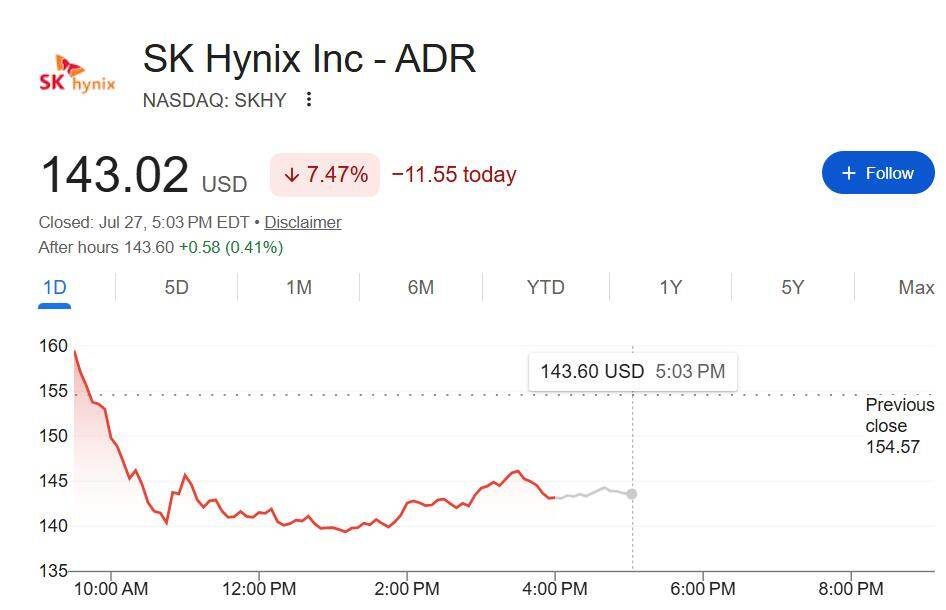
By the close, SanDisk, SK Hynix ADR, Western Digital, Seagate Technology, and Micron had dropped approximately 11%, 7.5%, 4.2%, 4.1%, and 2.3% respectively. SK Hynix closed below its IPO issue price for the first time since its listing in the U.S. on July 10, finishing 4% lower than the issue price.
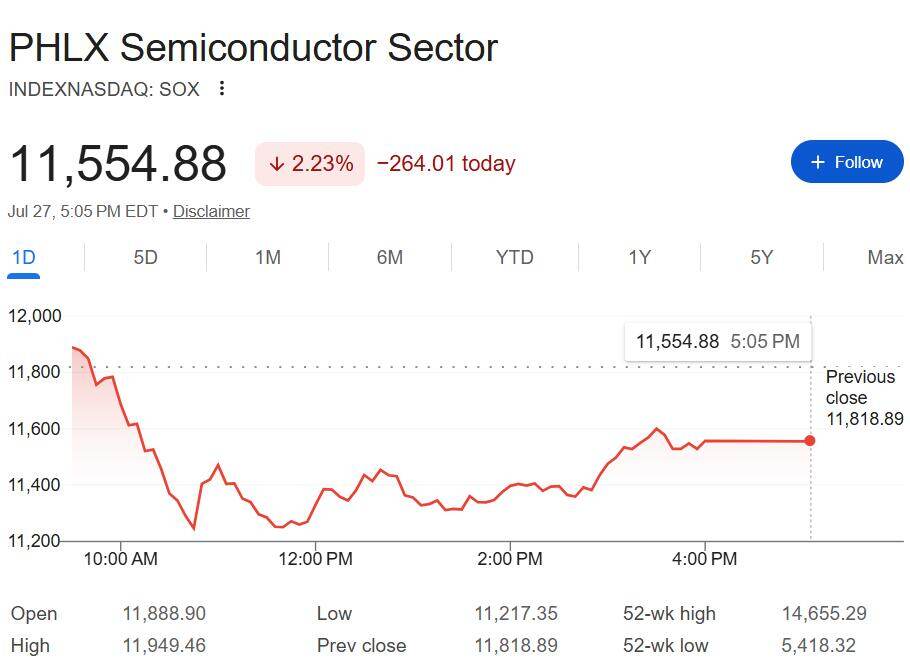
When it hit a daily low in the early session, the Philadelphia Semiconductor Index, which tracks the overall performance of chip stocks, fell around 5%, significantly underperforming the three major U.S. stock indices, and ultimately closed down 2.2%. The S&P 500 index and the Nasdaq both fell approximately 0.4% and 0.8% at their respective daily lows, while the Dow Jones maintained an upward trend throughout the day.
The market generally pointed fingers at Changxin Technology (CXMT), which was listed on the sci-tech innovation board of the Shanghai Stock Exchange that day. The largest DRAM manufacturer in China saw its stock price soar over 460% on its first day of trading, with its market value surpassing 3 trillion yuan, making it the new leader in A-share market capitalization, prompting global investors to reassess the competitive landscape of the DRAM industry in the coming years.
China’s DRAM leader goes public, triggering a global reevaluation of the storage sector
Regarding the sharp decline of memory chip stocks in the U.S. on Monday, multiple foreign media outlets suggested that the market's concerns were not about Changxin Technology's short-term performance, but rather the potential changes in the global DRAM supply landscape in the future.
Analysts argue that the completion of the largest IPO in Asia this year by Changxin Technology implies that the company will receive more substantial capital support, which is expected to enhance its ability to expand production, invest in technology research and development, and advance into high-end storage fields like HBM for AI applications. For global memory chip leaders who had already seen significant increases, this indicates that long-term competitive pressure is on the rise.
Some comments noted that the market is worried that, with the completion of Changxin Technology’s financing, the future release of new DRAM supply may accelerate, thereby undermining the current market's optimistic expectations for sustained increases in storage prices. Meanwhile, prior significant gains by companies like Micron, SK Hynix, and SanDisk have created an environment where any changes in competitive dynamics are likely to trigger profit-taking.
Other analysts believe that this round of adjustments mostly reflects a revaluation by the market. Although demand for HBM driven by AI remains strong, investors are beginning to rethink whether the traditional DRAM business will enter a phase of increased competition sooner than expected, thus affecting industry profit margins, especially if Chinese manufacturers continue to enhance their production capacity and technological strength.
However, many analysts believe the market reaction may exhibit a level of overinterpretation.
Currently, Changxin Technology's products remain primarily focused on traditional DRAM fields such as DDR4 and DDR5, while Micron, SK Hynix, and Samsung’s fastest-growing businesses derive from AI storage products like HBM. Due to U.S. export restrictions, Changxin Technology still faces significant technical barriers to entering the high-end HBM market in the short term, and thus the global AI storage market dynamics are unlikely to undergo fundamental changes in the near term.
Changxin Technology's stock surges on debut, capital markets bet on "Chinese storage"
Changxin Technology’s IPO has attracted significant global attention.
The company raised approximately 57.9 billion yuan (around 8.6 billion dollars), setting a new record for IPO fundraising in Asia this year. On its first trading day, the company's stock closed 465.82% higher than its issue price, with a total market capitalization reaching 3.28 trillion, surpassing Industrial and Commercial Bank of China to become the largest by market value in A-shares, equivalent to two Kweichow Moutai.
On Monday, Changxin Technology’s trading volume exceeded 140 billion yuan, making it the first stock in A-share history to surpass 100 billion yuan in a single day's trading.
According to public information, Changxin Technology was established in 2016 and is the largest DRAM chip manufacturer in China, as well as an important representative in China's stride towards independent DRAM research and mass production. The company’s products cover multiple areas, including consumer electronics, PCs, servers, and automotive electronics, and it continues to promote research and development of new products such as DDR5.
Domestic media generally believe that Changxin Technology’s listing not only signifies a new milestone for China's semiconductor industry but also indicates that capital markets are granting higher valuation premiums for domestic high-end manufacturing and "hard technology." The market anticipates that the raised funds will further support advanced process R&D, expand capacity, and enhance the domestic storage industry chain.
In the AI era, the true determinant of winners and losers remains HBM
However, from a global competitive perspective, most institutions still believe that Micron, SK Hynix, and Samsung's leading advantages in the AI storage field are unlikely to be shaken in the short term.
Currently, the explosive demand for AI servers has made HBM one of the world's most scarce semiconductor products. Micron and SK Hynix practically dominate the HBM supply for AI chip manufacturers like Nvidia, and this related business is the core driver of rapid profit growth for both companies.
Therefore, many analysts suggest that Monday’s plunge in memory stocks resembles an emotionally driven valuation adjustment rather than a turning point in the industry fundamentals. As the construction of AI infrastructure continues, demand for high-end storage is still expected to maintain rapid growth.
Bernstein analyst Mark Li even believes that the sector’s adjustment presented a new opportunity for positioning. He forecasts that by 2027 to 2028, global revenue from memory chips is still expected to surpass 1.3 trillion dollars, supported by ongoing demand for DRAM and HBM in the construction of data centers in the AI era.
免责声明:本文章仅代表作者个人观点,不代表本平台的立场和观点。本文章仅供信息分享,不构成对任何人的任何投资建议。用户与作者之间的任何争议,与本平台无关。如网页中刊载的文章或图片涉及侵权,请提供相关的权利证明和身份证明发送邮件到support@aicoin.com,本平台相关工作人员将会进行核查。


