Original | Odaily Planet Daily (@OdailyChina)
Author | Wenser (@wenser 2010)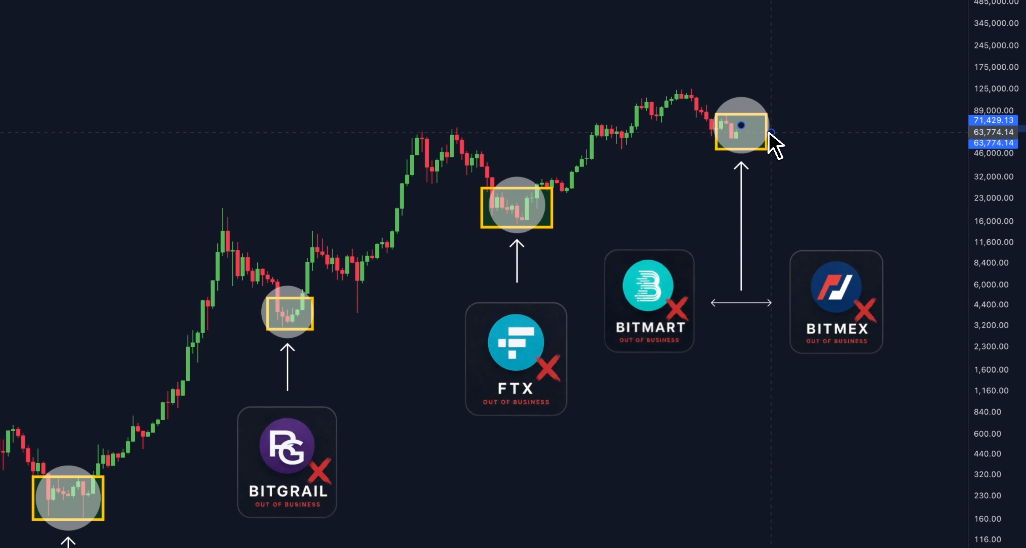
The tide of closures in the bear market continues, and within just a week, two major crypto exchanges have announced shutdowns.
On the morning of July 26, the second-tier crypto platform BitMart officially announced that after a prudent assessment of the company's operating conditions, market environment, and future strategic direction, it has decided to orderly cease operations of its trading platform: all trading services will stop on August 26; platform operations will cease on January 31, 2027.
On July 23, the pioneer of crypto perpetual contracts, BitMEX, announced that it would stop new user registrations immediately and will officially close on September 23, 2026. Many crypto OGs, including CZ, expressed their regrets and sadness in response. Earlier in July, AscendEX (formerly BitMax) also announced its shutdown, citing reasons related to MiCA regulations, market factors, and financial operational pressure.
Since the crypto market entered a bear phase on October 11 last year, dozens of crypto projects have announced shutdowns, covering DeFi platforms, crypto wallets, on-chain DEXs, crypto research institutions, and more. In past cycles, exchanges with sustainable profitability have successively shut down, viewed as one of the signals that the bear market has bottomed out. Now, a similar scene is unfolding again, seemingly indicating that the turning point has arrived.
Two exchanges announced shutdowns in three days: market liquidity tightens, "no one is trading" has become reality
On the afternoon of July 23, BitMEX officially announced that it would formally close at 12:00 (Beijing time) on September 23 and would stop new user registrations immediately. The official statement indicated that this decision was made by the board of directors of the parent company, HDR Global Trading Limited, after a strategic review.
Three days later, BitMart officially stated: "After prudently assessing the company's operating conditions, market environment, and future strategic direction, we have decided to orderly stop platform operations. New registrations, recharges, and new trading orders will be suspended starting from 01:30 UTC on July 26, 2026; all trading services will cease at 01:00 UTC on August 26, 2026; platform operations will formally end at 15:59 UTC on January 31, 2027. Withdrawal services will remain open."
If it were not for the inability to continue operations, exchanges with inherently "sustainable cash cow businesses" would not face such an outcome. Analyzing the reasons, there is much speculation in the market with no definitive conclusion.
CZ: The "crypto war" during the Biden administration is the main reason for BitMEX's downfall
After the news of BitMEX's closure spread, Binance founder CZ expressed regret and recalled, "BitMEX was the first to launch 100 times leverage perpetual contracts in the crypto market in 2014, driving the industry's development. In those days, BitMEX only supported BTC deposits, single-chain operations, and used a daily, multi-signature wallet to process withdrawals, which, despite seeming inconvenient, helped the platform avoid hacker attacks for a long time."
He also mentioned that the four co-founders of BitMEX admitted a month before the trial to violating the Bank Secrecy Act (BSA), with each fined $10 million and placed under house arrest, but no one went to prison. However, he believes that BitMEX ultimately could not survive the Biden administration’s "War on Crypto."
It is clear that CZ still has significant criticism of the high-pressure regulatory policies imposed on the crypto industry during the Biden administration, considering it the "last straw" that crushed BitMEX – the intense regulation rendered BitMEX unable to expand its business and sustain operations.
Flashbots Strategic Director: BitMEX's insurance fund mechanism may be the main reason for the platform's closure
Flashbots Strategic Director Hasu wrote that the structural issues of BitMEX's insurance fund could be a significant reason for the company's choice to close instead of selling.
Back in 2018, he pointed out that BitMEX's insurance fund did not employ isolated account management, lacked a clear upper limit on fund size, and had no clear process for dealing with excess assets, which could create incentives for more aggressive liquidation of users, expanding the insurance fund through liquidation, and ultimately monetizing those assets. According to Hasu’s estimates, the current size of the insurance fund is approximately $270 million.
Hasu's viewpoint is more focused, asserting that BitMEX's downfall stems from the internal imbalance of the platform's capital management mechanism leading to aggressive liquidation rules, which ultimately harmed its user base and operational strategy.
As for Bitmart's shutdown, it seems somewhat sudden, leading to more extensive discussions about various possibilities in the market.
The mystery of Bitmart's shutdown: platform fund explosion or internal mismanagement?
As a veteran exchange operating for eight years, Bitmart has over 13 million users, and the official announcement impacts not only users but also the hefty funds in users' accounts. However, the current fund withdrawal function on the Bitmart platform is causing much speculation.
Discussions in the community about Bitmart's closure mainly revolve around two aspects: one side believes that Bitmart may be facing a capital explosion.
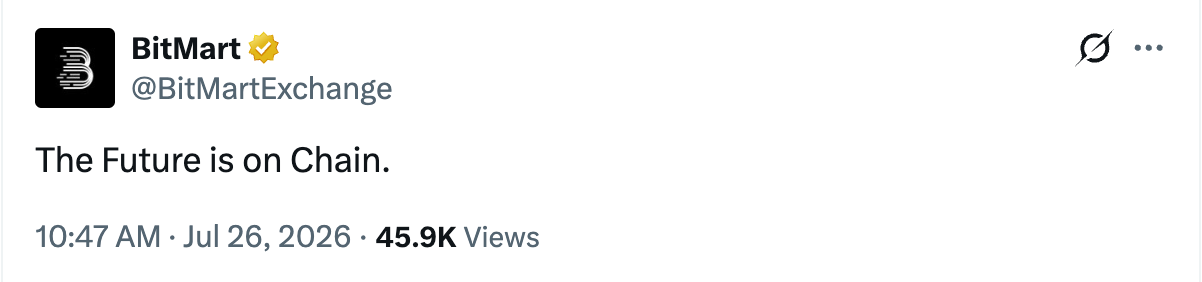
Crypto KOL Joes pointed out that there were previous anomalies in Bitmart's hot wallet addresses, and no clear responses have been given regarding issues related to user account freezes, abnormal fund withdrawals, and fund receipts; others have indicated that the chaotic internal management of Bitmart is the main reason for its closure. WEEX BD Manager DI wrote, "The internal atmosphere of Bitmart is chaotic, continuously deceiving employees, traders, and key individuals, refusing to pay them the salaries and bonuses they deserve." There are also posts Compared to the confirmed closed exchanges and unclear capital withdrawal channels and receipt times, many are more concerned about the corresponding liquidation losses and how users will handle them after the closures of BitMEX and Bitmart. In this regard, BitMEX's situation is more awkward, while Bitmart's users and platform have received many "takeover invitations" from other exchanges. As mentioned earlier, BitMEX's insurance liquidation fund may be the root cause of the platform's inability to continue operations. Because of its aggressive liquidation rules and mechanisms, BitMEX is currently facing a proposed class action lawsuit filed by BKX Services Inc. and David Namdar in the Southern District of New York. The plaintiffs claim that the exchange forcefully liquidated leveraged positions to retain 622.66 BTC that should have been returned to traders. After Bitmart's shutdown announcement, numerous exchanges and crypto platforms began their "acquisition battle" to attract users. Huobi official stated that it welcomes Bitmart users for C2C trading; moreover, Bitmart employees have a dedicated channel to join Huobi HTX. MSX.COM founder Bruce wrote immediately upon seeing the shutdown announcement: "Don't close, I’ll acquire." He showed quite a bit of bravado. Websea Chinese also announced it has opened an "settlement channel" to facilitate Bitmart users switching platforms. Blockfinex also expressed similar views. It can only be said that true commercial competition might be hidden in the tweets that promote "peaceful transitions," hoping that Bitmart users' assets will eventually be properly managed. As of today, this bear market, lasting over six months, is still ongoing. Even before the fall of BitMEX and Bitmart, the closure tide of projects within the industry had already begun. In the past week, crypto research institutions Hazeflow, Cardano's ecological wallet SecondFi, the DEX aggregation protocol Odos, and DeFi platform Dango have successively shut down, with numerous projects quietly "soft exiting" - halting social media updates and even teams disappearing. Given the current situation, despite the emergence of cases of exchanges closing down, it remains challenging to assert that the bear market has genuinely bottomed out. After all, the crypto industry has not reached a point of no return, nor has it experienced historical-level collapses like Mt.Gox or FTX. Regardless, the industry continues, as the last tweet from Bitmart's official account stated: "The future still belongs to blockchain." How far are we from the end of the crypto bear market? Five major historical indicators light up simultaneously, is Bitcoin's bear market at the bottom? 免责声明:本文章仅代表作者个人观点,不代表本平台的立场和观点。本文章仅供信息分享,不构成对任何人的任何投资建议。用户与作者之间的任何争议,与本平台无关。如网页中刊载的文章或图片涉及侵权,请提供相关的权利证明和身份证明发送邮件到support@aicoin.com,本平台相关工作人员将会进行核查。After the wave of exchange shutdowns, who will bear the loss? Who will take over users?
BitMEX may retain over 622 BTC due to forced liquidation
Bitmart's takeover invitations: Huobi, websea, MSX.COM all take action
Conclusion: The wave of shutdowns in the crypto industry continues, and it is still too early to say the bear market has bottomed out
Recommended Reading


