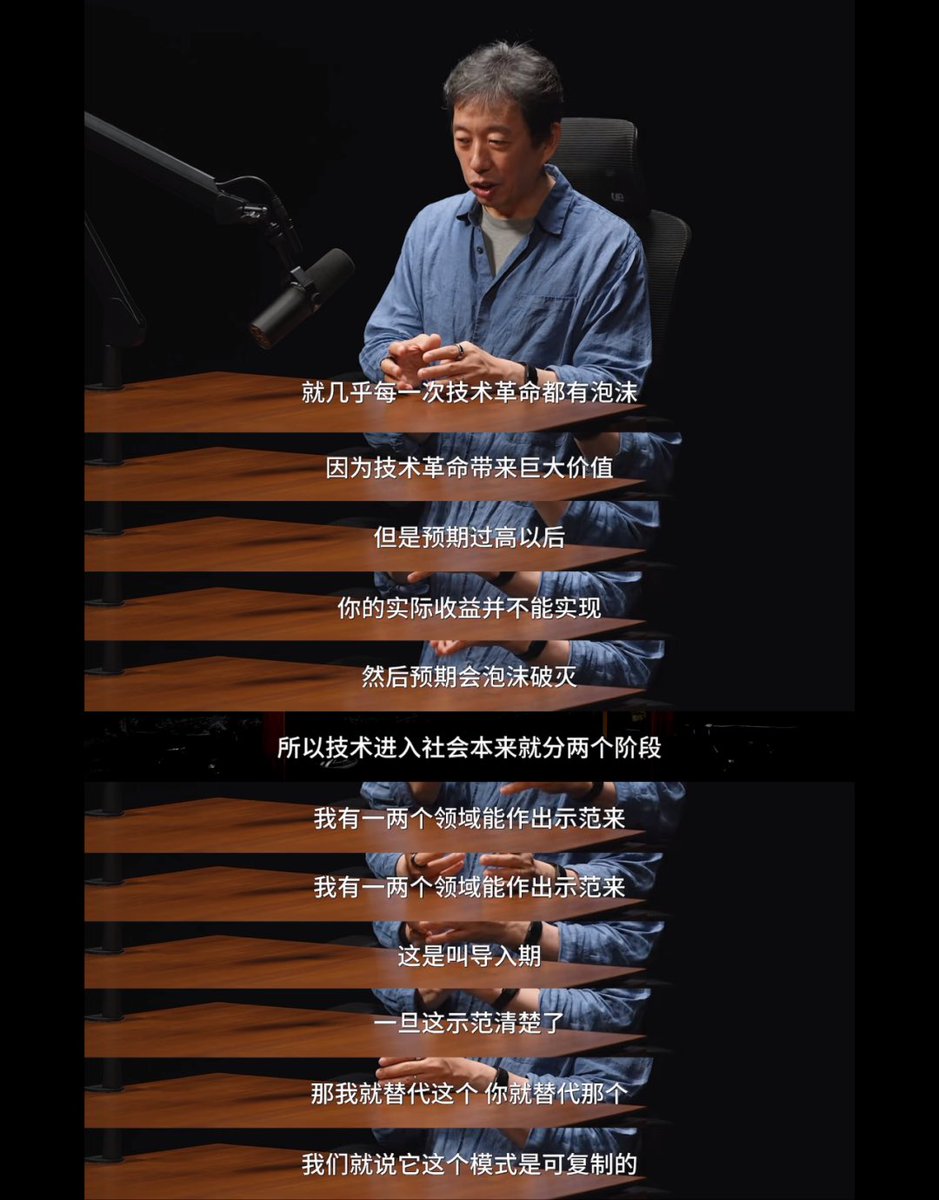
Recently, many friends have shared Wang Yuquan's podcast about the theory of the AI bubble bursting!
I have watched both segments,
To be honest, I agree with his theory on the bursting bubble, as it is bound to happen according to patterns, but I do not agree with treating 2029 as a precisely timed node.
Right now, from 2021 to 2027, we should be in the early stages of AI, similar to Crypto from 2012 to 2016,
Then from 2028 to 2031, it might be a high-risk window where AI shifts from infrastructure frenzy to the acceptance of commercial returns, similar to Crypto’s 2017 to 2021.
2029 is merely the median of this window; whether it will definitely burst here remains debatable.
Some of his more interesting points:
1️⃣ Absolutely Early!
Wang Yuquan believes that we are currently in the absolute early stages of AI development. Major technological revolutions typically go through:
Technological breakthrough → Social panic → Gradual acceptance → Collective frenzy → Bubble bursting → Infrastructure maturation → Long-term prosperity.
According to his judgment, society is still discussing "Will AI take jobs?" and "Will ordinary people be eliminated?", which still carries characteristics of a panic period.
The true peak of the bubble occurs when everyone is convinced that AI can make money, all companies start packaging AI, and capital no longer seriously calculates returns.
2️⃣ Why 2029?
He drew an analogy from the history of the Industrial Revolution and the automotive industry.
After the Ford assembly line emerged, it did not immediately bring about a productivity boom across society.
On the contrary, companies invested massively in new capacities, but most industries had not really learned how to restructure organizations and production processes, ultimately leading to severe mismatches between production capacity and finance.
In today’s context, it feels somewhat like:
Large models are akin to new general technology;
Data centers, chips, and electricity are similar to infrastructure;
AI programming and agents resemble new methods of production;
However, most companies have not yet completed the transformation of organizational structures and business processes.
Therefore, a wave of investment frenzy might first emerge in the coming years.
When the market realizes “so much computational power has been invested, but corporate profits and productivity have not synchronized,” valuations and capital expenditures will be revalued, leading to a breakdown, and the misalignment in perception will cause fluctuations, ultimately resulting in market restructuring.
He believes all this is likely to happen around 2029.
He often says: The period around 2029 may be a danger point for the capital market but could also be a golden starting point for AI application entrepreneurship.
In fact, this is not a viewpoint he recently formed; the materials I found show that as early as November 9, 2024, during the Vanguard Conference, he proposed that the first half of the digital revolution might face a “great divide” around 2029, due to society possibly overestimating the short-term changes brought by AI.
3️⃣ The current biggest contradiction is that capital expenditures are growing faster than commercial returns.
The following views are not those of Professor Wang Yuquan, but my own opinions, which you can criticize freely.
I also share the same view as Professor Wang Yuquan that visible risks are rapidly accumulating.
According to analysis by Reuters based on LSEG data, by 2027, the AI capital expenditures of companies like Microsoft, Alphabet, Amazon, Meta, and Oracle may significantly exceed the growth of operating cash flow. It’s estimated that for every additional $1 of operating cash flow, there could correspond to about $1.57 in new investments.
This structure cannot be sustained indefinitely.
The logic that the capital market is willing to accept right now is:
First build computing power, and revenue will naturally follow.
If in the next two to three years it turns into:
Computing power has been built, but revenue growth, profit margins, and productivity have not kept pace,
The market will shift from vying for “future space” to calculating “investment payback periods.” This is usually the moment when the bubble begins to burst.
So, the technical value of AI is real, but valuations can be overdrafted many years in advance.
4️⃣ Some judgments.
Dividing the next few years into three phases.
Phase One: 2026–2027, infrastructure continues to expand, computing power, electricity, data centers, chips, networks, and model training will still absorb large amounts of capital,
During this phase, selling shovels is the most profitable.
Phase Two: 2027–2029, AI applications and agents enter large-scale acceptance.
During this stage, true big companies will emerge, but many seemingly advanced companies that cannot charge will also die.
Phase Three: Around 2029, capital expenditures and cash flow collide head-on,
If by then the industry still can only maintain growth through continuous financing and capital expenditures, and AI application revenues are not enough to cover infrastructure costs, there may be significant valuation compression.
免责声明:本文章仅代表作者个人观点,不代表本平台的立场和观点。本文章仅供信息分享,不构成对任何人的任何投资建议。用户与作者之间的任何争议,与本平台无关。如网页中刊载的文章或图片涉及侵权,请提供相关的权利证明和身份证明发送邮件到support@aicoin.com,本平台相关工作人员将会进行核查。


