Core Overview:
- This round of storage market is not an ordinary price cycle, but rather the demand for AI infrastructure spreading gradually from HBM to server DRAM, enterprise SSD, NAND, and HDD, with the market trading focus extending from "faster storage" to "more, cheaper, and long-term storage needs";
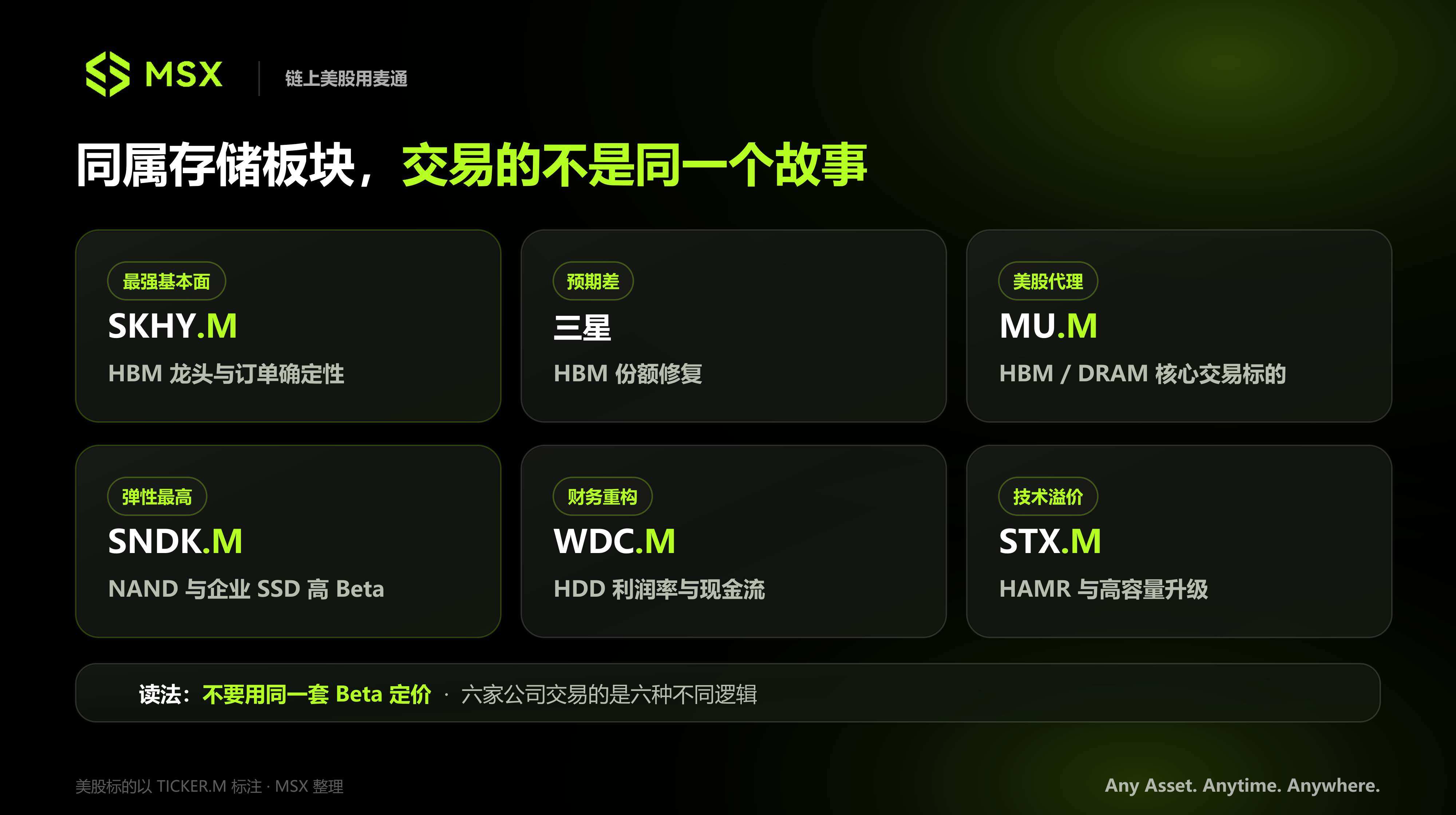
- Six companies correspond to different investment logics: SK Hynix (SKHY.M) trades on its leading position and order certainty in HBM; Samsung trades on technology catch-up and market share recovery; Micron is the most direct HBM and DRAM proxy in the US stock market; SanDisk is most sensitive to price increases in NAND and enterprise SSD; Seagate and Western Digital benefit from high-capacity HDD, data lakes, and cold storage demand;
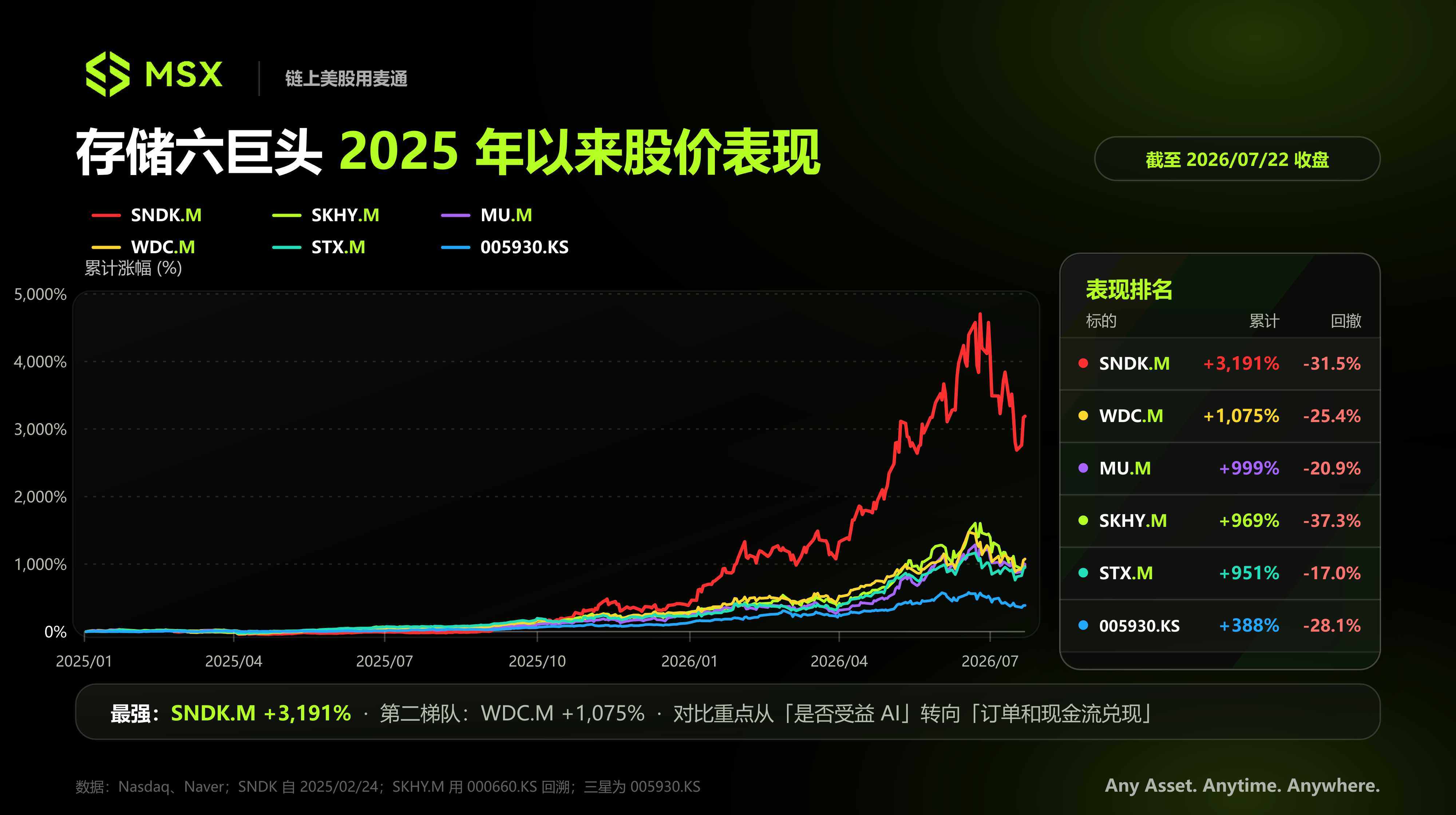
- Since 2025, all six companies have undergone significant revaluation, but as of mid-July 2026, they have generally retreated about 20%—30% from the peak, with the sector moving from "demand explosion and profit recovery" to high expectations, high valuations, and high volatility;
- Historical performance shows that the true catalysts for sustained market movements are often not product launches or samples, but earnings reports exceeding expectations, core customer certifications, scale deliveries, locking in orders for the next fiscal year, and upward guidance on revenue, prices, and profit margins;
- The core of the next market round lies in who can translate demand into long-term contracts, higher product prices, controllable capacity expansions, and continuously growing profits and free cash flow;
In June 2026, Micron (MU.M) released a financial report that had almost no significant shortcomings.
The company's quarterly revenue reached $41.456 billion, non-GAAP gross margin rose to 84.9%, adjusted free cash flow exceeded $18.3 billion, and the revenue guidance for the next quarter was further raised to around $50 billion, in other words, whether it's product prices, profit margins, or order visibility, all point to the same conclusion: AI storage demand remains strong.
Yet, the market's reaction was not as simple as before.
After initially surging post earnings report, Micron quickly gave back its gains, with SanDisk, SK Hynix, Samsung, Western Digital, and Seagate also retreating from their June peaks. As of July 22, the six companies had generally retreated about 20%—30% from their peak, with some stocks dropping more than 30%.
Strangely, the fundamentals did not suddenly weaken, nor did AI data centers stop expanding; it’s just that investors no longer doubt whether AI will bring greater storage demand but began to question how much longer product prices can rise. Will the new capacity change the supply-demand relationship again in 2027—2028?
The storage sector has thus reached a new watershed.
1. Expansion of the AI Storage Market Since 2025
The storage market since 2025 was initially ignited by HBM.
Large model training requires GPUs, and large-scale GPU clusters need high bandwidth and lower latency memory systems, thus HBM, through vertically stacking multiple layers of DRAM, greatly improved data throughput capability and quickly became one of the most critical, highest-margin, and supply-constrained components in AI accelerators.
SK Hynix (SKHY.M) took the lead with its HBM3E product and major customer relationships, quickly completing the revaluation of its profit center.
By the third quarter of 2025, the company announced that discussions on HBM supply for the next fiscal year were essentially complete, HBM4 would ship in the fourth quarter, and next year's DRAM and NAND production had nearly covered customer demand. By the first quarter of 2026, the company’s revenue, operating profit, and net profit continued to set records.
Micron (MU.M), on the other hand, became the most convenient core proxy for trading HBM and server DRAM supply and demand in the US market, especially with HBM4 beginning bulk shipments, server memory prices rising, and several long-term customer agreements together pushing revenue, gross margin, and cash flow higher.
Therefore, for US investors, the significance of its financial reports is no longer limited to the company itself; thus, when Micron raises its revenue, price, and profit margin guidance, the market usually reassesses the entire storage industry’s profit potential.
Samsung pursued a different path.
In 2025, the market primarily priced its lagging HBM product progress, customer certifications, and yield behind SK Hynix. Entering 2026, as HBM4 started commercial deliveries, HBM4E entered the sampling phase, and the profitability of the memory business improved significantly, Samsung’s valuation logic began to shift from "lagging" to "catching up."
The preliminary performance disclosed by the company for the second quarter of 2026 showed quarterly sales of approximately 171 trillion won and operating profit of around 89.4 trillion won. However, these figures include businesses such as smartphones, foundries, displays, and consumer electronics, and cannot be directly seen as the standalone performance of the storage division.
The real driver behind this round of sustained expansion is not just HBM itself.
When manufacturers allocate more wafers, capital expenditures, and advanced packaging resources to high-value AI products while maintaining relatively strict supply discipline, the supply-demand landscape for server DDR5, standard DRAM, and NAND also improves.
At the same time, as AI moves from training to large-scale inference, storage demand begins to spread from around GPUs to the entire data system.
Model weights, vector databases, key-value caches, inference contexts, and high-frequency access data drive the growth in capacity and performance demand for enterprise SSDs; training data, video, multimodal materials, inference logs, historical model versions, and compliance archiving require much lower-cost, scalable, high-capacity storage.
SanDisk (SNDK.M) has become the most elastic stock in the sector at this stage.
After completing its spin-off from Western Digital (WDC.M) in February 2025, SanDisk transformed from a mixed HDD and flash company to a purer NAND and SSD stock in the US market, with its most recent financial quarter showing a 233% quarter-over-quarter growth in data center revenue, signing multiple new business model agreements containing financial guarantees, and announcing a plan for up to $6 billion in stock buybacks after repaying debt.
As AI data continues to accumulate, demand extends from high-speed storage to high-capacity storage.
Because model training data, videos, multimodal data, inference logs, historical versions, and compliance archiving do not all need to be stored long-term in high-cost SSDs, large amounts of data, which have a lower access frequency but must be retained for the long term, will ultimately still need to enter nearline HDD and hierarchical storage systems.
Western Digital's latest quarter's non-GAAP gross margin has reached 50.5%, with free cash flow at $978 million, and it expects nearline HDD Exabyte shipments to maintain double-digit growth over the next three to five years.
Seagate (STX.M) has gained a clearer technology premium with HAMR commercialization, reporting a latest quarter non-GAAP gross margin of 47%, a free cash flow of $953 million, and the highest capacity reaching 44TB Mozaic 4+ products, which have begun to be shipped in bulk to two leading hyperscale customers.
This round of the storage market cannot simply be summarized as a price increase; it is more like a step-by-step expansion of storage demand radius after the deepening of AI infrastructure construction, where HBM addresses bandwidth problems around GPUs, server DRAM handles workloads during calculations, enterprise SSD supports high-frequency data access, and HDD accommodates ever-expanding data lakes and long-term archiving.
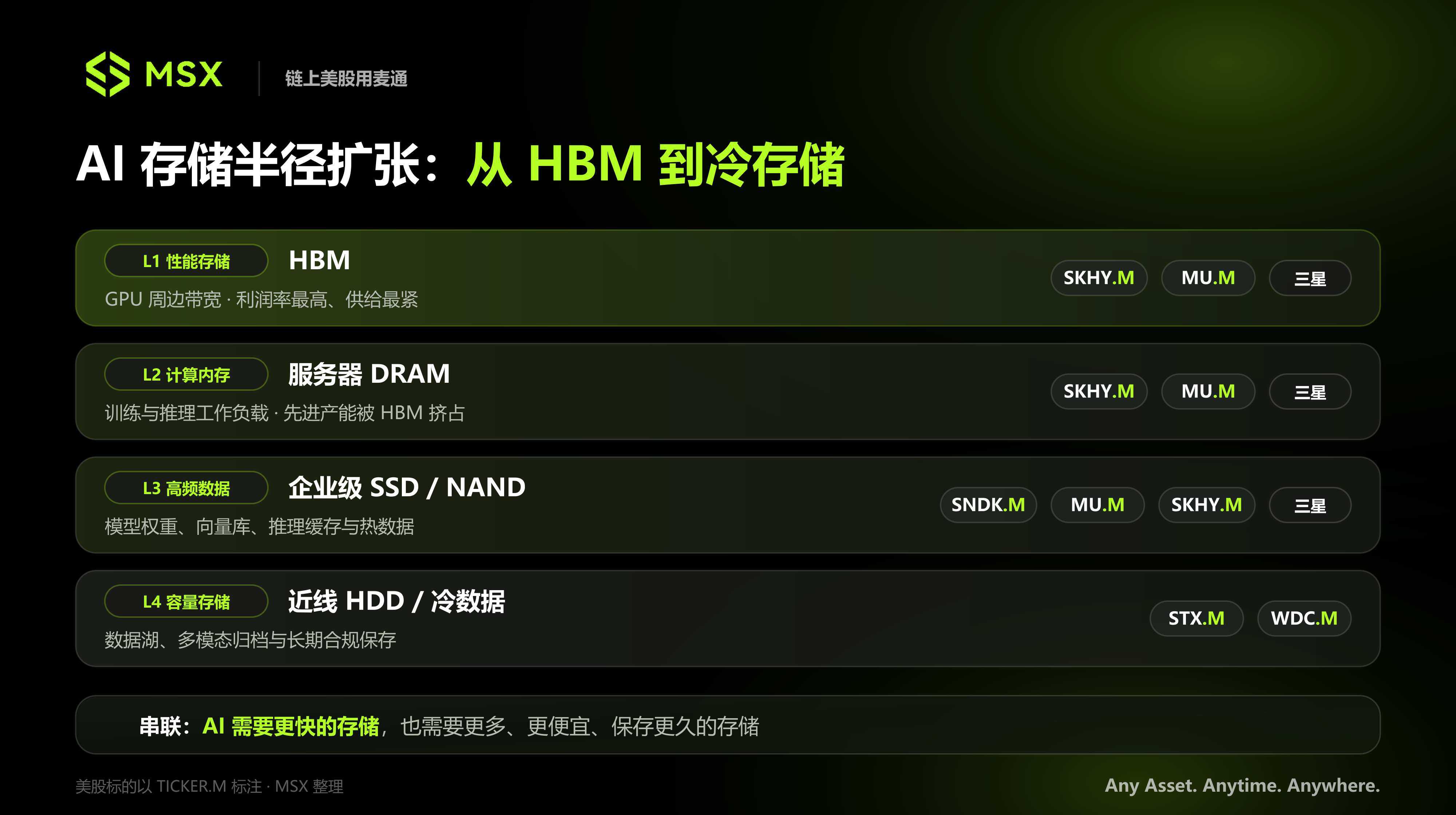
To some extent, the market initially traded on "AI needs faster storage," and then began to trade on "AI also needs more storage." This industrial logic reflecting the spread from HBM to server DRAM, NAND, enterprise SSD, and HDD is also fully reflected in the stock performance of the six companies.
According to a unified adjustment standard, from the beginning of 2025 or from the first trading day post-spin-off, as of July 22, 2026, all six companies have completed significant revaluation, but the increases and starting rhythms differ:
- SK Hynix and Micron benefited earliest from the upturn in HBM and server DRAM;
- Samsung then began to trade on HBM technology catch-up and market share recovery; SanDisk, after completing its spin-off, became the stock with the highest elasticity in this round of market movement due to its purer NAND and enterprise SSD exposure;
- Western Digital and Seagate took over the rise in the first half of 2026, as the market began to incorporate nearline HDD, high-capacity products, and cold data demand into the valuation system for AI infrastructure;
If we break down the past year and a half of market movements, it can roughly be divided into four stages:
- In the first half of 2025, the market first traded HBM. SK Hynix and Micron became the most direct beneficiaries, with investors confirming that HBM is not a short-term inventory replenishment but a long-term high-margin product associated with the expansion of AI accelerators;
- In the second half of 2025, the market expanded to standard DRAM and NAND. The occupation of advanced wafers, packaging, and testing resources by HBM tightened the supply of server DRAM and other storage products, leading the market to adjust upwards the profit expectations for companies like Samsung and SanDisk.
- In the first half of 2026, enterprise SSD and HDD followed suit. As AI moved from training to inference, the demand for storage no longer revolved solely around high-speed memory near GPUs, leading the requirements for training data, inference logs, and long-term archiving to push HDD and cold storage back into the pricing spotlight.
- Entering June and July of 2026, the market turned to high expectations and high volatility. The peak stock prices for the six companies were almost all concentrated in June, and afterward, even though companies like Micron continued to report strong earnings, the sector failed to maintain the previous unilateral rise;
This round of retracement indicates that the market's pricing logic is changing, as the previous stock price increases relied primarily on three continuously strengthening consensus points: AI storage demand continues to expand, industry supply remains tight, and product prices and profit margins still have room to rise.
However, after experiencing significant revaluation, investors began to consider several new issues simultaneously, such as whether the current valuations have already discounted future growth, whether capital trading has become overly crowded, whether new capacities in 2027—2028 will gradually be released, and how much strong demand can ultimately be translated into long-term orders and free cash flow.
Therefore, this round of collective retracement seems more like a marker for the storage market entering its second phase, where future developments will depend more on who can provide longer order visibility, stronger pricing power, and more sustainable profit growth.
2. Though all in storage, the six companies are not telling the same story
If you only look at stock prices, the six companies seem to belong to the same round of AI storage market.
However, from the perspective of industry position, profit elasticity, and catalysts for the next stage, they actually represent six different pricing logics.
SK Hynix remains the company with the strongest industry status and highest order certainty among the six.
Its core advantage lies not only in its leading market share in HBM but also in its ability to lock in customers, prices, and next-year capacities earlier. Compared to the general product release, early coverage of orders makes it easier to improve the visibility of future revenue and profit margins, as well as form a sustained business cycle.
However, in July 2026, after SKHY's listing on Nasdaq, the company introduced a new trading variable. SKHY issued at $149, closing at approximately $168 on the first day. Due to limited circulating shares in the initial US market, the ADR briefly formed a clear premium over the ordinary Korean stock. However, as conversion and arbitrage mechanisms gradually open, this premium might converge.
Therefore, it is necessary to analyze the company's fundamentals separately from ADR supply and demand.
Korean ordinary stocks reflect HBM orders, prices, and profit margins more, while SKHY is also influenced by US capital entry, circulating shares, ETF allocations, and arbitrage mechanisms, which means that even if the company's operations remain strong, the ADR may experience independent fluctuations from fundamentals due to increased supply.
Micron is the most direct US stock proxy and the easiest target to trade ahead of time.
Its advantage lies in covering HBM, server DRAM, NAND, and enterprise SSD together and having local US manufacturing and supply chain policy support. When Micron raises product prices, gross margins, and performance guidance, the market often adjusts the earnings expectations of the entire storage sector at the same time; its financial reports are not only catalysts for the company itself but also important price signals for the global storage industry.
Yet, its problem is equally evident: the speed of market expectation adjustments is extremely fast.
In plain terms, when the valuation is relatively low and industry expectations are weak, an earnings report exceeding expectations can lead to continuous revaluation. However, once entering a high-expectation phase, merely maintaining robustness is not enough; stock prices require higher prices than the most optimistic market predictions, longer order visibility, and a more significant upward adjustment of profit margins.
This explains why Micron’s stock remains highly elastic right after its earnings report, but the sustainability of the market movement begins to decline.
Samsung Electronics remains relatively behind in terms of upward movement but has the clearest elasticity for share recovery.
It is not the company with the purest fundamentals in this round of the market since its foundry, smartphone, consumer electronics, and display businesses dilute the impact of memory profit improvement on the group's overall earnings; its earlier lag in HBM customer certifications has also contributed to its weaker stock performance compared to SK Hynix and Micron.
However, looking the other way, Samsung possesses the most apparent "expectation gap" among the six companies. The market already knows that SK Hynix is the HBM leader, yet it remains uncertain how much high-end HBM orders Samsung will eventually secure.
Thus, Samsung's next phase with genuinely meaningful catalysts lies in whether core customer certifications are completed, whether products enter bulk procurement, whether the revenue share of HBM increases, and whether market share and storage business profit margins can improve simultaneously. Once these indicators start to deliver, Samsung's logic will transition from "technology catch-up" to "share recovery."
SanDisk is gradually shifting from a NAND price increase beta to contract visibility trading.
It is the company with the highest stock elasticity in this round of market movement and also has the highest risks when expectations fall. On one hand, its NAND and enterprise SSD business is relatively pure and extremely sensitive to product price and industry inventory changes; on the other hand, the independent valuation system post-spin-off, growth in data center revenue, and long-term business agreements further magnify the space for profit adjustments.
However, a noteworthy change is occurring for SanDisk. In the past, the market primarily viewed it as a high-elasticity proxy for NAND price increases. Recently, with an increase in agreements that include minimum purchases, financial guarantees, or long-term cooperation mechanisms, investors have started attempting to assign a higher valuation to its revenue and cash flow visibility.
Including the commencement of sending samples for BiCS10, this is an important product milestone, yet it does not necessarily lead to a sustainable business cycle. What needs to be observed is whether the product can pass enterprise customer certification, enter bulk procurement, and ultimately reflect in average selling prices, data center revenue, and gross margins.
After all, for stocks with high valuation cycles, technological advancement is merely the starting point, while order fulfillment is the endpoint.
Western Digital and Seagate also benefit from HDD but do so through different revaluation paths with different core logics.
Western Digital's revaluation leans more toward financial structure. After completing the spin-off of its flash business, WDC has become a purer HDD company, with an increased proportion of high-capacity products, improvements in pricing per TB, industry supply discipline, and operational leverage together driving up gross margins and free cash flow.
Therefore, WDC's stock price may sometimes not fully reflect right after the financial report releases; the market needs to confirm that profit margin improvements are not due to inventory, exchange rate, or one-time factors, but rather stem from sustained changes in long-term orders, product structure, and industry supply discipline.
Seagate's revaluation, on the other hand, leans more toward technology and capacity value. HAMR can increase the capacity of single disks without significantly increasing the number of physical hard disks, reducing costs per TB, and increasing the sales value of individual hard disks. As products above 40TB enter bulk delivery, the market trades not only on HDD shipment growth but also on the penetration rate of new generation products, scarce capacity, and long-term profitability.
This is also why Seagate's earnings report catalysts often have stronger sustainability, as investors adjust not only the current EPS but also the capacity upgrades and profit centers for the coming years.
3. What to Look for in the Next Market Round?
Overall, in the past year and a half, the valuation reconstruction of storage companies has mainly accomplished two things — the market confirms that AI storage demand is not a one-time inventory replenishment, and begins to acknowledge that the profit center of storage companies may be higher than traditional cycles.
However, with all six companies experiencing significant increases, the thresholds for the next stage have clearly risen.
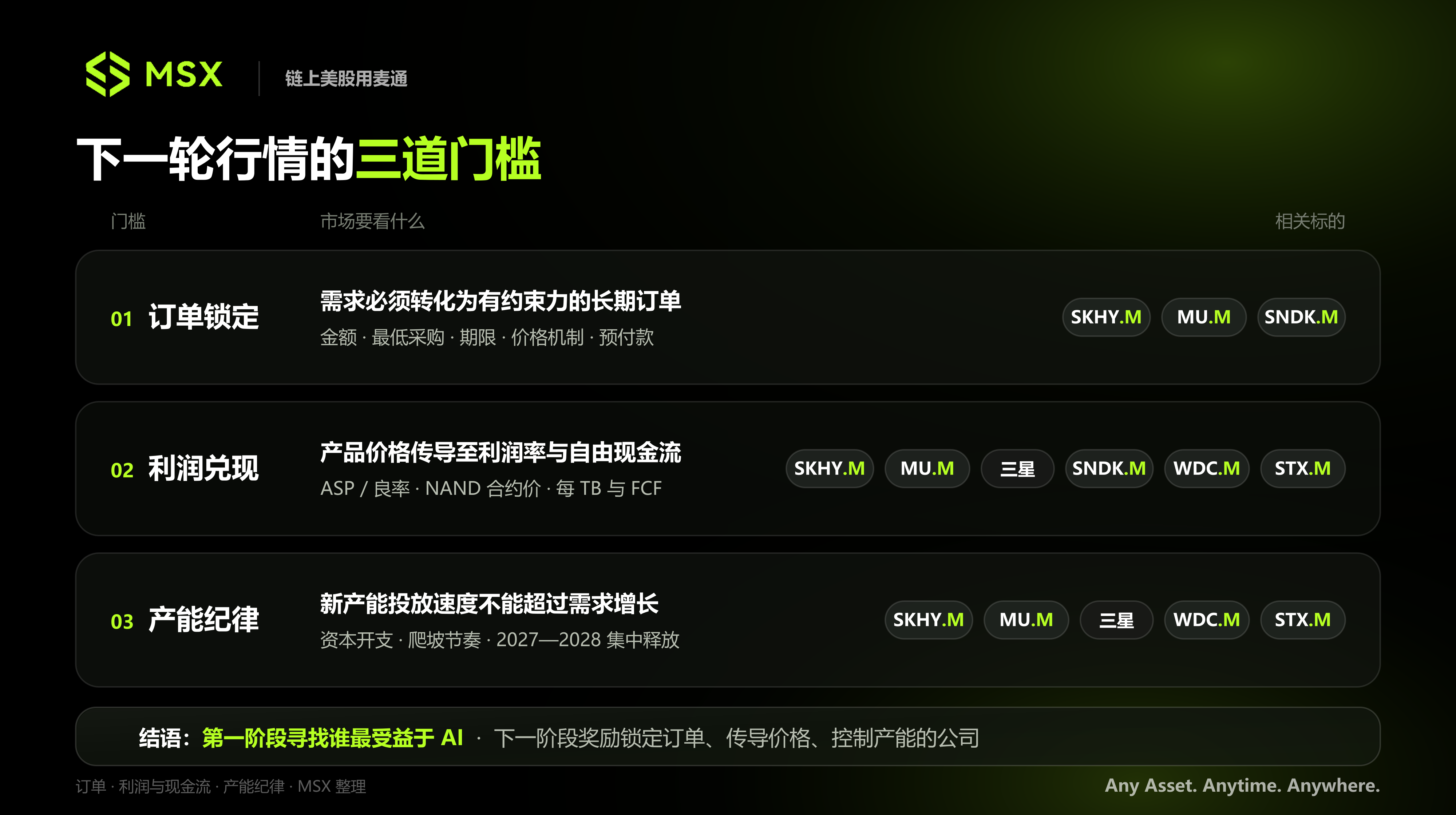
First, demand must be converted into binding long-term orders.
The market will place increasing importance on contract amounts, minimum purchase quantities, execution terms, price adjustment mechanisms, and advance payments from customers. Simply announcing strategic cooperation, joint research and development, or long-term partnerships is insufficient to raise future earnings forecasts. Only contracts that can lock in quantity, price, and cash flow may truly reduce cyclical volatility and achieve higher valuation multiples.
In this dimension, SK Hynix benefits most from long-term HBM supply arrangements; Micron can enhance revenue visibility through strategic customer agreements; SanDisk needs to prove that new business cooperation models can reduce the impact of NAND spot cycles on profitability.
Second, product prices need to continue to translate into profit margins and free cash flow.
A common misconception in the storage industry is to only discuss pricing without discussing profits. The rise in prices for HBM, DRAM, NAND, and HDD will ultimately translate into higher gross margins, depending on product mix, yield rates, depreciation, capital expenditures, and customer agreements.
For SK Hynix, Micron, and Samsung, the focus is on the average selling price, yield rates, and revenue share of HBM4; for SanDisk, the core lies in NAND contract prices, the proportion of enterprise SSDs, and inventory levels; for Western Digital and Seagate, the focus is on pricing per TB, penetration of high-capacity products, and free cash flow.
The market ultimately buys not just rise stories but earnings forecasts adjustments.
Third, capacity expansion cannot outpace demand fulfillment.
HBM, advanced DRAM, NAND, and HDD currently all benefit from supply discipline, but high profits will also stimulate capital expenditures.
If new wafer fabs, packaging capacities, and high-capacity hard disk production lines are released in concentration in 2027—2028, the market will reassess how long supply tightness can sustain. Thus, capital expenditure plans, equipment installation progress, capacity ramp-up speeds, and the duration of customer reservations will gradually become more important indicators than single-quarter revenues.
For Samsung, the market focuses on whether new capacity can come with share increases; for SK Hynix and Micron, the key is whether expansion still lags behind HBM demand; for Seagate and Western Digital, it is necessary to see if high-capacity HDD capacities continue to be pre-ordered by customers.
It is noteworthy that the end of July to mid-August will also become a new集中验证 window for the storage sector: Seagate will release earnings on July 28, SK Hynix will announce quarterly results on July 29; SanDisk and Western Digital both plan to release earnings on August 5, with SanDisk holding an investor day on August 13.
At that time, the market will need to truly answer what extent are 2027 orders reaching? How much more can product prices increase? When will new capacity be deployed? Can high profits continue to translate into free cash flow? How does management intend to allocate these cash flows through buybacks, dividends, or capacity expansion?
Final Thoughts
From HBM to server DRAM, from enterprise SSD to HDD, this round of market has proven that AI's impact on the storage industry extends far beyond a single high-bandwidth memory around GPUs.
The larger the model, the more frequent the inferences, and the more data generated, the entire storage hierarchy will receive new demands.
But defined industry demand does not equal guaranteed stock returns.
When the market still doubts AI storage demand, investors buy exposure; but when demand has become consensus, the market buys fulfillment — whoever can lock in orders early, raise product prices, control new capacity, and translate revenue into actual profits and free cash flow will continue to earn premiums.
免责声明:本文章仅代表作者个人观点,不代表本平台的立场和观点。本文章仅供信息分享,不构成对任何人的任何投资建议。用户与作者之间的任何争议,与本平台无关。如网页中刊载的文章或图片涉及侵权,请提供相关的权利证明和身份证明发送邮件到support@aicoin.com,本平台相关工作人员将会进行核查。


