On July 1, 2026, London. Robinhood officially announced the launch of the Robinhood Chain mainnet at an event called The World is Flat.
This is not just another slogan supporting crypto, but a traditional financial giant with nearly 28 million funded users and platform assets exceeding $370 billion, launching its own Ethereum-compatible Layer-2 public chain.
It is based on Arbitrum, focusing on RWA (real-world assets) tokenization, and connected with various DeFi and infrastructure players such as Uniswap, Morpho, Chainlink, and BitGo on the first day. Stock Tokens are available for 24/7 trading in over 120 countries, and USDG can earn about 7% self-custody yield on-chain, while AI Agents can buy and sell directly on the chain for you.
For Web3 users, this is both a heavy blow and a mirror: when TradFi is no longer satisfied with just connecting to crypto but instead dives in directly to build chains, issue tokens, and grab traffic, are we welcoming growth, or witnessing a harvest?
This report is specifically designed to dissect this from a Web3 perspective.
1. Why is this time different? Robinhood is no longer just an app for buying coins
In the past few years, the impression of Robinhood in the crypto space has been fragmented: it has introduced a large number of beginners to BTC and ETH for the first time, but has also been criticized as a centralized tumor due to frequent outages, withdrawal restrictions, and PFOF controversies.
In 2026, the situation has changed.
The company's strategy has upgraded from a retail trading tool to a three-layer goal:
- First platform for active traders
- First market share for next-generation user wallets
- World's first financial ecosystem
To achieve the third point, it chose the most hardcore path—building its own chain.
The positioning of Robinhood Chain is very clear:
A permissionless, EVM-compatible Layer-2 designed specifically for RWA and AI-native finance.
The technical base is Arbitrum Dedicated Blockchains, inheriting Ethereum's security while offering high throughput, low fees, and supporting ERC-4337 account abstraction. Gas is paid in ETH, using a first-come, first-served order, and is fully open for developers to deploy contracts.
It is not a closed consortium chain but a true public chain.
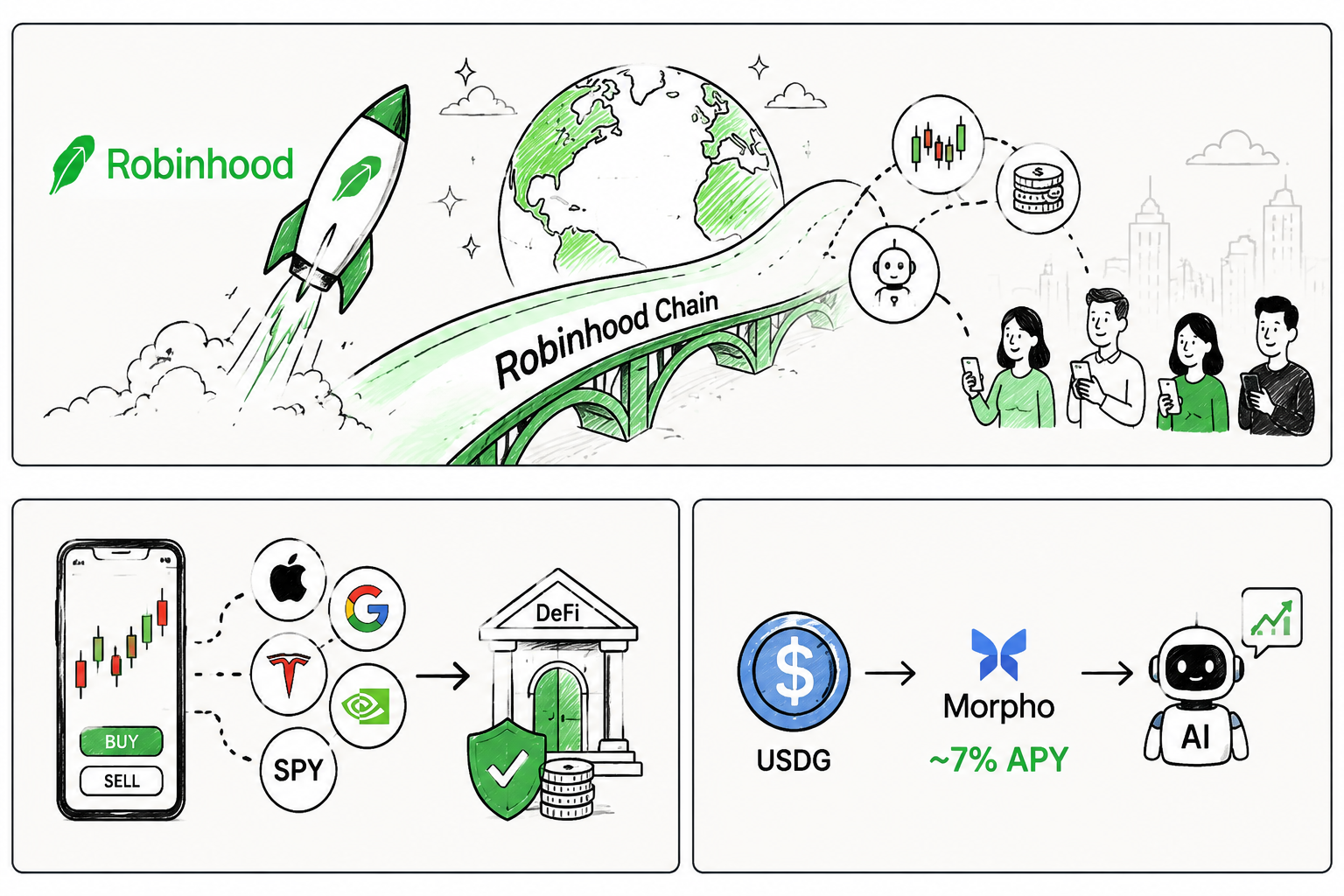
2. The "big gift bag" on the first day of the mainnet launch: Three things Web3 users should pay attention to
Stock Tokens: Tokenization of U.S. stocks officially launched
This is currently the most eye-catching product.
Users can trade tokenized U.S. stocks and ETFs (including popular targets like NVDA, AAPL, GOOG) in over 120 countries through the Robinhood Wallet. These are tokenized debt securities issued by Jersey entities, providing economic exposure without legal ownership or voting rights.
The key points are:
- 24/7 trading, not restricted by traditional market opening and closing
- Can be used directly as collateral for DeFi
- Can be deposited into lending protocols
- Can be traded via DEXs like Uniswap
For Web3 users, this is akin to moving U.S. stock liquidity directly onto the chain. Although it is not true stock ownership (regulatory red lines still exist), it transforms tokenized stocks from a concept into tradable, composable assets.
Robinhood Earn: About 7% self-custody yield on USDG
Based on the Morpho protocol, users can lend USDG (a dollar stablecoin issued by Paxos) with an estimated APY of about 7%, insured by Lloyd’s of London and RELM.
This is the first time Robinhood has truly offered a self-custody + DeFi yield product to mainstream users. For TradFi users accustomed to centralized finance, this is a dimension-lowering education; for DeFi veterans, it is a significant influx of users from a major platform.
AI Agentic Trading on the chain
After initially launching AI agent trading in stocks and options in May, it has now expanded to crypto and on-chain assets. Users can authorize AI Agents to autonomously execute trading strategies while retaining control over their funds.
With account abstraction and session keys, this makes AI trading agents truly possible. For Web3, this signifies an entry into the agentic economy, potentially being directly unlocked by an app with tens of millions of users.
3. The ambition revealed by ecosystem partners
When the mainnet launched, the list of announced partners clearly indicates the intention:
- Uniswap: Deploying dedicated AMM as a public liquidity pool
- Morpho: Underlying lending
- Chainlink: Oracles and cross-chain data
- BitGo & Fireblocks: Institutional-grade custody
- Alchemy: RPC and account abstraction infrastructure
- LayerZero: Cross-chain bridge
- Lighter, Arcus, 1inch, Rialto, etc.: Spot and perpetual trading
This is not a shallow collaboration where we support a few protocols, but directly positioning Robinhood Chain as a layer that carries financial primitives.
More importantly, Robinhood has clearly stated that it hopes to gradually replace its own infrastructure with blockchain in the future. This means the chain is not just an added service, but part of a long-term architecture.
4. Why must Web3 users take this operation seriously?
The real user entry is coming
Robinhood has nearly 28 million funded customers with an average age of about 36, entering their peak earning years. These individuals may have previously only bought some coins in the App, but now they have the opportunity to directly access self-custody wallets, DeFi yields, and on-chain stocks.
This is so far the closest attempt to massively pull traditional users into the on-chain world.
The RWA narrative now has a real trading scenario
Many RWA projects were previously stuck at the stage of putting government bonds on-chain with low liquidity and few users. Robinhood directly tokenized the most attractive assets (U.S. stocks) and opened 24/7 trading and DeFi composability, which is the actual product landing.
The competitive landscape is being rewritten
In the past, the crypto space discussed whether Coinbase would be taken over by Binance. Now we need to think one level deeper: when Robinhood, and potentially Schwab and Fidelity in the future, start building their own L2 or dedicated chains, how will traffic and liquidity be redistributed?
Robinhood Chain chose the Arbitrum tech stack and promised to recycle part of the protocol fees back into the ecosystem, which itself is a vote on the existing L2 landscape.
5. Cooling down, we must face the risks
No matter how much it is praised, several hard limitations cannot be ignored:
- Stock Tokens are not true stocks. They are debt instruments without shareholder rights. If regulation tightens, the product form may be forced to adjust.
- U.S. domestic users currently cannot use Stock Tokens. The core market is excluded, indicating that compliance remains the biggest bottleneck.
- Centralized inertia still exists. Although it is a public chain, the initial ecosystem and liquidity heavily rely on Robinhood's own traffic and products. The true degree of permissionlessness still needs observation.
- Security and responsibility issues with AI Agents. When users hand over trading authority to AI, who is responsible when something goes wrong? This will be a new governance challenge in the Web3 world.
6. In conclusion: This is not a false alarm, but a new species has emerged
The launch of Robinhood Chain marks the first time a traditional financial giant has directly entered the core battlefield of Web3—asset issuance, trading, lending, yield, and AI agency—through a self-built public chain.
For pure crypto-native players, this may feel like an invasion.
For pragmatic builders, it is a tremendous incremental opportunity: more users, more real assets, more composable scenarios.
No matter where you stand, one thing is clear—
When Robinhood starts seriously building a public chain, Web3 is no longer just a world of cryptocurrencies, but the new underlying layer of the entire financial market.
In the upcoming quarters, the three truly worth monitoring data points are:
- The actual trading volume and number of holders of Stock Tokens
- The deposit scale of Robinhood Earn
- The growth curve of on-chain independent developers and TVL
If these three can continue to rise, then 2026 may very well be the year when TradFi and Crypto truly begin to deeply integrate.
And you, are you ready?
免责声明:本文章仅代表作者个人观点,不代表本平台的立场和观点。本文章仅供信息分享,不构成对任何人的任何投资建议。用户与作者之间的任何争议,与本平台无关。如网页中刊载的文章或图片涉及侵权,请提供相关的权利证明和身份证明发送邮件到support@aicoin.com,本平台相关工作人员将会进行核查。


