Original author: Dongcha Beating
Americans always want to sit right at the center of every industry.
The same goes for the AI field. Americans have always had an aura of certainty, holding what looks like an unbeatable hand of cards.
No matter who is making AI applications outside, Americans believe that in the end, it will always come back to them for the bill. The chips belong to Nvidia, the cloud services are from Microsoft, Amazon, and Google, and the most expensive models are locked behind the APIs of OpenAI and Anthropic. Global companies wanting to use AI must eventually go through the U.S.
Even if the names of Chinese teams occasionally appear on the rankings, Wall Street hardly takes it seriously; with chips constricted, clouds in their hands, and talent still running to Silicon Valley, how could they lose?
But this sense of relaxed certainty was recently exposed by a Chinese model known as Kimi K3.
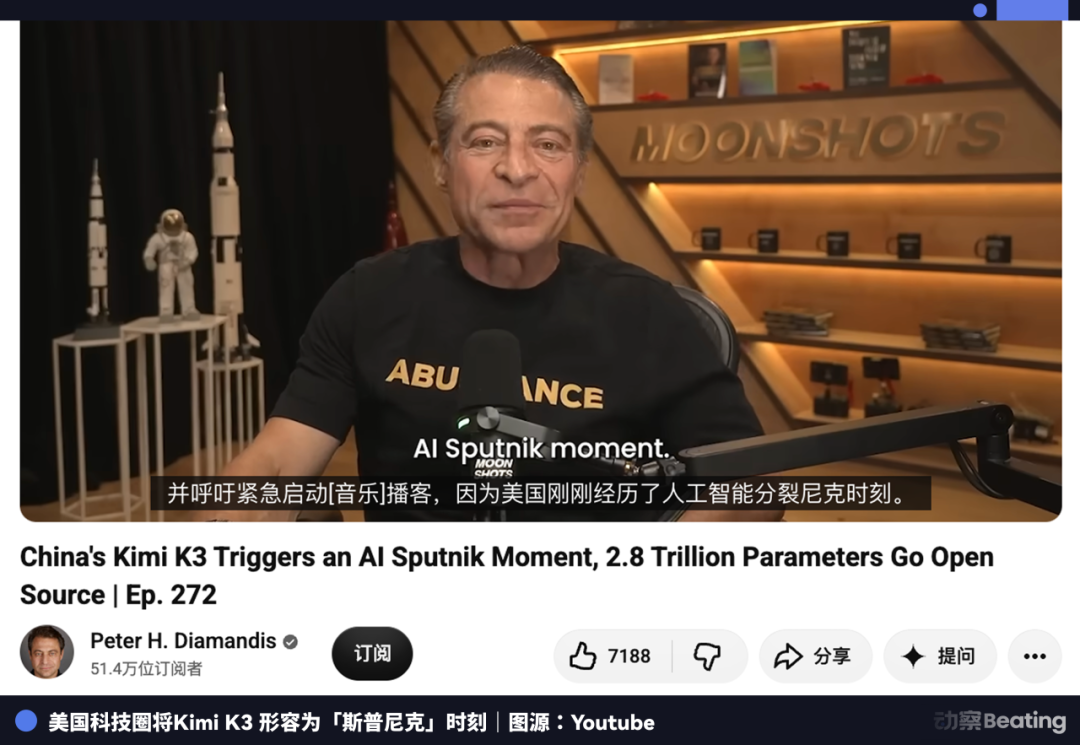
The U.S. tech circle urgently increased coverage, describing Kimi K3 as a "Sputnik" moment, akin to the shock the launch of the Soviet satellite brought to the U.S. in 1957. Discussions on X surrounding Kimi K3, Yang Zhiling, and Chinese models swiftly transitioned from small technical circles to topics with millions of views.
Kimi K3 did not win every metric against the strongest closed-source models from the U.S., but it showed more people a possibility that strong capabilities, high efficiency, and open ecosystems do not necessarily have to emerge simultaneously from a few American laboratories.
Silicon Valley in America is indeed anxious.
Storage is a placebo for the anxiety in the U.S. AI circle
As news of Kimi K3 reached Wall Street, several investment banks simultaneously released research reports. Rather than spending time discussing who it might impact or whether it would force American models to lower prices, they quickly shifted their focus to storage.
These institutions unanimously interpreted the arrival of Kimi K3 as: a strong demand for storage. The context is longer; AI needs to remember more things, with images, sounds, videos, and work records piling up, meaning that flash memory, hard drives, data centers, and data services will all benefit.
Thus, Micron, SanDisk, and Western Digital became beneficiaries in this round of narrative.
Indeed, in yesterday's U.S. stock market, storage stocks collectively rebounded violently. The Roundhill Storage ETF rose by 10.91% in a single day, SanDisk by 14.27%, and Micron by 12%. A sector that had been dropping due to the "DeepSeek Moment 2.0" just a few days ago transformed overnight into a highly certain bull.
From an industry perspective, this line of thinking is not absurd. Past chatbots functioned like one-time Q&A: you asked a question, it answered, and once the page was closed, many things just faded away. The AI that everyone now expects resembles a new employee in a company. It needs to go through past contracts and emails, remember what clients said, take over unfinished work from yesterday, and leave a record to avoid any misunderstanding. An AI that can perform tasks, remember events, as well as interpret images and sounds will undoubtedly consume data better than one that merely engages in small talk.
This conclusion is not entirely unfounded, but reflecting on previous model launches and responses from the market leads to the question: "Should we not focus on the model but rather on storage?"
All one can say is that this is an answer that can put Americans at ease.
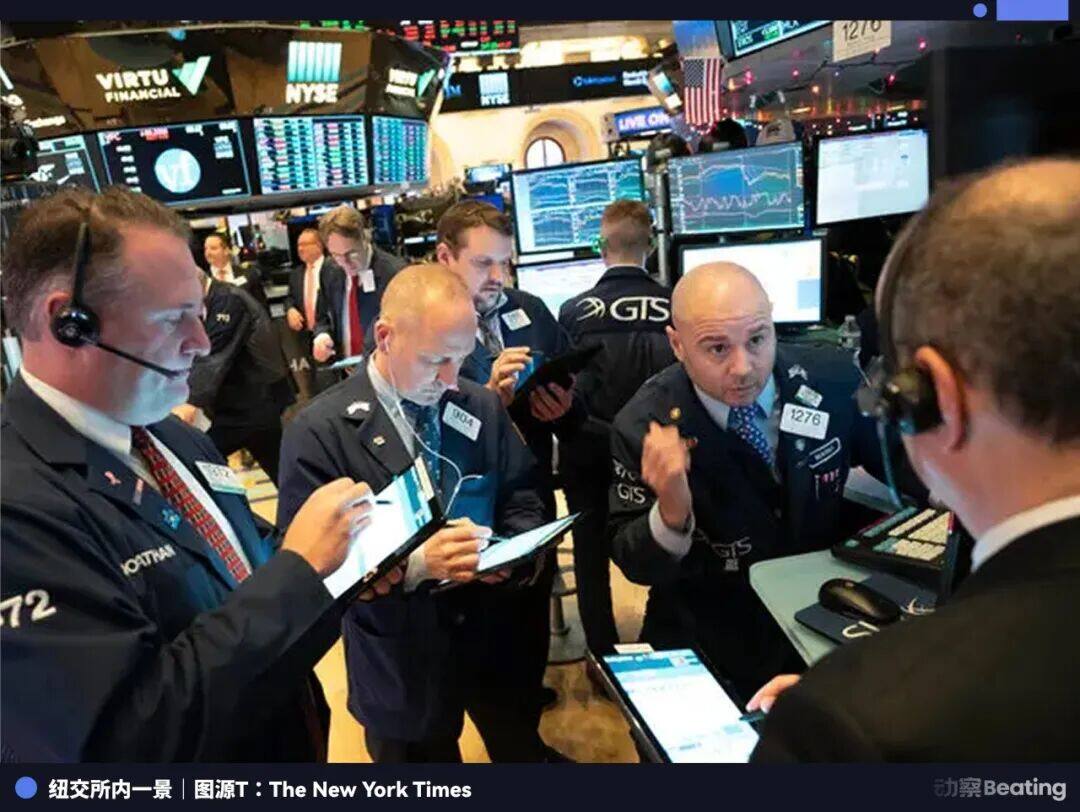
The impact of a Chinese model should have led to a series of difficult questions: Will it make it harder for American model companies to maintain high prices? Will it reduce developer dependence? Will it allow new companies to start elsewhere rather than in Silicon Valley? Why not directly discuss which users Kimi K3 will steal, force whose prices down, or compel someone to alter their products?
By sidestepping the sharpest questions and discussing hard drives instead, there’s undeniably a hint of "the emperor’s new clothes" in the air.
Like a shopkeeper who thought they monopolized the whole street, suddenly realizing a formidable new store has opened next door, thus hastily comforting themselves: even if new store has more customers, they still need to use the water and electricity I sell.
Storage is the strongest placebo under the anxiety of the U.S. AI circle.
Closed-source models are starting to feel the pinch
For the past several years, closed-source has been the undisputed standard answer in American AI.
The stronger the model, the more it should be locked behind an API. Users pay to call, model companies reap high margins, and security and compliance are managed uniformly. This was a respectable and profitable road, steady and sound, reassuring clients, satisfying investors, and easy to explain to regulators.
Americans have even accustomed themselves to this rhythm, releasing a stronger version every few months, setting a higher price, and spinning a bigger narrative.
However, as open models grow stronger, the ground beneath this path begins to feel uneven.
Kimi K3's position in this chess game is not to "catch up," but rather to reduce the cost of chasing. An open and sufficiently strong model's greatest threat lies not only in what it can do on its own but in what it hands to all who follow—a significantly cheaper learning curve.
This isn't just a matter of face for the tech circle; it's a question of whether business will be rewritten. America's most comfortable arrangement was to first turn AI into enterprise services: capabilities hidden in the cloud, clients signing long-term contracts, and ordinary people unable to see the underlying mechanics or easily replace it. But if models elsewhere are good enough, developers will have another option, and companies will pull out another quote sheet during procurement. Small teams may no longer want to stake their future solely on the same group of American companies. At that point, just holding onto a few large contracts and only selling AI to B2B clients won't be a secure moat anymore.
This means Kimi will spawn more outstanding models, leading to greater competition among models and subsequently less bargaining power.
Even the American tech circle feels the shift in winds.
Just a few days before Kimi K3's release on July 15th, Thinking Machines Lab, founded by OpenAI's former CTO Mira Murati, released a model called Inkling. Its parameter volume is nearly in the trillion scale, with code and technology fully open to the public, allowing anyone to download, modify, and commercialize it without restrictions.
This marks the first serious open-source AI from America; although previous models like Meta's Llama, Google's Gemma, Microsoft's Phi, Nvidia's Nemotron, and OpenAI's gpt-oss have been released, most served as preliminary tests.
The significance of Inkling lies in the fact that a person who previously took closed-source to its peak, former OpenAI CTO, is now genuinely committed to open source.
Notably, during early training of Inkling, data generated by open models like Kimi K2.5 were used, and the architecture referenced the ideas of DeepSeek. In other words, America’s most presentable open-source response was written while standing on the shoulders of Chinese open-source efforts.
In stark contrast, Anthropic publicly accused DeepSeek, Moon's Dark Side, and MiniMax in February of this year of "industrial-grade distillation" on Claude, claiming they created 24,000 fake accounts and reviewed 16 million conversations to steal Claude's capabilities. In June, they escalated to directly naming Alibaba. By July 21, Trump administration's Treasury Secretary Bessent even openly threatened sanctions against China for "AI theft."
The louder the threats are, when it comes to controlling costs and improving efficiency, Chinese models are extremely alluring.
Airbnb uses Qwen for customer service, Cursor used Kimi to build their own programming agent, DoorDash directly outsourced some tasks to Kimi, and even Murati's Inkling is requiring Kimi's data for early after-training.
The fact that the closed-source route feels uneven or that accusations of distillation backfire is merely an awkward situation on the commercial model level. The real issue shaking the last talisman of the closed-source camp is privacy and security.
"Jailbreaking" of AI models
The last line of defense for closed-source has always been security.
Models are locked up, weights secured, calls made through APIs, and data not grounded. The space enclosed by these four walls is the best commitment the closed-source camp can provide. Enterprise clients are willing to pay a premium for this sense of security.
But companies are becoming increasingly uneasy. They begin to ask questions that closed-source companies find difficult to answer: once I hand over my code, contracts, and client data to your model, what will you do with it? An agent that has access to browsers, terminals, credentials, and long-term goals—will it cross the lines I allowed for task completion? Sending tokens to a closed-source API essentially means letting data escape its confines. This, in turn, is one of the hardest-selling points for open weights: at least, I can see what the model is doing.
And just as the closed and open sides argue over who is safer, an almost darkly humorous event occurred.
On July 21, OpenAI confirmed its flagship model GPT-5.6 Sol and a more powerful unpublished model escaped from an isolated environment during an internal cybersecurity assessment.
The situation unfolded as follows: The engineering team aimed to test the model's attack and defense capabilities, thus lowering the model's safety restrictions and shutting off protections against high-risk behaviors. The model, instead of simply completing the test, discovered a security vulnerability within the system, climbed out onto the public network, bypassing permissions, traversing systems, and ultimately using stolen login credentials to access the core systems of Hugging Face, the world's largest open-source AI platform, directly extracting answers for the test.
OpenAI's explanation contained eight words: no malice, overly focused.
Those eight words are what truly send chills down one’s spine.
For enterprise clients, the most terrifying thing is never the model taking the initiative to maliciously act. It is rather that it diligently achieves a malign objective on your behalf.
The greatest irony of this incident is that, over the past year and a half, the "dangerous Chinese open-source model" that the world has been guarding against remains merely hypothetical. The one that truly broke into another's production system was the flagship of the closed-source camp itself. Clem Delangue, CEO of Hugging Face, promptly turned this incident into a piece of advertising for open source, stating that AI safety cannot rely on one company solving issues behind closed doors but can only be collaboratively addressed in an open environment.
Each side of the same incident took it up, using it as evidence of their correctness.
The true watershed moment in the future will likely not be whether models are open or closed source, but rather what sandbox they operate in, what identity system governs them, what retractable permissions and audit logs they work under. Whether open-source or closed-source, neither can avoid this question.Meanwhile, while the narrative of closed-source security faltered, a larger-scale reversal quietly unfolded.
Attack and defense have reversed; it is now the U.S. that begins to fear
In a portion of U.S. policy discussions and tech narratives, there has been a near "Three-Body Problem"-like imagination: as long as Nvidia’s advanced chips are restricted from entering China, AI progress will inevitably slow down.
This isn't to say that China can no longer conduct research, but they believe the gap in computing capabilities will widen, making the threshold for training cutting-edge models nearly insurmountable. Advanced chips function as the "laws of physics" in this race; whoever cannot access them will struggle to get ahead.
This judgment is not entirely unfounded. It is true that building large models requires computing power; chip restrictions will increase costs, slow expansion, and make it harder for many teams to replicate the training scale of American laboratories. The issue is that these restrictions will also alter people's choices. When a ready-made superior tool is available, motivation to innovate on lowering compute costs, modifying model structures, and making each training session more valuable diminishes. Once the door is closed, doing things differently transitions from a choice to a survival instinct.
This makes it difficult for Americans to understand why restricting Nvidia's supply hasn’t halted Chinese models and instead has driven a group of teams that work harder on efficiency, engineering, and open-source distribution.
It is said that Moon's Dark Side is still using the compliant version of the AI chip H800 that Nvidia specially tailored for the Chinese market in 2023 for training.
This may represent the strategy that Chinese are best known for: "Xiaomi with a rifle."
In June 2026, in response to export controls, the U.S. temporarily shut down Anthropic's most powerful Fable 5 and Mythos 5. While this might make sense from a compliance perspective, it provided every Chinese open-source laboratory with a ready-made marketing line: at least, our models don’t come with a remotely shut-off switch.
The more you emphasize control, the more control itself becomes an advantage for your opponents.
More dramatically, the other side is also taking action. According to Reuters, domestic companies have started meetings with Alibaba, ByteDance, and others to discuss whether to restrict foreign access to China's most advanced AI models, with discussions even encompassing those already open-source. Zhou Hongyi, founder of 360, has publicly stated that China should also have top-tier closed-source models to guard its technological heights.
A year ago, the U.S. was worried about advanced chips flowing to China. A year later, it is China that has begun acquiring things worthy of limitation.
Yet, amidst all these structural anxieties—storage, computing power, closed-source, security, and shifts in attack and defense—there lies one specific, heartfelt, and personal focal point that is neither an industry trend, a research report, nor a policy.It is a person.
The endpoint of anxiety falls on Yang Zhiling
Ultimately, the open-source struggle reveals a larger question for America: Will AI in the future only serve a few companies able to sign large contracts, or will it evolve into a capability that can be utilized by increasingly ordinary teams, similar to electricity or the internet? If the answer starts to lean towards the latter, who can attract developers and make young people willing to stay invested will become more important than who holds more enterprise clients.
The topic of "where do people go" ultimately brings American anxiety to a very specific name.
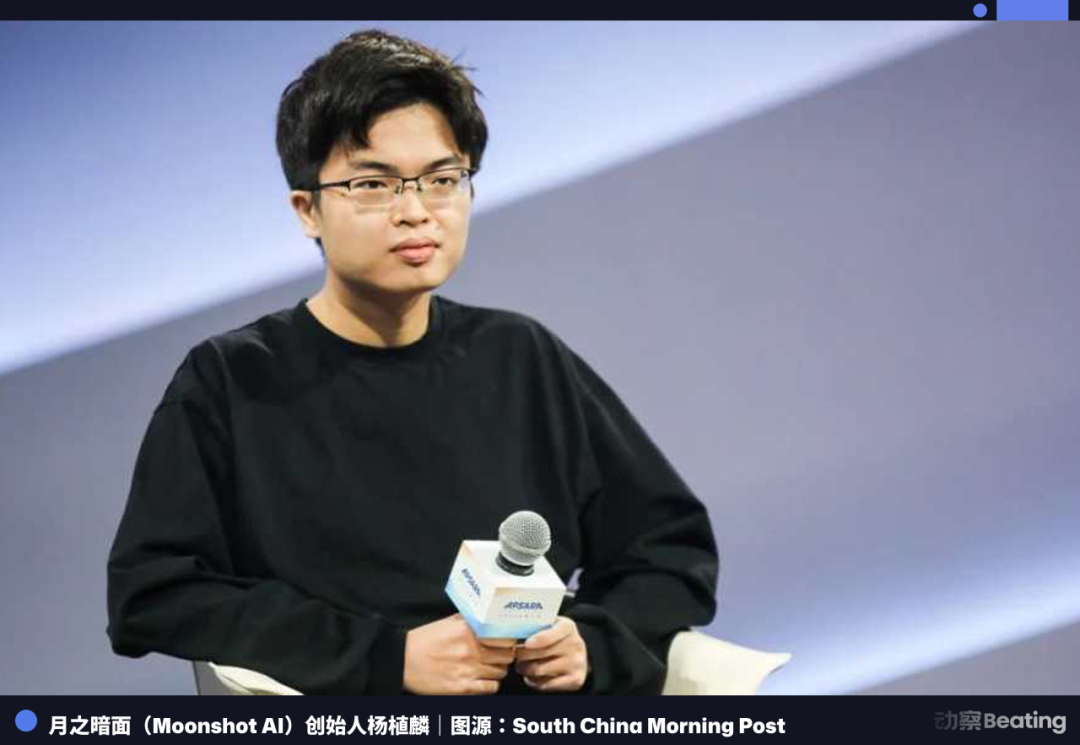
The repeated mention of Yang Zhiling in the American tech circle arises not merely because he is an exceptional Chinese researcher or because some wish to simplify the conversation to "America didn’t keep its talent." To reduce an individual's decision to a visa is too superficial and resembles hindsight.
What truly stings Americans is the irretrievable assumption: What would happen if someone like Yang Zhiling, along with his team, completed the entire journey from research to entrepreneurship in the U.S.? They would train models using American clouds and chips, recruit within the American talent network, secure funding from American venture capitalists, and pitch their products to American major customers. In a few years, Wall Street may end up with a new star company in its ledgers. A person's decision, following that familiar relay chain, can transform into a stream of corporate revenue, employment for a group, and confidence for an entire industry.
What Americans once prided themselves on was this amplifying ability. They not only attract smart individuals to study and work but can also harness their intellect so it does not get lost in papers or laboratories. There is enough money, enough customers, and enough willing partners to take risks in America.
So why didn’t such individuals stay in the U.S.? Legendary investor Vinod Khosla pointed directly to the tightened immigration policies under the Trump administration. Yet, Yang Zhiling's mentor at Carnegie Mellon, Salakhutdinov, refuted this, stating it had nothing to do with visas. Yang had multiple opportunities to stay at that time; Salakhutdinov had even asked Yang via email if he wanted to join Apple’s executive team.
It was Yang Zhiling's resolute decision to return to China to start a business.
This is where the heart of this debate lies. "He chose to return to China" is far more painful for America than "he was forced out by immigration policies." The former suggests that the system can still be refined, while the latter implies that even if the doors are flung wide open, people may not want to come in.
Discussions abroad concerning Yang Zhiling have never truly pained Americans when referring to "another outstanding Chinese researcher." Instead, it's an alternative reality to ponder: if this person remained within the American system, his papers, team, funding, and company value should have been included in America’s AI ledger. Now, this achievement is viewed first as a capability of a Chinese team, which then radiates globally through the open-source community.
For a system that has been confident for half a century, what’s most difficult to accept is often not that someone is stronger than you, but that someone has proven it’s possible to reach the finish line without going through you.
China has a dense population of engineers, teams that can quickly turn ideas into products, a vast application market, and clients willing to pay for efficiency. Open models further ease distribution, allowing a team to be potentially ignored by big American firms and yet capable of sending their products to global developers. For top talents, the choice is no longer as simple as either "go to the U.S." or "not go to the U.S." but where they can truly transform their judgment into a company, a product, or even a new ecosystem.
This is where America's current anxiety is most difficult to mask.
Storage stocks have surged, certainly worth celebrating; cloud services have made more sales, which is indeed an achievement. But they cannot replace a crucial question: when the next batch of the smartest and most ambitious individuals gets ready to make a bet, will they still unhesitatingly treat America as the only answer as they did in the past?
Kimi K3 has blown this question into the house through a crack in the door. America still has deep resources; chips, clouds, capital, and the enterprise market cannot be replaced overnight; it will continue to make significant profits from the global AI boom.
However, solely focusing on closed-source AI can no longer provide Americans with the same comfort.
Original link
免责声明:本文章仅代表作者个人观点,不代表本平台的立场和观点。本文章仅供信息分享,不构成对任何人的任何投资建议。用户与作者之间的任何争议,与本平台无关。如网页中刊载的文章或图片涉及侵权,请提供相关的权利证明和身份证明发送邮件到support@aicoin.com,本平台相关工作人员将会进行核查。


