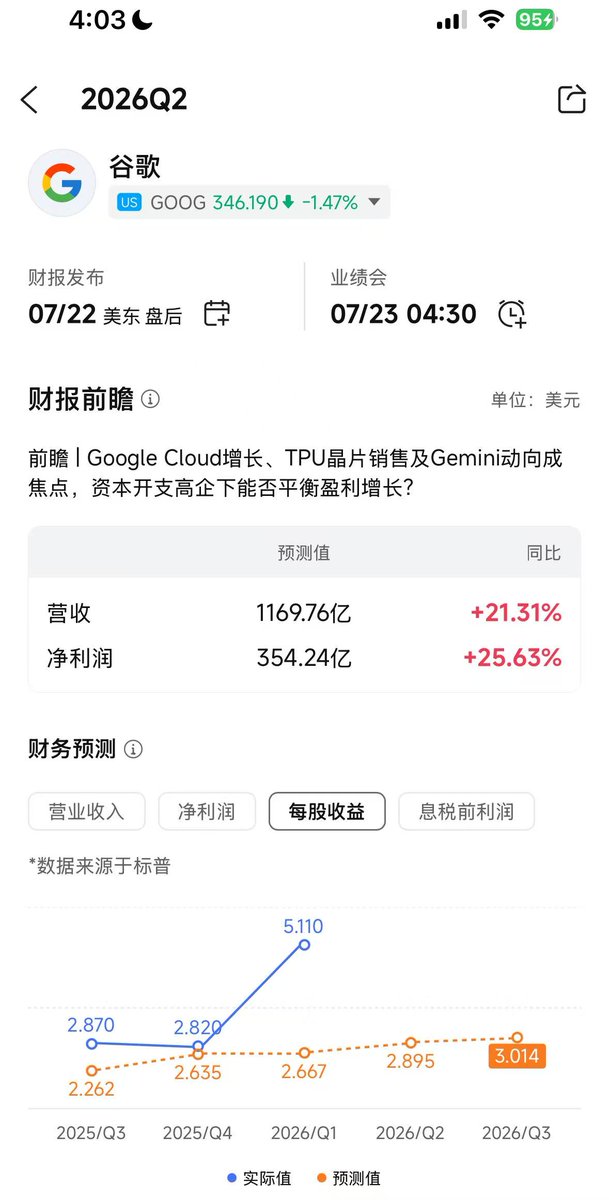
Recently, Google has faced several challenges. The first is the delay of the Gemini 3.5 Pro model. The second is that top AI talents have been poached for higher salaries and options. The third is that some institutions predict a slowdown in capital expenditures, far below the full-year guidance of $180 billion to $190 billion. Therefore, Google's earnings report after hours tonight is particularly important!
Google is currently the earliest cloud service provider to release an earnings report. Its capital expenditure situation determines the fate of key upstream suppliers like GPU Nvidia, HBM, optical modules, electricity, liquid cooling, and so on. Additionally, the income from cloud services directly affects investors' expectations for Google's return on investment!
Thus, Google's earnings report must satisfy both upstream suppliers and a variety of investors; its data will be crucial!
I will focus on three points in Google's earnings report: the first is the market's expectation gap, the second is cloud service growth rate, and the third is capital expenditure!
As we all know, Google's stock price performance has been unsatisfactory recently. Last night, the Nasdaq 100 index surged, while Google's stock fell slightly, which is quite unusual. For any company, stock price fluctuations following an earnings report are essentially a market reaction to expectation gaps.
1️⃣ Market Expectation Gap
The expectation gap in the investment market is often divided into three levels:
The first level (management guidance): the performance expectations given by the company itself.
The second level (sell-side consensus): the average forecasts given by Wall Street brokerage analysts.
The third level (buy-side signals): the "invisible thresholds" in the minds of the institutional fund managers who actually spend money.
What’s most outrageous this time is that the buy-side expectations are surprisingly high.
While sell-side and management expectations for cloud business growth are generally around 64%, the expectations within this group of buy-side institutions have surprisingly been pushed to 70%~80%+! This amounts to raising the threshold by nearly 20 percentage points. The market's optimistic sentiment towards Google Cloud has reached its peak, which is both momentum and an extremely high standard.
2️⃣ Cloud Service Growth Rate and Computing Power: A Double-Edged Sword
The reason Google Cloud can achieve such exaggerated growth rates is straightforward: it leases computational power on a large scale to external customers to quickly monetize.
However, this brings with it a side effect:
Model iteration has slowed down; computational power is prioritized for tenants, leaving resources for training internal top models like Gemini relatively limited. Coupled with industry talent competition, Google's AI model updates continue to slow down.
Personally, I have a direct feeling that I often use Gemini for industry research, and recently data in long articles frequently leads to hallucinations, requiring multiple verifications across models, which is quite troublesome. Moreover, Gemini has been consistently dropping in AI rankings, which is also a key reason for the delay of 3.5 Pro.
If Gemini cannot be updated and iterated to fix these bugs, I believe many people will be like me and abandon the renewal of Gemini!
Tonight's earnings report will verify: how much longer can Google's "making money by selling computing power" strategy last? Will customers start reducing renewals due to the underlying models not being absolutely leading?
3️⃣ Is CapEx Euphoria or Panic?
Capital expenditure is the lifeline of the semiconductor and hardware supply chain, and it is the second absolute highlight that the market is focused on.
The market expects Google's investment in AI to remain extremely large. Based on Google's recent actions in raising funds through bond issuance and equity financing, this money is very likely to continue being poured into CapEx, and the investment growth rate is unlikely to slow down. However, some institutions believe that, influenced by China's Kimi K3, there is still uncertainty about whether high capital expenditure correlates with computing power. Additionally, with the continuous delay of Gemini 3.5 Pro, the slowdown in capital expenditure may be a reason for the model's delay.
For investors, the most ideal rising 📈 scenario is:
Cloud service revenue far exceeds expectations + CapEx maintains reasonable high-speed growth. Revenue exceeding expectations proves that the money spent can be recouped, allowing for profit realization; continuing to invest in CapEx proves that the company has strong confidence in future profitability, indicating robust demand, which directly benefits the semiconductor supply chain.
Conversely, if CapEx expenditure skyrockets while revenue doesn't keep up, shareholders will worry about ROI; if CapEx suddenly slows down, the bullish sentiment in the entire AI hardware sector will be hit.
In summary, in the medium to short term, Google's earnings report is crucial. Currently, Buffett is also invested, so there shouldn't be any major problems in the long term. Moreover, in Buffett's video interview, he personally acknowledged that this is an investment he has personally directed, hoping this earnings report brings some surprises! 🧐
免责声明:本文章仅代表作者个人观点,不代表本平台的立场和观点。本文章仅供信息分享,不构成对任何人的任何投资建议。用户与作者之间的任何争议,与本平台无关。如网页中刊载的文章或图片涉及侵权,请提供相关的权利证明和身份证明发送邮件到support@aicoin.com,本平台相关工作人员将会进行核查。


