The impact of the Clarity Act on the US crypto market after its passage
Let me share my views, which may be a bit objective, but price movements often have little to do with objectivity.
First, it’s important to clarify what the Digital Asset Market Clarity Act is all about, so we can understand which industries or assets it benefits.
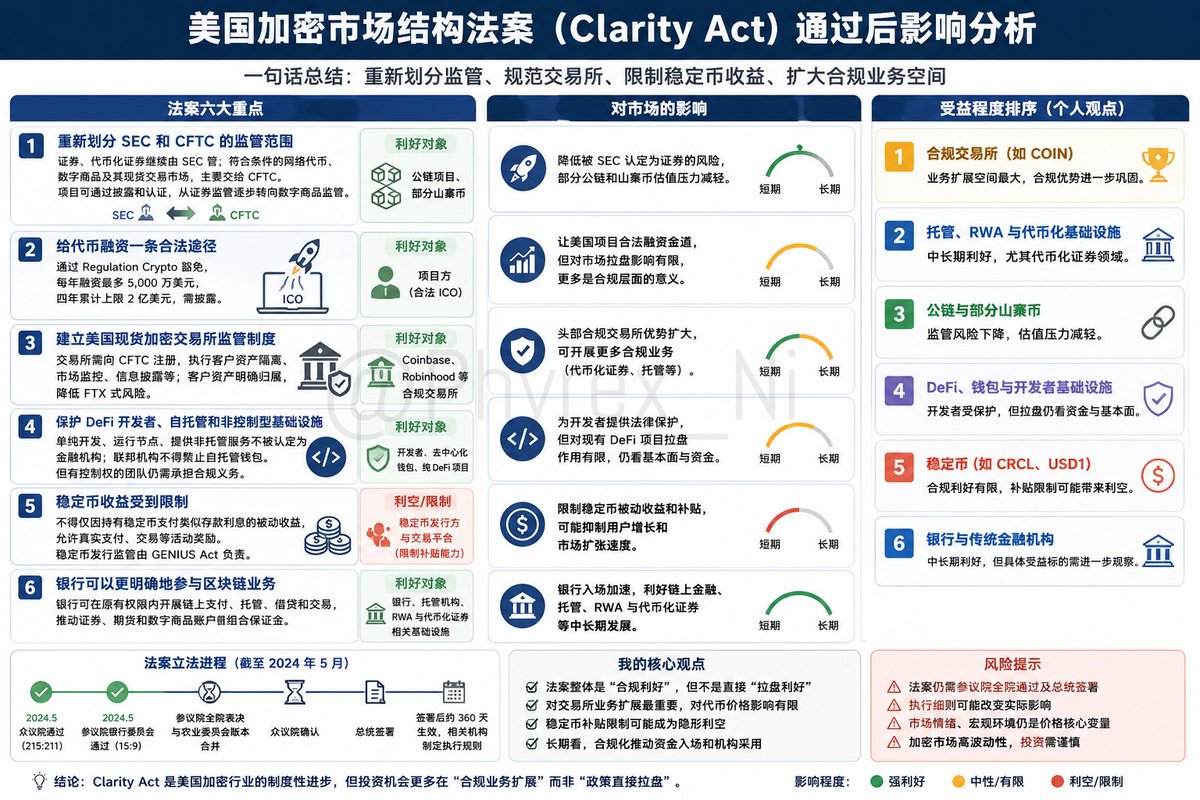
1. Redefining the regulatory scope of the SEC and CFTC
Securities and tokenized securities will continue to be regulated by the SEC, while eligible network tokens, digital goods, and their spot trading markets will mainly be overseen by the CFTC. The Senate version also introduces concepts like "network tokens" and "ancillary assets," allowing projects to demonstrate through disclosure and certification processes that their tokens no longer depend on the project's ongoing operation, gradually shifting from security regulation to digital goods regulation.
In layman's terms, this part is indeed favorable for some "altcoins," especially public chain projects, as they can shift from being regulated by the SEC to being regulated by the CFTC. But does this mean much for a purely "token issuance" project?
2. Providing a legitimate pathway for token financing
Project teams can exempt their offerings under the new Regulation Crypto, raising up to $50 million per year and a cumulative limit of $200 million over four years, provided they submit initial and semi-annual disclosures. This will significantly reduce the risk of US projects being deemed as illegal securities offerings by the SEC when raising funds through tokens.
In simpler terms, this part benefits the legal "ICOs" of projects, but doesn’t fundamentally influence whether the project will pump its coins, nor does it offer substantial benefits to launch platforms because compliant ICO firms are likely to use compliant launch platforms.
3. Establishing a regulatory system for US spot crypto exchanges
Digital goods exchanges, brokers, and market makers must register with the CFTC and implement measures for customer asset segregation, conflict of interest management, market surveillance, information disclosure, anti-money laundering, and sanction compliance. The digital goods held by customers will also be explicitly acknowledged as customer property in case of the exchange's bankruptcy, reducing the risk of asset commingling like the FTX situation.
In layman's terms, this section favors US compliant trading platforms like Coinbase and Robinhood, but the actual impact on Coinbase is quite low since its compliance is already sufficient. All required registrations are completed, and as a public company, the market values performance more, making Coinbase currently the ceiling for crypto exchanges' compliance in the US.
Of course, it’s beneficial for platforms like Coinbase and Robinhood to pursue new business opportunities, such as tokenized securities, indeed allowing for expansion. However, it increases the difficulty for other exchanges or branches aiming to enter or operate in the US market.
4. Protecting DeFi developers, self-custody, and non-controlled infrastructure
Individuals purely developing software, running nodes, validating transactions, or providing non-custodial services will not automatically be classified as securities brokers or money transmitters just because their code is used by others, and federal agencies may not generally prohibit individuals from using self-custody wallets.
However, teams that can freeze users, control protocols, or have special privileges may still be seen as centralized controlling entities and must comply with AML, sanctions, and financial institution obligations.
In layman's terms, this seems favorable for DeFi, but in reality, if it's purely DeFi or decentralized wallets, it’s acceptable. However, if it involves on-chain protocols that could pose money laundering risks, such as the Tornado Cash scenario and many privacy protocols, they will still receive scrutiny.
This favorable aspect can be said to be ignored in the past; now it may likely still be ignored, but the risk has increased and will this become a reason for DeFi projects to pump?
5. Limitations on stablecoin yields
Currently, the biggest controversy in the market revolves around this regulation. Exchanges and service providers are prohibited from paying passive income akin to bank deposit interest merely because users hold stablecoins, though rewards derived from actual payments, trading, or activities are still permitted.
The regulation of stablecoin issuance is mainly overseen by the already passed GENIUS Act, while the CLARITY Act focuses more on the use of stablecoins within trading platforms and the overall market structure.
In simple terms, many believe that the greatest advantage of the Clarity Act post-passage is stablecoins, such as $CRCL or solana:USD1ttGY1N17NEEHLmELoaybftRBUSErhqYiQzvEmuB. However, from the current developments, it appears that the Clarity Act imposes restrictions on stablecoin growth, particularly with regard to previous interest-bearing or subsidy practices, which will likely not be allowed post-enactment.
This means that the 3.5% interest Coinbase offers for USDC and the airdrop to users with USD1, essentially fall under what the Clarity Act prohibits, which is not beneficial for stablecoin development. While it saves some funds, market expansion may face limitations. However, if stablecoins and exchanges can find more suitable ways and bypass the Clarity Act’s subsidy schemes, opportunities may still exist.
Therefore, I personally believe that if the Clarity Act includes restrictions on subsidies for stablecoins, I fail to see any benefits for Circle. If it’s merely about compliance, to be honest, Circle is already sufficiently compliant in the US, facing the same issues as Coinbase; after all, public companies prioritize performance.
6. Banks can more clearly participate in blockchain businesses
Banks, bank holding companies, and credit unions can engage in blockchain payments, custody, lending, and trading within their existing business permissions, while also facilitating combined margin accounts between securities, futures, and digital goods.
In layman's terms, banks may engage in collateral lending for certain cryptocurrencies or tokenized securities, which is indeed favorable and should be good for some bank stocks, though I can't specify which ones will benefit.
That concludes the legislative analysis!
Overall, the US compliant exchanges are the most affected in terms of business operations; the more compliant they are, the greater their advantage in quickly entering new sectors. Therefore, if the Clarity Act is passed, I personally think it will benefit $COIN relatively more. However, some decentralized exchanges may face challenges.
Custody, RWA, and tokenized infrastructure are considered long-term benefits, particularly in the area of tokenized securities, but as discussed, with the compliance of leading exchanges in the US, demand for on-chain RWA or on-chain US stocks will gradually be compressed.
Next, there will be some help for public chain projects; at the very least, they won’t be harshly restrained by the SEC. However, public chains resemble public companies, and just because the SEC is not regulating them doesn’t guarantee price increases; the best example is $ETH. Even after the spot ETF approval and SEC acknowledgment that it’s not a security, it still struggles, meaning while policies may aid growth, their enduring impact remains uncertain.
Regarding DeFi, wallets, and developer infrastructure, there will also be benefits, but I personally feel it targets developers rather than specific fields or projects, especially for DeFi projects where price movements still depend on market manipulation.
As for stablecoins, I believe there might be a small bump for $CRCL upon passage, but it’s purely emotional. In reality, if there are no changes to stablecoin subsidy restrictions, I view the Clarity Act as unfavorable for stablecoins.
That’s all. I welcome discussions, but since it involves CRCL, I want to clarify that this does not represent my bearish stance; I’m merely discussing the matter objectively.
免责声明:本文章仅代表作者个人观点,不代表本平台的立场和观点。本文章仅供信息分享,不构成对任何人的任何投资建议。用户与作者之间的任何争议,与本平台无关。如网页中刊载的文章或图片涉及侵权,请提供相关的权利证明和身份证明发送邮件到support@aicoin.com,本平台相关工作人员将会进行核查。


