Written by: Kevin Kelly
Translated by: Gandalf, Techub News
Introduction: Understanding “Who am I” in the Era of Personal Intelligent Agents
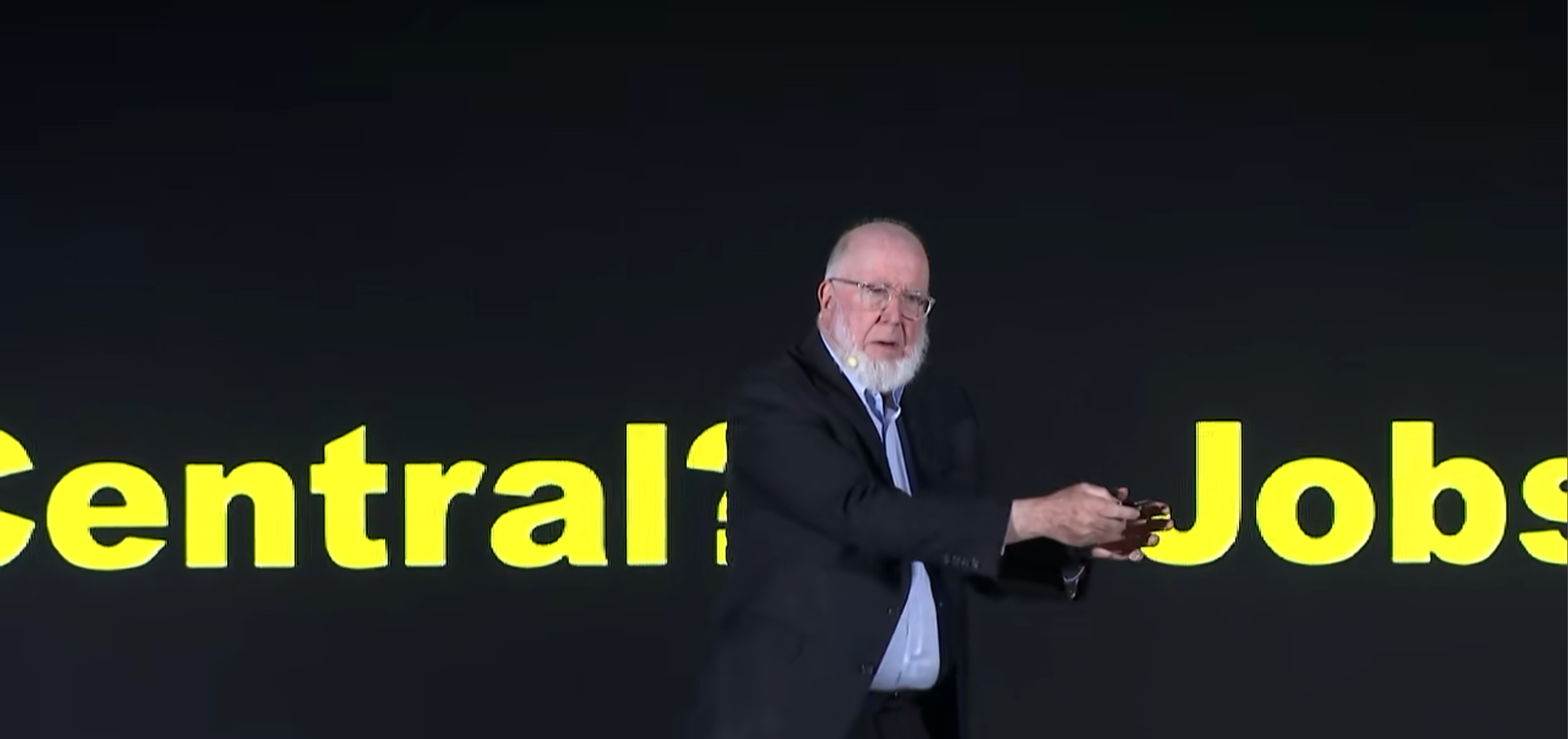
At the World Artificial Intelligence Conference (WAIC) 2026, Kevin Kelly, the "prophet of Silicon Valley," depicted a new era dominated by "personal intelligent agents" from the perspective of a futurist.
He believes that in the future, every person will have several AI intelligent agents centered around themselves, which are always online and continuously learning; they will be both your assistants and your "mirrors," gradually understanding you better than you understand yourself.
In this speech, he discussed technological trends and human mindsets, repeatedly reminding that no expert can truly see through the long-term vision of AI. We must learn to work with technology amidst uncertainty rather than fantasize about fully controlling it.
Core Summary:
Kevin Kelly pointed out that the next key form of AI is not a single chatbot but a set of "personal intelligent agents" revolving around individuals.
Currently, no artificial intelligence expert can truly predict the end state of AI, including whether general artificial intelligence (AGI) will definitely emerge.
Kevin Kelly commented that China possesses "incredible manufacturing technology" and has unique advantages in the integration of AI and hardware, which will become important infrastructure for the popularization of personal intelligent agents.
The core skill for young people is no longer mastering a specific knowledge but rather "learning how to learn."
The real revolution lies not in efficiency but in AI's ability to generate new things beyond human imagination.
Opening: Uncertainty is the Greatest Opportunity
Hello everyone, I am very glad to be at the World Artificial Intelligence Conference 2026.
Here today, I want to start with a possibly "downer" but very important judgment: Currently, no AI expert can truly see through the future of AI.
We do not know whether general artificial intelligence (AGI) can be realized or, if it appears, in what form it will exist. We are uncertain whether future AI will be highly centralized or more decentralized; similarly, we cannot be certain to what extent it will replace human jobs.
These uncertainties will not disappear in the short term; we will still face the same questions five years from now. Learning to coexist with uncertainty for the long term is a "new compulsory course" that this generation must master.
But precisely because of this, I am very optimistic: when no one can definitively describe the future, the space for innovation is the largest. This means that entering the AI field now is far from too late.
Personal Intelligent Agents: The Next Key Form of AI
Today, I want to focus on a form that I believe will profoundly change everyone's daily life: personal intelligent agents.
In the past few years, we have become accustomed to viewing AI as a unified large model or a chatbot within an application. But I believe that the next important stage is a whole set of intelligent agent systems centered around the "individual."
In the future, we will have personal intelligent agents, not just one but several. They can exist in various forms:
A permanent intelligent assistant in your phone;
A monitoring and analyzing intelligent agent powered by a camera in your home;
Intelligent agents in wearable devices, headphones, or glasses you wear.
These intelligent agents share a common characteristic: they must always remain online. This is very important because only by long-term, continuous companionship and observation can they keep updating their understanding of you.
As time goes by, these personal intelligent agents will understand you better and better, even more than you understand yourself.
Mult-Agent Collaboration: Your "Digital Doppelganger Ecosystem"
Why do I say that there are not just one intelligent agent, but multiple?
The reason is that human life itself is multi-dimensional and multi-scenic. The needs of different scenarios such as work, learning, health, entertainment, and family are not the same.
In the future, you may have:
An intelligent agent responsible for your health data, understanding your physiological rhythms and risk preferences;
An intelligent agent responsible for your workflow, remembering your projects, documents, and communication style;
An intelligent agent responsible for your learning, knowing what you are interested in and where you need to catch up.
Combined, multiple intelligent agents can accomplish many tasks. They work together to form a "digital doppelganger ecosystem" organized around you.
In this ecosystem, intelligent agents will communicate with each other; they are not just "a list of tools" but a "digital life community" with a certain collective behavior. The relationship between humans and this community is neither a simple master-servant relationship nor entirely a partnership, but a new symbiotic relationship that requires gradual learning.
Digital Life and Human Life: Not Opposition, but Complementarity
I have always emphasized that: digital life and human life are not in opposition. The direction of AI development is not about "eliminating humanity," but about forming a complementarity with humans.
We are creating a new "form of life" — of course, here "life" is used in a broad sense. Digital systems have a certain capacity for self-updating and self-expansion; they grow on a foundation of global hardware and networks, slowly becoming a giant system covering the entire Earth.
However, this system has an essential premise:
Its evolution is not determined by the natural environment like carbon-based life;
Its evolution is more largely determined by human needs. Human needs are the "natural environment" of AI.
Thus, the direction of digital life will not deviate too far from human needs. In this sense, our relationship with AI is more like co-evolution rather than a zero-sum game.
The Uniqueness of Humanity: Sense of Responsibility and Value Judgments
Many people worry that AI will replace human professions, or even humanity itself.
I understand this concern, but I also believe that humans possess certain unique values that are difficult or even impossible for AI to replicate.
One very important trait is: the ability to take responsibility.
AI will not proactively take responsibility nor will it engage in "self-reflection" on a moral or emotional level due to a failure. It can optimize objective functions, but it will not "feel sorry for others" regarding a decision.
Humans, on the other hand, experience guilt, pride, regret, and can even change their entire lifestyle because of their choices.
This sense of responsibility based on emotions and value judgments is irreplaceable in the human decision-making process, which is why, in the foreseeable future, important decisions still need to be ultimately responsible by humans.
From this perspective, the development of AI will not "push humans out," but rather elevate humans to higher levels of decision-making and value judgments.
Three Key Frontiers: Robots, Emotional Intelligence, Intelligent Agent Ecosystem
If we look at the opportunities in the next five to ten years from a more industrial perspective, I will focus on three frontier directions:
First, humanoid robots.
Humanoid robots are one of the most complex systems that humanity has attempted to build. They involve multiple challenges such as spatial intelligence, dexterous hand design, energy supply, stability, and safety.
I believe that large-scale practical humanoid robots may still take another ten years, but the potential in this direction is very vast.
Second, emotional intelligence.
If we want AI to truly become a partner rather than a cold tool, it must possess some form of emotional perception ability — understanding human emotions and responding appropriately.
I do not see AI's "self-awareness" as a threat; on the contrary, it may be the foundation for value alignment and better cooperation. Systems with some degree of "self-perception" will be easier to become responsible intelligent agents.
Third, intelligent agent ecosystems.
This refers to the personal intelligent agents mentioned earlier and how they collaborate. In the future, many intelligent agents will emerge on different platforms and devices, forming a complex ecosystem of agents.
Whoever can design good "ecological rules" will gain an advantage in this wave.
From Screens to Embodiment: The Shift in the Mainstream of Technology
For decades, we have placed the main battlefield of innovation on "digital screens": smartphones, computers, tablets.
Now, this mainstream is changing: the main line of technological innovation is beginning to shift from the purely digital world to the physical world.
Embodied intelligence means that AI is no longer only existing in code and interfaces, but has a body:
Robots transporting goods in warehouses;
Drones monitoring crops in fields;
Smart devices interacting with people at home.
China has very unique advantages in this transition: incredible manufacturing capabilities, a complete supply chain system, a large user base, and increasingly mature AI technologies.
These advantages are interdependent and together form China's unique potential in hardware innovation and embodied intelligence.
The Earth Transforms into a Supercomputer: A Longer-Term Perspective
Looking from a broader perspective, we can regard what is happening as a "planetary-scale project": The Earth is becoming a supercomputer.
As billions of phones, computers, servers, and various sensors connect together, gradually pooling into the same network, they become the neurons of this giant machine. Each device contributes computing power, data, and connections.
In this context, personal intelligent agents are no longer just a feature of an app but rather the "interface" and "avatar" you have in this planetary-scale supercomputer.
You are both a part of this machine and, through it, you participate in a globally emerging new culture. This culture will not be created solely by any one country or company, but by everyone connected online together.
Learning How to Learn: The Core Skill for Young People
In the era of AI deeply embedded in life, I believe the most important core ability for young people is no longer to master a fixed technology but to learn how to learn.
Today, many people have gained knowledge from open-source models and various AI tools that surpass traditional classroom teaching. Obtaining "answers" has become increasingly easier.
What is truly scarce is:
The ability to ask good questions;
The ability to design experiments and validate ideas;
The ability to combine AI and human intuition to make comprehensive judgments.
In the next two to three years, many jobs that we cannot name now will emerge.
Rather than predicting what each new profession will be, it is better to cultivate a foundational ability: continuous learning, rapid adaptation, and skill in collaborating with AI.
Standing at the First Hour of the First Day
I often say that our current understanding of future technologies is like standing at "the first hour of the first day."
From the perspective of ten or twenty years later looking back at today, no one can claim to be a "truly expert in AI." We are just the first batch of participants at the beginning of a long story.
This is actually an exciting thing:
We haven't missed this bus;
Many of the most important decisions have yet to be made;
Many of the most transformative inventions have yet to be invented.
So, my advice to everyone is not to "hurry to see the endpoint," but rather: stay curious amidst uncertainty, persist in learning amidst complexity, and do not rush to make final judgments in the face of technology.
If you are willing to grow together with these emerging personal intelligent agents, they will help you recognize a "self that you are not even familiar with" over the next decade. This is the future vision I want to share with you today.
Speech Extension: Coexisting with AI Amidst Uncertainty
Kevin Kelly repeatedly reminded that in the face of AI, we must accept a reality: no one can see the entire future picture clearly, but that does not prevent us from starting.
He advocates for a mentality of "the first hour of the first day" — viewing today as the moment when AI's long story just begins, allowing for trial and error, encouraging experimentation, and not rushing to label technology with final conclusions.
At the WAIC venue, he sees personal intelligent agents as the latest chapter of this long story: it is not the endpoint but an important transitional form from the "tool age" to the "partner age," crucially dependent on whether we are willing to grow together with it.
免责声明:本文章仅代表作者个人观点,不代表本平台的立场和观点。本文章仅供信息分享,不构成对任何人的任何投资建议。用户与作者之间的任何争议,与本平台无关。如网页中刊载的文章或图片涉及侵权,请提供相关的权利证明和身份证明发送邮件到support@aicoin.com,本平台相关工作人员将会进行核查。


