Original |Odaily Planet Daily(@OdailyChina)
Author|Golem(@web3_golem)
As the mandatory window period in August approaches, recent discussions about the BIP-110 proposal have become lively.
BIP-110 was proposed by Dathon Ohm in December 2025 and has the support of Bitcoin core developer Luke Dashjr. The proposal aims to restrict arbitrary/non-monetary data in Bitcoin transactions within the next year, mainly targeting large data storage for Ordinals and Bitcoin NFTs, hoping to reduce "garbage transactions" in the network and let Bitcoin focus on its currency function.
The proposal has been controversial since its inception, but from the data perspective, BIP-110 is currently not supported by mainstream miners and nodes. The activation threshold for BIP-110 is 55%, and statistics show that the current miner support rate is less than 1%. Out of a total of 102,674 nodes in the network, only 15,035 nodes are willing to execute BIP-110, accounting for 14.64%.
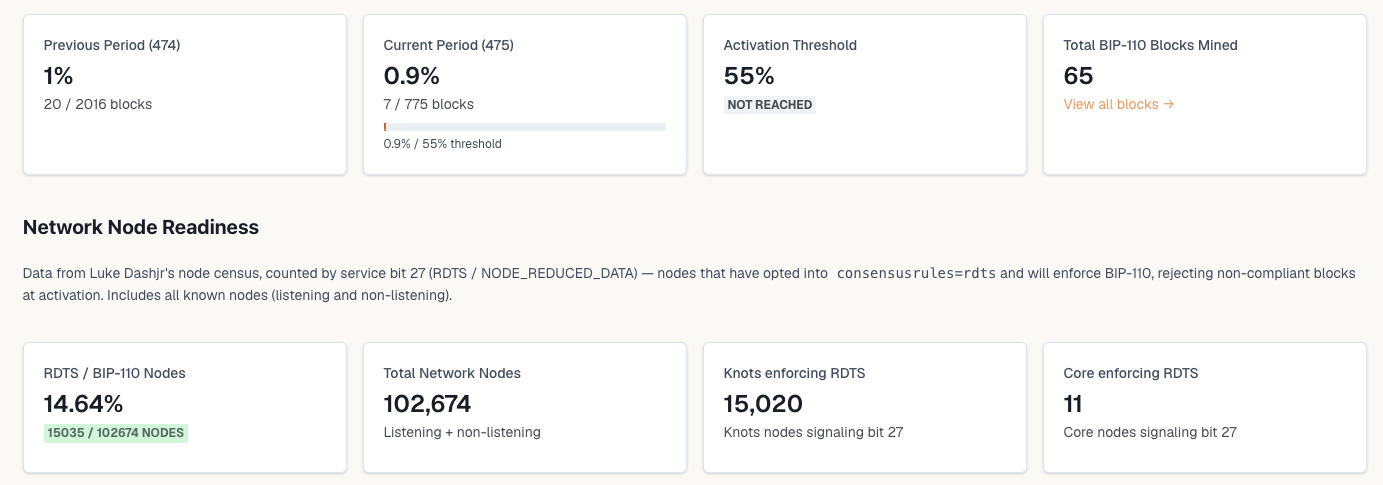
Miner and node support rate for BIP-110
Generally speaking, a proposal with such a low support rate cannot pass on the Bitcoin network, but the bold point of BIP-110 is that even without consensus, nodes supporting BIP-110 will be forced to execute it. If BIP-110 does not reach the 55% activation threshold before the block height reaches 961632, it will enter a mandatory window (block heights 961632-963647), during which nodes running BIP-110 will reject non-compliant blocks, forcibly raising the pass rate to 100%, allowing BIP-110 to be forcibly activated at block height 965664.
According to the current Bitcoin network block generation speed, BIP-110 will enter the mandatory window period at the beginning of August, which means that although BIP-110 is a soft fork proposal, there will be a chain fork in the Bitcoin network at that time (with a minority chain supporting BIP-110 and the main chain not supporting BIP-110).
BIP-110 Controversy
According to Bitcoin's "longest chain principle," only when the actual miner hash power supporting BIP-110 accounts for the majority (>50%) will they become the longest chain, and the entire network will unify under the new rules, meaning a successful soft fork. Therefore, although the outcome of BIP-110 being forcibly activated is already determined, whether it can be sustained ultimately depends on consensus; otherwise, BIP-110 may meet the same fate as the vast majority of Bitcoin soft forks in history: natural death.
Supporters: BIP-110 is not a transformation, but a denial of transformation
The main representatives of the supporters of BIP-110 are Luke Dashjr and his mining pool Ocean. Luke Dashjr has been a radical figure opposing BRC-20 and inscriptions in the Bitcoin developer community for years and has also provided draft suggestions for the BIP-110 proposal.
Luke Dashjr is seen as a representative of Bitcoin fundamentalism; they do not want to see Bitcoin block space used for any purposes other than Bitcoin transfers. The BIP-110 proposal views inscriptions that emerged in 2022 as a form of "Bitcoin attack," since allowing arbitrary data to be embedded in Bitcoin transactions would impose a huge and unnecessary burden on nodes, while this "garbage data" will occupy a significant amount of block space, forcing currency transactions to raise the bidding threshold to get packed into blocks, undermining Bitcoin's monetary purpose.
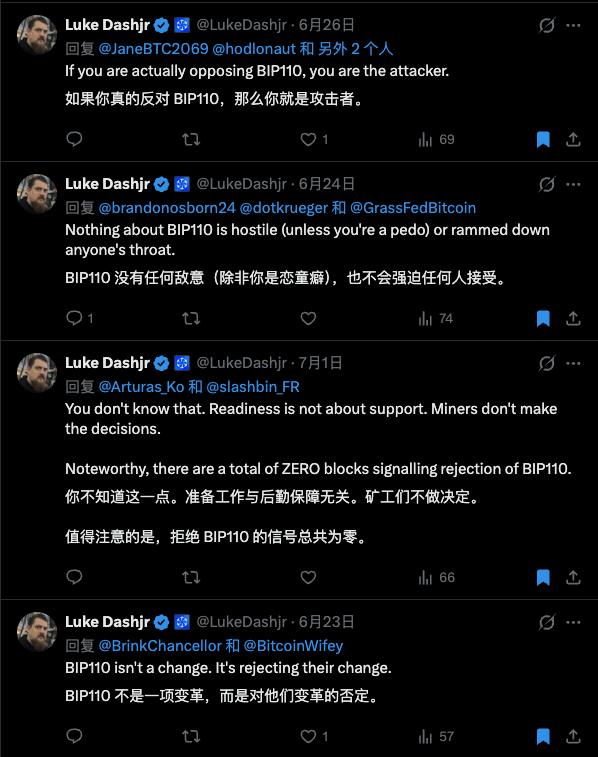
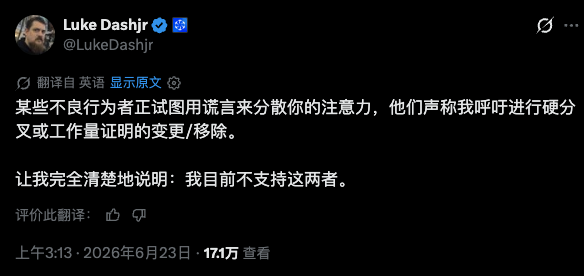
Therefore, Luke Dashjr stated on the X platform that BIP-110 is not a transformation, but a denial of transformation. He also skillfully used sophistry against opponents of BIP-110, at one moment claiming that BIP-110 poses no hostility and does not force anyone to accept it, while at another moment asserting that those who oppose BIP-110 are the real attackers on Bitcoin.
Moreover, although the current voting rate of miners supporting BIP-110 is very low (1%), Luke Dashjr remains optimistic that the voting rate of miners directly opposing BIP-110 is also nearly 0, implying that miners do not make decisions, and once BIP-110 is activated, they will naturally follow.
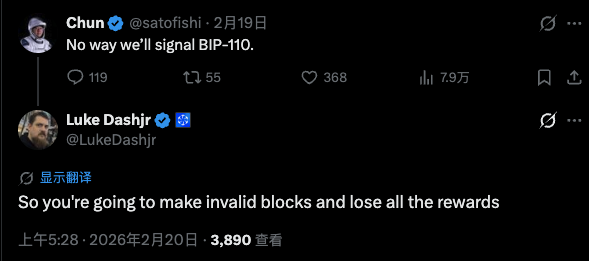
In reality, as of now, the only publicly supportive mining pool for BIP-110 is Luke Dashjr's Ocean. F2Pool co-founder Wang Chun publicly stated in February that he absolutely would not support BIP-110, to which Luke Dashjr confidently replied in his comments, "Then you will mine invalid blocks and lose all rewards."
According to miningradar data, F2Pool is the third-largest Bitcoin mining pool in the network, accounting for 13.6% of the hash rate; while Ocean's current hash rate is only 24.6 EH/S, accounting for 2.6% of the network hash rate.
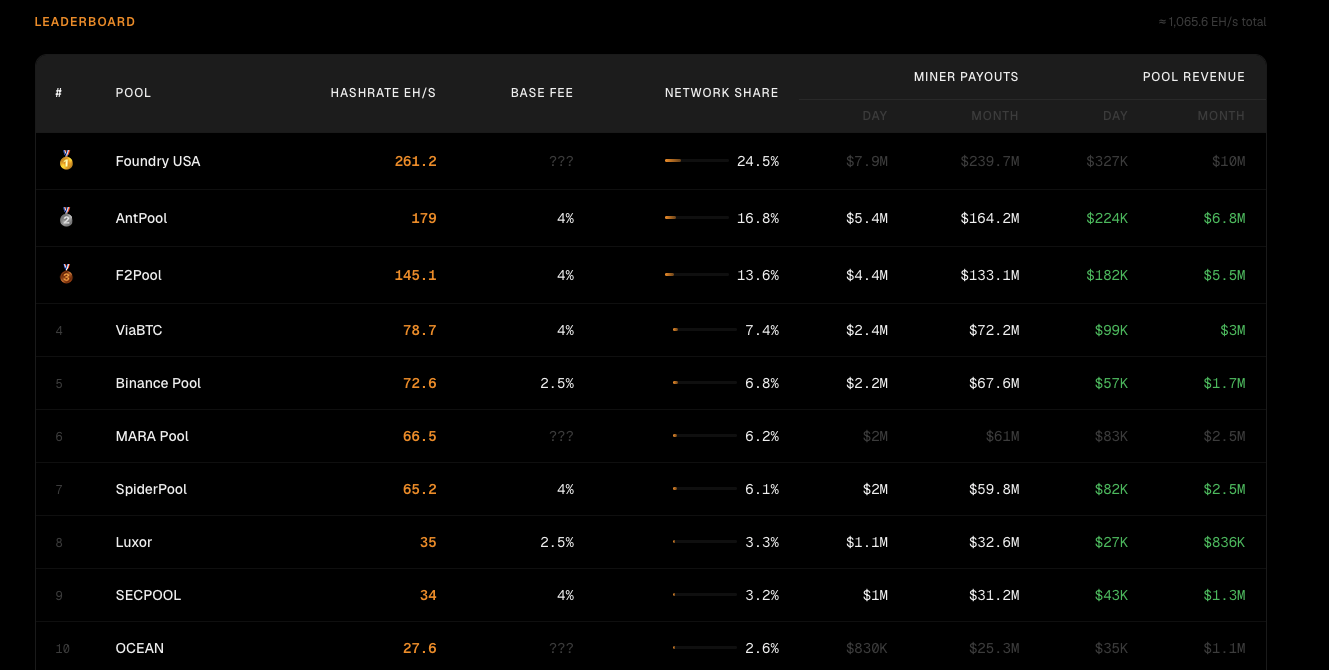
Bitcoin mining pool rankings
If Ocean is ultimately the only mining pool supporting the fork, they will only mine 3-5 blocks a day, and such work efficiency and block generation speed cannot establish them as the "longest chain" on the Bitcoin network.
Opponents: BIP-110 does not solve problems while creating more new problems
The opposition to the BIP-110 proposal does not only focus on whether it will succeed after activation, but rather critiques that it cannot solve the existing “garbage transaction” problem within the Bitcoin network while also creating many potential new issues. In short, the reason the opposition still strongly opposes is due to concerns about many unintended consequences, rather than any affection for Ordinals or inscriptions. The representative figures of the opposition include cryptopunk pioneer Adam Back, Bitcoin core developer Jameson Lopp, and Strategy founder Michael Saylor.
Firstly, the opposition believes that BIP-110 cannot fully solve the "garbage transaction" issue faced by the Bitcoin network, as the author of the BIP-110 proposal has also admitted it can only provide temporary relief. Jameson Lopp believes that the block size limit and the competitive market for block space have somewhat alleviated the garbage transaction issue, but Bitcoin remains a target for various garbage transaction attacks primarily because almost no one is genuinely using the Bitcoin network, and the transaction fees have remained low, hence failing to create enough pressure on transaction fees to suppress the majority of garbage transactions.
At the same time, BIP-110 would kill future innovations of Bitcoin. The BIP-110 proposal has acknowledged that its restrictions on Taproot hinder the realization of advanced features or complex contracts like BitVM on the Bitcoin network. Although BIP-110 is described as a temporary measure for one year, Jameson Lopp believes this is merely a delaying tactic from Luke Dashjr; if these restrictions severely hinder future upgrades to Bitcoin, it could potentially lead to a hard fork instead of a soft fork.
Adam Back focuses even more on Bitcoin’s anti-censorship nature and decentralization spirit. He argues that BIP-110 would subjectively censor transactions in blocks, fundamentally aiming to control others, which contradicts the neutrality and anti-censorship spirit upheld by the Bitcoin network since its inception, representing a dangerous step toward centralization and control. Adam Back uses Bitcoin fundamentalism to negate the extremist's arguments for transformation within Bitcoin, equating to using "magic to defeat magic."
Michael Saylor summarized BIP-110 as the "Bitcoin Iatrogenic Proposal," suggesting that this "treatment plan" itself may harm Bitcoin rather than solve existing problems.
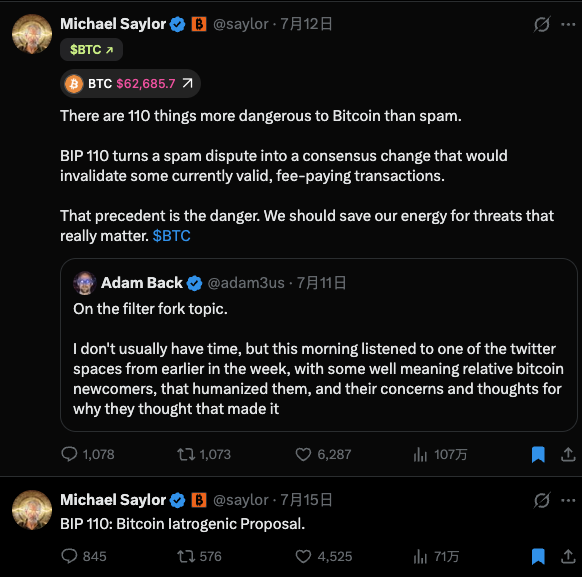
Furthermore, Michael Saylor believes that if BIP-110 becomes consensus, some effective paid transactions will also become invalid, and setting such a precedent for censorship is the real danger.
A major concern for the opponents is the potential split of the Bitcoin chain ecosystem after BIP-110 activation. This would result in two competing chains vying for the status of "real Bitcoin," and in such a scenario, due to the uncertain outcome of the fork, there could arise the risk of double spending in Bitcoin. Even if there’s no double spending, if BIP-110 eventually evolves into a new chain, it would also divide developer resources, hash power, and monetary consensus for Bitcoin.
The opponents believe that BIP-110 is attempting to use technical means to resolve a cultural problem, which if resolved may lead to even more unpredictable issues.
Despite their concerns, the opponents are confident in the failure of BIP-110. Jameson Lopp wagered on BIP-110 back in February, with a minimum stake of 1 BTC, and up to now, no supporters of BIP-110 have publicly accepted the bet.
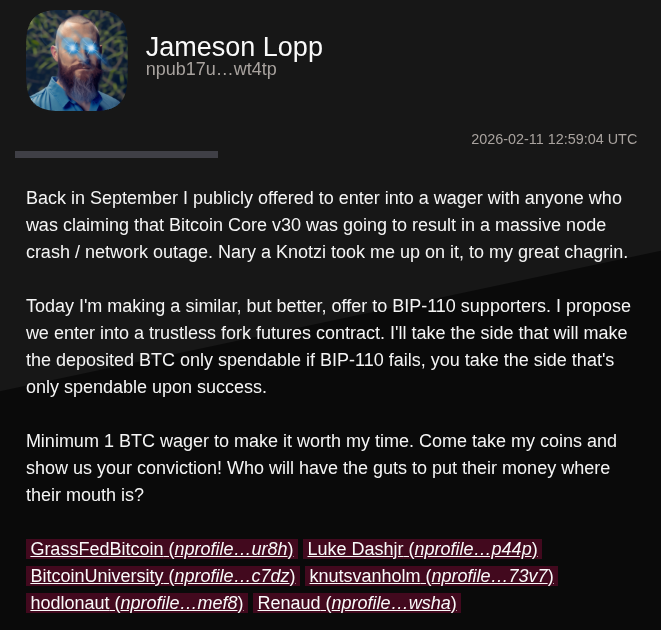
Jameson Lopp's betting invitation to the supporters of BIP-110
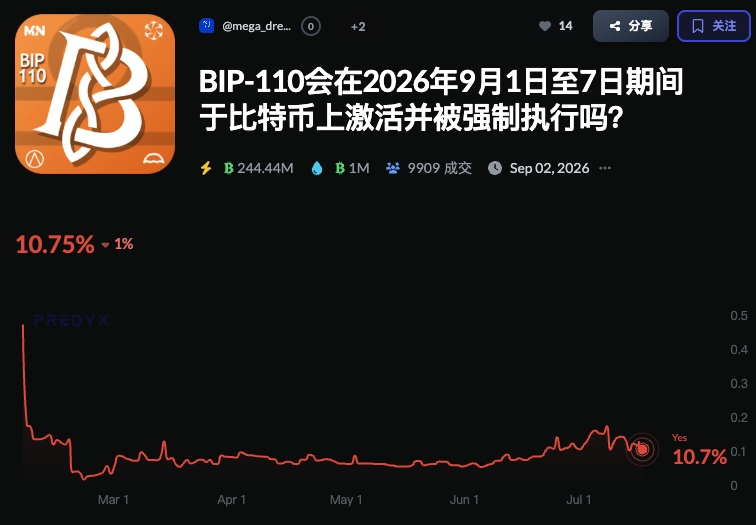
On the prediction market Predyx, the probability that "BIP-110 will be activated and enforced on Bitcoin between September 1 and September 7, 2026" is 10%, and the condition for settlement of "Yes" is that the BIP-110 chain must become the "longest chain of Bitcoin" accepted by the majority of nodes.
What will happen after BIP-110 is activated?
We can now make some hypothetical scenarios of what will happen when BIP-110 is ultimately forcibly activated at block height 965664 (end of August to early September).
The first scenario, as described above, is that after reaching the activation height, BIP-110 nodes reject the main chain blocks, but there is not enough proportion of miners producing new blocks that comply with BIP-110 rules, leading to an extremely slow block generation speed for BIP-110, ultimately ceasing to produce blocks and no longer "growing."
The second scenario is that a certain proportion of miners support BIP-110. The supporters of BIP-110 believe they possess an "asymmetrical advantage" because the rules of BIP-110 are stricter; thus, although BIP-110 nodes will reject blocks containing non-compliant data (inscriptions, etc.), non-BIP-110 nodes (mainstream Core nodes) will regard blocks produced by BIP-110 nodes as valid.
Moreover, currently, the proportion of inscription transactions in the Bitcoin block space has dropped to 5%, with over 95% still being traditional Bitcoin transfer transactions, meaning BIP-110 nodes can still receive a significant amount of mainstream blocks. Therefore, Luke Dashjr believes that BIP-110 will ultimately become the "longest chain" and unify the network.
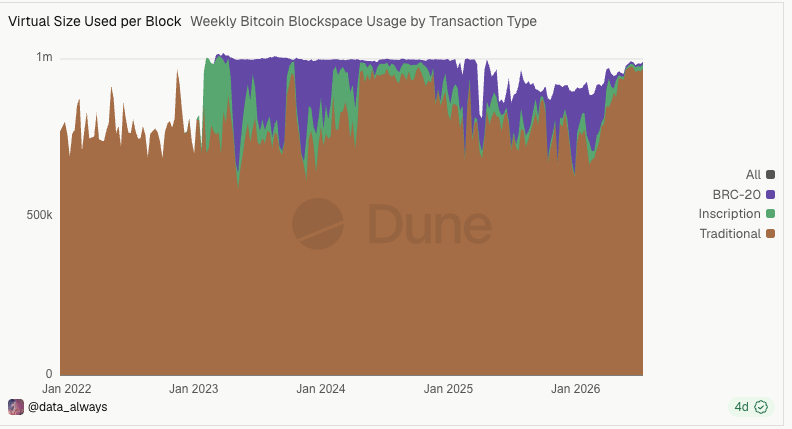
Proportion of different transaction types in Bitcoin's block space
The third scenario is that a certain proportion of miners support BIP-110, but their hash power can never surpass the existing majority chain. Generally, miners are extremely rational; once their machines are turned on, they start incurring electricity costs. In the competition between two chains, miners weigh the pros and cons, making it easier for miners on the BIP-110 chain to abandon their sunk costs (mining rewards on the minority chain) to join the majority chain, as the minority chain not only lags in chain length but also accumulates fewer Bitcoin rewards than the majority chain. Ultimately, this situation would revert back to the first scenario.
So, assuming that Luke Dashjr has a strong calling, and miners remain irrational and insist on mining on the BIP-110 chain, what will happen? This chain would continue to operate independently, but its block times may be very slow, with miners almost completely producing energy for love, leading to meaningless energy consumption. The most reasonable outcome in this scenario is that the BIP-110 chain permanently forks into an independent chain under the supporters of BIP-110, "manually" adjusting the block difficulty and launching a new network token.
However, Luke Dashjr has repeatedly emphasized his rejection of a hard fork for BIP-110, believing it's not yet time to resort to hard fork measures. Water can carry a boat but also capsize it; there’s a fear that at that time, Luke Dashjr may also be swept by the will of the masses, having no choice but to shoot when the arrow is on the bowstring.
Therefore, the minority chain supported by BIP-110 supporters can technically continue to operate, but it is highly unlikely to thrive because it depends on economic and ecological factors, including support from wallets, exchanges, users, etc. There are actually many such examples on the Bitcoin network, with a majority ultimately failing; even if they manage to run successfully, the ceiling is only at independent coins like BCH, BSV, etc.
免责声明:本文章仅代表作者个人观点,不代表本平台的立场和观点。本文章仅供信息分享,不构成对任何人的任何投资建议。用户与作者之间的任何争议,与本平台无关。如网页中刊载的文章或图片涉及侵权,请提供相关的权利证明和身份证明发送邮件到support@aicoin.com,本平台相关工作人员将会进行核查。


