In the early morning yesterday, Base co-founder Jesse Pollak posted a long tweet on X, reflecting on the good and bad aspects of Base's development strategy over the past two years.
This tweet was quite candid for both himself and the public; admitting one's mistakes is not an easy task. Jesse believes that betting on social networking as the main strategy for Base, hoping that the on-chain native social experience would drive the mainstream adoption of both Base and cryptocurrency, was a mistake. However, the other bet, which is that application developers on Base would also promote mainstream adoption by producing good applications, is correct.
Now, he has handed over the Base App (the super application of Base, not the Base chain) to Cobie to manage, allowing himself to return to focusing on the development of the Base chain. From the perspective of an on-chain player, reflecting on some of Jesse's actions over the past two years, I highly affirm the honesty in his "self-criticism," but I also feel that there are aspects of his understanding that are worth discussing.
Betting on Social: 0 Points
The native on-chain social experience does not enhance the mainstream social experience at all; it even complicates social interactions. In fact, I really wish Jesse would analyze in detail in his "self-criticism" what new social enjoyment users can gain from using a completely new social application like Farcaster, what new forms of social content users can access, or what innovative paths for shaping social networks this application offers that would lead him and the entire Base team to feel that this could drive the mainstream adoption of Base by challenging the traditional social media market...
If it were for the ideal of decentralized social networking, this operation might score some points. But if he believes that this could promote mainstream adoption, it can only be rated a solid 0.
Let's look further. In terms of social networking, Jesse also mentioned creator tokens and recently popular $ANSEM on Solana, expressing uncertainty about whether it was the wrong timing for his push on Zora or if the idea of creator tokens was flawed from the beginning.
This understanding also earns 0 points. Firstly, the strong push for the concept of "creator tokens" is rather strange. In the past debate between Jesse and Toly, it was evident that Jesse believed "content" holds value, and individual creators as personal brands have value; therefore, this is different from meme coins, which lack fundamentals, and he wanted to push things with fundamentals.
But who can this logic persuade? After all, Jesse himself issued a $JESSE token, and nearly 240 days later, the situation is as follows:
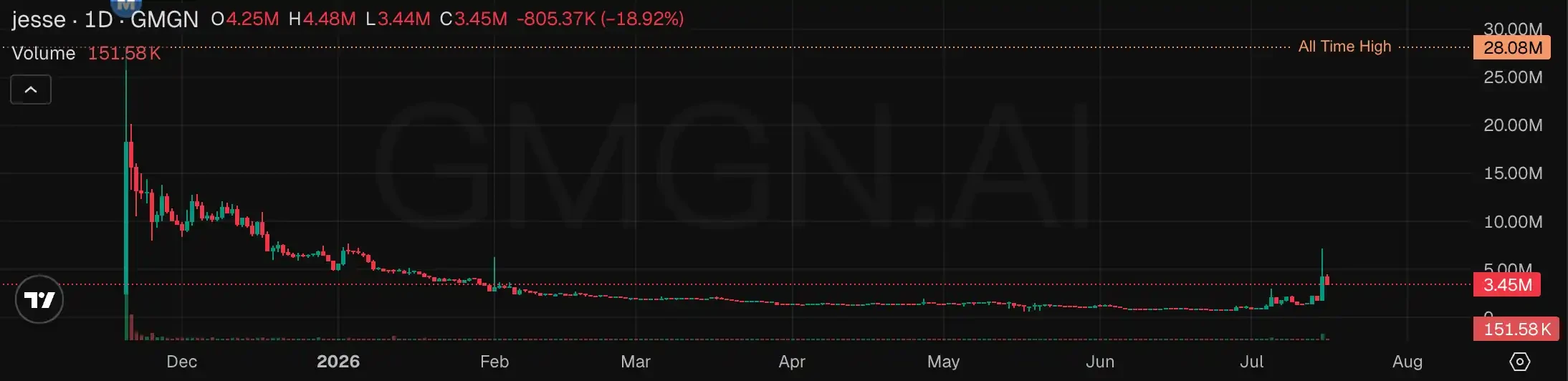
Content and personal IP do have value, but is issuing tokens a unique monetization channel? What caliber of creators can you attract? How can you ensure that the value you emphasize has a logical connection? There are too many problems to solve in between, but the impression Base gives is, "I've set up the stage, and people will start walking."
In this regard, Jesse's understanding is completely outmatched by Toly; at least Toly could say something like, "meme coins are worthless, but mobile game items and skins also lack value, yet people around the world are still willing to spend hundreds of billions of dollars a year on worthless things."
$ANSEM is not the type of "creator token" that Jesse is promoting; it is neither issued by Ansem nor created for monetizing personal IP, making it inconsistent with anything.
In conclusion, Jesse, you really got this wrong in the social aspect, but you haven't figured it out yet. In fact, the best reference sample for doing well in the Crypto + Social area so far should be the social trading application FOMO.
Lagging Behind in Areas such as Perp DEX: 80 Points
In fact, a higher score can be given here. In horizontal comparison, Solana has also failed to demonstrate any strong competitiveness in the areas of Perp DEX and prediction markets compared to Hyperliquid and Polymarket, not performing significantly better than Base.
The reason Jesse feels quite frustrated is, "Because we overbet on social, these two aspects haven't kept up." This is setting expectations a bit too high for oneself; after all, this is a hindsight god's perspective. Hyperliquid is a competitor that has completely understood this track; it has not appeared, and Perp DEX is only at the level of GMX and dYdX. As for the prediction market, Polymarket has a first-mover advantage, which is not a major competitive failure.
Moreover, Base is quite successful in the AI field, boasting not only outstanding achievements but also being a leader in the entire market in on-chain narrative. In specific targets, it has large assets like $vvv that attract the entire market's attention, and platforms like Virtuals of considerable scale. The x402 protocol leads in Agent payments while allowing USDC to become the dominant stablecoin for payments between Agents.
The success of Base in AI narratives also extends to some technology narratives related to AI; for instance, targets in the robotics sector have been performing well, and many of them also appear on Base. In the RWA aspect, before Solana dominated on-chain U.S. stock token spot trading with $SPCX, on-chain players would often think more of Base, such as the $LFI involved in the on-chain trading of property tax liens.
If there is anywhere Jesse has not performed well, I would argue it goes back to the beginning of the article, where he mentions that "betting on application developers on Base would also promote mainstream adoption by producing good applications." In reality, Base’s support for its chain developers is not as good as he claims; from the perspective of on-chain players, choosing targets on Base, seeing whether the project parties and the Base team can have some connection is extremely critical, and one must play within the "circle." The situation where a developer has a moment of inspiration and creates a hot project outside of the tracks valued by Base and quickly gains support from Base is indeed very rare.
At the beginning of this year, developers had already complained about this, “A developer wasted three years on Base”. I believe that not being sufficiently immersed in the developer community and market may be just as powerless in the new narrative sector's innovation competition as being overly focused on the social sector.
Jesse's Reflections: 60 Points
Does cryptocurrency need social networking to promote large-scale adoption at the billion-person level? Jesse used to believe it was absolutely necessary and the only path, but now he thinks stablecoins, prediction markets, Perp DEX, and RWA can all drive adoption; social networking is not the only way to facilitate large-scale adoption.
Thus, he states that Base should focus on winning competitions in trading, payments, and AI Agent in the future, and Base must become an essential part of global financial on-chainization.
Jesse has realized one thing—spending effort to attract users and investing significant resources to champion cryptocurrency evangelism is far less effective than policies that suddenly become favorable or even supportive towards stablecoins, RWA, and prediction markets. No matter how much you promote Bitcoin/stablecoins for real-world payments, you can only reach users with real inflation-hedging needs like those in Venezuela or Africa. This is a national-level orientation, not something that businesses can easily accomplish.
However, the reason I give a passing score is that neither Jesse nor Toly from Solana, nor Ethereum's Vitalik, seem to have recognized that meme coins have been an important path for large-scale adoption over the years.
They have degraded from "I have the mission to actively push cryptocurrencies to capture the world" to "the state-level forces have become friendly; we just need to follow suit." Jesse says he feels that social networking is no longer the only path to large-scale adoption; he still doesn’t understand that cryptocurrency certainly needs word-of-mouth and proactive discussions among billions of people around the world, but this is not something that providing everyone with an on-chain social platform can achieve.
People using Polymarket to bet on World Cup match outcomes won’t discuss what exactly the stablecoins they use for bets are. Similarly, with Agent payments made on-chain to trade U.S. stocks, they won’t care about stablecoins or blockchain either. Years have passed, and the concepts like NFTs and the metaverse that once became popular topics are now likened to how most people despise pump.fun still promoting lottery meme coin get-rich stories, which can once again embed themselves in the public's mind.
Whether it's Jesse, Toly, or recently Robinhood's Vlad, everyone knows that meme coins are a great tool for attracting traffic, but they’re generally used once and discarded. Everyone can say they like memes to be polite, but no one has ever stepped up to guide meme coins into becoming a more standardized industry.
This reflects very smart and rational business awareness and decision-making, but the retreat in idealism and insufficiently grounded thinking about large-scale adoption leads me, from the perspective of a small on-chain player, to ultimately give Jesse a passing grade for his reflections over the past two years.
免责声明:本文章仅代表作者个人观点,不代表本平台的立场和观点。本文章仅供信息分享,不构成对任何人的任何投资建议。用户与作者之间的任何争议,与本平台无关。如网页中刊载的文章或图片涉及侵权,请提供相关的权利证明和身份证明发送邮件到support@aicoin.com,本平台相关工作人员将会进行核查。


