I often say that investment comes from life. In 2024, I invested in Pop Mart with this logic, and now I am investing in Miniso, also following this logic! $MNSO
Not long ago, I was curious about why Duan Yongping invested in Pop Mart. It is said that he certainly did not become the second shareholder of Pop Mart based on the teasing of his "little girlfriend." His thought process must have a deeper meaning, just like in his book "The Great Way: Duan Yongping's Investment Chronicle," where he stated that he understood Apple's business and made the decision to heavily invest after at least 20 years of industry accumulation and thought. As for Pop Mart, there must be a deeper layer to it.
So I specifically studied it, including Wang Ning's book "Because Unique." I won't talk about Pop Mart today, but it gave me a lot of insights about IP and the consumption thoughts of young people in Generation Z.
After researching Pop Mart, my attention naturally shifted to Miniso, because I had experienced the dividend period of Pop Mart, and Miniso's current transformation is quite similar to Pop Mart, but there are also some drawbacks. 🧐
If Pop Mart is the "star-making factory" of the trendy toy industry, then Miniso feels to me more like a landlord that is undergoing a crazy renovation, trying to transform a grocery store into a "theme park."
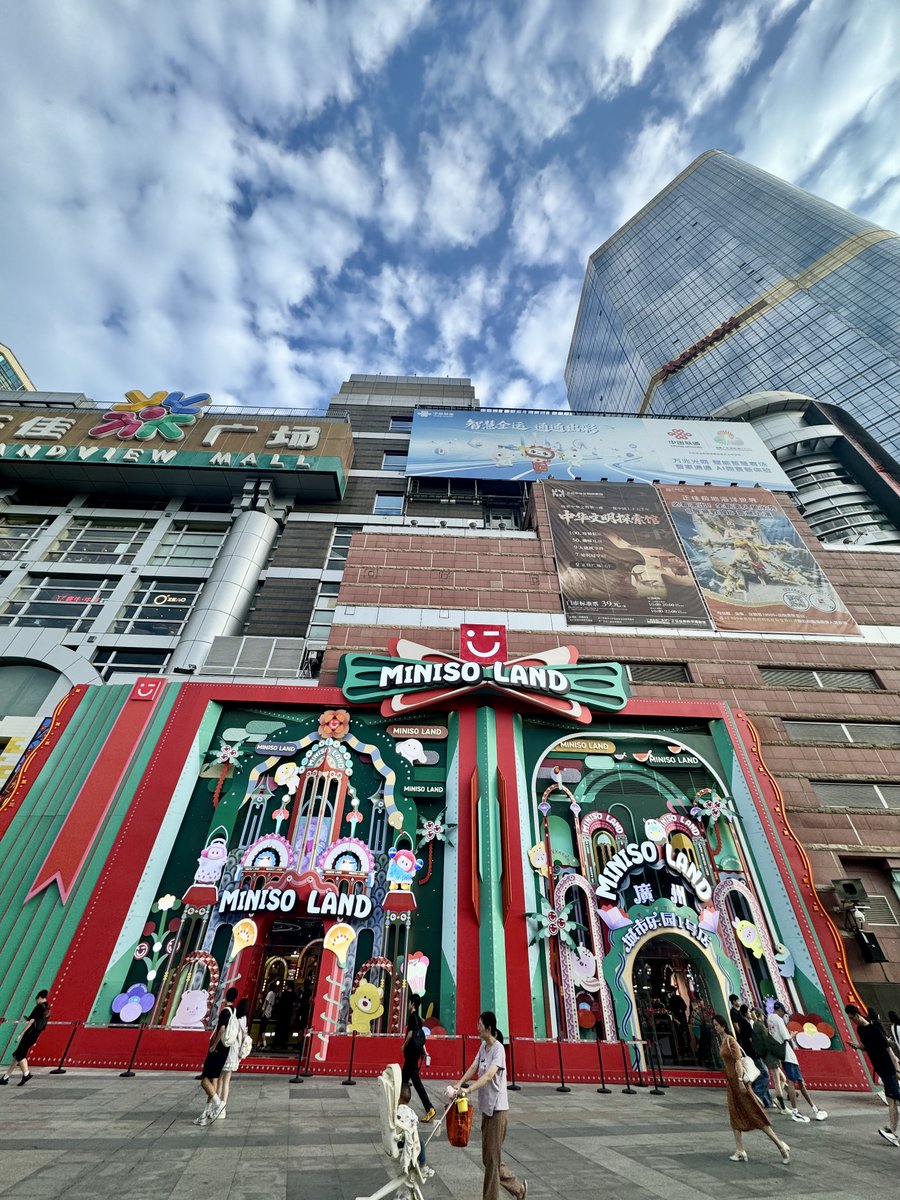
To verify the grand narrative of "the Disney of the IP world" as mentioned by Ye Guofu, I specially visited MINISO LAND on Beijing Road in Guangzhou and Zhengjia MINISO LAND, staying there for an entire day until the mall closed at 10 PM.
To be honest, the site did indeed subvert my cognition. This was no longer the "10 yuan store" I remembered; the store was packed with young people, and the immersive experience was overwhelming. The staff were as enthusiastic as those welcoming guests at an amusement park. From the financial report, this transformation has indeed brought in substantial revenue. The global No. 1 store on East Nanjing Road in Shanghai achieved over 100 million in revenue just nine months after opening, with IP products contributing nearly 80% of the sales.
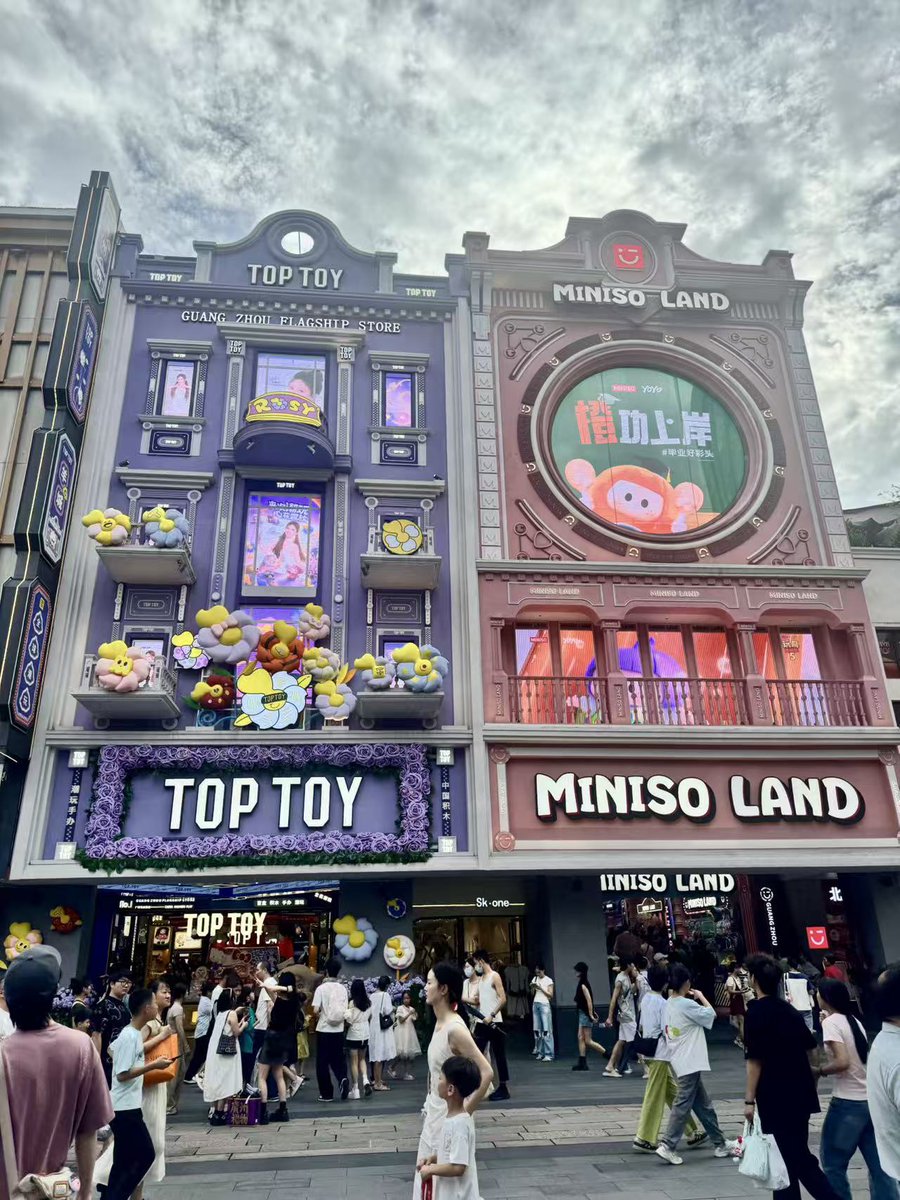
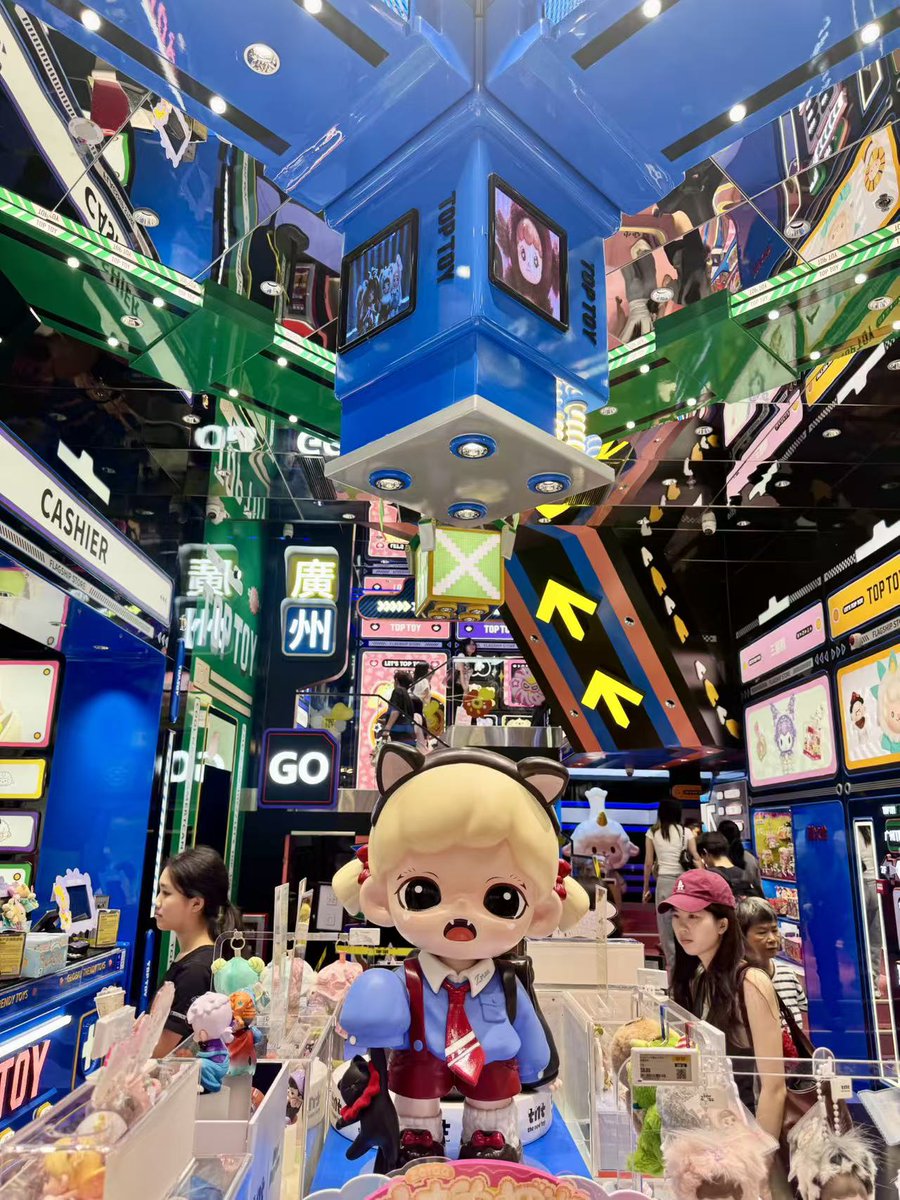
For example, the flagship MINISO LAND on Beijing Road, across two whole buildings and three floors (see image 2, image 1 is Zhengjia), covers nearly 2,000 square meters. As soon as you enter, it feels like you've traveled through time; the highly saturated colors are eye-catching, as if you've entered a virtual scene from "Minecraft." The whole place is a big IP harvesting machine (I heard the design was handled by a top design team from Nanjing Deji Plaza known for the “internet celebrity restroom”).
• Space Design: It no longer categorizes by "cups, stationery, cosmetics" but divides by "Sanrio Area," "Disney Area," "Chiikawa Area." Each IP module has numerous SKUs, and there is always an IP peripheral that can resonate with users, greatly increasing the users' stay time, from the previous 5-10 minutes at the 10 yuan store to an average stay of over 30 minutes, creating the illusion that the store is very lively.
• Visual Impact: A wall of figurines several meters high, densely filled with pink Melody, paired with lights and photo spots, accurately hits the dopamine of young people. There were not only girls on site but also a large number of fans of Animes and foreign tourists, who basically couldn't help but take out their cameras to take pictures. Even if they don't buy anything, sharing creates a viral effect.
• Price Temptation: I casually picked up a Sanrio cooperative mug for 19.9 yuan, while the nearby authorized store might sell it for 69 yuan. There’s also a Disney authorized Winnie the Pooh for only 45, while it's at least over 200 at Hong Kong Disneyland. This gives a sense of satisfaction from "official IP purchase downgrading." At Pop Mart, you might have to spend 69 yuan to “gamble” on a blind box; at MINISO LAND, for the same amount, you could take home a huge Kuromi pillow and a collaborative umbrella. Observing from the cash register, the age group under 20, who are sensitive to prices, are the main consumers, creating a competitive difference from Pop Mart.
Thus, Miniso uses extremely low prices and an efficient supply chain to lower the threshold for young people to consume genuine IP. This approach is indeed effective; both foot traffic and average transaction value have increased, and I believe this will soon be reflected in its financial reports.
Let’s talk about the two sides of the coin of the business model.
Ye Guofu said he wants to become "the Disney of the IP world," but from an investment research perspective, Miniso's essence is not Disney; it is more like an ultimate "supply chain buyer and channel platform."
Its underlying logic is completely different from Pop Mart:
Pop Mart (self-produced IP): Sign artists → Incubate IP → Master absolute pricing power → Earn excess premium on IP (gross margin 70%+)
Miniso (authorized IP): Global supply chain → Acquire major IP authorizations → Rapid mass production industrialization → Earn high turnover under scale effects (gross margin 40%+)
In the world of martial arts, speed is paramount; Miniso’s moat lies in its "speed."
• Absolute Dominance of Supply Chain: Behind it is the most mature small goods manufacturing network in China and even globally. It can shorten the cycle of getting an IP from signing to design, mold opening, mass production, and shelf display to just a few weeks. This "quick response" is something Disney itself cannot achieve.
• High Tolerance of the "Buyer" Model: Unlike Pop Mart, which struggles with the worry of whether the next Molly will succeed. Whatever is popular in the market, they will sign it. If Chiikawa is popular this year, they will do Chiikawa; if Line Friends is popular next year, they will do Line Friends. They are "IP carriers," relying on a diverse brand and IP "big net fishing" strategy to remain evergreen.
But this is also Miniso's biggest pain point; the fate of a "worker under someone else's roof" is also my biggest concern. Next, I will discuss its "IP leasing" model in conjunction with financial data 📊.
The reason Disney and Sanrio can make money effortlessly is that they are the "landlords" of IP, possessing absolute discourse power. Miniso now resembles a "super tenant" with thousands of stores globally. Through a dual-track strategy of "top-level authorization + exclusive contracts," they bring high-profile IPs like Disney, Harry Potter, and Sanrio into the stores. This approach has indeed been effective in the short term, as consumers do not need to establish trust again and will directly purchase when they see a character they like.
However, "rented things" will always have two fatal pain points: one is that they become increasingly expensive, and the other is that they are never under your control.
Looking at the Q1 2026 financial report, this anxiety has already become evident. Although Miniso's total revenue for the quarter increased by 28.5% year-on-year, the adjusted net profit, excluding exchange rate effects, only grew by 8.1%. Revenue surged by nearly 30%, but profit only increased by 8%; where did the money go?
From my observations, a significant portion has been swallowed by the rising growth costs. The authorization fees for that quarter soared by 42.0% year-on-year, while promotion and advertising expenses rose by 73.7%. The essence of this business is to pay rent, acquire licenses, produce products, and earn the price difference. Initially perceived as efficiency, when all consumer brands compete for these popular IPs, the authorization fees will only keep rising, with the copyright owners always holding the initiative.
Another significant challenge is the non-exclusivity of the brands. We can buy Sanrio products at Miniso, but we can also find various authorized products at other grocery stores or even on Taobao and Pinduoduo. Although Miniso tries to enhance the scene through large stores like MINISO LAND, they still cannot prevent consumers from turning to other channels because of "lower prices."
This leads us to an unavoidable comparison target: Pop Mart. Pop Mart is in the "creation" business, while Miniso is in the "rental" business.
Pop Mart's gross margin in 2025 reached 72.1%, while Miniso's gross margin in Q1 2026 has already fallen to 43.3%. This vast profit gap fundamentally distinguishes landlords from tenants. Pop Mart earns brand premium through its own IP, while every time Miniso sells an authorized product, they pay a hefty "toll fee" to the copyright owner.
This extends to the issues of marginal costs and gross margin limits. Pop Mart's IP is its own; as the scale expands, the marginal production cost approaches zero, resulting in continuously rising gross margins. In contrast, the larger Miniso's scale, the higher the total authorization fees it pays to the copyright owners. It is a typical "linear growth" model. Once market competition intensifies or top IPs increase their prices, like Disney reclaiming licenses or raising commission rates, Miniso's profit margins will be severely squeezed.
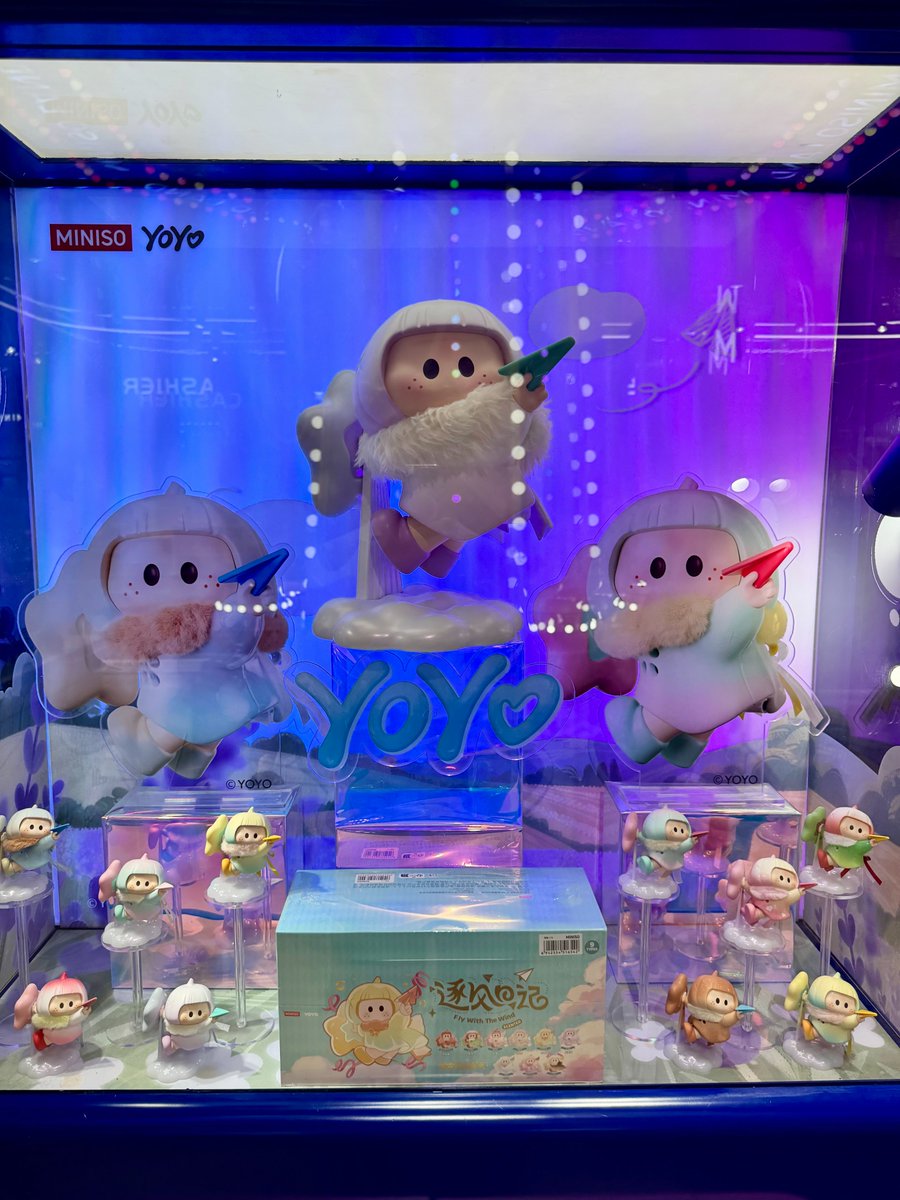
Ye Guofu is clearly aware of this issue; he repeatedly emphasizes that self-owned IP is Miniso's "chip." Miniso is also making efforts, such as signing trendy toy artists and launching self-owned IPs like "YOYO," which achieved over 100 million in revenue in June, reflecting high popularity and adorableness (see image below 👇).
However, the proportion of self-owned IP is still too low; in Q1 2026, the revenue share from self-owned IP indeed increased from 0.5% to 5.7%. But there is still a significant gap to support the profit structure. Compared to Pop Mart's terrifying revenue of 14.16 billion for a single IP, LABUBU, in 2025, Miniso's annual sales of 40 million for its self-owned IP currently look like just a drop in the bucket.
Deeper issues lie in that Miniso is fundamentally still based on the "fast turnover logic" of retail, not "long-termism of IP." It attempts to quickly filter IPs using store sales data, allocate additional resources to successful ones, and inefficiently eliminate those that do not perform well. However, true IP requires emotional core and long-term content operation. A recent example is the wildly popular WAKUKU, which quickly exploded due to celebrity endorsement and channel distribution but rapidly cooled off after peaking; it neither formed stable revenue nor enhanced IP brand strength. This "short-term explosive strength with weak long-term stickiness" reflects the lack of a moat for self-owned IP.
Finally, I will share my conclusion. Overall, it is very challenging for Ye Guofu to create a Chinese Disney, but he has indeed triumphed in making the traditional business of "retail" reach a certain extreme. Additionally, the company is quite competent; yesterday, I conducted a valuation assessment and concluded that it is worth at least 40-50 billion Hong Kong dollars, while currently only at 30 billion, with substantial room for growth. Additionally, there is a 5% dividend, which is also quite attractive.
From a business model perspective, Pop Mart is certainly superior and has deeper barriers. However, with a market value already exceeding 220 billion, new IPs seem to have entered a bottleneck period. Today, Wang Ning led a team to discuss with Apple's CEO Cook, and the offerings also included LABUBU, without any new IP.
Pop Mart engages in the business of "emotional derivatives," selling addiction based on attachments and human nature. Miniso, on the other hand, deals in "high-cost-performance IP lifestyle goods," selling "using the least money to get genuine small happiness in life."
From an investment perspective, Miniso's future valuation ceiling does not depend on how many MINISO LAND stores it opens or how many new IP collaborations it has.
The true winning edge lies in whether it can utilize its vast channel and financial advantages to genuinely cultivate two to three self-owned IPs with global recognition like "Dundun Chicken" and "YOYO" that do not require payment of authorization fees. If this step can be successfully achieved, it will truly have the capital to challenge Pop Mart.
However, based on my understanding of founder Ye Guofu, his business execution capabilities and supply chain integration abilities, along with his track record of successful multiple ventures from "Aiya Ya" to "Miniso," and now the upgrade and transformation of the "big store model," alongside the performance of offline physical stores, I still have a lot of confidence in this transformation of MINISO and have also invested a certain amount of funds into its stock. 🧐
DYOR🙏
免责声明:本文章仅代表作者个人观点,不代表本平台的立场和观点。本文章仅供信息分享,不构成对任何人的任何投资建议。用户与作者之间的任何争议,与本平台无关。如网页中刊载的文章或图片涉及侵权,请提供相关的权利证明和身份证明发送邮件到support@aicoin.com,本平台相关工作人员将会进行核查。


