Original | Odaily Planet Daily (@OdailyChina)
Author|Azuma (@azuma_eth)

If you were to ask what the most talked-about concept in the global capital markets this year is, the answer would undoubtedly be storage.
As the infrastructure for AI continues to be developed, HBM (High Bandwidth Memory) is in short supply. The three major memory manufacturers, SK Hynix, Samsung, and Micron, have become the focal point of market enthusiasm, with a surge of investment driving their stock prices to soar. Even after experiencing a significant recent correction, the annual increase remains quite dramatic.
When a stock continues to rise, there are always some in the market who feel “it’s not rising fast enough,” and thus, a relatively niche product has rapidly entered the sight of investors — Single Stock Leveraged ETF. Unlike traditional ETFs that track a basket of stocks or indexes, these products only track a single stock and use derivatives like swaps and futures to amplify the daily fluctuations of the stock by 2 times or even 3 times. In other words, if the underlying stock rises by 10% on a given day, a corresponding 2x leveraged ETF would theoretically rise by about 20%; conversely, if the stock falls by 10%, the product would also lose about 20%.
Because of this, Single Stock Leveraged ETFs are becoming a new tool for an increasing number of aggressive investors to bet on hot AI stocks. Since the beginning of this year, as speculative funds seek to magnify profits through AI and storage trends, the scale of Single Stock Leveraged ETFs launched around popular AI concept companies like SK Hynix continues to expand.
However, what many investors overlook is that the other side of amplified returns is that risks are also magnified by the same multiples — in extreme market conditions, while the underlying stock may rebound, the Single Stock Leveraged ETF may not even have the opportunity to wait for a rebound.
Vivid Case: The Delisting Journey of a 2x Leveraged ETF
Don't think this is an exaggeration; a case that occurred in U.S. stocks the night before is enough to reveal how dangerous Single Stock Leveraged ETFs can be.
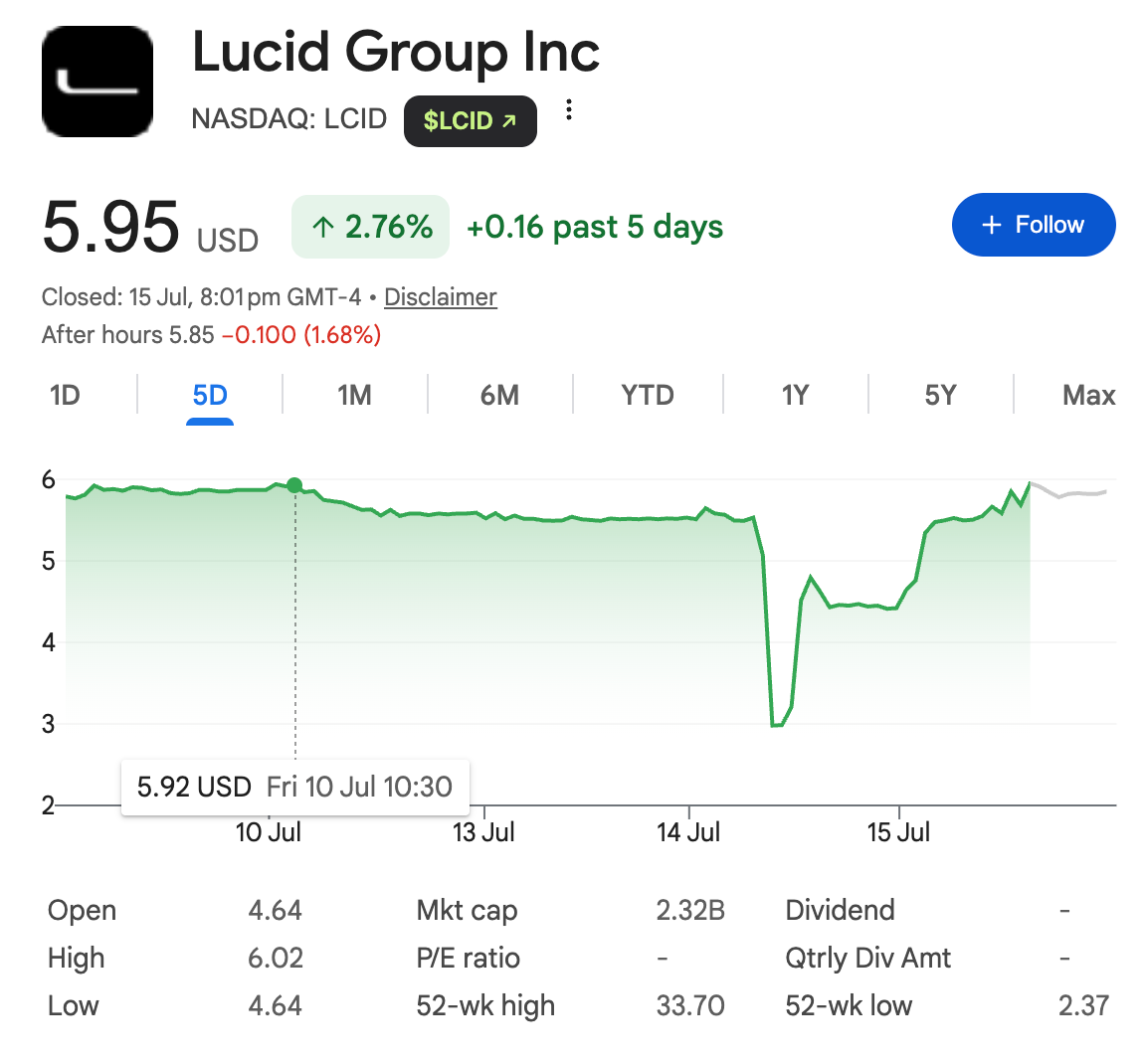
The above image shows the recent stock price trend of the American electric vehicle manufacturer Lucid (LUID). On July 14 local time, rumors suddenly surfaced during U.S. trading hours that Lucid was considering filing for bankruptcy. As a result of this negative news, LUID's stock price plummeted by as much as 57%, triggering circuit breakers multiple times and creating the largest intraday drop since its listing.
However, the plot quickly turned around. Lucid subsequently issued a statement indicating that the company had indeed hired a consulting firm, AlixPartners, to conduct a comprehensive review of its operations to optimize operations, reduce costs, and promote the development of new vehicle models, and that the rumor about filing for bankruptcy was “completely unfounded.” Lucid also emphasized that it currently has sufficient liquidity to support operations until next year, and AlixPartners was solely responsible for operational optimization and had not made any bankruptcy recommendations to the management or board.
As Lucid quickly debunked the rumors, market sentiment rapidly recovered, and Lucid's stock price rebounded from its intraday low, ultimately closing with a drop of about 16%. For investors holding Lucid stock, this felt more like a thrilling “roller coaster” ride.
However, for another group of investors, the story ended at the moment of the drastic decline.
During Lucid's plummet, the 2x long ETF tracking its stock performance — GraniteShares 2x Long LCID Daily ETF (LCDL) — directly faced a liquidation event. The fund manager, GraniteShares, subsequently announced that the fund had cleared all LCID holdings on that day due to its net asset value dropping to a negative number, and it would officially begin the delisting process.
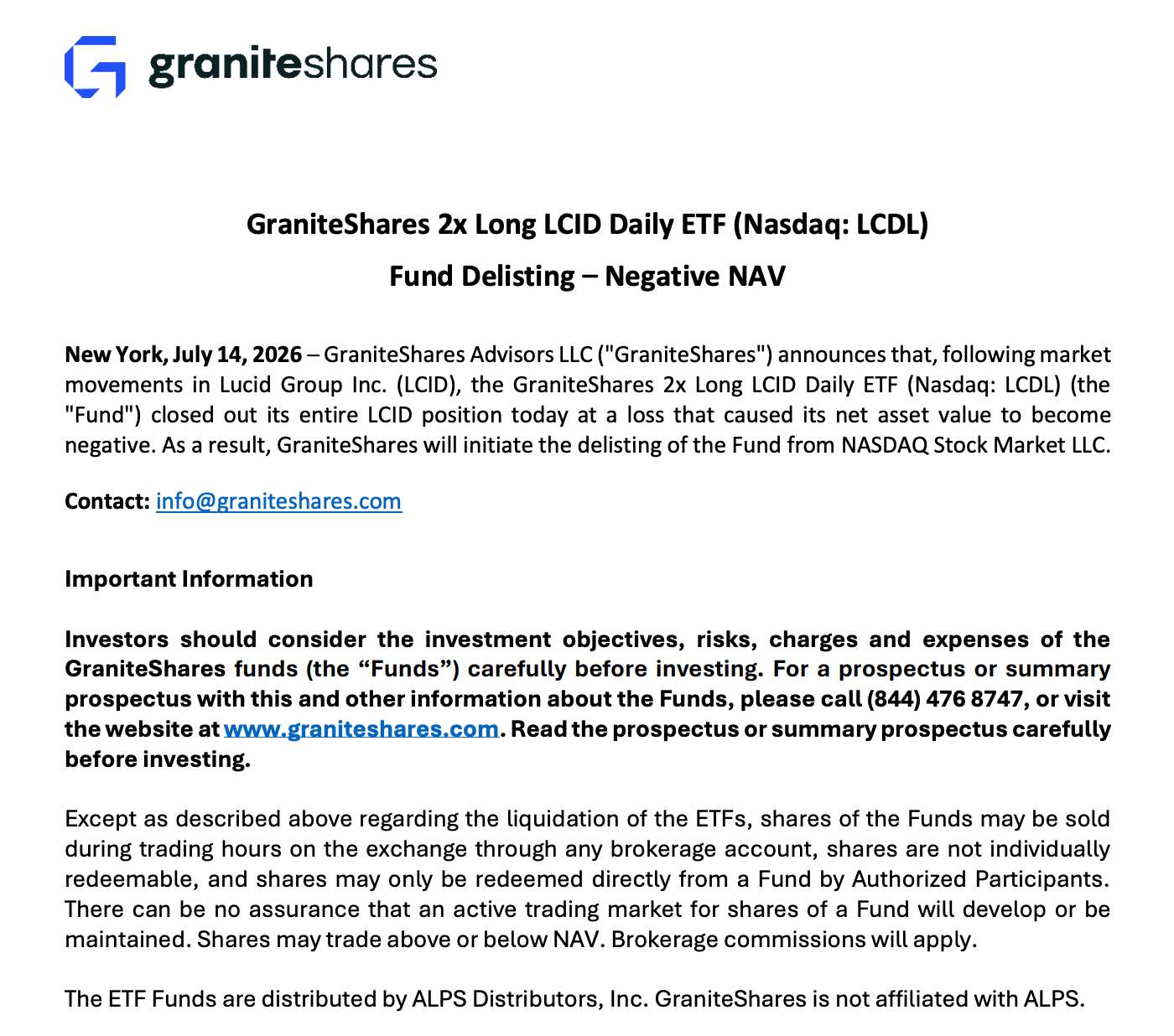
This means that when Lucid's stock price quickly rebounded later, this ETF had no positions left to recover its net asset value. For all users of LCDL, there was no longer any opportunity to participate in subsequent increases of LCID.
This highlights the biggest difference between Single Stock Leveraged ETFs and regular stocks. Even if a stock encounters a sharp decline, as long as the company still exists, investors still have the opportunity to wait for a rebound; but if a Single Stock Leveraged ETF "triggers a death mechanism" during extreme volatility, even if the underlying stock later recovers, investors may never see that day.
Social Issues Rise, the South Korean Government Starts to Be Alarmed
The delisting of LCDL is by no means an isolated case. In fact, as Single Stock Leveraged ETFs rapidly proliferate among hot AI stocks, regulatory bodies have begun to reassess the systemic risks these products may pose.
The stance of South Korea is particularly representative.
In mid-July, according to The Korea Times, the Ministry of Finance, the Financial Services Commission, the Financial Supervisory Service, and the Bank of Korea, four major financial departments, will hold a special meeting under the government’s macroeconomic and financial coordinating mechanism (F4) to discuss the risks and regulatory measures of Single Stock Leveraged ETFs. The discussions in the market include increasing margin requirements, limiting daily price fluctuations, and reducing leverage ratios.
In recent years, as retail investors in South Korea have continued to flood into the stock market, the AI trend has almost transformed into a nationwide investment frenzy among South Koreans. Major stocks like Samsung Electronics and SK Hynix have become the focuses of capital pursuit, while leveraged ETFs launched around these stocks have further amplified market sentiment and stock price volatility. The regulators’ concern is that as more and more investors start to use high-leverage products to chase popular stocks, the impact of a dramatic volatility would no longer just be a numerical change in investment accounts but could further evolve into social issues.
As the storage concept is under pressure and correcting, several extreme events have occurred in South Korea's capital market. On one hand, there have been rumors on social media of suicide incidents triggered by failed stock investments; The Chosun Ilbo reported yesterday that a YouTuber with a stock investment channel was stabbed multiple times by a man in his twenties on the street, with initial police investigations indicating that the suspect was a subscriber of that channel, who suffered significant losses due to stock recommendations by the blogger, leading to resentment and the attack.
Although the above incidents were not directly caused by Single Stock Leveraged ETFs, for regulators, the signals they send are highly consistent — when high-risk investment tools continuously lower the participation threshold and overlap with social media, live stock recommendations, and other dissemination channels, financial risks may eventually spill over into social risks.
For the South Korean government, this is the most frightening scenario.
免责声明:本文章仅代表作者个人观点,不代表本平台的立场和观点。本文章仅供信息分享,不构成对任何人的任何投资建议。用户与作者之间的任何争议,与本平台无关。如网页中刊载的文章或图片涉及侵权,请提供相关的权利证明和身份证明发送邮件到support@aicoin.com,本平台相关工作人员将会进行核查。


