Last year, there was a time when the market was circulating rumors that Sun Yuchen bought a power plant in Norway.
To find his logic, I went back through his previous Youtube videos and found him saying this, "If you missed Nvidia, keep watching, for example, electricity, nuclear fusion." Later he made it clearer, saying the end of AI is energy, and nuclear fusion is a long-term direction worth watching in the AI era.
At that time, the term "nuclear fusion" felt too distant, and the AI market was not as vibrant as it is now; it seemed the market did not care.
On July 14, Asia's richest man, Masayoshi Son, talked about AI, and he didn't start with chips. He also talked about nuclear fusion.
The SoftBank founder said that within fifteen years, nuclear fusion could power AI data centers, gradually replacing natural gas. He famously wasn’t worried about the “AI bubble,” and advised Japan not to watch this wave from the sidelines.
Two people, separated by completely different businesses and contexts, were both looking at the same machine that does not yet exist from the perspective merely accessible to ordinary people.
Data centers lack electricity.
Nuclear fusion hasn't generated power yet, but General Fusion has already surged
On July 13, Canadian fusion company General Fusion went public on NASDAQ through a merger with a SPAC, stock code GFUZ. It became the world's first publicly listed pure fusion energy company.
On its first day of trading, the stock price surged at one point and closed up approximately 38%.
General Fusion has about 150 million dollars in cash, and the company expects this amount is sufficient to support operations until 2028. They hope to build their first commercial fusion reactor by around 2035.
In other words, what the market traded that day was not a power station that has already generated electricity.
It was a ticket for nine years later.
The business of fusion has a brutal aspect. The progress of scientific experiments can be measured in seconds of plasma stability, a materials test, or a device parameter; the capital market doesn’t have such patience. It always needs to ask, when can electricity be sold, who will buy it, and can the accounts be settled.
In the past, fusion companies often gave very grand answers.
Clean energy. Man-made sun. Infinite fuel. The ultimate energy for humanity.
All these words are correct, but they are too far from the balance sheet.
Now someone has supplemented it with a more mundane statement.
AI companies need electricity.
Thus, a company planning to build a commercial reactor by 2035 also suddenly had a visible future customer image. Not some vague utility company, but rows of AI data centers that have already burned money to build, waiting to connect to power.
The attitude of money changes quickly.
According to the latest statistics from the Fusion Industry Association, new investments in the global fusion industry reached 4.48 billion dollars in the past year, setting a record. This figure reflects the industry's own criteria and cannot be treated as evidence that fusion has already won.
But it at least indicates one thing.
Suddenly, there were more people willing to pay a deposit for "distant electricity."
By the time X-energy went public, the market had already changed its algorithm
General Fusion is just the furthest ticket.
The nearer ticket is X-energy.
This advanced nuclear energy company attempted to go public via SPAC in 2023 but didn’t succeed. At that time, people looked at it much like they would at someone claiming they were going to build a rocket. The project was huge, the timeline long, and the financial statements were laid out on the table that no one could overlook.
Three years later, X-energy came back with an IPO.
In April of this year, the company raised approximately 1.02 billion dollars, with an implied valuation of around 9.1 billion dollars, and its stock closed up about 27% on the first day. It expects a revenue of about 109 million dollars in 2025, with a net loss of about 390 million dollars.
Looking strictly at these figures, they aren't very appealing.
But it also has Amazon.
The collaboration between Amazon and X-energy aims to participate in deploying up to 5GW of small modular reactor capacity by 2039.
It’s not just Amazon; Google has also reached out to Kairos Power to secure a spot for nuclear power.
These collaborations are still far from actual power plants being built. Approvals may delay, projects may change, and options do not equal revenue. Whoever takes these as future revenues might easily regard a reservation as an invoice.
But in capital markets, reservation slips have their own value.
Stretch the timeline, and you’ll find that the nuclear energy sector has seen a wave of public listings in a short time. Oklo, Terra Innovatum, Terrestrial Energy, and X-energy sent reactor developers to the exchange; Eagle Energy Metals capitalized uranium mines and small reactor technology together; Standard Nuclear led the market to pursue TRISO fuel. General Fusion and TAE also brought the furthest fusion stories to the public market's doorstep.
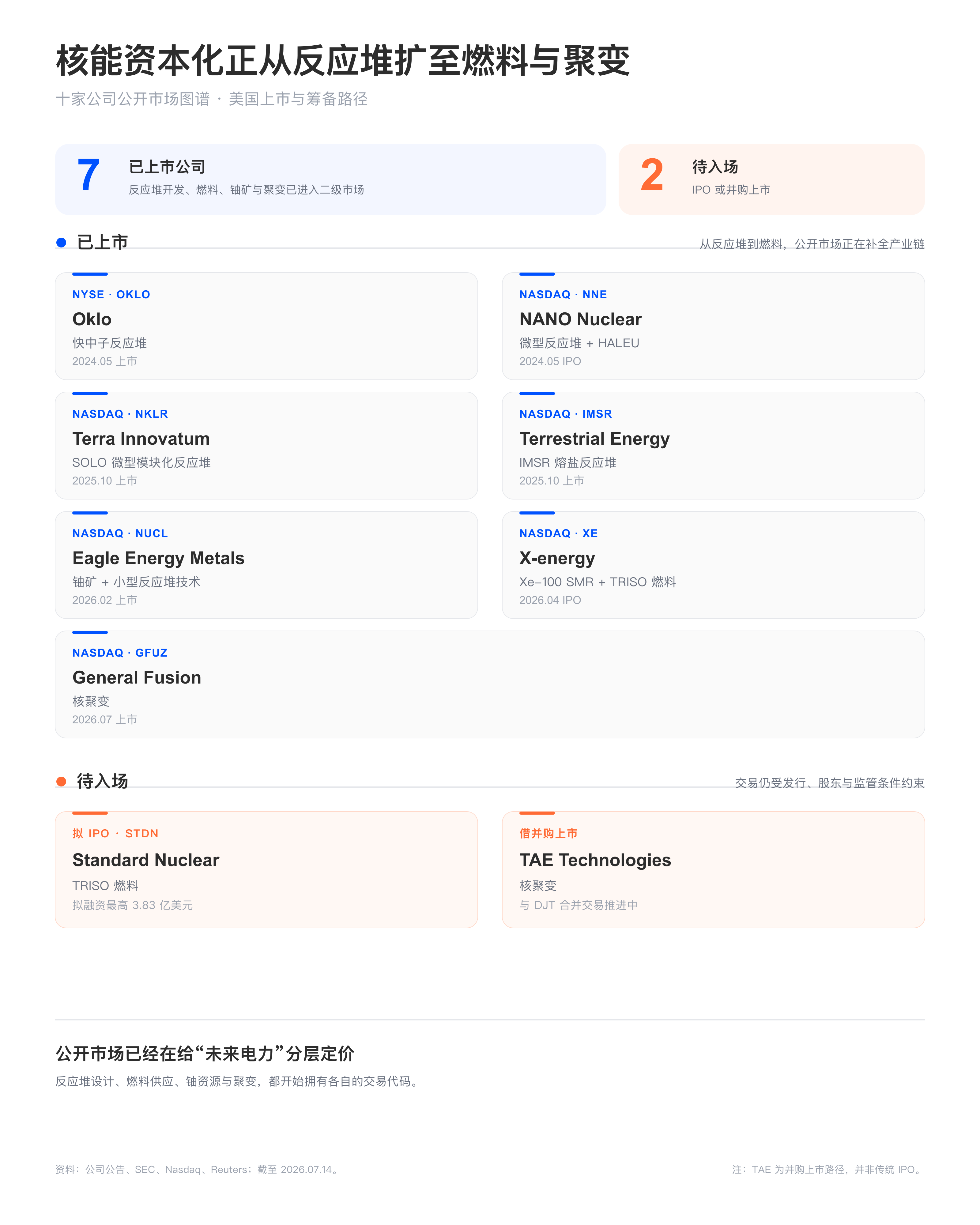
In the past, nuclear energy companies sold low carbon, stability, and energy security.
Today, they are starting to sell another thing.
The qualifications for computational power expansion.
First secure the electricity, then continue to pack chips into the data center
Why would data centers bring such a slow technology to the forefront?
Because no matter how expensive chips are, they can still be ordered.
Not so for electricity.
Servers can be procured in advance, delivered to the site, and stored in warehouses. If GPUs are insufficient, Nvidia can expand production, AMD can catch up, and customers can upgrade. Electricity does not work that way. It must first have power generation, then transmission, then substations, and finally local governments, regulatory bodies, power grid companies, and communities must nod bit by bit.
AI companies fear not high electricity prices.
What they fear is that the data center is built, but the electricity cannot be connected.
A large data center park runs day and night, machines heat up, and cooling systems also heat up. During model training, thousands of chips work simultaneously. You can’t tell customers, the wind is light today, let’s have the model answer questions tomorrow.
Wind and solar energy are certainly important, but they always depend on the weather. Gas units are flexible but bring old issues of fuel, emissions, and supply. Large traditional nuclear power plants are stable, but their construction periods can last long enough to drive internet companies crazy.
SMR, or small modular reactors, happen to fit in the middle.
It promises to shrink nuclear power plants, standardize them more, deploy part first, and then gradually expand. This promise has yet to be tested by large-scale commercial operation but aligns well with the temperament of data centers.
They are unwilling to wait for a giant power station to finish construction.
They are willing to reserve a spot first.
Long-term procurement agreements penned by tech giants like Amazon and Google essentially queue them up in front of future electricity windows. They are not just buying a certain amount of electricity but are leaving a socket for their future expansion.
This brings more to nuclear energy companies than a technical white paper.
Data centers chase the problem all the way to the mines
When the matter of "wanting electricity" was first placed on the table, capital first focused on reactors.
Companies like Oklo, X-energy, Terrestrial Energy, and Terra Innovatum were pushed to the front. They all sell a new generation of reactors still on the road. Some produce fast neutron reactors, some create molten salt reactors, and some work on SMRs.
SMRs are small modular reactors. They break down large nuclear power plants that could only be built at a city level into smaller, repeatable manufacturing equipment that can be deployed in batches. Data centers like this approach because they also do not wish to wait for a giant power plant to slowly grow.
But once a reactor is truly listed in the project schedule, problems begin to cascade down.
What does this machine consume?
X-energy's Xe-100 requires TRISO fuel. TRISO sounds like a laboratory acronym; it can be understood as a micro nuclear fuel particle covered by several layers of ceramic materials. It must withstand high temperatures and stay inside the reactor long enough. No matter how beautifully the reactor’s design is depicted, without this type of fuel, it can only remain in the computer. That’s what Standard Nuclear does.
Thus, Standard Nuclear prepares for an IPO, and it is no longer just a standalone story of a fuel company.
The product it sells is unremarkable. There's no spotlight from a reactor launch event, no massive orders from data centers, and no grand talk like Masayoshi Son’s fifteen-year plan. But when the market begins to believe that advanced reactors will be built, everyone will eventually have to ask who can deliver fuel on time.
Looking further upstream, fuel itself can also become a bottleneck.
Some advanced reactors require HALEU, or High-Assay Low-Enriched Uranium. Its concentration is higher than the fuel commonly used in traditional nuclear power plants but much lower than weapon-grade materials. The name is long, but the logic is not complicated. New machinery requires a different specification of oil, which is absent from the old tank, and there aren’t many factories producing this oil.
Companies like Centrus have thus regained focus.
The problems haven’t stopped.
Where does HALEU come from? Where does uranium come from? Therefore, companies like Eagle Energy Metals, which hold both uranium mine assets and small reactor technology, can also enter the public market along the same line. The mines, which were originally furthest from AI, have been illuminated by the electricity anxiety of data centers.
This wave of listings isn’t a sudden collective love of Wall Street by the nuclear industry.
It’s more like data centers laid an electricity order on the table and then traced back from this order. First, they query who can build reactors. After those are built, they check who has the fuel. If there isn’t enough fuel, they check who can enrich uranium and who has mines.
Every step upstream will encounter something that can't be solved by overtime.
Approvals can be expedited. Models can be iterated. Servers can be procured additionally. Fuel production lines and uranium mines don’t respond to these things.
So the current market no longer just asks which company has a good reactor plan. They begin to ask which link could delay this reactor from generating electricity for a year.
After 1973, oil was no longer just oil
Before the 1973 oil crisis, oil was already very important.
Cars rely on it, factories rely on it, planes rely on it. But what truly made governments suddenly anxious was not that everyone discovered this one year that oil could burn, but that they realized they had almost no control over a long supply chain.
Oil wells are far away. Tankers are at sea. Pipelines cross borders. Prices are set by others.
Since then, oil was no longer just a commodity. It intertwined with diplomacy, reserves, wars, and industrial policy.
AI is making electricity follow a similar path.
Electricity used to be too ordinary. Plug it in, and the light turns on, computers run. Because it was so ordinary, people seldom seriously thought about where it came from.
Until a group of companies began planning to multiply computing power by tenfold, a hundredfold.
That’s when they discovered electricity also has geographical locations, queue orders, and construction cycles. It’s not just a socket on the wall, but a path that needs to be reserved years in advance.
Masayoshi Son talks about fifteen years, Sun Yuchen mentions nuclear fusion as the next stop, General Fusion's stock skyrockets on its first day, and X-energy presents its losses and large valuations before the market.
Bringing these matters together does not prove that fusion has arrived.
They merely demonstrate that more and more people are beginning to worry about whether they will still get a spot when it really does arrive.
免责声明:本文章仅代表作者个人观点,不代表本平台的立场和观点。本文章仅供信息分享,不构成对任何人的任何投资建议。用户与作者之间的任何争议,与本平台无关。如网页中刊载的文章或图片涉及侵权,请提供相关的权利证明和身份证明发送邮件到support@aicoin.com,本平台相关工作人员将会进行核查。


