Original |Odaily Planet Daily(@OdailyChina)
Author|Golem(@web3_golem)
On July 14, a community user discovered that the Coinbase platform has quietly opened user registration for Mandarin-speaking regions—without needing proof of overseas address, users can successfully register using their Chinese mainland ID card and mobile phone number, with the entire review process taking less than a minute. As of the time of writing, the registration channel has not yet been closed.
According to the Q1 2026 financial report, Coinbase's global share of the cryptocurrency trading market is 8.6% (not including the Mandarin-speaking market). Coinbase had previously adopted a restrictive attitude towards KYC for Chinese users, briefly opening registration for Chinese users in April 2025, where users could register successfully with a Chinese passport + Hong Kong address or other overseas proof, but those accounts were quickly banned on a large scale.
Therefore, July 14 can be seen as the first genuine opening of registration for users from the mainland by Coinbase. Coinbase has not yet issued any statements or explanations regarding this, but the market has interpreted it as an important signal of Coinbase's acceleration into the international market. According to Gate's US stock data, Coinbase’s (COIN) stock price rose 2.62% on July 14, with a pre-market increase of 0.74% today.
Facing Performance Pressures, Coinbase Targets Chinese Users
According to statistics from the National Cryptocurrency Association (NCA), the United States is the leading regional market in the global cryptocurrency trading share; as of 2026, approximately 67 million American adults hold cryptocurrency, accounting for about 25% of the adult population in the United States. Although it is difficult to provide precise statistics, Chinese users and the Mandarin-speaking market are undoubtedly also among the top three in the global regional cryptocurrency trading market, with mainstream exchanges like Binance and OKX considering the Mandarin-speaking market as a primary target.
The once "proud" Coinbase has now quietly opened its doors to Chinese users, and this shift is not sudden; the reason has long been marked in every previous financial report.
Coinbase has reported net losses for two consecutive quarters, with a net loss of $666.7 million in Q4 2025 and a net loss of $394.1 million in Q1 2026. Coinbase attributed the main reasons for the losses in Q1 2026 to the weak cryptocurrency market, but looking at a longer timeline, it is evident that Coinbase's revenue has been declining since 2025.
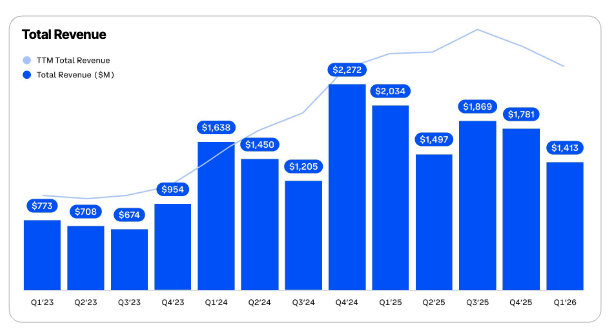
Coinbase's Quarterly Revenue
Coinbase's main source of income still comes from trading brokerage, with retail trading revenue contributing 80% of the total income. Since 2025, Coinbase's trading brokerage revenue has shown a declining trend, particularly in retail trading revenue, which represents a substantial portion of the income: in Q1 2025, retail contributed $1.096 billion in trading revenue, while in Q1 2026, it dropped to only $567 million, a year-on-year decline of 48.2%.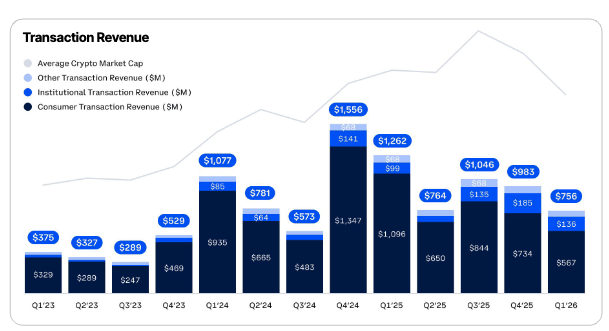
Coinbase's Quarterly Trading Revenue
The downturn in the cryptocurrency market and the sluggish trading volume from users is only one reason for Coinbase's decline in retail trading revenue; another reason is the intensified competition in the domestic market and user attrition.
Coinbase's monopoly established in the US market through its "compliance brand" has long been lost with the maturation of US regulation, with over 10 exchanges obtaining licenses to provide cryptocurrency trading services to US users, such as Robinhood, Kraken, and Binance.US. Moreover, these exchanges universally charge lower fees than Coinbase, and with safety and trust no longer being industry barriers, retail users naturally prefer platforms with lower fees. 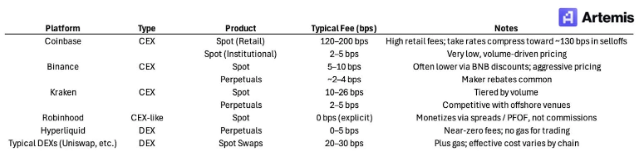
Fee Rates Charged by Different Exchanges
Under such pressure, Coinbase has begun to vigorously develop business beyond cryptocurrency spot trading, such as derivatives trading, prediction markets, and tokenized stocks, attempting to repackage itself as an "everything exchange." Whether these businesses can shake up the status of cryptocurrency spot trading in Coinbase's revenue can only be answered after the Q2 2026 financial report is released.
Faced with performance pressures, Coinbase, this stubborn donkey, has finally come to realize: since you all come to the US to steal my users, why shouldn't I also go out and explore? After all, there is only incremental growth outside of the US. Therefore, Coinbase has its sights set directly on the Mandarin-speaking market, which ranks among the top three in global cryptocurrency trading market share.
Coinbase's opening of KYC for Chinese users also exploits a loophole in US law.
Crypto KOL Phyrex (X: @PhyrexNi) stated that Coinbase cannot provide services to countries and regions prohibited by the US OFAC, and China is not on the list, so providing services to Chinese users is not illegal in the US. However, for Chinese users, Coinbase's operations in China are not compliant, and even cryptocurrency trading itself is in a gray area; should a dispute arise between Chinese users and the Coinbase platform, in the worst-case scenario, not only might US law fail to protect Chinese users, but Chinese law may not protect them either.
Coinbase Only Has Advantages in the US
Aside from compliance issues, from a product usage perspective, most Mandarin-speaking users have already lost their enchantment with Coinbase, as it has advantages only in the US, and there are too many choices for crypto users on the international stage. To put it more bluntly, registering with Coinbase now is basically useless, and most users rushing to register are driven by the mindset of "better to have than not."
From 2021 to 2024, Coinbase indeed had a listing effect. When Coinbase announced support for and launched a certain token, that token often experienced significant short-term price increases, as seen with LINK, POL, and AAVE after their listings on Coinbase.
At that time, Coinbase was still the largest compliant exchange in the US, with extremely strict listings, launching only a few dozen projects a year. This meant that millions of American investors and institutions could only buy coins through Coinbase compliantly. Thus, listing on Coinbase equated to the entry of new demand, and the listing effect became significantly pronounced.
However, with recent years seeing the relaxation of US cryptocurrency regulations and investors having more purchasing channels, including various traditional brokerages and DEX, Coinbase's "gatekeeping role" in the US cryptocurrency market has weakened, and the listing effect has naturally disappeared.
Coinbase CEO Brian Armstrong once stated emphatically during the Q1 earnings call, “Customers choose us not because we have the lowest fees, but because we can provide products that meet their needs.” So let's set aside the point of Coinbase's high fees for retail transactions (up to 1.2%); from a product and usage perspective, Coinbase not only lacks differentiation but also fails to meet the needs of Chinese users.
Firstly, although Coinbase has opened KYC for Chinese users, it cannot support fiat currency deposits and withdrawals, a limitation that is enough to deter most people. Secondly, from the recently popular tokenized US stocks perspective, while Coinbase claims to focus on the development of this business, in terms of supported categories and market share, it is far behind Binance's bStocks and Hyperliquid—today, Hyperliquid even launched pre-market contracts for A-share Changxin Storage. Furthermore, Coinbase's product experience and support in Meme, prediction markets, and other areas do not have obvious advantages.
Nowadays, Coinbase can only be described as "expensive and useless," and to truly tap into the Mandarin-speaking market, beyond quietly relaxing registration, it also needs corresponding exclusive new activity or to provide other wealth effects; otherwise, it will really go unnoticed.
免责声明:本文章仅代表作者个人观点,不代表本平台的立场和观点。本文章仅供信息分享,不构成对任何人的任何投资建议。用户与作者之间的任何争议,与本平台无关。如网页中刊载的文章或图片涉及侵权,请提供相关的权利证明和身份证明发送邮件到support@aicoin.com,本平台相关工作人员将会进行核查。


