Original | Odaily Planet Daily ( @OdailyChina )
Author | Asher ( @Asher_ 0210 )
The hottest token issuance platform on Robinhood Chain, NOXA, suddenly announced the suspension of its token issuance business during peak traffic periods.
For more than ten days, NOXA almost monopolized the meme popularity of Robinhood Chain, with the platform issuing approximately 60,000 tokens in total, once accounting for over 75% of the entire chain's new token issuance. It also launched a meme coin, CASHCAT, which reached a market value of over $200 million. Additionally, NOXA's cumulative protocol fees briefly exceeded $14.5 million, with several consecutive days before the outage having daily fees even surpassing Pump.fun.
However, this explosion lasted less than two weeks, and NOXA quietly exited due to ownership disputes. Who can take over from NOXA and become the next leading token issuer under the Robinhood Chain ecosystem?
From temporary suspension to no recovery, what exactly happened at NOXA?
On July 11, NOXA officially announced a suspension of new token issuance, claiming the platform faced a large number of bots issuing tokens in bulk, copying popular projects, and undergoing vamp attacks, causing severe overload in the number of new tokens. At that time, the market generally believed this was just a temporary adjustment.
Subsequently, the NOXA website experienced two days of continuous outages. The official explanation stated that the traditional domain was affected by Cloudflare and IP issues, and the team was testing a new entry based on ENS. Historical tokens could still be traded on Uniswap, and creators could continue to receive fees.
However, the page that was relaunched last night made things far from an ordinary technical failure. NOXA only restored a static entry for viewing historical tokens, trading, and receiving creator fees; the new token issuance function was not restored. Meanwhile, the transaction fees generated from historical tokens were adjusted to be 100% allocated to creators. This means that while NOXA has not completely shut down, it has stopped the most core token issuance business, effectively exiting the competition of the Robinhood Chain token issuance platform.
As a result, the community began to describe NOXA as "running away." However, as of the time of publication, there is no chain evidence indicating that NOXA has withdrawn locked historical LPs, transferred user custody assets, or exhibited clear on-chain theft behavior. More accurately, NOXA appears to have suddenly stopped its core business during peak traffic, rather than disappearing after siphoning off assets.
From the team's background, NOXA's sudden halt in its token issuance business is not entirely without signs. Its publicly leading developer, Amun Phantom, is anonymous, and has previously participated continuously in new chain projects such as Monad, Plasma, MegaETH, resembling a serial entrepreneur chasing new chain windows: skilled in quickly launching products in the early stages of the ecosystem and seizing initial traffic, but whether it can sustain operations after the hype wanes remains unproven.
NOXA has fallen, but the issuance volume on Robinhood Chain has reached a new high
After NOXA paused its token issuance, the issuance frenzy on Robinhood Chain did not cool down.
Dune data shows that on July 12, the total token issuance on the entire chain briefly fell but rebounded rapidly just one day later: on July 13, 19,586 Meme tokens were created in a single day, second only to Solana; on July 14, it further broke through 31,000, reaching a new high since the mainnet launch of Robinhood Chain.
The issuance of new tokens on Robinhood Chain was quickly diverted to other token issuance platforms. Currently, there are over 20 launchpads on Robinhood Chain. Platforms issuing more than 1,000 tokens in a single day include Flap, trench.today, Bankr, and Klik; at the same time, products like Virtuals, Clanker, and Bankr, originally active in Base, have also entered Robinhood Chain through cross-chain deployments or external entry points.
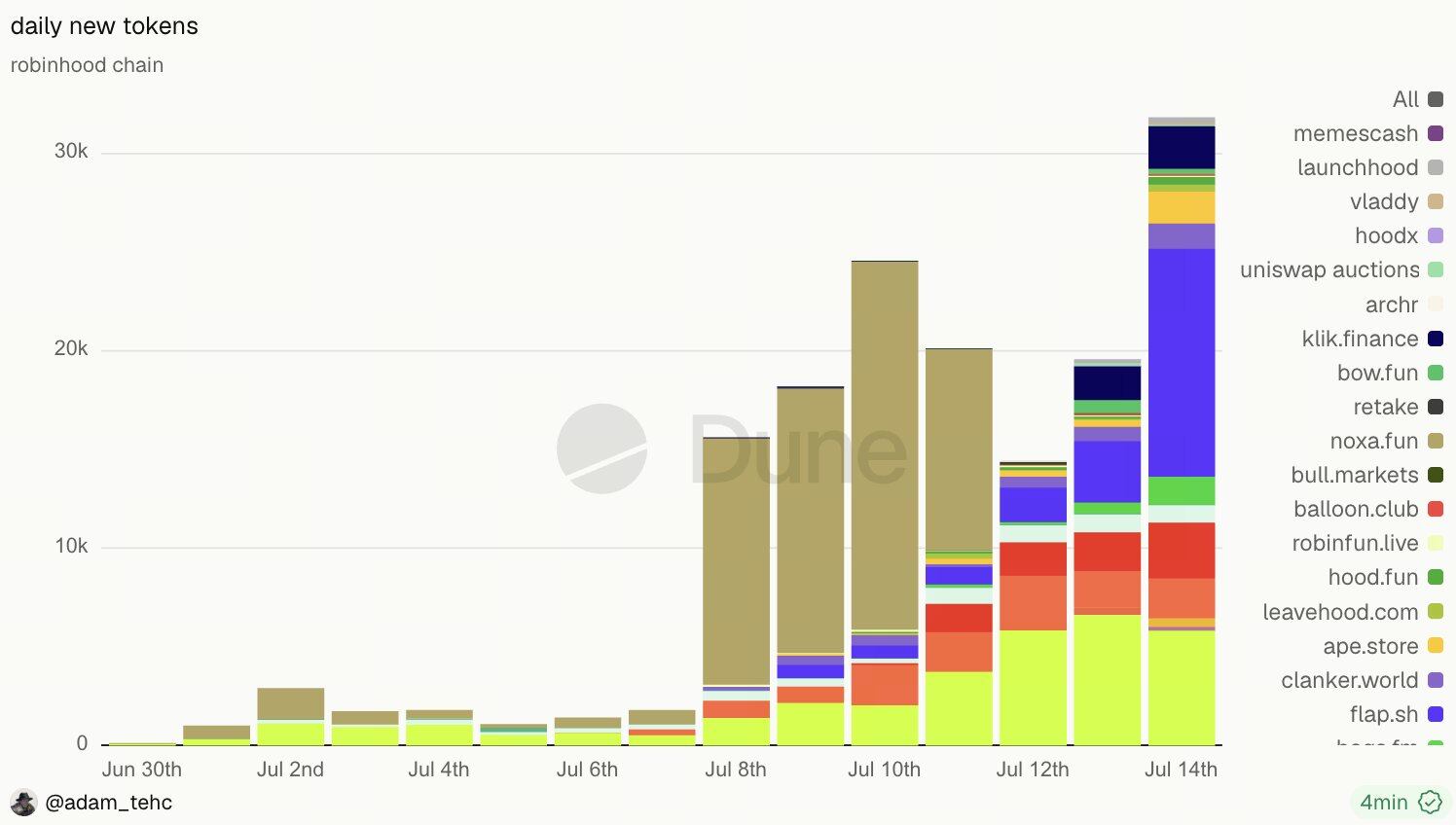
Daily token issuance quantity on Robinhood Chain
Flap becomes the biggest beneficiary
After NOXA stopped its token issuance, Flap was the first to catch this wave of traffic. Flap created over 11,000 tokens in a single day, accounting for over 35% of the token issuance volume on Robinhood Chain that day, becoming the largest platform for token issuance on Robinhood Chain.
Flap is not a new platform hastily built after NOXA's outage. Previously, Flap had already deployed token issuance business on BNB Chain, Base, and other EVM networks, supporting ordinary tokens, tax tokens, and creator fee distribution models, and was selected for the third season of YZi Labs EASY Residency.
Although Flap's previous performance on BNB Chain and Base has not been outstanding, this multi-chain accumulation has allowed it to complete its deployment rapidly after the hype on Robinhood Chain. Unlike a native token issuance platform starting from scratch, Flap does not need to rebuild its products and contracts; it only needs to connect the trading terminal and open issuance entrances to quickly absorb a large token issuance demand left by NOXA.
However, currently, what Flap has mainly caught is the number of issuances, and the platform has not yet launched a representative token that could approach CASHCAT.
Bankr, the newcomer with the strongest team background
Bankr is not a traditional web-based token issuance platform, but a token issuance entry centered on AI Agent. Users can directly create tokens through Bankr Agent, X, Telegram, or Console, with issuance and liquidity deployment completed by Doppler and Uniswap V4. Currently, Robinhood Chain has become the main issuance network supported by Bankr outside of Base.
Bankr's biggest advantage comes from its team and resources. Coinbase Ventures previously supported Bankr through the Base Ecosystem Fund, facing numerous teams that are anonymous and products just launched, Bankr is more complete in terms of product maturity, funding background, and external channels.
In terms of token issuance quantity, Bankr currently finds it challenging to compete with Flap, which has an open API and can absorb a large number of batch issuance demands. However, it has established more issuance entries through AI Agents, social platforms, and developer tools, increasing its chances of attracting real creators and project parties. Compared to purely pursuing the number of token issuances, it is more worth noting whether Bankr can rely on its distribution capabilities to produce higher quality, longer lifecycle tokens.
Klik uses fee subsidies to compete for traders
Klik is also not a new token issuance platform on Robinhood Chain. Its official documentation shows that Klik has already supported Ethereum, Base, and Robinhood Chain, with tokens issued directly acquiring liquidity from Uniswap V4 and adopting a dynamic fee model that decreases as market value grows.
After entering Robinhood Chain, Klik officially announced that all fees obtained by the platform would be fully returned to traders to attract early users and trading traffic.
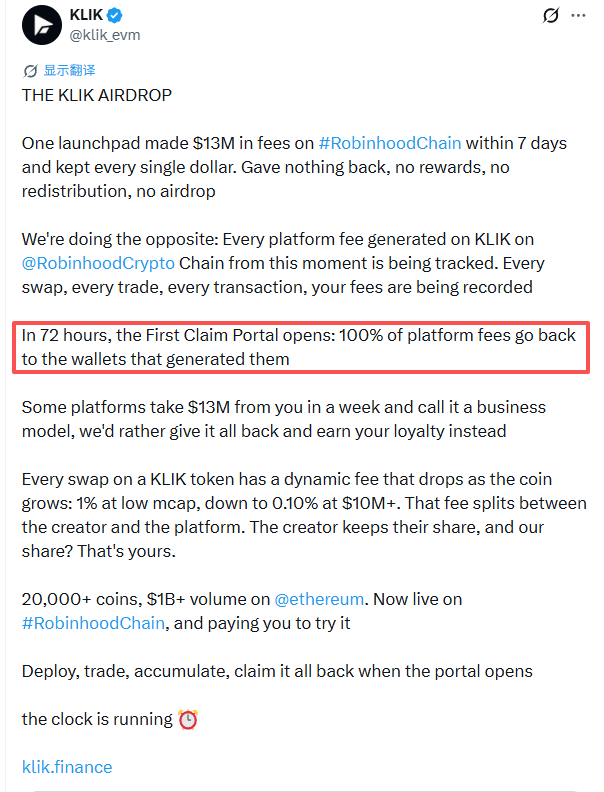
Klik's fee return can attract bots and high-frequency traders within a short period, but whether it can convert the subsidized traffic into long-term users remains to be seen as it needs to produce truly distinguishable representative tokens.
trench.today enters the first echelon, but the platform lacks transparency
On July 14, trench.today created 2,830 tokens in a single day, with its issuance volume ranking among the forefront of token issuance on Robinhood Chain. The platform uses a bonding curve model, focusing on creator fee sharing, and has previously conducted business on Ethereum, quickly expanding its issuance capabilities to Robinhood Chain as well.
From the data, trench.today has successfully captured the spillover demand after NOXA's token issuance halt and entered the current top tier of issuance volume. However, trench.today also has obvious shortcomings. Currently, verifiable information about the team background, financing situation, and historical operating data is still limited, and no representative tokens with sufficient recognition have appeared on the platform.
Intense competition among token issuance platforms, the next leader has yet to emerge
Robinhood Chain is an open network on which any developer can deploy contracts and create tokens. Having Robin, Hood, or Vlad in the name, being included in transaction terminals, or even receiving likes or retweets from individuals associated with Robinhood does not prove that they have received official review, investment, or endorsement from Robinhood.
NOXA's rapid rise and exit also demonstrate that the biggest moat for token issuance platforms has never been code. Issuance pages can be replicated within a day, issuance contracts can be cross-chain deployed, and bots can switch entry points at any time. Thus, creating several thousand or even tens of thousands of tokens in a single day only indicates that the platform has temporarily accommodated the demand for token issuance, and is not enough to prove that it has become a new traffic center.
The key reason NOXA was able to occupy the leading position of the token issuance platform on Robinhood Chain was not solely its issuance volume, but that the platform managed to churn out CASHCAT. A meme coin that once had a market value of over $200 million brought continuous trading volume, user attention, and wealth effects to NOXA, also prompting more issuers and traders to flock to the platform.
Therefore, to become the next leading token issuance platform on Robinhood Chain, it is still necessary to launch a representative meme with a market value of tens of millions or even over a hundred million dollars; before that, Robinhood Chain remains a chaotic battleground with numerous entries and an undecided leader.
免责声明:本文章仅代表作者个人观点,不代表本平台的立场和观点。本文章仅供信息分享,不构成对任何人的任何投资建议。用户与作者之间的任何争议,与本平台无关。如网页中刊载的文章或图片涉及侵权,请提供相关的权利证明和身份证明发送邮件到support@aicoin.com,本平台相关工作人员将会进行核查。


